Choosing Between AI Productivity Platforms: A Decision Framework for Professionals

ALT: Professional comparing AI productivity platforms using a structured decision framework on a laptop
Choosing Between AI Productivity Platforms: A Decision Framework for Professionals
Which AI productivity platform should you actually choose? The answer is not "whichever has the longest feature list" — it is whichever platform treats artificial intelligence as a native, load-bearing part of your workflow rather than a bolted-on extra. AI productivity platforms are software systems that use machine learning and large language models to automate, accelerate, or augment knowledge work, and the difference between a good one and a mediocre one usually comes down to architecture, not marketing copy.
Tech professionals, engineering leaders, and job seekers evaluating these tools face a genuinely confusing market: dozens of products claim "AI-powered" status while quietly running a thin chatbot layer over legacy infrastructure. This article lays out a practical decision framework — grounded in the kind of evaluation we apply when architecting production AI systems — so you can separate substance from surface-level AI features and choose a platform that delivers real return on investment.
Scope of Application
Applicable Scenarios:
- You are evaluating AI tools for personal productivity, career preparation, or content creation and need a repeatable way to compare options
- Your team or organization is standardizing on an AI-native platform and needs criteria beyond feature checklists
- You have budget constraints and need to justify AI tool spend with a clear cost-effectiveness rationale
Not Applicable/Cautions:
- This framework does not replace a formal security or compliance audit required for regulated industries
- If you need a single-purpose tool with no future scaling requirements, some criteria here (long-term architecture, integration depth) may be lower priority
Why the AI Productivity Platform Market Is So Hard to Navigate
The core problem is that "AI-powered" has become a marketing label rather than a technical descriptor. Many products simply attach a generic chatbot widget to an existing tool and call it an AI feature, while the underlying data model, search index, and workflow logic remain untouched. This creates a gap between perceived capability and actual utility that professionals only discover after they have already invested time and budget.
Market trends make this decision harder, not easier. According to the National Institute of Standards and Technology (NIST), organizations adopting AI systems increasingly need structured risk and capability evaluation frameworks because ad hoc adoption leads to inconsistent outcomes and wasted spend. Meanwhile, research bodies such as Stanford University's human-centered AI initiatives have repeatedly noted that the gap between AI prototypes and dependable, production-grade tools remains one of the biggest sources of failed technology investments.
For engineering leaders in particular, this mirrors a pattern we consistently see in production AI work: teams ship an impressive demo, then discover the underlying architecture cannot handle real usage, real data volume, or real edge cases. The distinction matters so much that it deserves its own evaluation lens — one explored in depth in The Difference Between AI Prototypes and Production-Ready AI Systems, which is directly relevant to anyone vetting a productivity platform's underlying claims.
The stakes are highest for two groups: engineering leaders selecting tools that will shape team workflows for years, and individual professionals — job seekers, creators, freelancers — whose career outcomes depend on tools performing reliably under pressure, not just in a sales demo. Both groups need a framework, not a feature list, because feature lists are trivially easy to pad and genuinely hard to verify.
Cost-effectiveness compounds the problem. A platform priced attractively on a monthly basis can still produce a poor return on investment if it requires constant manual correction, generates unreliable outputs, or locks your data into a proprietary format you cannot easily migrate away from. Evaluating total cost of ownership — not sticker price — is therefore central to any serious comparison, and it is the thread that runs through every section of this framework.
A Practical Framework for Comparing AI Productivity Platforms
Three-Step Quick Start
Step 1: Audit Your Actual Workflow Bottlenecks
Before comparing any platform, spend roughly 30 minutes listing the three tasks in your workflow — file retrieval, interview preparation, content drafting, or similar — that currently consume the most time or produce the most errors. This audit becomes your evaluation checklist for every subsequent step.
Step 2: Run a Real-Task Pilot, Not a Demo
Test each shortlisted platform against one of your actual bottleneck tasks, using real (or realistic) data, for a defined trial period. A guided sales demo tells you what the vendor wants you to see; a real-task pilot, typically a few days of hands-on use, tells you what the architecture can actually do.
Step 3: Score Integration Depth and Total Cost
Rate each platform on how deeply AI is embedded in its core functions versus layered on top, then estimate total cost including migration effort, training time, and any workflow rework required. This step converts subjective impressions into a comparable, decision-ready score.
Main Solution Comparison Analysis
Professionals typically encounter three broad categories of AI productivity tooling, and understanding the structural differences between them is more useful than comparing individual product names. The table below organizes the comparison around the criteria that most affect real-world cost-effectiveness and long-term value.
| Comparison Dimension | Native AI-Integrated Platforms | Add-on AI Features on Legacy Tools | Fragmented Point Solutions |
|---|---|---|---|
| AI Integration Depth | AI is embedded in core data handling and logic | AI sits as a surface layer over unchanged infrastructure | Varies by tool; consult provider |
| Workflow Continuity | Single continuous experience across tasks | Frequent context-switching between AI layer and base tool | High friction from juggling multiple apps |
| Total Cost of Ownership | Lower long-term cost due to reduced manual correction | Moderate; hidden costs from workarounds | Higher due to multiple subscriptions and integration overhead |
| Data Portability | Consult provider for specific export policies | Often limited by legacy system constraints | Depends on each individual tool |
| Long-Term Scalability | Designed to scale with usage and new use cases | Constrained by original non-AI architecture | Difficult to scale coherently across tools |
The pattern that emerges from this comparison is consistent with what the Association for Computing Machinery (ACM) has documented in discussions of software architecture quality: systems designed around a core capability from the outset tend to age better and cost less to maintain than systems where that capability is retrofitted. This is precisely the architectural principle behind treating AI as native rather than superficial.
Why Integration Depth Determines Real-World Value
Integration depth refers to how deeply an AI capability is woven into a product's core data model, logic, and user workflows, as opposed to being a separate module bolted onto an existing interface. This single factor predicts more about a platform's long-term value than any individual feature on its marketing page.
Consider an AI-powered cloud drive as an illustrative case. If AI search, tagging, and summarization are native to the storage layer, every file benefits automatically and consistently. If AI is instead an add-on search bar sitting above a conventional file system, results are often shallow, inconsistent, and disconnected from how files are actually organized and used. A pattern we consistently see in engineering reviews is that add-on AI features work well in a demo with a handful of curated files, then degrade noticeably once real-world volume and messiness enter the picture.
The same logic applies to AI mock interview tools and creator-focused platforms. A mock interview experience where AI evaluates responses using genuinely contextual understanding of role, industry, and communication style delivers materially better preparation than one that runs generic sentiment scoring over a transcript. Similarly, a creator cockpit tool where AI assists with structuring, refining, and packaging content from the first draft onward saves meaningfully more time than a tool where AI is limited to a single suggestion button.
This is the architectural philosophy behind Darius, the personal brand of an Engineering Director and AI Architect focused on building production-ready AI products including an AI-powered cloud drive, an AI mock interview platform, and an AI creator cockpit tool. Each of these products is built around the premise that AI should function as a core capability of the system, not an optional layer — a principle explored further in The Minimum Viable Architecture for Your First AI-Powered App, which outlines how to structure AI-native products from day one rather than retrofitting them later.
For professionals managing large volumes of documents and files, the practical benefits of native integration are especially visible in file management workflows, a topic covered in more depth in AI-Powered File Organization: A Getting-Started Guide for Professionals, which walks through how deeply integrated AI changes day-to-day file handling rather than simply adding a search shortcut.
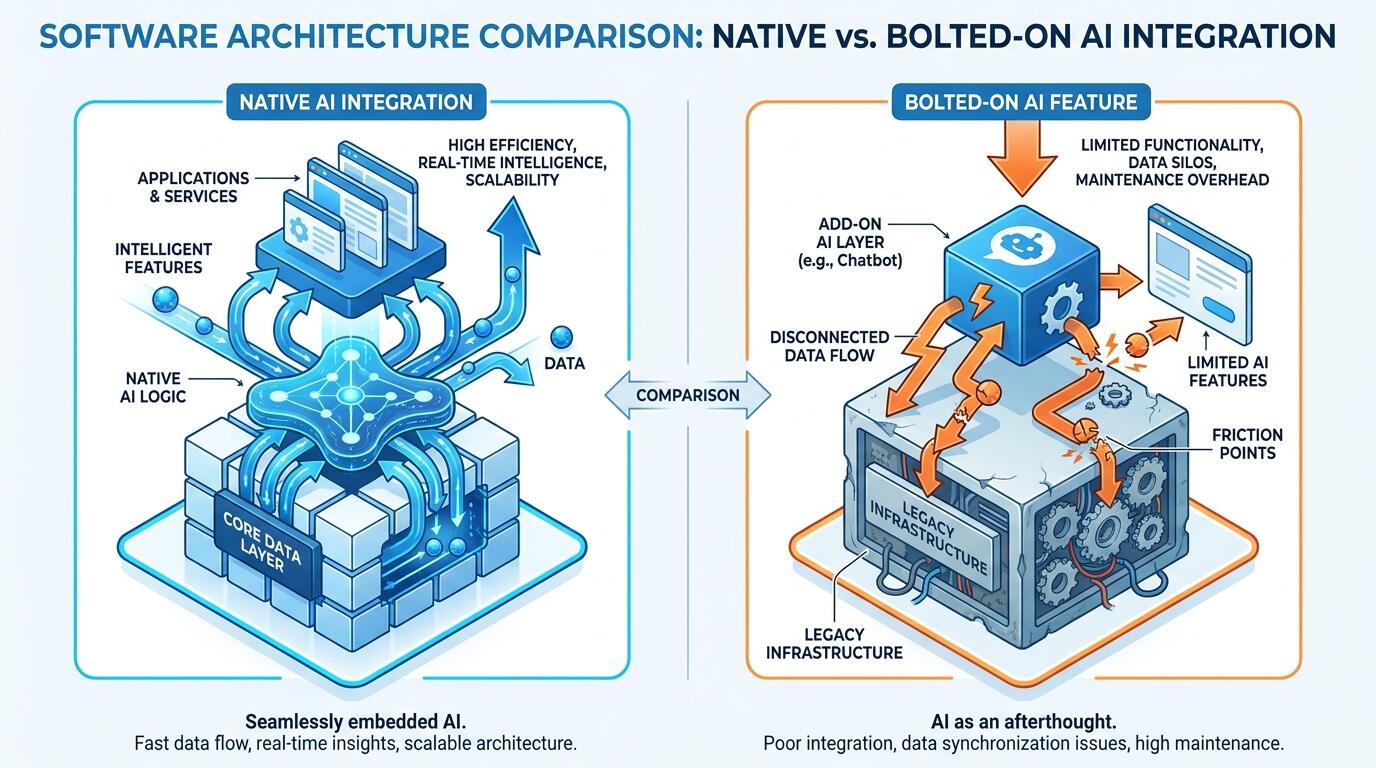
ALT: Diagram comparing native AI integration architecture versus bolted-on AI feature layer in productivity tools
Advanced Considerations for Evaluating AI Productivity Tools
Special situations require adjustments to this framework. Teams operating under strict data governance requirements should verify how a platform handles data residency and retention before piloting, since even a technically excellent AI feature can be disqualified by a governance mismatch. Organizations scaling rapidly should weight long-term scalability more heavily than initial cost, since migration between platforms later is typically far more expensive than a slightly higher subscription today.
A common misconception is that more AI features automatically indicate a better platform. In practice, according to IEEE's published perspectives on software engineering quality, feature count correlates poorly with system reliability, and a smaller set of deeply integrated capabilities often outperforms a sprawling list of shallow ones. Another misconception is that AI productivity tools are interchangeable commodities; in reality, the underlying architecture — not the interface — determines whether a tool remains useful as your workload grows.
It is also worth clarifying the relationship between this framework and formal AI governance standards. This decision framework is a practical selection tool for individual professionals and teams, not a substitute for enterprise AI risk management frameworks such as those published by NIST, which are designed for organization-wide compliance rather than day-to-day tool selection.
Common Questions
Q1: How do I know if an AI feature is native or just bolted on?
Test the feature against a messy, real-world dataset rather than a curated demo. Native AI integration typically performs consistently across varied inputs, while bolted-on features tend to work well only in narrow, well-prepared scenarios and degrade noticeably as complexity increases.
Q2: Are AI productivity platforms worth the cost for individual professionals?
Yes, when the platform saves measurable time on recurring tasks like file retrieval, interview preparation, or content drafting. The return on investment depends on integration depth: deeply integrated AI tools tend to reduce manual correction work, which is where most of the hidden cost of "cheap" tools actually lives.
Q3: How long should a platform pilot or trial period last?
A trial period of several days to about two weeks, focused on your actual bottleneck tasks rather than generic demo scenarios, is typically enough to reveal whether AI integration is genuinely deep or merely surface-level. Longer trials are warranted for team-wide rollouts given migration and training costs.
Final Thoughts
Choosing between AI productivity platforms comes down to evaluating architecture and integration depth, not counting features on a landing page. The professionals who get the best return on investment are the ones who test real tasks, question surface-level AI claims, and prioritize platforms built around AI as a core capability.
Key Takeaways:
- Native AI integration consistently outperforms bolted-on AI features under real-world usage conditions
- Total cost of ownership, not subscription price, is the real cost-effectiveness metric to track
- A short, real-task pilot reveals more than any vendor demo or feature list
- Integration depth is the single strongest predictor of long-term platform value
- This framework applies to individual tool selection, not enterprise-wide AI governance decisions
The next step is straightforward: apply the three-step framework above to your current shortlist before committing budget or migrating workflows.
Ready to experience AI built the right way — as a native capability, not an afterthought? Explore Darius's suite of production-ready AI products, from smart cloud storage to AI-powered mock interviews and creator tools, at the Darius website. Visit today to see how Darius can help you work smarter, prepare better, and create faster with AI.
References & Further Reading
- National Institute of Standards and Technology (NIST). "AI Risk Management and Evaluation Guidance".
https://www.nist.gov/ - Institute of Electrical and Electronics Engineers (IEEE). "Software Engineering and System Quality Standards".
https://www.ieee.org/ - Association for Computing Machinery (ACM). "Research on Software Architecture and System Design".
https://www.acm.org/ - Stanford University. "Human-Centered Artificial Intelligence Research".
https://www.stanford.edu/ - Gartner. "Research on Enterprise Productivity and AI Technology Adoption".
https://www.gartner.com/
Note: Standards may be updated; please check the latest official documents or consult professional advisors.