Best Programming Languages for Building Production Systems in 2026
ALT: Best programming languages for building production systems in 2026, comparing top choices for scalability and AI
Choosing the Right Language for Production Systems in 2026
A startup CTO sits down to scope out their next backend service — a real-time AI inference pipeline that needs to handle unpredictable traffic spikes without falling over. The team debates between what they already know and what the architecture actually demands. It's a conversation that happens constantly in engineering rooms, and getting it wrong means rewriting core infrastructure six months later under pressure.
This list is built for that moment of decision. It covers the programming languages that engineering teams are shipping with in 2026 — not the ones getting conference buzz, but the ones that hold up when systems are under load, when bugs need diagnosing at 2 a.m., and when the business needs to iterate without breaking production. The selection criteria weigh ecosystem maturity, performance characteristics, AI/ML tooling, developer availability, and what patterns consistently emerge across real production architectures.
Each entry is structured to give you a signal quickly: what the language excels at, who it fits, and where it will disappoint you. Use the comparison table to narrow your shortlist, then use the decision guidance to match your specific situation to the right choice.
The Languages That Actually Ship in 2026
Python: The Lingua Franca of AI-Driven Systems
Python is a high-level, general-purpose programming language that has become the dominant runtime for machine learning, data pipelines, and AI application layers in production. Its strength is not raw performance — it is the depth and quality of its ecosystem. Libraries like PyTorch, LangChain, and FastAPI have made Python the default starting point for any team building AI-powered products, and that momentum shows no sign of reversing in 2026.
In practice, Python serves as the glue layer in many production AI architectures: the API surface, the orchestration logic, the model serving wrapper. Async frameworks have improved its concurrency story meaningfully, and running Python behind a well-configured reverse proxy with proper worker management handles significant throughput for most startup-scale systems. The challenge is that Python's performance ceiling is real, and teams often hit it when moving from prototype to scale.
According to industry surveys tracking language adoption trends, Python consistently ranks among the most in-demand languages for software teams building AI and data-intensive systems.
Best for: AI inference APIs, ML pipeline orchestration, rapid prototyping that evolves into production services, and any team whose primary bottleneck is model integration rather than raw compute throughput.
Watch out: Python's Global Interpreter Lock (GIL) limits true parallelism in CPU-bound workloads. For high-frequency, low-latency systems processing thousands of concurrent requests, you will likely need to offload hot paths to a faster runtime or use it in conjunction with a systems language.
Go: The Production Workhorse for Backend Services
Go (also known as Golang) is a statically typed, compiled language developed at Google and designed specifically for building reliable, high-performance networked services. In production environments, Go delivers consistent low-latency performance, a clean concurrency model based on goroutines and channels, and fast compilation — all of which translate directly into operational simplicity.
A pattern that emerges consistently across mature engineering teams is the use of Go for microservices, API gateways, and infrastructure tooling where performance predictability matters as much as raw speed. Its standard library is unusually capable, its static binaries simplify deployment, and its tooling around profiling and race detection makes production debugging tractable. Go is not fashionable — it is dependable, which is exactly what production systems need.
Best for: High-throughput API servers, internal microservices, CLI tooling, and any component where operational simplicity and deployment efficiency are first-class concerns.
Watch out: Go's generics support is relatively recent and the ecosystem is still maturing around it. Teams coming from object-oriented languages sometimes find Go's composition model initially counter-intuitive. It is also not the right choice for ML model training or heavy numerical computation.
Rust: Maximum Performance Where Correctness Is Non-Negotiable
Rust is a systems programming language that guarantees memory safety at compile time without requiring a garbage collector. For production systems where both performance and reliability are critical — think low-latency financial data processing, high-performance networking, or safety-critical embedded logic — Rust eliminates entire categories of bugs that plague C and C++ codebases.
The productivity curve for Rust is steeper than for Go or Python, and hiring senior Rust engineers remains a real constraint for most teams. But in the right context, Rust's compile-time guarantees dramatically reduce the class of production incidents related to memory corruption, data races, and undefined behavior. The WebAssembly ecosystem has also made Rust increasingly relevant for edge computing and browser-side computation.
Best for: Infrastructure components, network proxies, WebAssembly modules, and performance-critical services where correctness is non-negotiable and the team has the capacity to invest in the learning curve.
Watch out: Rust's borrow checker is genuinely demanding. Hiring is harder, onboarding takes longer, and the productivity penalty during ramp-up is real. Avoid Rust for rapid iteration on business logic; deploy it surgically where its guarantees pay dividends.
TypeScript: Full-Stack Coherence for Product-Focused Teams
TypeScript is a statically typed superset of JavaScript that compiles to plain JavaScript, enabling type safety across both frontend and backend Node.js codebases. In 2026, TypeScript has become the default choice for product teams that want shared language, shared types, and shared tooling across their entire stack without maintaining two separate language environments.
The Node.js runtime has matured significantly, and frameworks like Next.js, Fastify, and tRPC have made TypeScript a credible choice for production backend services — particularly in B2B SaaS products where developer velocity on the application layer matters more than squeezing the last millisecond of latency from the runtime. For teams building AI-assisted web products, TypeScript integrates cleanly with AI SDK layers that target the JavaScript ecosystem.
According to multiple language trend reports tracking developer adoption, TypeScript has seen sustained and accelerating growth across full-stack product teams in recent years.
Best for: Full-stack product teams, B2B SaaS backends, API layers that pair with React or Next.js frontends, and rapid product development cycles where context-switching between languages creates real friction.
Watch out: Node.js is single-threaded at its core. CPU-intensive workloads will block the event loop, making TypeScript the wrong choice for compute-heavy backend services. Type system complexity can also grow unwieldy in large codebases without disciplined architectural boundaries.
Java (and Kotlin): Enterprise Reliability at Scale
Java is a statically typed, object-oriented language with decades of production battle-testing behind it. In 2026, Java remains the language of choice for large-scale enterprise systems, particularly where organizational compliance requirements, long-term maintainability, and access to a deep talent pool are primary constraints. The Spring Boot ecosystem continues to power a substantial share of the world's backend services.
Kotlin, which runs on the JVM and is fully interoperable with Java, has become the preferred modern alternative for teams that want Java's ecosystem without its verbosity. Kotlin's coroutines provide clean async handling, its null safety reduces a broad class of runtime errors, and its concise syntax reduces boilerplate significantly. For teams already invested in the JVM, Kotlin is often the pragmatic upgrade path rather than a full language switch.
Best for: Enterprise-scale systems, financial services backends, teams with existing JVM infrastructure, and organizations where long-term maintainability and a large hiring pool are strategic requirements.
Watch out: JVM startup time and memory overhead make Java and Kotlin awkward fits for serverless or highly constrained edge deployments. The ecosystem is powerful but heavy; teams building lean, fast-deploying services often find lighter runtimes more operationally suitable.
Python + C++ Extension Pattern: AI Inference at Production Speed
This is not a single language but a well-established architectural pattern that deserves its own entry because it appears so frequently in production AI systems. The pattern works as follows: Python handles the API surface, orchestration, and business logic, while performance-critical inference paths drop into compiled C++ extensions or call into optimized runtimes like ONNX Runtime, TensorRT, or native CUDA kernels.
Teams building AI products that serve real users at scale almost invariably end up here. The Python layer keeps development fast and the ML ecosystem accessible; the C++ layer ensures that inference latency stays within acceptable bounds. Understanding this pattern is essential for anyone architecting AI systems at production scale, and it connects directly to broader AI system architecture patterns that CTOs should evaluate when designing for production throughput and reliability.
Best for: High-traffic AI inference systems, on-device model serving, and any ML product where Python's performance ceiling has been reached and latency SLAs are binding.
Watch out: Maintaining C++ extensions requires systems programming expertise that many ML teams lack. Debugging across the Python/C++ boundary is non-trivial. This pattern demands intentional architectural investment, not a quick optimization patch.
Swift: The Right Answer for Apple Platform Production Systems
Swift is a compiled, type-safe language developed by Apple for building iOS, macOS, and visionOS applications. For production systems that live on Apple platforms — and in 2026, this includes a growing segment of AI-powered mobile and spatial computing applications — Swift is not optional. It is the only first-class production choice.
Swift has also made meaningful strides on the server side through frameworks like Vapor, and Apple's on-device ML frameworks (Core ML, Create ML) integrate directly with Swift. For teams shipping AI features directly on device, Swift's combination of performance, safety, and platform integration is unmatched.
Best for: iOS and macOS application development, on-device AI features leveraging Apple's neural engine, and any product whose primary delivery surface is the Apple ecosystem.
Watch out: Swift's server-side ecosystem remains significantly smaller than Go, Java, or Node.js. Cross-platform backend use is viable but requires accepting a thinner library ecosystem and a smaller pool of server-side Swift expertise.
SQL: The Underrated Production Language That Never Leaves
SQL (Structured Query Language) is a declarative language for managing and querying relational databases. It is almost certainly the most overlooked "programming language" in conversations about production systems, yet it runs at the core of nearly every production product ever shipped. In 2026, with the explosion of data-intensive AI products, the ability to write correct, efficient SQL is more operationally valuable than ever.
Poor SQL is one of the most common root causes of production performance incidents in data-backed applications. A team that invests in SQL fluency — understanding query planning, indexing strategies, and transaction semantics — prevents whole categories of scaling problems before they happen. When evaluating production system costs, database query efficiency directly impacts what it costs to run data-intensive AI workloads in production.
Best for: Any team building data-backed applications (which is most teams), analytics pipelines, transactional systems, and AI products where retrieval efficiency directly impacts user experience and operational cost.
Watch out: SQL's declarative nature can mask what the database engine is actually doing. Writing SQL without understanding execution plans and indexing strategies leads to queries that work in development and fail at production load.
Quick Comparison at a Glance
| Language / Pattern | Best For | Key Strength | Limitation |
|---|---|---|---|
| Python | AI/ML systems, data pipelines, API layers | Deep AI ecosystem, rapid iteration | GIL limits parallelism; performance ceiling |
| Go | Backend microservices, infrastructure tooling | Predictable performance, deployment simplicity | Not suited for ML workloads |
| Rust | Systems programming, high-performance infrastructure | Memory safety, zero-cost abstractions | Steep learning curve, slower hiring |
| TypeScript | Full-stack product teams, B2B SaaS | Stack unification, developer velocity | Single-threaded; CPU-bound workloads struggle |
| Java / Kotlin | Enterprise scale, JVM-invested teams | Ecosystem depth, talent availability | Heavy runtime; poor fit for serverless |
| Python + C++ | High-traffic AI inference | Python DX + native performance | Requires systems expertise to maintain |
| Swift | Apple platform products, on-device AI | Platform integration, performance | Small server-side ecosystem |
| SQL | Any data-backed production system | Universality, query power | Requires deep understanding to use safely at scale |
How to Choose the Right Language for Your Production System
The most effective approach to language selection starts with a clear-eyed assessment of your primary bottleneck — not your team's preferences, not what's trending, but what constraint will actually break your system under load.
If your team is building an AI-powered product and the critical path runs through model inference and orchestration, Python is almost certainly the right starting point, with the understanding that hot paths may need to be offloaded later. If you need a reliable, high-throughput API layer that your team can operate without deep systems expertise, Go is the pragmatic choice. If you are building a product that lives primarily on Apple devices, Swift is not a preference — it is a requirement.
A common misconception worth addressing directly: the idea that you must choose a single language for an entire system. Production systems are almost always polyglot. The real skill is knowing which language to reach for in which layer, and keeping the surface area of each integration boundary clean and well-defined. A Python orchestration layer calling Go microservices sitting on top of a PostgreSQL database is not an unusual architecture — it is a common one, and it works well when each choice is intentional.
For teams at the early stages of building an AI product, the temptation to over-optimize for performance before understanding the actual bottleneck is a consistent pattern that leads to wasted engineering effort. Start with the language that gives your team the fastest path to a working, deployed system. Optimize specific components when real production data tells you where the constraint actually is. When evaluating technical partners to help navigate these decisions, the right questions to ask are covered in depth in this guide to choosing an AI architecture partner.
The other dimension to weigh is team composition. A language that is theoretically optimal but that your team cannot hire for or onboard quickly creates operational risk that outweighs the technical benefits. Language choice is an organizational decision as much as a technical one.
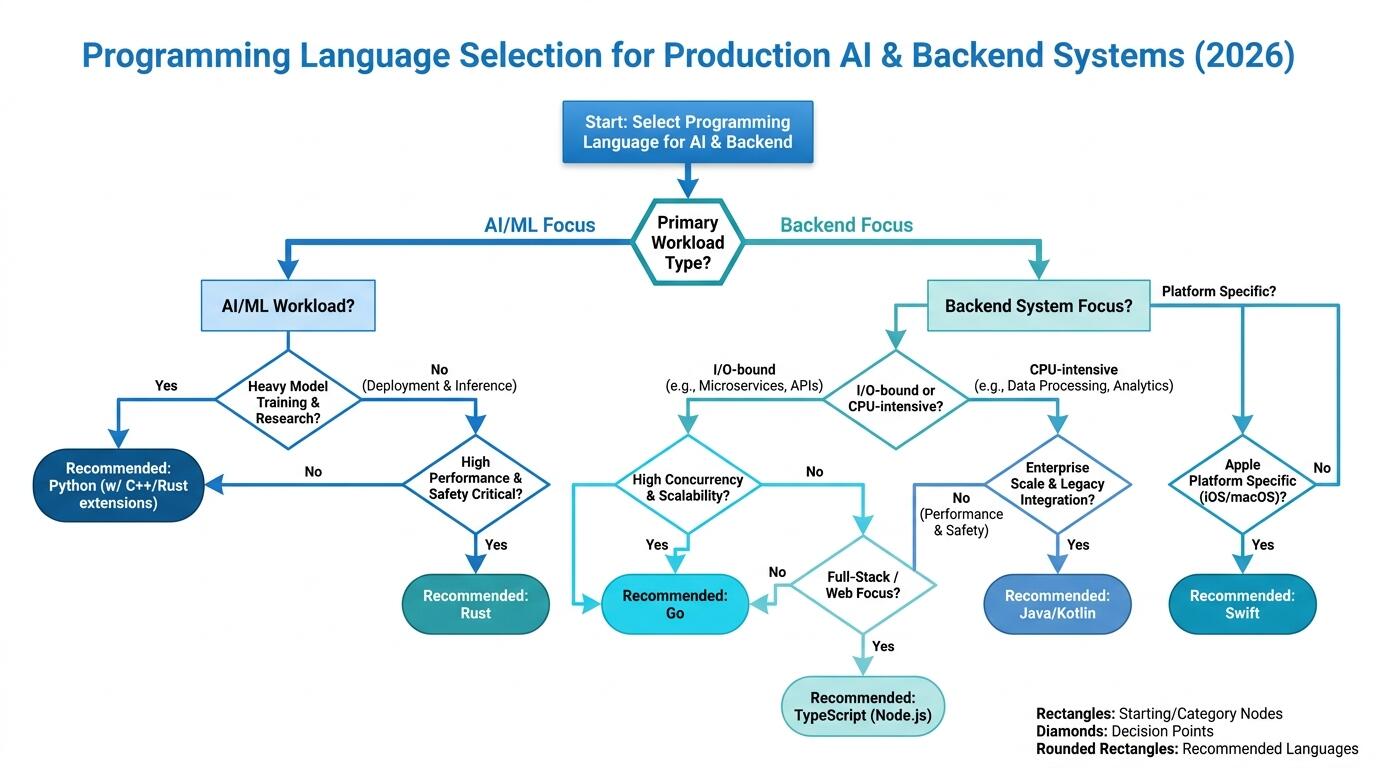
ALT: Decision framework showing how to select programming languages for production AI and backend software systems in 2026
Questions & Answers
Q1: How do you decide which programming language to use for a new production service in 2026?
Start by identifying the primary constraint of the service: is it I/O-bound, CPU-bound, or latency-sensitive? I/O-bound services with complex business logic often work well in TypeScript or Go. CPU-intensive or ML-driven services typically start in Python and offload hot paths. If the service has strict latency SLAs or memory constraints, Rust or Go should move up the shortlist. Team familiarity and hiring realities should be weighted alongside these technical factors.
Q2: Is Python still a viable language for production systems in 2026, or has it been replaced by faster alternatives?
Python remains one of the most viable production languages in 2026, particularly for AI-driven systems. Its dominance in the ML ecosystem — PyTorch, LangChain, FastAPI, and the broader data science toolchain — means that for most AI product teams, there is no practical alternative that offers equivalent library depth. Performance-critical paths are typically handled by dropping into optimized runtimes rather than abandoning Python altogether, making it a durable production choice for the foreseeable future.
Q3: How long does it typically take for a team to become productive in a new language like Rust or Go when transitioning from Python?
The timeline varies meaningfully by language and team background. Go is generally considered the faster ramp — most experienced engineers can write production-quality Go within a few weeks, and the language is deliberately constrained to keep the surface area small. Rust requires substantially longer, often several months before a team is comfortable with the borrow checker in real production code. These timelines should factor directly into architectural decisions, especially when delivery windows are tight.
Key Takeaways
Three principles consistently separate teams that choose languages well from those that regret their decisions six months into production.
First, match the language to the constraint, not to the hype cycle. Every language on this list is a legitimate production choice in the right context. The failure mode is choosing based on enthusiasm or familiarity when the system's actual bottleneck demands something different.
Second, embrace polyglot architectures deliberately. The best production systems in 2026 are not monolingual — they use the right tool at each layer. The skill is in keeping integration boundaries clean, not in achieving language purity.
Third, treat language selection as a team and operational decision, not just a technical one. Hiring availability, onboarding speed, and long-term maintainability are as important as benchmark performance numbers, and they are factors that compound over time.
The practical next step is to map your current or planned system's architecture against the decision framework above — identify the primary bottleneck, assess team capability, and select the language that gives you the fastest path to a working, observable, production-deployed system. Revisit language choices at real architectural inflection points, not hypothetical ones.
If you're ready to move from language selection to full system architecture and execution, explore the portfolio and shipped projects at the Darius website — and get in touch to discuss how to architect and ship your AI-powered product with a technical partner who has done it before.
Sources
- iTransition. "Most In-demand Programming Languages for 2026".
https://www.itransition.com/developers/in-demand-programming-languages - Wezom. "Top programming languages in 2026".
https://wezom.com/blog/top-programming-languages-in-2026 - NextGen Coding Company. "Top Programming Languages in 2026".
https://www.nextgencodingcompany.com/top-programming-languages-2026
Note: Language ecosystems evolve rapidly; consult the latest official documentation and community resources before making architectural decisions.