A Beginner's Guide to Multi-Surface Content Distribution
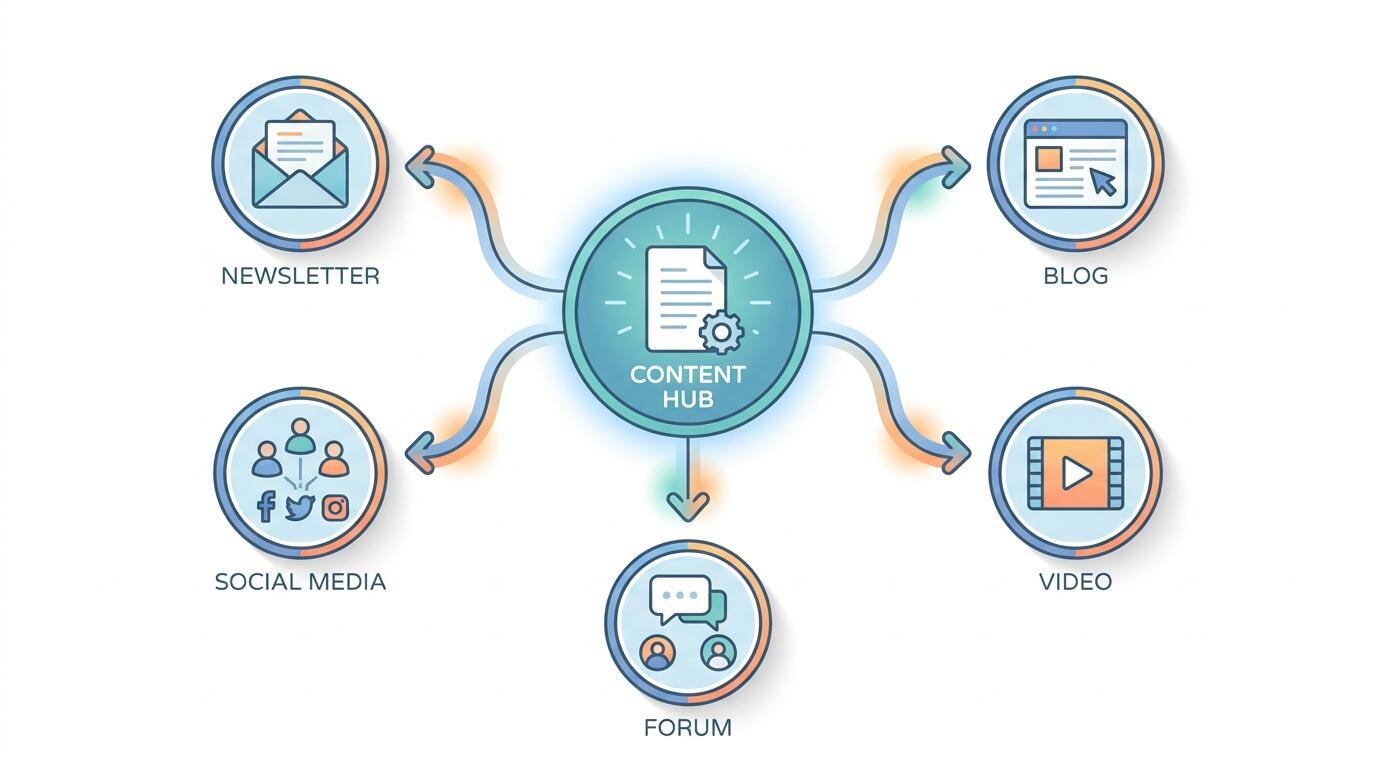
ALT: Beginner's guide to multi-surface content distribution across digital channels and platforms
What Multi-Surface Content Distribution Actually Gets You
Multi-surface content distribution is the practice of delivering a single piece of content — or a coherent content strategy — across multiple distinct platforms, formats, and contexts simultaneously, each adapted to the norms and audiences of that surface. Done well, it compounds reach without proportionally compounding effort. Done poorly, it fragments your message, dilutes your brand voice, and wastes the time of everyone involved in production.
If you've ever published an article and then scrambled to turn it into a LinkedIn post, a newsletter excerpt, and a short-form video script — all as separate, disconnected efforts — you've felt the pain this guide addresses. The goal here is to replace that reactive scramble with a repeatable, deliberate system.
This guide is written for builders: engineers shipping content-adjacent AI products, technical leads who own documentation and developer communications, product managers coordinating release messaging across surfaces, and independent developers trying to build an audience without a dedicated content team. The framework applies whether you're distributing human-written editorial or output from an AI drafting pipeline.
Before You Start: Prerequisites and Preparation for Cross-Platform Content Strategy
Effective multi-surface distribution requires more upfront thinking than most people expect. The common failure mode is jumping straight into publishing without establishing the structural decisions that make distribution coherent rather than chaotic.
Before you begin distributing across surfaces, you need clarity on three things: your core content asset, your surface inventory, and your adaptation rules. Without all three, you're not running a distribution strategy — you're just posting in multiple places and hoping for the best.
What you need beforehand:
- A defined content format you can actually produce consistently (article, briefing, video, audio — pick one as your primary)
- A clear understanding of who you are reaching on each target surface and why they are there
- At least a rough content calendar or publishing cadence — even a loose one — so you can plan adaptations without improvising each time
- Access credentials and working familiarity with each platform you plan to use (don't add surfaces you haven't actually explored as a user)
- A simple asset management system — even a shared folder with a consistent naming convention — so repurposed assets don't get lost
- A documented set of voice and formatting guidelines, however brief, so adaptations stay coherent across platforms and authors
Effort estimate: Setting up the strategic foundation — surface selection, adaptation rules, asset structure — typically demands a meaningful block of focused time before you see any publishing output. Expect the upfront investment to be front-heavy; the payoff comes from not having to reinvent decisions on every publication cycle.
Checklist before starting:
- Primary content format selected and production workflow validated
- Target surfaces identified and evaluated (no more than three to four for a first attempt)
- Voice and tone guidelines documented, even informally
- Adaptation rules defined per surface (length, format, CTAs, visual requirements)
- Asset management system in place
- Publishing access and tooling confirmed for each surface
Step-by-Step Instructions: Building Your Multi-Surface Distribution System
Step 1: Audit Your Current Content Assets and Identify the Pillar
Multi-surface distribution starts with a "pillar" — the canonical, highest-effort version of your content from which all surface-specific adaptations are derived. Identify what form that pillar takes for your context: a long-form article, a detailed technical briefing, a recorded explanation, or a structured data export. The pillar must be rich enough that meaningful value can be extracted and repackaged multiple times without becoming thin.
If you don't yet have a consistent pillar format, establish one before worrying about distribution. Distributing weak content across more surfaces just spreads the weakness. In our work building and advising AI product teams, a pattern we consistently see is teams trying to solve a reach problem with distribution when the actual problem is upstream: the content itself lacks a clear, defensible point of view.
Tip: A strong pillar answers a specific question for a specific person — not a general question for a general audience. The more precisely scoped the pillar, the more each surface adaptation can sharpen that specificity for its context.
Step 2: Map Your Target Surfaces and Their Native Conventions
A "surface" is any distribution channel that has its own content norms, audience expectations, and engagement mechanics. Common surfaces include long-form blog or documentation sites, email newsletters, LinkedIn or professional social networks, short-form video platforms, developer community forums, and podcast or audio channels.
For each surface you plan to use, document three things explicitly: the format that performs natively (length, structure, media type), the audience's intent when they encounter content there (discovery versus depth versus conversation), and the specific constraints imposed by the platform (character limits, image dimensions, algorithmic surfacing behavior). Never add a surface just because it exists — add it because you can articulate why your audience is there and what they need from content in that context.
Tip: Limit your initial surface inventory to three or four channels. A pattern we consistently see is over-extension: teams that launch across seven surfaces simultaneously maintain quality on none of them. Depth on fewer surfaces consistently outperforms breadth across many.
Step 3: Define Adaptation Rules, Not Just Republishing Rules
This step is where most beginners make their most consequential mistake. Republishing means copying content from the pillar and pasting it onto another surface. Adapting means restructuring, reframing, and sometimes rewriting content so it serves the specific audience on that surface in the way that surface demands.
A blog post adapted for a weekly newsletter is not a copy-paste of the introduction — it is a rewritten summary that gives the subscriber the key insight immediately, respects their inbox context, and provides a clear path to the full piece if they want depth. A blog post adapted for a developer forum thread is not a link dump — it is a direct answer to the community's likely question, with the link as supporting material rather than the point of the post.
Document your adaptation rules per surface. A rule might be: "Newsletter version — lead with the one-sentence takeaway, maximum three paragraphs, single CTA, no inline images." Another might be: "LinkedIn version — open with a concrete observation or tension, not a headline restatement; no more than five short paragraphs; end with a question or provocation." Written rules reduce decision fatigue and make it possible to delegate or automate adaptations without quality loss. For teams using AI drafting pipelines, this is exactly the kind of structure that makes writing editorial rules an agent can actually follow — without that specificity, AI-generated adaptations default to generic output.
Tip: The most dangerous adaptation rule is "just shorten it." Length is a proxy for depth, and surface-appropriate content isn't just shorter — it's restructured around a different reader goal.
Step 4: Build a Lightweight Production Workflow
A multi-surface distribution system breaks down when the production workflow for adaptations is too manual, too slow, or too dependent on a single person's judgment in the moment. Design a workflow that separates decisions from execution.
The decision layer is where you determine, for each piece of content: which surfaces will receive an adaptation, what the angle or lead for each adaptation will be, and who or what is responsible for producing each version. Make these decisions at the calendar or editorial planning stage — not at publication time. The execution layer is where adaptations are produced and reviewed against your documented rules.
For teams running any degree of automated or AI-assisted content processing, the agent pipeline behind a daily AI briefing is a useful reference point for how retrieval, verification, and publication stages can be structured to support multi-surface output without collapsing into a single undifferentiated output stream.
Tip: Treat each surface adaptation as a distinct deliverable with its own brief, even if that brief is one sentence. "Newsletter version: lead with the risk angle, link to full piece" is a brief. "Post it to the newsletter" is not.
Step 5: Establish a Consistent Publishing Cadence Per Surface
Inconsistent publishing is the most common reason audiences disengage from content that was initially useful. Each surface has its own cadence expectations, and those expectations differ significantly. Email newsletter audiences tolerate lower frequency but expect higher reliability — missing a promised send is more damaging than never having set the expectation in the first place. Social platform algorithms and audience habits reward consistent signal over sporadic bursts.
Set a sustainable cadence for each surface and publish to that cadence before expanding to additional surfaces. "Sustainable" means a pace you can maintain with your current production resources without degrading quality. An honest weekly newsletter beats an aspirational daily one that arrives three times in the first two weeks and then goes silent.
Tip: If you're uncertain what cadence is sustainable, under-commit publicly and over-deliver privately. It is much easier to increase frequency with a positive audience response than to recover credibility after repeated missed commitments.
Step 6: Implement Tracking and Close the Feedback Loop
You cannot improve a distribution system you cannot measure. Define, before publishing, what a successful outcome looks like for each surface — and make those definitions surface-specific, because what counts as engagement on a newsletter differs fundamentally from what counts as engagement on a developer forum or a social platform.
Tracking doesn't require sophisticated tooling at the outset. A consistent review of qualitative signals — which adaptations generate replies, which drive traffic to the pillar, which produce meaningful conversation — gives you enough signal to make directional decisions. The goal is to build a feedback loop that informs your next editorial planning cycle, not to optimize obsessively for metrics that don't reflect real audience value.
Tip: The highest-value signal on most surfaces is direct response: a reply, a comment, a forwarded message, a question. Volume metrics like impressions and reach tell you about distribution; response tells you about resonance.
Step 7: Iterate the System, Not Just the Content
A pattern we consistently observe in teams that succeed at multi-surface distribution over the long term: they treat the distribution system itself as a product, not just a channel for pushing content. That means reviewing the system — not just the content — at regular intervals. Which surfaces are generating disproportionate value? Which adaptation rules are producing consistently weak output? Which steps in the workflow create the most friction?
If you're making build-versus-buy decisions about content infrastructure — tooling for scheduling, adaptation, or analytics — the principles in revisiting the build vs. buy framework for AI infrastructure apply directly: evaluate based on your specific workflow requirements and where the leverage actually is, not on feature lists or default assumptions.
Tip: Deprecating a surface is a valid strategic decision. Continuing to publish on a surface that generates no meaningful signal because you feel obligated to maintain presence there is a resource drain, not a distribution strategy.
Common Mistakes and Troubleshooting in Multi-Surface Distribution
| Symptom | Likely Cause | How to Fix |
|---|---|---|
| Content feels generic across all surfaces | Adaptation rules don't exist or aren't enforced; content is republished rather than restructured | Document explicit per-surface adaptation briefs; treat each version as a distinct deliverable |
| Engagement drops sharply after initial launch | Cadence is inconsistent or the pillar quality has declined; audience expectation was set but not met | Audit publishing history for gaps; reduce committed cadence to a sustainable level before expanding |
| Team cannot keep up with adaptation volume | Too many surfaces launched simultaneously; no decision-execution separation in workflow | Cut surfaces to a manageable core; build a planning layer that frontloads decisions before the production sprint |
| AI-generated adaptations sound identical across surfaces | The adaptation prompts or rules fed to the AI are not surface-specific; the AI has no context about audience or format norms | Rewrite adaptation briefs to include surface-specific constraints and audience intent; test and iterate on prompt structure |
| Distribution effort doesn't translate to audience growth | Content is reaching platforms but not resonating — distribution is solving the wrong problem | Audit the pillar itself for specificity and point of view before optimizing distribution further |
| Metrics look healthy but inbound inquiries or conversions are flat | Tracking vanity metrics rather than signal of genuine audience value | Redefine success metrics per surface around qualitative response and downstream action, not impressions |
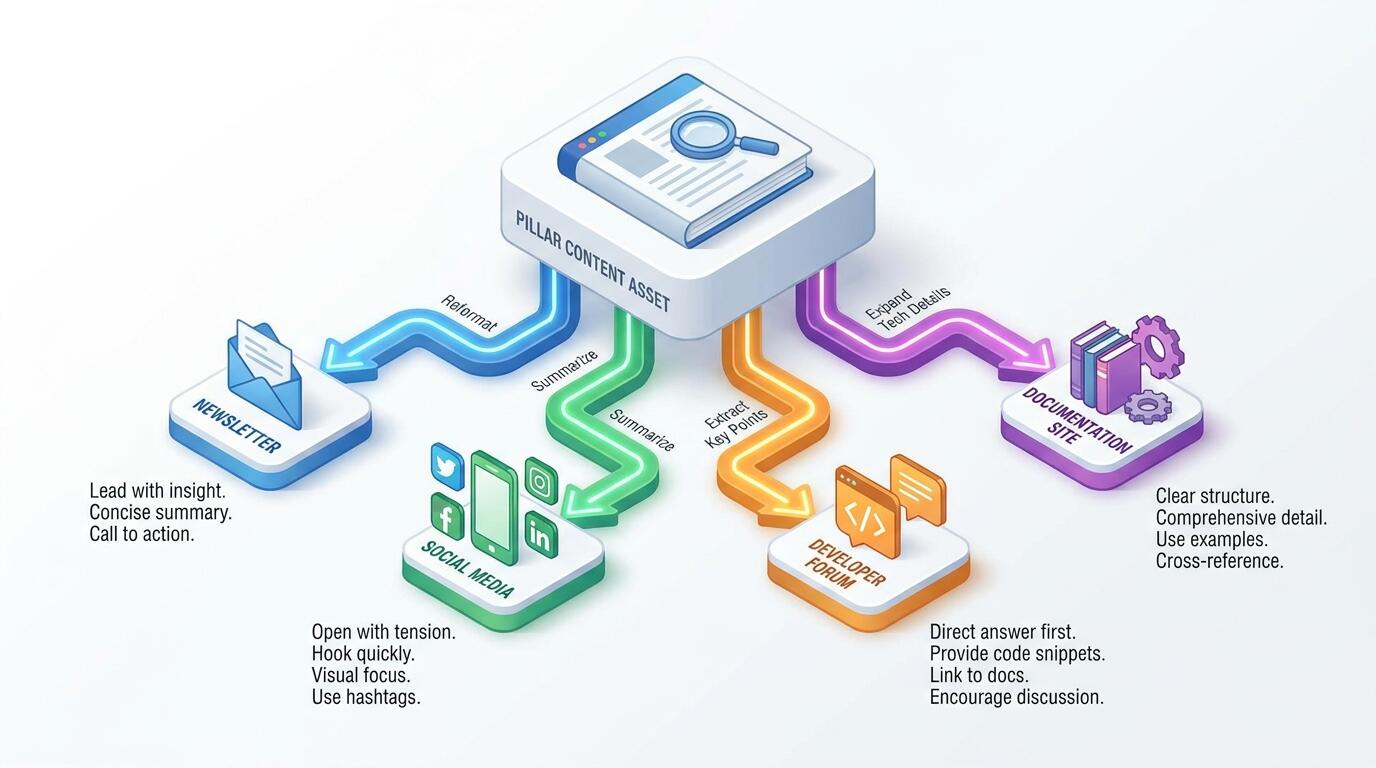
ALT: Diagram showing a pillar content asset being adapted and distributed across newsletter, social, forum, and documentation surfaces with per-surface editorial rules
Pro Tips for Better Results in Cross-Platform Content Distribution
Let the pillar breathe before distributing. A pattern that consistently damages content quality is adapting and distributing immediately after the pillar is published — before you have any signal about which angle, section, or argument actually resonated. Give each pillar piece a short window of observation before committing to which elements to amplify on other surfaces. The sections that generate direct response are usually the highest-leverage material for adaptation.
Treat surface-specific formatting as a first-class editorial decision. The structure of a piece — how it opens, how it moves through its argument, where the key claim sits — is not cosmetic. It determines whether the audience on that surface can extract value from the content or not. A technical briefing that opens with context and buries the insight in paragraph four might be appropriate for a long-form reader who brought patience to the piece; it will fail in a newsletter inbox or a social feed. Restructure, don't just reformat.
Build a "content parts" library alongside your pillars. Rather than always adapting from the full pillar, identify and store discrete components — a particularly sharp one-sentence summary, a concrete example, a counterintuitive framing — as reusable assets. These components can be recombined for surface adaptations, embedded in responses to community questions, or used in future pillars. This practice compounds the value of past production work without requiring proportional new effort.
The common misconception to correct: Many practitioners assume that more surfaces equals more reach, and more reach equals better results. In practice, a pattern we consistently see is that reach without resonance produces diminishing returns quickly. Distribution is a multiplier — it amplifies what the content already is, good or bad. A weak pillar distributed widely is just weak content in more places. The leverage is in the quality and specificity of the pillar first, the intelligence of the surface adaptation second, and the breadth of distribution a distant third.
Align your surface selection with where your audience actually makes decisions. For technical and AI product audiences, in particular, the surfaces where decisions are made — developer forums, focused newsletters, peer-to-peer professional networks — are often lower-volume and higher-trust than general social platforms. Reaching a smaller, more precisely targeted audience on the right surface consistently outperforms broader distribution on surfaces where your audience's intent doesn't match your content's purpose.
Questions & Answers
Q1: How do I decide which surfaces to prioritize when starting a multi-surface distribution strategy?
Start by identifying where your target audience already consumes content with genuine intent — not where they passively scroll, but where they actively seek information or professional insight. For technical and AI product audiences, a pattern we consistently observe is that focused newsletters, developer communities, and professional networks generate higher-quality engagement than general social platforms. Prioritize surfaces where your audience's intent matches your content's purpose, then add surfaces only as your production capacity allows you to maintain quality.
Q2: Is it acceptable to publish identical content across multiple surfaces without adapting it?
Identical republishing is rarely effective and frequently counterproductive. Each surface has distinct audience expectations, algorithmic behaviors, and format norms. Content that is not adapted to these norms signals to the audience — and increasingly to platform systems — that the content is not genuinely intended for them. Beyond engagement quality, publishing identical long-form content on multiple indexed surfaces can create duplicate content concerns for search visibility. The rule of thumb: adapt the structure and lead for each surface, even if the underlying argument remains consistent.
Q3: How long does it take to see meaningful results from a multi-surface distribution strategy?
Multi-surface distribution is a compounding system, not an immediate amplifier. The feedback loops that tell you whether your surface selection and adaptation approach are working operate on the timescale of weeks to months, not days. The speed of results depends heavily on whether your audience is already established on your target surfaces, how consistently you publish to your committed cadence, and the quality and specificity of the pillar content. Expect to complete several full publishing cycles — pillar plus adaptations plus feedback review — before drawing directional conclusions about what is and isn't working.
Final Thoughts
Multi-surface content distribution, done with discipline, is one of the highest-leverage content strategies available to small teams and individual builders. The three core principles that determine whether it compounds value or compounds chaos are:
First, the pillar must be strong before distribution scales. No distribution system rescues weak content — it only moves it further and faster.
Second, adaptation is a substantive editorial act, not a formatting task. Surface-specific versions require structural thinking about audience intent and platform norms, not just length adjustment.
Third, the system itself needs maintenance. Surface selection, cadence, and adaptation rules should be reviewed and revised at regular intervals based on real feedback signal — not just the content within the system.
The practical next step for most readers is narrower than they expect: pick one pillar format, select two surfaces, document the adaptation rules for each, and run the system consistently for a defined period before adding complexity. Discipline at small scale builds the habits and institutional knowledge that make larger-scale distribution sustainable.
If you're building AI products and want first-hand, practitioner-level analysis of how content and AI infrastructure decisions actually interact in production — not aggregated editorial takes — visit the Darius briefing for bilingual, engineering-grounded AI insights written by someone who runs these systems, not just writes about them.
If you're building AI products and don't want to waste time filtering signal from noise, the Darius briefing is written for exactly that purpose — curated AI developments with first-hand production context, every issue. Visit the Darius website and subscribe to the bilingual AI briefing written by an engineering director, so every piece of information genuinely serves your build decisions.
Sources
- IEEE (Institute of Electrical and Electronics Engineers). "Standards and Publications on Information Technology and Content Systems".
https://www.ieee.org/ - ACM (Association for Computing Machinery). "Digital Library — Publications on Content Distribution and Platform Systems".
https://www.acm.org/ - W3C (World Wide Web Consortium). "Web Content Accessibility and Publishing Standards".
https://www.w3.org/
Note: Standards and guidelines may be updated; please check the latest official documents or consult professional advisors.