Quality Control Checklist for an AI Newsroom With No Newsroom
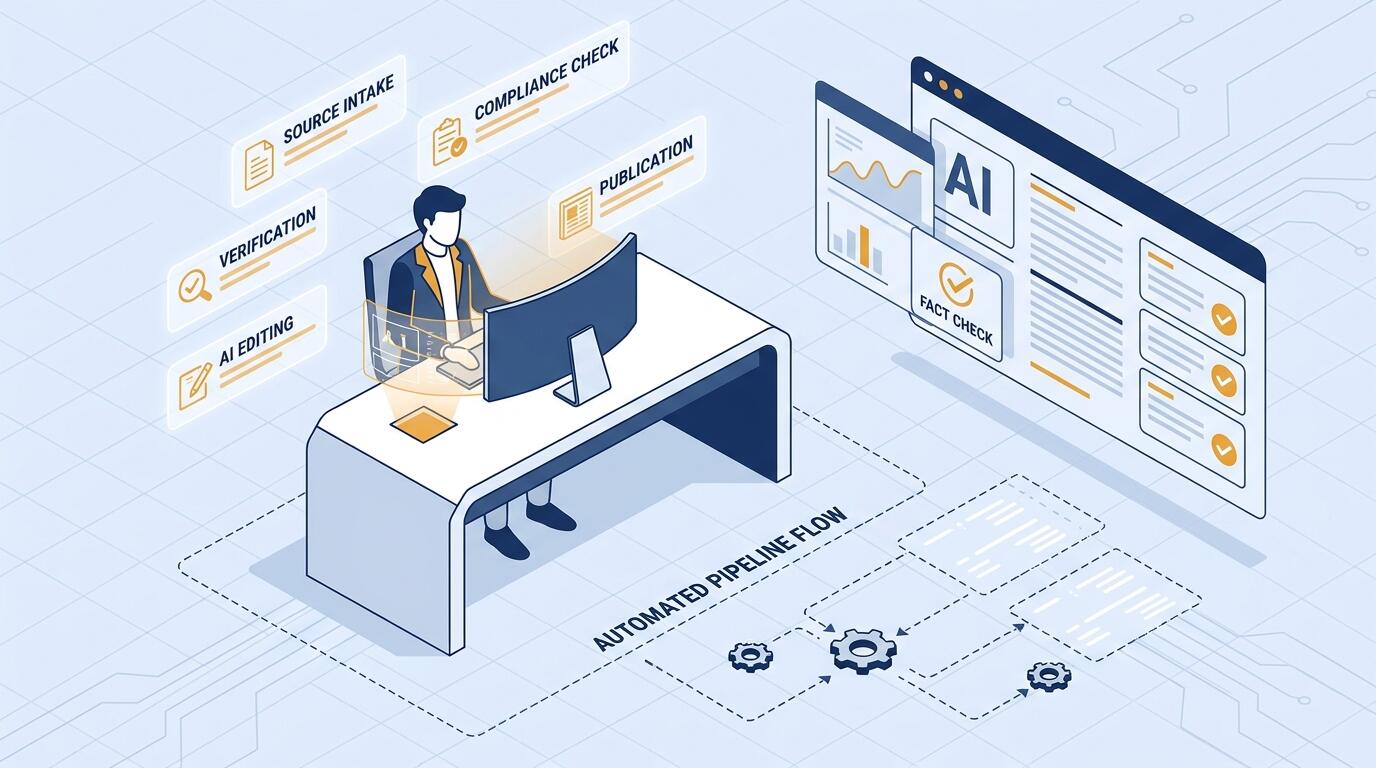
ALT: Quality control checklist for a solo AI newsroom managing automated briefing pipelines without editorial staff
When You Are the Editor, the Engineer, and the Fact-Checker: A Quality Control Checklist for AI-Driven Publishing
Running a fully automated publishing operation with no dedicated editorial staff is now a realistic and increasingly common setup. AI briefing tools, agent pipelines, and LLM-assisted drafting have made it possible for a single engineer or a small founding team to push out daily content at scale. The gap that opens up is quality control — the set of checks that a traditional newsroom handles through editors, sub-editors, researchers, and institutional memory. When no one fills those roles by title, the checks need to be baked into the process itself.
This checklist is drawn from the pattern of problems that surface most consistently in production AI publishing systems: hallucinated citations, drifting editorial voice, attribution failures, publication timing errors, and compliance gaps that are easy to overlook until they become expensive. Each item below is a distinct failure mode with a concrete check you can implement — regardless of whether you are running a daily briefing, a weekly digest, or any AI-assisted content pipeline with a small or no editorial team. The items are ordered by the stage in the pipeline where they matter most, from source intake to post-publication.
The Checklist: Nine Quality Gates for a Staffless AI Newsroom
Source Legitimacy and Provenance Verification
Source verification is the first quality gate in any AI-assisted editorial pipeline, because downstream errors compound quickly when the input is bad. Before any AI-drafted content reaches a draft state, the originating source for each claim should be traceable to a named publication, institution, or primary document — not just an AI-generated summary of a summary.
In practice, this means logging the raw URL or document reference alongside every piece of content the pipeline ingests. If a retrieval step pulled from an aggregator or an intermediate layer, the check should require tracing one level further back to a primary source. The agent pipeline behind a daily AI briefing relies heavily on this upstream verification step — if the retrieval layer is sloppy, no amount of generation-layer filtering can fully compensate.
Best for: Teams using retrieval-augmented generation (RAG) pipelines or any automated system where sources are fetched programmatically before content is drafted.
Watch out: Aggregators and syndication platforms often strip original attribution. Do not treat an aggregator URL as a primary source confirmation — the check needs to reach the original publisher.
Factual Claim Spot-Checking Against Named Sources
Factual spot-checking is the process of verifying that specific claims in a draft — statistics, named entities, dates, product versions, regulatory statuses — match what a named, checkable source actually states. AI language models, even well-calibrated ones, will produce plausible-sounding figures that do not correspond to any real document. This is not a hypothetical edge case; it is a pattern that surfaces with regularity in production drafts.
The check does not need to cover every sentence. A risk-weighted approach works well: prioritize any claim with a number, a named person or organization, a regulatory reference, or a claim about a competitor or third-party product. According to AI-assisted reporting best practices documented by practitioners in the field, the most reliable mitigation is a defined spot-check protocol with a minimum sample size per draft — not a general instruction to "be accurate."
Best for: Briefings or newsletters where regulatory, financial, or technical claims carry reputational weight if wrong.
Watch out: Asking an AI to fact-check its own output is not a reliable substitute. The same model that generated an error will often validate that error when asked to review it. A separate retrieval step against a primary source is the minimum viable check.
Editorial Voice and Tone Consistency Audit
Editorial voice consistency is about ensuring that each published piece sounds like it was written by the same author with the same point of view — not by whichever LLM sampling temperature happened to produce that day's output. This matters more than many builders initially expect. Voice drift is subtle, accumulates over time, and erodes reader trust before the audience can articulate why.
A practical check is a short rubric applied per draft: Does this piece use the same structural patterns, sentence length norms, and framing conventions as recent issues? Does it avoid phrases or register shifts that do not match the publication's established style? For publications with an engineering or practitioner audience, the most common failure mode is the AI defaulting to a softer, more marketing-adjacent register when uncertain — hedging with filler phrases rather than making a direct claim. Writing editorial rules an agent can actually follow requires specificity: not "write professionally" but "open each item with the core claim, follow with the evidence, close with the implication for builders."
Best for: Any publication where the author's distinct voice is a product differentiator — particularly solo-creator briefings and practitioner newsletters.
Watch out: Over-specifying voice rules can cause the agent to produce rigid, formulaic output. The goal is guardrails, not a template that every draft fills mechanically.
Citation Format and Inline Attribution Integrity
Citation integrity means that every claim attributed to a named source in the published content actually links to or clearly identifies that source — and that the link or reference is not fabricated. This is a distinct failure mode from factual accuracy: a draft can cite a real organization with a made-up URL, or attribute a claim to a publication that exists but did not publish that specific finding.
The check here is structural: run a pass over every inline attribution and every hyperlink in a draft before publication. Confirm that named sources are real, that hyperlinks resolve, and that the page at the other end of the link actually contains the attributed claim. Per the EU AI Act Compliance Checklist published by Baltum AI, traceability of AI-generated outputs — including the sources used to generate them — is an emerging compliance expectation for AI systems used in high-visibility contexts, not just a best-practice recommendation.
Best for: Any AI-assisted publication that includes research citations, regulatory references, or links to external data.
Watch out: Do not rely on the AI pipeline to self-report which URLs it used. Retrieve and log source URLs at the ingestion step, and validate them as a separate downstream check rather than trusting the draft's own citations.
Hallucination Detection for Named Entities
Named entity hallucination — where an AI draft invents or misattributes a person's name, a product name, an organization name, or a job title — is one of the most damaging failure modes for a credibility-dependent publication. A briefing that attributes a quote to the wrong executive or misspells a product name in a technical context signals to specialist readers that the source cannot be trusted.
The check is entity extraction followed by cross-reference. Extract all named entities from each draft — people, organizations, products, standards, and proper nouns — and run a lookup against a known-good reference for each. This does not require a sophisticated NLP pipeline; even a simple grep-style pattern match followed by a manual spot-check of the high-risk entities (people and products especially) catches the majority of failures.
Best for: Technical briefings covering fast-moving fields where new organizations, product names, and executive roles change frequently.
Watch out: Entity lookups against stale internal reference lists will miss recent changes. The reference data for entity checks needs to be updated on the same cadence as the publication itself.
Publication Timing and Scheduling Validation
Publication timing validation ensures that a piece goes out on the right date, to the right audience segment, in the right format — and that no draft queued for future publication gets accidentally pushed early or held indefinitely due to a pipeline state error. This sounds operational rather than editorial, but timing failures are a quality problem with real consequences: an early release of an embargoed piece, a missed send window for a time-sensitive briefing, or a duplicate send that reaches subscribers twice.
A reliable check is a dry-run confirmation step in the publishing pipeline that logs the scheduled time, the target audience, and the send state before any irreversible action is taken. For operations with AI drafting pipeline failures as a documented risk, this confirmation step is particularly valuable for catching state inconsistencies — when a draft that should be in review has been marked as approved by a pipeline error.
Best for: Automated pipelines where human review happens asynchronously and approvals are tracked in a state machine rather than watched in real time.
Watch out: Adding a confirmation step that requires manual approval for every issue defeats the efficiency purpose of automation. Design the confirmation gate to trigger only on anomalies — unexpected state changes, missed deadlines, or drafts that fall outside normal length or content parameters.
Legal and Compliance Flagging
Legal and compliance flagging is a pre-publication review step that checks draft content against a defined set of risk criteria: defamation-adjacent claims about named individuals or companies, regulatory representations that could be construed as advice, copyright-adjacent reproduction of third-party content beyond fair use norms, and jurisdiction-specific content restrictions. This check matters more as AI-assisted content scales — a single automated pipeline that produces fifty pieces a month has a much higher aggregate surface area for compliance issues than a single writer working the same volume over a longer period.
The AI Automation Security Checklist published by Wizora Studio identifies compliance review as one of the key controls that should be in place before an AI-generated content pipeline moves to production at scale. A practical implementation is a keyword and pattern-flagging layer that routes any draft containing high-risk patterns — named individuals in a negative context, specific financial figures, specific regulatory citations — to a human review queue before publication.
Best for: Publications that cover corporate news, regulatory developments, financial technology, or any domain where third-party claims are central to the content.
Watch out: Automated compliance flags will generate false positives. The goal is to reduce the review burden to a manageable queue, not to eliminate every edge case programmatically. Design the flag criteria conservatively and tune them over time.
Reader Feedback Loop and Error Correction Protocol
A reader feedback loop is a defined mechanism by which errors in published content can be reported, triaged, and corrected with a documented correction notice. Traditional newsrooms have corrections policies because errors are inevitable; an AI-assisted operation with no editorial staff is, if anything, at higher risk and therefore needs a clearer protocol, not a less formal one.
The check here is process, not technology: Is there a publicly visible way for readers to flag errors? Is there a defined owner for the corrections queue? Is there a template for how corrections are published when a material error is confirmed? Building this protocol before it is needed is significantly easier than retrofitting it after a high-visibility error surfaces. Readers of practitioner publications — engineers and technical leads especially — will notice errors and will judge the publication by how those errors are handled, not just by the fact that they occurred.
Best for: Any AI-assisted publication with a subscriber base that includes domain specialists who are positioned to catch subject-matter errors.
Watch out: A corrections protocol that promises response but does not deliver is worse than no protocol at all. Staff the queue to the scale of the publication — even if that means a weekly review cycle rather than a 24-hour response window.
Output Diversity and Repetition Monitoring
Output diversity monitoring is the ongoing check that the publication is not converging toward a narrowing set of topics, framings, sources, or structural patterns due to the feedback loops inherent in AI generation. This is a failure mode that does not surface in any single issue — it accumulates over weeks of publication until the content starts to feel repetitive even to readers who cannot identify why.
A practical check is a periodic audit of recent issues against a topic and source diversity log: What topics have appeared in the last ten issues? What sources have been cited most frequently? What story angles have been used repeatedly? This audit does not need to be automated — a manual review every four to six issues is sufficient to catch drift before it becomes a pattern readers notice. A publication that commits to covering the full landscape of a field owes its readers range, not just depth on the same two or three story templates.
Best for: High-frequency publications (daily or multiple-times-weekly) where the compounding effect of repetition is most pronounced.
Watch out: Chasing diversity for its own sake can dilute the focus that makes a specialist publication valuable. The goal is to avoid unintentional narrowing — not to cover every topic equally.
Quick Comparison at a Glance
| Quality Gate | Best For | Key Strength | Limitation |
|---|---|---|---|
| Source legitimacy and provenance | RAG pipelines, automated retrieval | Catches bad inputs before they propagate | Aggregators complicate source tracing |
| Factual claim spot-checking | Regulatory, financial, technical briefings | Directly reduces reputational risk from errors | Spot-checking is sampling, not exhaustive verification |
| Editorial voice audit | Solo-creator or voice-driven publications | Preserves reader trust and brand identity | Hard to automate reliably; needs human judgment |
| Citation format and attribution integrity | Research-heavy or data-driven publications | Prevents fabricated references from publishing | Requires a separate validation step, adds friction |
| Named entity hallucination detection | Fast-moving technical fields | Catches high-visibility naming errors early | Reference lists go stale; need regular updates |
| Publication timing validation | Async review pipelines, embargoed content | Prevents operational errors with irreversible consequences | Adding gates can reduce publication velocity |
| Legal and compliance flagging | Corporate, regulatory, or financial content | Reduces aggregate compliance risk at scale | Generates false positives; needs tuning over time |
| Reader feedback and corrections protocol | Any publication with specialist readers | Builds long-term credibility through transparent error handling | Only effective if the queue is actively staffed |
| Output diversity monitoring | High-frequency publications | Prevents gradual topic and framing drift | Risk of over-correcting into unfocused coverage |
How to Choose Which Checks to Prioritize First
The right starting point depends on your publication's specific risk profile, not on implementing all nine gates simultaneously. Start with the checks that correspond to your highest-consequence failure modes.
If your publication covers technical or regulatory subject matter where a wrong number or a misattributed claim would be immediately visible to expert readers, prioritize factual claim spot-checking and named entity hallucination detection first. These are the checks that protect you from the kind of high-visibility errors that spread on social media and damage subscriber trust in a single issue.
If your pipeline is fully automated with minimal human review, prioritize source provenance logging and publication timing validation. These are the checks that prevent the operational failure modes — sending the wrong draft, publishing from a bad source — that are hardest to correct after the fact.
If your publication has been running for several months and the immediate launch risks are managed, shift attention to output diversity monitoring and editorial voice auditing. These are the checks that protect long-term publication quality and are easy to defer until the operation is stable — but they need to be scheduled, not left open-ended.
A common misconception is that implementing a quality control process requires building a dedicated review interface or a separate QA application. In practice, most of these checks can be implemented as documented manual steps, a short review rubric, or a simple automated flag within an existing pipeline. The goal is consistency of execution, not complexity of tooling. Whether you are shipping fast without sacrificing quality or taking a more methodical cadence, what matters is that the checks run on every issue, not that they run through sophisticated infrastructure.
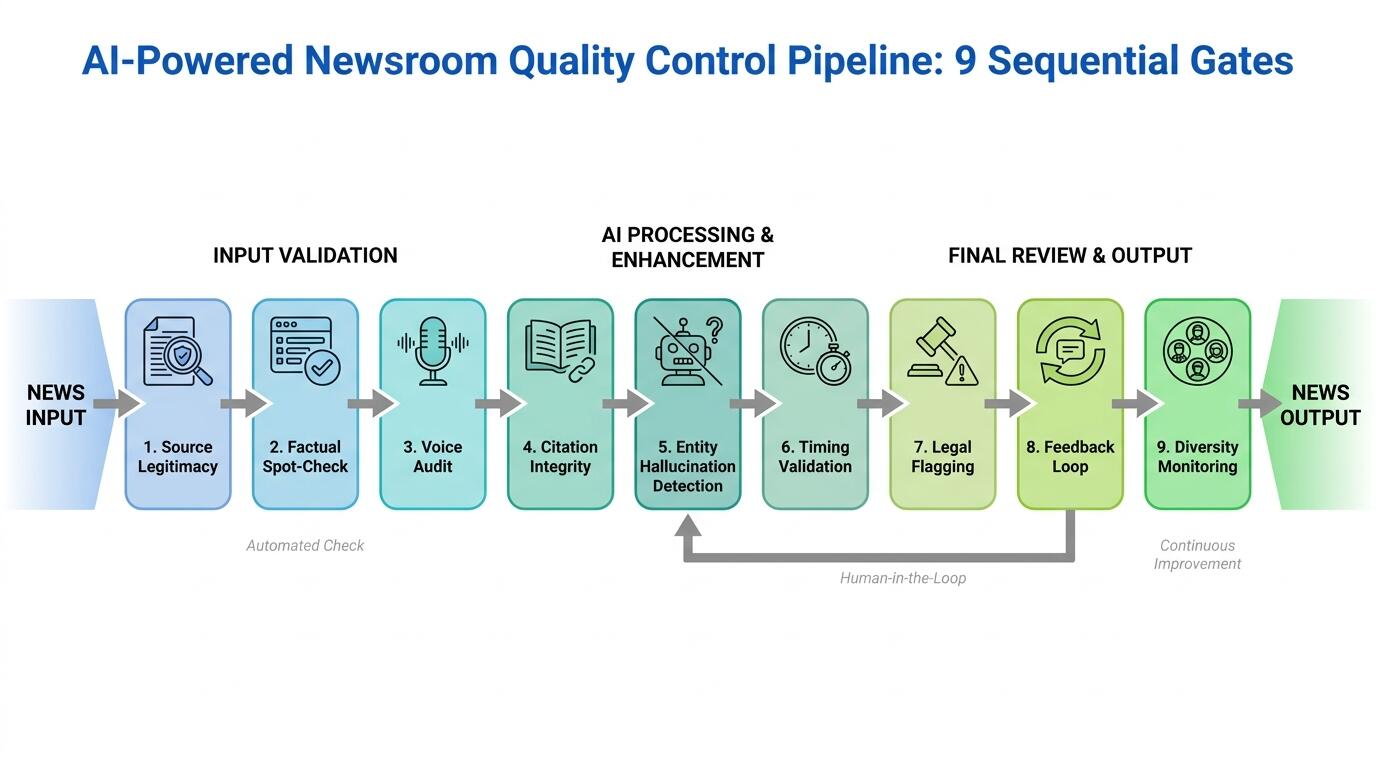
ALT: AI newsroom quality control workflow diagram showing nine editorial checks from source intake to post-publication monitoring for automated briefing pipelines
Questions & Answers
Q1: How do you fact-check AI-generated content without a human editor reviewing every draft?
A risk-weighted spot-check protocol is the practical answer. Rather than reviewing every claim in every draft — which defeats the efficiency of an automated pipeline — identify the categories of claims that carry the highest consequence if wrong: named individuals, regulatory references, specific figures, and third-party product claims. Apply a defined minimum check to each of those categories per draft, using primary sources rather than asking the AI to self-verify. This concentrates human review time where the failure cost is highest.
Q2: Are automated compliance checks sufficient for an AI-driven publication covering regulatory topics?
Automated flags are a useful first filter, not a complete compliance solution. A pattern-matching layer that routes high-risk drafts to a review queue can significantly reduce the volume of content that needs human legal review. However, automated checks will miss contextually complex compliance issues — a claim that is technically accurate but misleading in context, for example. For publications covering financial or regulatory subject matter, a periodic full-draft review by someone with domain expertise remains necessary alongside automated flagging.
Q3: How long does it take to set up a basic quality control checklist for an AI newsroom?
The process design is relatively fast — documenting the checks, assigning owners, and setting a review cadence for a basic version of this checklist can be done in a few days. The ongoing cost is what builders underestimate: each check needs to run consistently on every issue, not just at launch. The highest time investment is in the checks that require human judgment — voice auditing, factual spot-checking, and corrections triage — not in the automated gates. Realistic planning allocates a recurring time budget per issue rather than treating quality control as a one-time setup cost.
Final Thoughts
Running an AI-assisted publication with no dedicated editorial staff is not an excuse to skip quality control — it is the reason quality control needs to be more explicit, not less. Three points are worth holding on to.
First, most quality failures in AI newsrooms are systematic, not random. They come from the same pipeline gaps repeating across issues: bad sourcing at the retrieval step, hallucinated entities in generation, voice drift over time. Fixing the system fixes the pattern.
Second, the checks that protect long-term credibility — reader feedback protocols, output diversity monitoring, editorial voice consistency — are easy to defer and costly to retrofit. Build them early, even if you run them infrequently at the start.
Third, none of these checks require sophisticated tooling to be effective. The value is in consistent execution, not in the complexity of the mechanism.
If you are building or tightening the quality layer of an AI-assisted editorial pipeline, start with the two or three checks most relevant to your current failure risk, run them consistently for a full publication cycle, then expand. The goal is a process that runs reliably without requiring heroic effort on any single issue.
If you are building AI products or want to track the AI frontier from a first-hand practitioner perspective — not a secondhand editorial one — subscribe to the Darius bilingual briefing. Each issue features five to ten documented AI developments with hands-on analysis drawn from real production systems, helping you turn information noise into actionable judgment. Subscribe free and join thousands of builders working at the same frontier.
References & Further Reading
- Baltum AI. "EU AI Act Compliance Checklist for 2026".
https://baltum.ai/blog/eu-ai-act-compliance-checklist - Wizora Studio. "AI Automation Security Checklist: 42 Controls Before Production".
https://wizora.studio/blog/ai-automation-security-checklist - LinkedIn Top Content. "AI-Assisted Reporting Best Practices".
https://www.linkedin.com/top-content/technology/best-practices-in-technology/ai-assisted-reporting-best-practices/ - IEEE. IEEE Standards and Publications on AI Systems and Trustworthy Automation.
https://www.ieee.org/
Note: Standards and regulatory guidance may be updated; please check the latest official documents or consult professional advisors.