AI Interview vs. Human Mock Interview: When Each Actually Helps

ALT: AI interview practice session compared side by side with human mock interview coaching format
AI Interview vs. Human Mock Interview: When Each Actually Helps
Which one actually helps you land the job: an AI interview simulator or a human mock interview partner? The honest verdict is that AI interview tools win on repetition, availability, and structured feedback, while human mock interviews win on nuance, adaptability, and the kind of pressure-testing only a real person can deliver — meaning the strongest interview prep strategy uses both, at different stages of your preparation.
This comparison evaluates AI-driven mock interview platforms against traditional human-led mock interviews using criteria that matter to real candidates: feedback quality, availability, cost, realism under pressure, and scalability. Both approaches to interview practice have a legitimate place in a job seeker's toolkit, but they are not interchangeable, and treating them as such is one of the most common mistakes candidates make when preparing for technical interviews.
Evaluation Criteria for Comparing Interview Preparation Methods
Choosing between an AI mock interview and a human mock interview requires judging both against the same yardstick, not vague impressions of which "feels" more advanced. In our work building AI-native products, we've found that candidates who succeed treat interview prep as a system with measurable inputs, not a single event.
Feedback quality and specificity matters because vague encouragement ("you did great") does nothing to fix a rambling answer or a shaky system-design explanation. The best feedback pinpoints exact moments — a missed edge case, an unclear tradeoff explanation, a filler-word habit — and ties it to a concrete fix.
Availability and scheduling flexibility determines whether you can actually practice as often as you need to. A method that requires coordinating calendars with another person inherently limits repetition, while an always-on tool removes that friction entirely.
Cost per session is a practical constraint for most job seekers, especially those interviewing across multiple companies simultaneously. Recurring human coaching sessions carry a materially different cost structure than software-based practice.
Realism and adaptability under pressure captures how well the practice session mimics the unpredictability of a real interview — follow-up questions, behavioral curveballs, and reading a live interviewer's reactions.
Scalability across interview types matters because candidates often need to practice coding rounds, system design, and behavioral questions in parallel, and not every method covers all three equally well.
Each of these criteria maps to a real risk. Get feedback quality wrong and you rehearse the same mistakes repeatedly. Get availability wrong and you under-prepare. Get realism wrong and you freeze the moment a real interviewer deviates from the script.
The Contenders: AI Mock Interviews and Human Mock Interviews
AI Interview Platforms
An AI interview platform is a software system that simulates interview scenarios using natural language processing and, in more advanced implementations, large language models to generate questions, evaluate responses, and deliver structured feedback. These platforms are typically available on demand, allow unlimited repetition of the same question type, and can score responses against consistent rubrics for clarity, structure, and technical accuracy.
The headline characteristic of a well-built AI mock interview tool is consistency: it asks questions the same way every time, evaluates against the same criteria every time, and never gets tired or distracted. This makes it particularly strong for drilling specific weak points — such as practicing the same behavioral question fifteen times until the STAR-format answer becomes second nature, or running through algorithm explanations until the delivery is tight.
Darius's own AI Mock Interview Platform reflects this category at its best: an AI-native tool designed specifically to give candidates structured, repeatable practice with instant, actionable feedback on both technical and behavioral answers, rather than treating AI as a superficial add-on to a generic interview prep product.
Human Mock Interviews
A human mock interview is a practice session conducted by another person — a peer, mentor, professional coach, or former hiring manager — who asks interview questions and provides feedback based on direct observation and industry experience. This format has been the standard interview preparation method for decades, particularly for senior technical and leadership roles.
The defining strength of a human mock interview is adaptive judgment. A skilled human interviewer can read hesitation in your voice, notice when you're avoiding a topic, improvise a harder follow-up question when your first answer was too polished, or share war stories about what a specific hiring committee actually cares about. According to Chicago Booth Review, human evaluators bring contextual judgment to hiring assessments that purely algorithmic scoring can miss, particularly around nuanced signals like team fit and communication style.
Human mock interviews are typically arranged through mentorship networks, paid coaching services, career centers, or informal peer-practice arrangements, and their quality varies significantly based on the specific interviewer's experience and preparation.
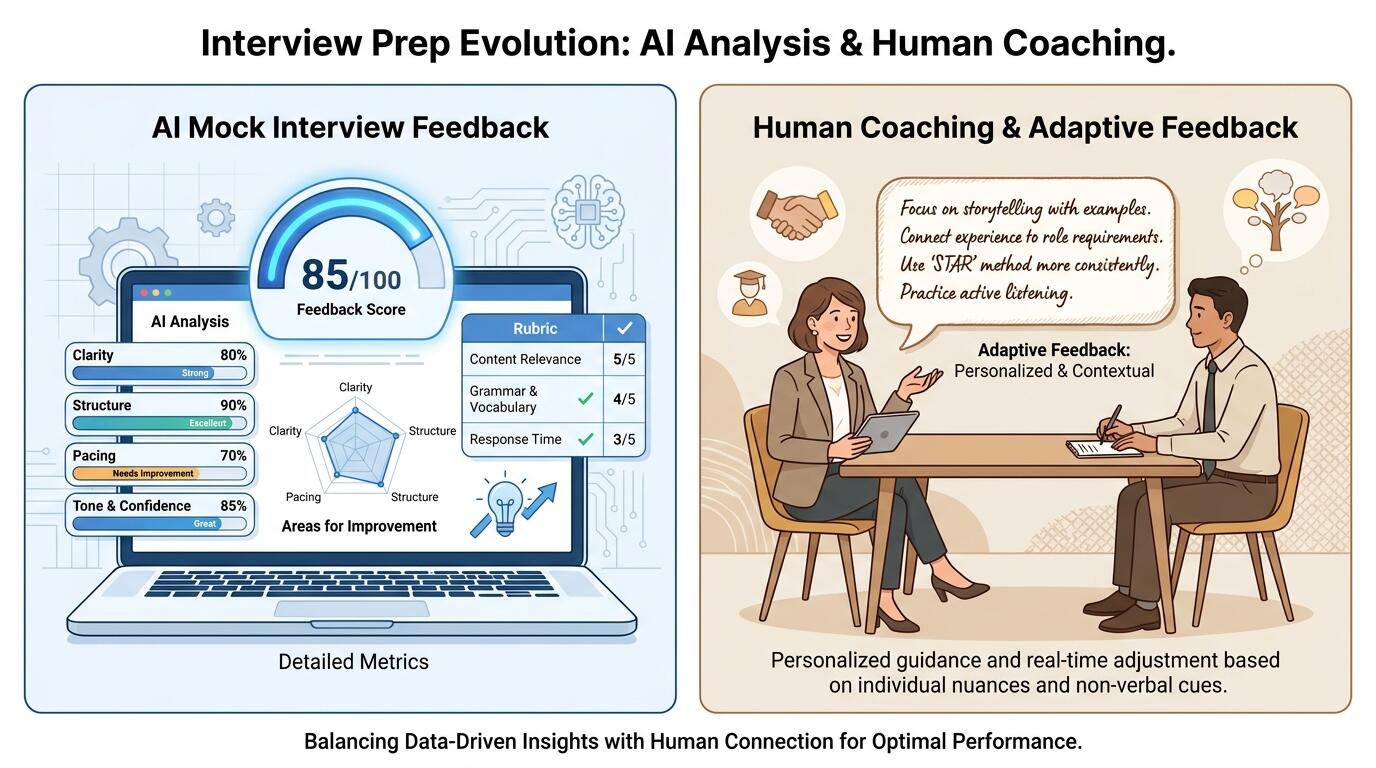
ALT: Split comparison graphic contrasting AI mock interview feedback dashboard with human coach discussion
Head-to-Head Comparison: AI Interview vs. Human Mock Interview
The table below places both methods side by side across the criteria defined earlier, making the tradeoffs explicit rather than leaving them to guesswork.
| Criterion | AI Mock Interview | Human Mock Interview |
|---|---|---|
| Feedback consistency | High — same rubric applied every session | Variable — depends on interviewer's skill and mood |
| Availability | On demand, any time, unlimited repetition | Limited by scheduling and interviewer availability |
| Cost per session | Generally lower, often subscription-based | Consult provider — varies by coach or platform |
| Adaptive follow-up questions | Improving but generally scripted or pattern-based | Strong — can improvise based on your specific answer |
| Reading soft signals (nerves, tone, hesitation) | Limited | Strong |
| Best for repetition and drilling | Strong | Weak — repetition is costly and time-intensive |
| Best for high-stakes final-round simulation | Moderate | Strong |
| Data privacy and recording considerations | Consult provider | Consult provider |
The clearest pattern in this table is a division of labor rather than a winner-takes-all outcome. AI mock interview tools dominate on anything that benefits from repetition and consistency — which is most of early-stage technical prep, where the goal is to build muscle memory around structure, clarity, and timing. Human mock interviews dominate on anything that benefits from judgment and improvisation — which matters most in later-stage, high-stakes rounds where a real interviewer's unpredictability is exactly what you need to rehearse against.
A common mistake we see candidates make is over-indexing on one method for the entire preparation cycle. Candidates who only use AI tools sometimes arrive at final rounds well-drilled on structure but thrown off by an interviewer who asks something the AI never covered. Conversely, candidates who rely exclusively on expensive human coaching sessions often under-practice simply because each session is costly and hard to schedule, leaving long gaps between practice attempts. Per the analysis in AI Vs. Human Interviews: What Really Works in Hiring Today, hiring processes increasingly blend automated and human-led evaluation stages, and preparation should mirror that same blended structure rather than betting entirely on one format.
Another distinction worth flagging is scope. AI interview platforms are increasingly capable of covering coding rounds, behavioral questions, and even some system-design walkthroughs within a single tool, which matters for candidates juggling multiple interview types in a short window. Human mock interviews, by contrast, are usually scoped narrowly to the interviewer's own expertise — a former engineering manager can mock a system-design round well but may be a weaker fit for rehearsing a coding-specific technical screen.
Which Should You Choose? Scenario Recommendations
If you are early in your preparation and need to build baseline fluency answering common technical and behavioral questions, choose an AI mock interview tool first. The unlimited repetition lets you fail privately, adjust, and retry immediately, which is exactly what's needed before you're ready to be evaluated by another person.
If you have a final-round interview scheduled within the next short stretch of time and need to simulate real pressure, prioritize a human mock interview. A person who can push back, ask unexpected follow-ups, and give you a candid read on how you come across under scrutiny is difficult to replace at this stage.
If you're a job seeker with a tight budget and need frequent practice across many companies, lean heavily on AI mock interview tools as your default, reserving human sessions for the one or two interviews that matter most. This scenario is where a tool like Darius's AI Mock Interview Platform is particularly effective — it's designed to give production-grade, structured feedback on demand rather than the shallow scoring found in many bolt-on AI features.
If you're preparing for a role where soft-skill assessment and communication style are heavily weighted — such as leadership or client-facing engineering positions — invest more heavily in human mock interviews, since reading interpersonal signals remains an area where humans currently outperform automated tools.
If you're switching careers or industries and don't yet know which questions to expect, start with an AI tool to build broad coverage across common question types, then narrow down with a human mock interview from someone with direct experience in your target industry to validate nuance and industry-specific expectations.
In short: AI mock interviews are your volume and consistency tool; human mock interviews are your precision and pressure-testing tool. The pitfall to avoid is treating either one as sufficient on its own — candidates who blend both consistently report feeling more prepared for the actual variability of a real interview process.
Common Questions
Q1: How does an AI mock interview actually generate feedback on my answers?
An AI mock interview platform typically analyzes your spoken or written response using natural language processing to assess structure, clarity, relevant keywords, and pacing, then compares that against a scoring rubric built from common interview evaluation standards. More advanced platforms, including AI-native tools, layer in large language model analysis to flag specific weak points, such as a missing quantifiable result in a behavioral answer.
Q2: Is an AI interview simulator accurate enough to replace human interview feedback entirely?
No — an AI interview simulator is highly effective for structural feedback, repetition, and consistency, but it currently cannot fully replicate a human's ability to read tone, hesitation, or improvise unpredictable follow-up questions. Per Medium's comparison of AI mock interviews vs. human mock interviews, each format is "actually good at" different things, which is why most effective preparation strategies combine both rather than choosing one exclusively.
Q3: How much time should I spend on AI mock interviews versus human mock interviews before a real interview?
There's no fixed universal ratio, but a practical pattern many candidates follow is spending the bulk of early preparation time on AI mock interview repetition to build fluency, then shifting toward human mock interviews as the real interview date approaches to simulate pressure and improvisation. Consult your specific timeline and the seniority of the role to adjust this balance.
Summary
The core distinction between an AI interview and a human mock interview comes down to three points: AI tools deliver consistent, repeatable, low-cost feedback that's ideal for building fluency, human mock interviews deliver adaptive, high-pressure realism that's ideal for final-stage rehearsal, and the strongest preparation strategy deliberately sequences both rather than picking a single method.
The most common pitfall we see candidates fall into is treating this as an either-or decision instead of a staged approach — over-relying on AI drilling without ever testing under real human scrutiny, or over-investing in costly human sessions without enough repetition to internalize the fundamentals. Avoiding that mistake is often the difference between feeling prepared and feeling ambushed on interview day.
If you're mapping out your own preparation plan, start by identifying which interview stage you're closest to, then match the method to that stage using the scenarios outlined above. From there, the natural next step is finding tools that are actually built for this purpose rather than generic add-ons — which is exactly the gap production-grade AI-native platforms are designed to close.
Ready to experience AI that's built to work, not just bolted on? Explore Darius's suite of production-ready AI products — from the AI Cloud Drive to the AI Mock Interview Platform and AI Creator Cockpit — at Darius's website. Visit today to discover tools designed to help you store smarter, interview better, and create faster. If you're also exploring how AI-native products are built beyond interview prep, our breakdown of the difference between AI prototypes and production-ready AI systems is a useful next read, alongside our guide on shipping your first live AI product.
Sources & Further Reading
- Chicago Booth Review. "Does AI Beat Humans at Recruiting?".
https://www.chicagobooth.edu/review/does-ai-beat-humans-recruiting - Medium (CodeGrey). "AI mock interviews vs. human mock interviews: What each is actually good at".
https://medium.com/@codegrey/ai-mock-interviews-vs-human-mock-interviews-what-each-is-actually-good-at-4caed8b96d9f - HRMLESS. "AI Vs. Human Interviews: What Really Works in Hiring Today".
https://www.hrmless.com/blog/ai-vs-human-interviews - IEEE. Institute of Electrical and Electronics Engineers — standards and research on AI systems.
https://www.ieee.org/
Note: Standards may be updated; please check the latest official documents or consult professional advisors.