Implementing AI Governance Frameworks Without Slowing Down Delivery
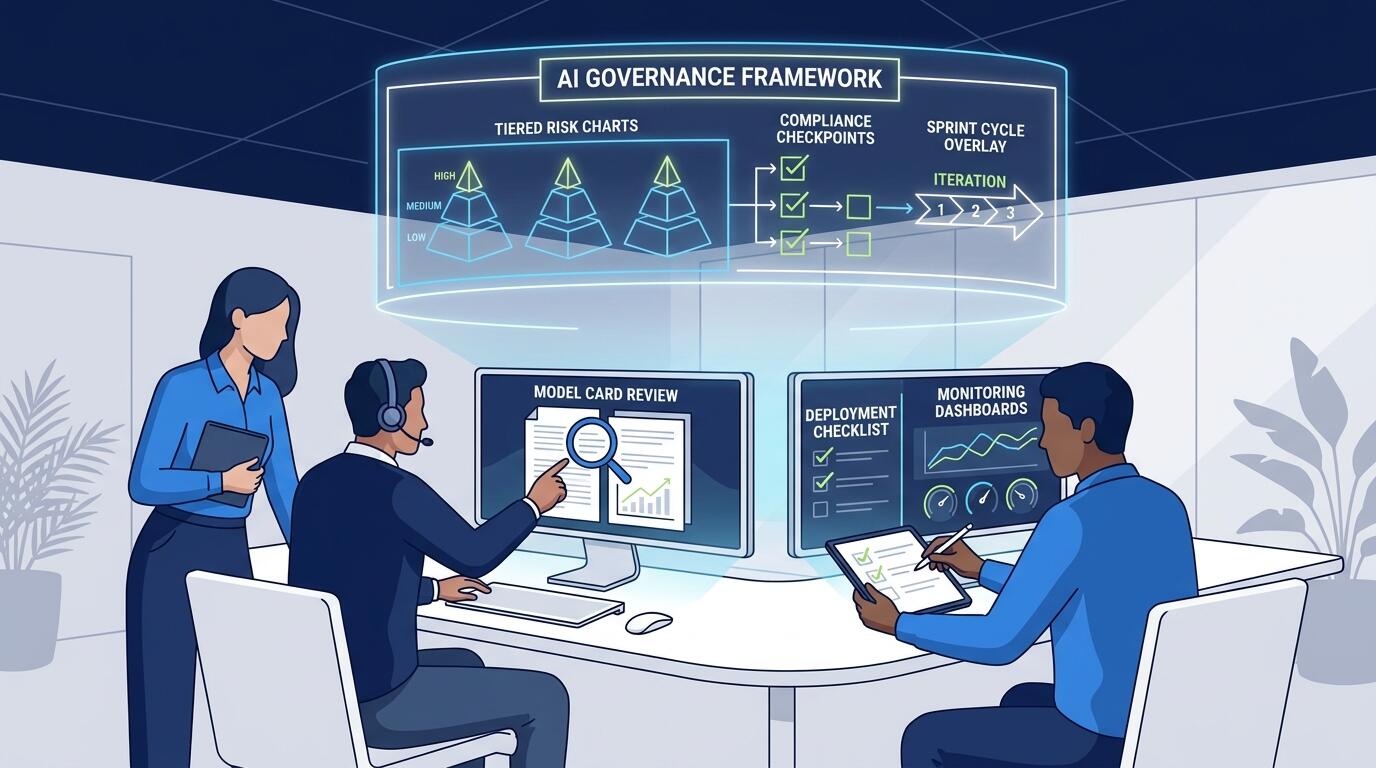
ALT: Engineering team implementing AI governance frameworks while maintaining fast product delivery velocity
AI Governance Without the Brakes: How to Build Responsible AI Systems Without Killing Delivery Speed
The pressure to ship AI-powered products quickly has never been higher. At the same time, the pressure to ship them responsibly — with documented oversight, explainability, and risk controls — is equally intense and growing. For most engineering teams and startup founders, these two forces feel like they are pulling in opposite directions. A pattern we consistently see in our work with clients is that governance gets treated as an afterthought: bolted on after a product ships, or skipped entirely until a compliance event forces the issue.
That approach is expensive. Retrofitting accountability structures into a live AI system costs far more in engineering time, credibility, and rework than building lightweight governance in from the start. The real question is not whether to implement AI governance frameworks — it is how to do so without adding so much overhead that you lose the delivery momentum that makes AI products competitive.
This article presents a structured set of strategies for implementing AI governance in a way that is proportional, pragmatic, and compatible with fast-moving engineering cycles. Each item was selected based on what actually works in practice when shipping live AI-powered systems — not what looks good in a compliance document. Whether you are a startup founder standing up your first AI product or an engineering director governing an expanding model fleet, these approaches are designed to give you the oversight you need without creating the bureaucratic drag you fear.
Practical Strategies for Implementing AI Governance Without Slowing Delivery
Tier Your Governance by Risk, Not by Uniformity
Applying the same level of governance scrutiny to every AI component in your system is the fastest path to process paralysis. Risk-tiering is the practice of calibrating oversight intensity to the actual consequences of a failure in each component — high-stakes decision systems get rigorous review; low-risk recommendation helpers get lightweight checklists.
In practice, this means classifying each AI feature or model at the point of scoping. A content moderation model affecting user safety sits at a different risk tier than an autocomplete suggestion in a search bar. Documenting that classification explicitly — even in a simple internal wiki entry — gives your team a shared, defensible rationale for the governance effort applied to each component. According to guidance from the National Institute of Standards and Technology (NIST), risk-based approaches to AI management are foundational to responsible deployment, and NIST's AI Risk Management Framework formalizes this tiered thinking for organizations building or procuring AI systems.
- Best for: Engineering teams managing multiple AI features with limited governance bandwidth, and founders who need to prioritize where to invest compliance effort.
- Watch out: Risk classifications must be revisited as the product evolves. A feature that starts low-risk can become high-risk as user volume or business criticality grows.
Embed Governance Checkpoints Into Existing Engineering Rituals
Governance frameworks fail most often not because the rules are wrong, but because they exist in a separate process that engineers treat as external to their real work. Embedding governance checkpoints directly into sprint ceremonies, pull request templates, and architecture review meetings eliminates that separation.
This looks like adding a "model card" section to your internal design doc template, or including a two-question accountability check in your deployment checklist: What is this model's intended use? What monitoring is in place for out-of-distribution inputs? These additions take minutes to complete and produce a durable record of intent. As noted by practitioners in the field of responsible AI deployment, integrating governance into existing developer workflows — rather than creating a parallel compliance track — is the single highest-leverage structural change an engineering organization can make. For teams building at scale, how enterprise teams are governing AI systems offers a practical lens on how mature organizations are operationalizing this integration.
- Best for: Agile teams running two-week sprints who cannot afford to add dedicated governance sprints or separate review boards.
- Watch out: Checkbox compliance is a real risk. If the governance prompts are too generic, engineers will fill them out without genuine reflection. Keep the questions specific and actionable.
Define Your Data Lineage Before You Build, Not After
Data governance is not a separate discipline from AI governance — it is the foundation of it. Data lineage is the documented record of where training and inference data originates, how it has been transformed, and what its known limitations are. Without it, you cannot trace a model's behavior back to its inputs, and you cannot make defensible claims about fairness or reliability.
In our work with clients, we find that establishing data lineage documentation as a required artifact at the start of a new AI workstream — not at the end — adds minimal time to scoping but dramatically reduces the cost of incident investigation and compliance review later. This is a direct ROI argument: the hours spent documenting data sources upfront are recovered many times over when a production issue requires rapid root-cause analysis. Teams that treat data lineage as a delivery prerequisite rather than a post-hoc audit artifact consistently ship with more confidence and fewer costly surprises.
- Best for: Teams working with third-party datasets, scraped data, or proprietary customer data where provenance is complex or legally significant.
- Watch out: Lineage documentation becomes stale if not maintained. Build update triggers into your data pipeline changes, not just into your initial documentation workflow.
Implement Model Cards and System Cards as Living Documents
A model card is a structured document that captures a model's intended use, performance characteristics across demographic groups, known limitations, and evaluation conditions. A system card extends this concept to the full AI system, including the infrastructure, human oversight mechanisms, and downstream integrations. Both formats were introduced and formalized in the academic literature and have been adopted by major AI organizations as a standard transparency practice.
The governance value of model cards is not in the document itself — it is in the discipline of completing one. Teams that write model cards at deployment are forced to articulate, explicitly and concisely, what their system is and is not designed to do. That clarity prevents scope creep at the product level and reduces the likelihood of harmful misuse. Critically, model cards should be treated as living documents that are updated when a model is retrained, fine-tuned, or deployed in a new context — not filed away and forgotten. This approach is consistent with responsible AI guidance from the IEEE, which has published standards on algorithmic bias considerations and transparency in autonomous systems.
- Best for: Any team deploying a model that makes decisions affecting users, particularly in regulated industries or consumer-facing products.
- Watch out: A model card written once and never updated is worse than no model card — it creates a false sense of accountability. Assign ownership and set a review cadence.
Build Monitoring and Observability Into the Governance Architecture From Day One
AI governance is not only about what happens before a model ships — it is equally about what happens after. Production monitoring for AI systems goes beyond uptime metrics to include behavioral drift detection, input distribution shifts, output anomaly rates, and user feedback signals. Without this layer, governance frameworks are blind to the most consequential failures, which typically emerge in production under real-world conditions rather than in test environments.
The practical recommendation here is to define your monitoring schema alongside your model training and evaluation plan, not as a separate post-launch workstream. What signals indicate the model is operating within its intended parameters? What thresholds trigger a review or a rollback? Answering these questions before launch means your governance framework has teeth — it can actually catch and respond to problems. For teams assessing the cost implications of building robust AI infrastructure, understanding what it actually costs to run a RAG system in production provides a useful grounding in the real operational economics involved, including monitoring overhead.
- Best for: Production AI systems with ongoing inference, particularly those where model behavior can drift due to changing user patterns or data distribution.
- Watch out: Monitoring generates signal, but signal without a defined response protocol is noise. Pair every monitoring metric with an explicit escalation or remediation path.
Establish Clear Human-in-the-Loop Boundaries for High-Stakes Decisions
Human-in-the-loop (HITL) design is the practice of defining, at the architecture level, which decisions require human review or override capability before action is taken. HITL is not about adding friction universally — it is about ensuring that consequential, irreversible, or high-uncertainty AI outputs are not acted on automatically without human judgment in the loop.
In governance terms, establishing explicit HITL boundaries is both a risk control and a liability management mechanism. It answers the question: at what point does a human have to be accountable for what this system does? Getting that answer into your architecture documentation before you build removes ambiguity during development and provides a clear defense in the event of a compliance inquiry. The NIST AI Risk Management Framework explicitly addresses human oversight as a core component of trustworthy AI, and the European Union's AI Act — which is progressively shaping AI governance norms globally — uses HITL requirements as a key criterion for classifying AI system risk levels.
- Best for: AI systems operating in healthcare, financial services, legal technology, hiring, or any domain where automated decisions carry significant legal or ethical weight.
- Watch out: Poorly designed HITL interfaces can create the illusion of oversight without the substance of it — reviewers rubber-stamp outputs they cannot meaningfully evaluate. Invest in interface design that enables genuine review.
Create a Governance Runbook, Not a Governance Policy Document
A policy document describes what an organization's AI governance principles are. A governance runbook describes what an engineer or product manager actually does when a specific situation arises — a model produces unexpected outputs, a data supplier changes their terms, a user reports a discriminatory result. Runbooks operationalize principles into executable steps.
The distinction matters because policy documents are rarely consulted under pressure, while runbooks are. Teams that invest in translating their AI governance policies into concrete, scenario-specific runbooks are consistently faster at responding to incidents and less likely to make improvised decisions that create downstream liability. A well-structured runbook includes: trigger conditions, the escalation path, the communication template, the technical remediation options, and the post-incident review requirement. This is governance that actually governs — and it costs remarkably little to produce relative to the risk it mitigates.
- Best for: Organizations that have AI governance policies in place but find that those policies are not meaningfully influencing day-to-day engineering decisions.
- Watch out: Runbooks must be tested through tabletop exercises or post-incident reviews to remain useful. An untested runbook may contain gaps that only become visible during an actual incident.
Align Governance Cadence With Your Release Cadence
One of the most common mistakes in AI governance implementation is setting governance review cycles that are out of sync with engineering release cycles. If your team ships every two weeks and your AI governance review happens quarterly, you have effectively created a governance framework that cannot keep up with your product — and that will be bypassed under delivery pressure.
The fix is not to slow down releases; it is to modularize governance reviews so that lightweight checks happen continuously and deeper reviews happen at meaningful milestone intervals, such as major version releases or significant changes to model behavior or data. This is the same logic that makes continuous integration work in software engineering: moving from batch reviews to incremental, integrated checks. Governance aligned with delivery cadence is governance that stays relevant and gets used. For teams actively thinking through how to maintain quality at speed, our thinking on shipping fast without sacrificing product quality addresses the underlying tension directly.
- Best for: Startups and product teams operating in fast release cycles who have experienced governance reviews becoming a bottleneck or being skipped under time pressure.
- Watch out: Continuous lightweight checks must not replace substantive periodic reviews. Use both levels deliberately — one for ongoing compliance and one for strategic risk assessment.
Quick Comparison at a Glance
| Strategy | Best For | Key Strength | Limitation |
|---|---|---|---|
| Risk-Tiered Governance | Teams managing multiple AI features | Proportional effort allocation | Classifications need active maintenance |
| Embedded Checkpoints | Agile teams in sprint cycles | Zero-friction integration | Risk of checkbox compliance |
| Data Lineage Documentation | Teams with complex data sourcing | Enables fast incident root-cause | Becomes stale without update triggers |
| Model Cards and System Cards | Consumer-facing or regulated AI | Forces explicit intent documentation | Requires living document ownership |
| Production Monitoring | Ongoing inference systems | Catches real-world behavioral drift | Signal without protocol is noise |
| Human-in-the-Loop Boundaries | High-stakes decision domains | Establishes clear accountability | Poor interface design can undermine review |
| Governance Runbooks | Organizations with existing policies | Operationalizes principles into steps | Must be tested to remain reliable |
| Cadence Alignment | Fast-release product teams | Keeps governance relevant and used | Continuous checks must not replace deep reviews |
How to Choose the Right Approach for Your Context
Implementing AI governance effectively means matching the strategy to the maturity of your organization, the risk profile of your product, and the reality of your delivery constraints. Not every team needs every approach simultaneously.
If you are a startup shipping your first AI product, the highest-return starting points are risk-tiering and embedded checkpoints. These require almost no tooling investment and produce governance artifacts that will be valuable in future fundraising due diligence and enterprise sales conversations. Start with a simple risk classification table and add two governance questions to your existing deployment checklist. That foundation will take less than a day to establish and will grow with you.
If you are an engineering director governing an existing AI product at scale, the gaps most likely to create liability are in production monitoring and runbooks. Policy documents may already exist — the missing layer is operational: what does the team actually do when something goes wrong, and are behavioral drift signals being tracked in production?
If you are in a regulated industry — financial services, healthcare, legal technology — HITL boundaries and model cards are non-negotiable foundations. The EU AI Act and equivalent emerging regulatory frameworks in other jurisdictions are increasingly explicit about requiring documented human oversight for high-risk AI systems. The cost of compliance architecture built in is a fraction of the cost of compliance architecture retrofitted after a regulatory inquiry.
A common misconception worth addressing directly: AI governance frameworks do not have to be large, formal, or resource-intensive to be effective. The most durable governance implementations we have seen are lightweight by design — they embed into existing workflows, use simple documentation formats, and create accountability through clarity rather than through bureaucracy. Governance is not the enemy of delivery speed; poor governance architecture is.
For teams thinking carefully about how AI system design choices upstream affect governance requirements downstream, the AI system architecture patterns every CTO should evaluate offers a complementary strategic perspective on building systems that are governable by design.
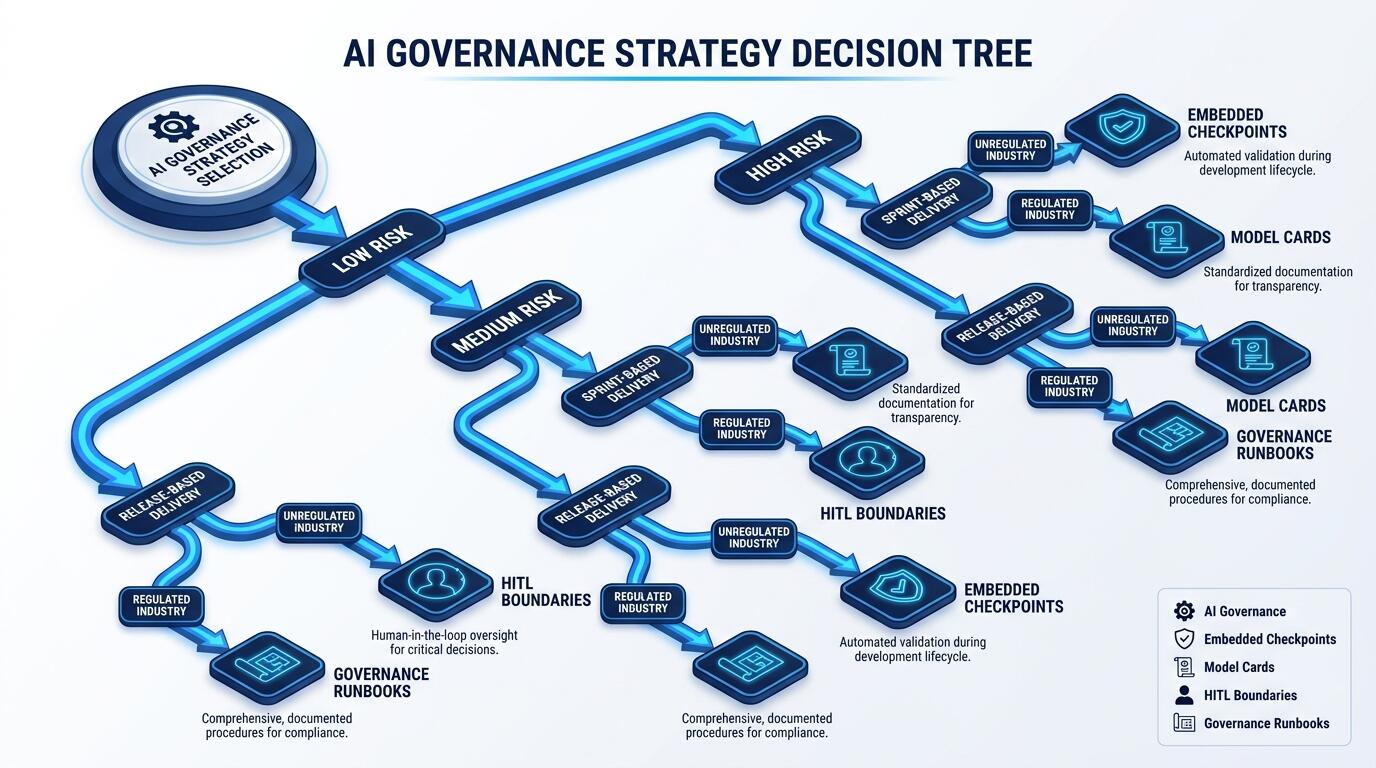
ALT: Decision framework diagram showing how engineering teams select AI governance strategies based on risk level, delivery cadence, and regulatory context for responsible AI deployment
Questions & Answers
Q1: How do you implement an AI governance framework without creating a separate compliance team?
AI governance does not require a dedicated compliance team — it requires governance responsibilities to be clearly owned within your existing engineering and product roles. The most effective approach embeds governance checkpoints into sprint ceremonies, pull request processes, and architecture reviews. Assigning explicit ownership of model cards and runbooks to named engineers — not to a separate team — keeps accountability close to the work and removes the organizational distance that makes compliance feel disconnected from delivery.
Q2: Are AI governance frameworks legally required for startups shipping AI products?
The legal requirement for formal AI governance depends on your jurisdiction, industry, and the risk classification of your AI system. The EU AI Act establishes legally binding requirements for high-risk AI systems, and similar legislation is advancing in multiple jurisdictions. Even where formal governance is not yet legally mandated, enterprise customers, institutional investors, and regulated industry partners increasingly require evidence of responsible AI practices as a condition of doing business. Building lightweight governance early is a low-cost way to meet both current diligence requirements and anticipate near-term regulatory obligations.
Q3: How long does it take to set up a baseline AI governance framework for a small engineering team?
A functional baseline — covering risk classification, embedded checkpoints, model card templates, and a basic runbook — can typically be established in a focused one-to-two week effort for a small team, assuming existing delivery processes are already in place to embed into. The ongoing maintenance cost is low if governance artifacts are treated as living documents with assigned owners. The largest time investment is usually in the initial runbook development and in defining the monitoring schema — both of which pay back quickly in reduced incident response time.
Key Takeaways
Implementing AI governance frameworks without slowing down delivery is not a compromise — it is a design choice. The three core principles that make it work are proportionality, integration, and operationalization.
Proportionality means calibrating governance effort to actual risk, not applying uniform overhead to every AI component regardless of consequence. Integration means embedding governance into the engineering workflows that already exist — sprints, pull requests, architecture reviews — rather than creating a parallel process that competes with delivery for time and attention. Operationalization means translating governance principles into executable runbooks, living documents, and defined monitoring protocols that function under pressure, not just under calm review conditions.
The direct ROI argument for governance-by-design is strong: the cost of building accountability structures into a product from the start is consistently lower than the cost of retrofitting them after an incident, a regulatory inquiry, or a failed enterprise deal. Teams that treat governance as a delivery prerequisite — not a post-launch obligation — ship with more confidence, respond to problems faster, and build the kind of institutional trust that compounds over time.
The next concrete step is to pick the two or three strategies from this list that are most misaligned with your current practice and address them before your next major release. You do not need a perfect governance framework on day one — you need a functional one that grows with your product.
Ready to build AI systems that are both fast to ship and built to last? If you're looking to turn your idea into a live, running product — from AI architecture to full-stack execution — explore real-world projects, technical insights, and professional services at the Darius website. Whether you're an early-stage founder or a scaling engineering team, Darius can help you build smarter and ship faster.
Sources & Citations
- Acceldata. "AI Governance Frameworks: How Organizations Scale AI Without Losing Control".
https://www.acceldata.io/blog/ai-governance-frameworks-how-organizations-scale-ai-without-losing-control - Ivanti. "AI Governance Framework: How to Implement Responsible AI Guardrails".
https://www.ivanti.com/blog/ai-governance-framework-responsible-ai-guardrails - TrueFoundry. "AI Governance Best Practices: How to Scale AI Safely".
https://www.truefoundry.com/blog/ai-governance-best-practices - National Institute of Standards and Technology (NIST). AI Risk Management Framework.
https://www.nist.gov/
Note: Standards and regulatory guidance may be updated; please check the latest official documents or consult professional advisors.