How Enterprise Teams Are Governing AI Systems Heading Into 2027

ALT: Enterprise engineering teams building AI governance frameworks and oversight systems heading into 2027
Why AI Governance Has Become the Defining Engineering Challenge of 2027
A senior engineering leader once described their AI deployment situation to me like this: "We have models in production doing real work, but I genuinely couldn't tell you who owns accountability when one of them fails." That discomfort is now the norm across enterprise teams — not because they lack technical capability, but because the governance infrastructure to support responsible AI operation at scale has lagged well behind the pace of deployment.
Heading into 2027, governing AI systems is no longer a compliance checkbox or a future-state aspiration. It is an active, operationally urgent discipline that touches architecture decisions, organizational design, risk management, and product strategy simultaneously. The teams that get this right are building systematic frameworks for oversight, auditability, and control — before incidents force their hand. The teams that don't are discovering that ungoverned AI at scale creates technical debt that is genuinely difficult to unwind.
This article examines what effective enterprise AI governance actually looks like in practice, where the common failure modes appear, and how engineering and product leaders can build durable oversight systems rather than performative ones.
Who This Guidance Is — and Is Not — For
Applicable Scenarios:
- Engineering leaders and CTOs at companies with one or more AI models actively running in production environments, making decisions that affect users, operations, or revenue
- Product and platform teams scaling AI-powered features beyond a single model or use case, where coordination and oversight complexity is growing
- Founders and technical leads at growth-stage companies proactively building governance infrastructure ahead of regulatory pressure or enterprise customer requirements
Not Applicable / Cautions:
- Teams still in the research or prototype phase with no production AI deployments — governance architecture at that stage risks over-engineering before the actual problems are known
- Organizations seeking a compliance-only approach: governance designed purely to satisfy auditors, rather than to actually control system behavior, creates a false sense of security that is arguably worse than acknowledged uncertainty
The Governance Gap That Is Now a Business Risk
Enterprise AI governance is the set of policies, processes, architectural controls, and organizational structures that ensure AI systems operate reliably, transparently, and within acceptable risk boundaries across their operational lifecycle. As of the current state of the industry, most enterprises have deployed AI faster than they have built the oversight infrastructure to manage it responsibly.
This is not a theoretical concern. According to the Enterprise AI Adoption Report 2026-2027, enterprises are increasingly confronting the gap between the velocity of AI deployment and the maturity of their governance practices. The pattern is consistent across industries: initial deployments move quickly under competitive pressure, governance is deferred as a "phase two" concern, and by the time phase two arrives, there are multiple production systems operating without consistent oversight standards.
From the perspective of engineering work that spans AI architecture and production deployment, the consequences of this gap are concrete. Ungoverned models drift silently — their performance degrades without anyone detecting it because no monitoring baseline was established. Ownership of AI outputs is ambiguous, so when something goes wrong, the incident response is chaotic. Regulatory scrutiny is accelerating, particularly in the EU under the AI Act framework, and enterprises without documented governance structures face real exposure.
The regulatory environment is tightening in a way that makes governance a competitive differentiator, not just a risk mitigation exercise. The European Union's AI Act, which classifies AI systems by risk level and imposes corresponding obligations, is the most structured regulatory framework currently in force, but similar legislative activity is underway in multiple jurisdictions. Enterprises building governance capability now are investing in something that will be required of them anyway — the question is whether they build it deliberately or reactively.
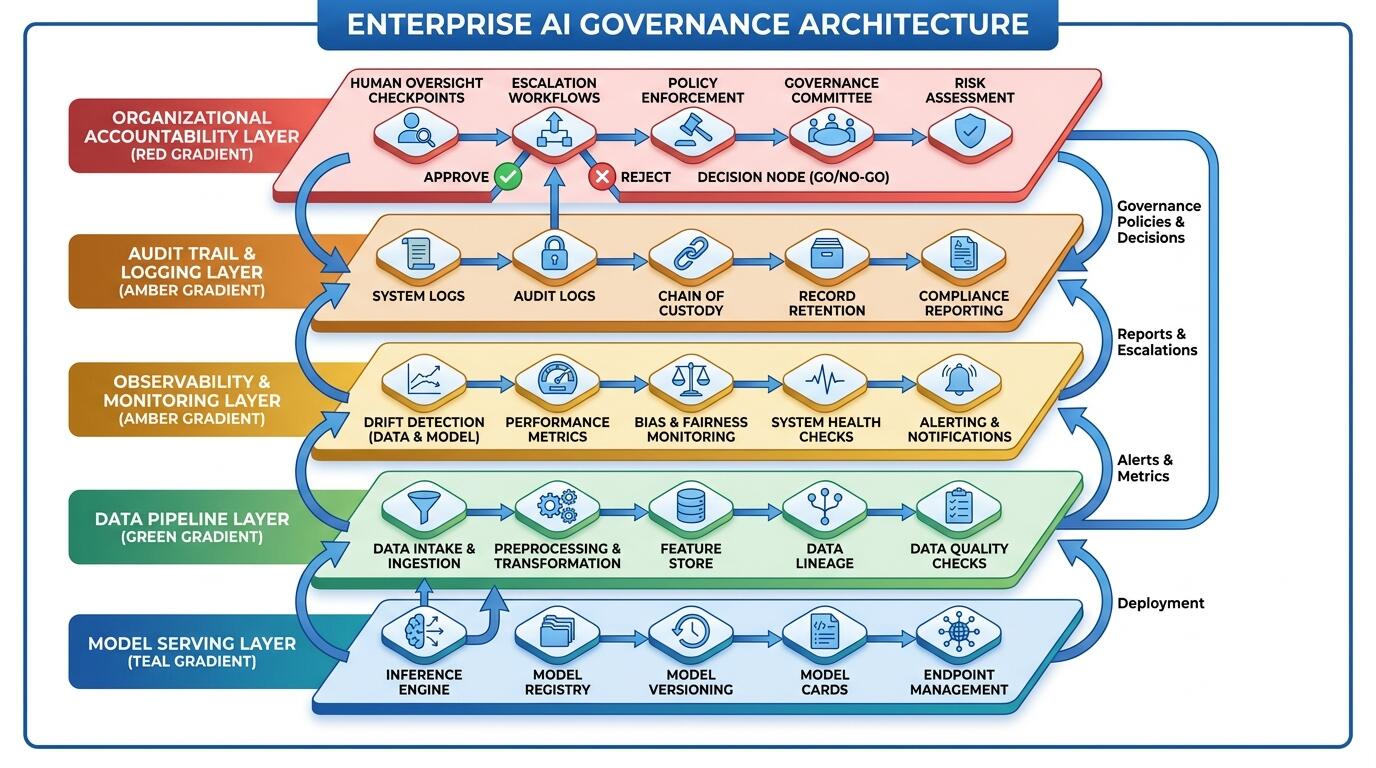
ALT: Diagram of enterprise AI governance architecture layers including model monitoring, audit trails, and organizational accountability structures
Building Effective AI Governance: From Principles to Production Systems
Three Steps to Getting AI Governance Off the Ground
Step 1: Map Your Existing AI System Inventory
Before any governance framework can function, teams need an accurate, current inventory of every AI system in production — including models embedded in third-party tools, API integrations, and automated workflows that may not be labeled as "AI" internally. This sounds elementary, but in practice, a pattern consistently seen in maturing engineering organizations is significant undercounting of AI touchpoints. Shadow deployments, vendor-managed models, and automated decisioning systems that predate the current AI wave all need to be captured. The output of this step is a registry with ownership, use case, risk classification, and deployment status for each system.
Step 2: Establish Risk Tiers and Corresponding Oversight Requirements
Not every AI system carries the same risk profile, and uniform governance requirements across all systems create compliance theater rather than meaningful control. A recommendation engine for content discovery requires different oversight than an automated system making credit decisions or patient triage recommendations. Drawing on the risk classification logic embedded in frameworks like the EU AI Act, teams should define tiers — typically three to four — based on the potential harm of a failure, the autonomy of the system, and the reversibility of its outputs. Each tier then maps to specific requirements: monitoring frequency, explainability standards, human review checkpoints, and escalation procedures.
Step 3: Assign Ownership and Build Accountability Into Architecture
Governance frameworks fail most often not at the policy level but at the accountability level — nobody actually owns what happens when a model misbehaves. Effective governance requires named owners for each AI system who are accountable for its performance, its drift monitoring, and its incident response. This ownership must be built into the engineering workflow, not bolted on after deployment. Concretely, that means model cards with assigned owners, automated alerts routed to specific teams, runbooks for common failure modes, and regular review cycles scheduled as standing engineering rituals rather than ad-hoc reactions.
Governance Approach Comparison: Three Models Enterprise Teams Are Using
Enterprise teams are currently converging on a relatively small set of structural approaches to AI governance. Understanding the tradeoffs between them is essential before committing to an architecture.
The choice of governance model has significant downstream implications for tooling, staffing, and process design. In work with engineering organizations at various stages, the centralized model tends to produce higher consistency but slower responsiveness; the federated model scales better but requires strong standards enforcement to avoid fragmentation; the embedded model is closest to actual engineering practice but requires the most cultural change to sustain.
| Comparison Dimension | Centralized Governance | Federated Governance | Embedded Governance |
|---|---|---|---|
| Ownership structure | Central AI governance team owns all standards and review | Domain teams own governance with central standards body | Governance is built into each team's engineering process |
| Consistency | High — uniform standards across all systems | Moderate — standards set centrally, implementation varies | Variable — depends on team capability and discipline |
| Scalability | Lower — central team becomes a bottleneck at scale | Higher — distributes workload to domain teams | Highest — scales naturally with engineering headcount |
| Speed to production | Slower — review gates add lead time | Moderate — review is domain-local but standards still apply | Fastest — governance is part of the build, not a gate |
| Regulatory auditability | Strongest — centralized records and accountability | Moderate — requires aggregation across domains | Requires deliberate tooling investment to consolidate |
| Best suited for | Regulated industries, early-stage governance programs | Mid-to-large enterprises with distinct AI domains | Engineering-mature teams with strong DevOps culture |
The Technical Building Blocks Governance Actually Requires
Model Observability Is Not Optional
Model observability is the continuous monitoring of an AI system's inputs, outputs, and performance metrics against established baselines, with alerting when behavior drifts outside acceptable bounds. It is the technical foundation without which any governance policy is effectively unenforceable — you cannot govern what you cannot see.
In practice, observability for AI systems extends well beyond the infrastructure monitoring that engineering teams are already comfortable with. Beyond latency and error rates, teams need to track statistical properties of model inputs and outputs over time, detect distribution shift in incoming data, monitor for performance degradation across population subgroups, and log the information necessary to reconstruct any individual decision for audit purposes. Building this capability requires deliberate architectural investment at the point of deployment, not retrofit after the fact.
The Audit Trail Is an Architectural Decision, Not an Afterthought
A consistent pattern in organizations that struggle with AI accountability is that auditability was treated as a logging problem rather than an architectural one. Effective audit capability means that for any AI-driven output that affects a user or business outcome, you can reconstruct: which model version produced it, on what input data, at what point in time, and what the confidence or uncertainty profile of that output was.
This requires decisions at the model serving layer, the data pipeline layer, and the infrastructure layer to be made with auditability in mind from the start. Teams that defer these decisions find themselves unable to answer regulator or customer questions about past decisions without substantial forensic effort — and in some regulatory contexts, the inability to answer those questions is itself a compliance failure.
Human Oversight Mechanisms Must Be Genuine, Not Performative
The EU AI Act and emerging governance frameworks in other jurisdictions share a common requirement: for high-risk AI systems, there must be meaningful human oversight — not a rubber-stamp approval loop, but genuine capacity for human reviewers to understand, challenge, and override AI outputs. Per the guidance documented in the Enterprise AI Governance Framework from EWSolutions, effective oversight requires that humans in the loop have both the information and the authority needed to act on what they see.
Building genuine oversight mechanisms means designing interfaces that surface model reasoning in human-interpretable terms, establishing review workflows with real authority to override automated decisions, and ensuring that reviewers are not so overloaded that meaningful review is practically impossible. The last failure mode — nominal oversight that is actually rubber-stamping at scale — is the one most commonly seen in organizations that have built governance structures primarily for compliance purposes rather than operational control.
Model Cards and System Documentation as Living Artifacts
Model cards — structured documentation describing a model's intended use, performance characteristics, known limitations, and risk profile — were initially proposed as a research tool. In the enterprise governance context, they are becoming a functional operational artifact, serving as the canonical reference for risk assessment, incident response, and regulatory examination.
The key word is "living." A model card created at deployment and never updated provides a false picture of a system that has potentially drifted significantly from its original state. Effective governance treats model documentation as a continuously maintained artifact, updated when the model is retrained, when significant distribution shift is detected, or when the operational context changes materially.
Advanced Governance Scenarios and Common Misconceptions
Multi-Model Systems Require Compositional Governance
As enterprises move from single-model deployments to AI systems composed of multiple models — orchestration architectures, retrieval-augmented generation pipelines, multi-agent systems — governance frameworks designed for single-model contexts become inadequate. The accountability question shifts: when a multi-model pipeline produces a problematic output, which component is responsible?
Compositional governance addresses this by requiring that each component model maintains its own governance documentation and monitoring, that data flows between components are themselves observable and auditable, and that the system-level behavior is monitored as a distinct object of governance, not merely inferred from component-level monitoring. This is an area where the gap between current practice and what effective governance requires is particularly wide.
The "Governance as Bureaucracy" Misconception
A common objection to structured AI governance in engineering cultures is that it will slow down development velocity. This concern is legitimate when governance is designed as a series of approval gates disconnected from the engineering workflow. It becomes a misconception when governance is architected as a continuous engineering discipline — monitoring, documentation, and accountability built into the SDLC rather than imposed on top of it.
In work with engineering teams across different maturity levels, the difference in velocity impact between well-designed embedded governance and poorly-designed gate-based governance is substantial. The former adds discipline without meaningful friction; the latter adds friction without discipline, because teams learn to work around it.
Vendor Model Governance Is Your Responsibility
A growing area of risk in enterprise AI governance is the assumption that using a third-party model or AI API transfers accountability to the vendor. It does not. When a commercial model's outputs cause harm in your product context, the enterprise deploying that model bears accountability for the deployment decision, the integration design, and the oversight of outputs. Effective governance frameworks explicitly address third-party model usage with the same rigor as internally trained models, including documented risk assessments of the vendor's model behavior, monitoring of outputs in the production context, and escalation paths when vendor model behavior changes unexpectedly.
Frequently Asked Questions FAQ
Q1: How should an enterprise team prioritize governance investments when resources are constrained?
Governance investment should be sequenced by risk exposure, not by comprehensiveness. Start with the AI systems that carry the highest consequence of failure — those affecting regulated decisions, customer-facing outcomes with significant impact, or automated processes with low reversibility. Build monitoring, ownership, and documentation for those systems first. A narrow, deep governance capability for high-risk systems is more valuable than shallow coverage across all systems, and it creates the institutional practice and tooling that can be extended to lower-risk deployments over time.
Q2: Are existing software engineering governance frameworks sufficient for AI systems?
Existing software governance frameworks — change management, access control, code review, incident response — are necessary but not sufficient for AI systems. The distinguishing challenge of AI governance is that model behavior is statistical and emergent rather than deterministic, which means it cannot be fully specified or verified at deployment. AI governance requires additional capabilities: continuous behavioral monitoring, distribution shift detection, performance auditing across subpopulations, and explainability mechanisms that have no direct analog in conventional software governance.
Q3: How long does it take to build a functional enterprise AI governance framework from scratch?
Building a governance framework that is genuinely operational — with documented inventory, risk tiers, ownership assignments, monitoring baselines, and audit capability — is typically a multi-quarter engineering and organizational effort for an enterprise with meaningful AI deployments already in production. The timeline depends significantly on the number of systems in scope, the state of existing observability infrastructure, and organizational readiness to assign and enforce accountability. Teams should expect early iterations to surface significant gaps in their AI system inventory alone, which extends the initial phase.
The Bottom Line
Key Takeaways:
- Enterprise AI governance is an active operational discipline, not a compliance exercise — it requires architectural decisions made at deployment time, not retrofitted afterward.
- The most common governance failure is accountability ambiguity: nobody owns what happens when a model fails, which makes incident response chaotic and audit exposure high.
- Effective governance scales with engineering practice, not against it — embedded governance built into the development lifecycle outperforms gate-based review processes in both control quality and velocity impact.
- Multi-model and agentic AI architectures require compositional governance approaches; single-model frameworks do not transfer cleanly to orchestrated systems.
- Third-party and vendor model deployments carry the same enterprise accountability obligations as internally trained models — governance frameworks must address them explicitly.
The organizations that will be best positioned heading into 2027 are those that treat AI governance as a core engineering capability rather than a periodic compliance exercise. That requires deliberate investment now, while the systems are still comprehensible — before scale and complexity make retroactive governance impractical.
If you're building or scaling AI systems and want to ensure the governance architecture is as sound as the product architecture, explore Darius's work and insights — where production-grade AI architecture meets the real operational demands of enterprise deployment. Whether you're an early-stage founder or a scaling engineering team, reach out and let's build something that holds up under scrutiny.
Sources
- Cybertize Web. "Enterprise AI Adoption Report 2026-2027".
https://cybertizeweb.com/reports/enterprise-ai-adoption-report-2026-2027/ - EWSolutions. "Enterprise AI Governance Framework: What to Build Before...".
https://www.ewsolutions.com/the-enterprise-ai-governance-framework/ - Aditya Sakhale, LinkedIn Pulse. "AI in 2027: The Governance Reality We're Building Right Now".
https://www.linkedin.com/pulse/ai-2027-governance-reality-were-building-right-now-aditya-sakhale-ntkse - European Union. EU Artificial Intelligence Act — Official Legislative Framework.
https://digital-strategy.ec.europa.eu
Note: Standards and regulatory frameworks may be updated; please check the latest official documents or consult qualified legal and technical advisors for current requirements.