Why Agent Autonomy Should Scale With Task Reversibility
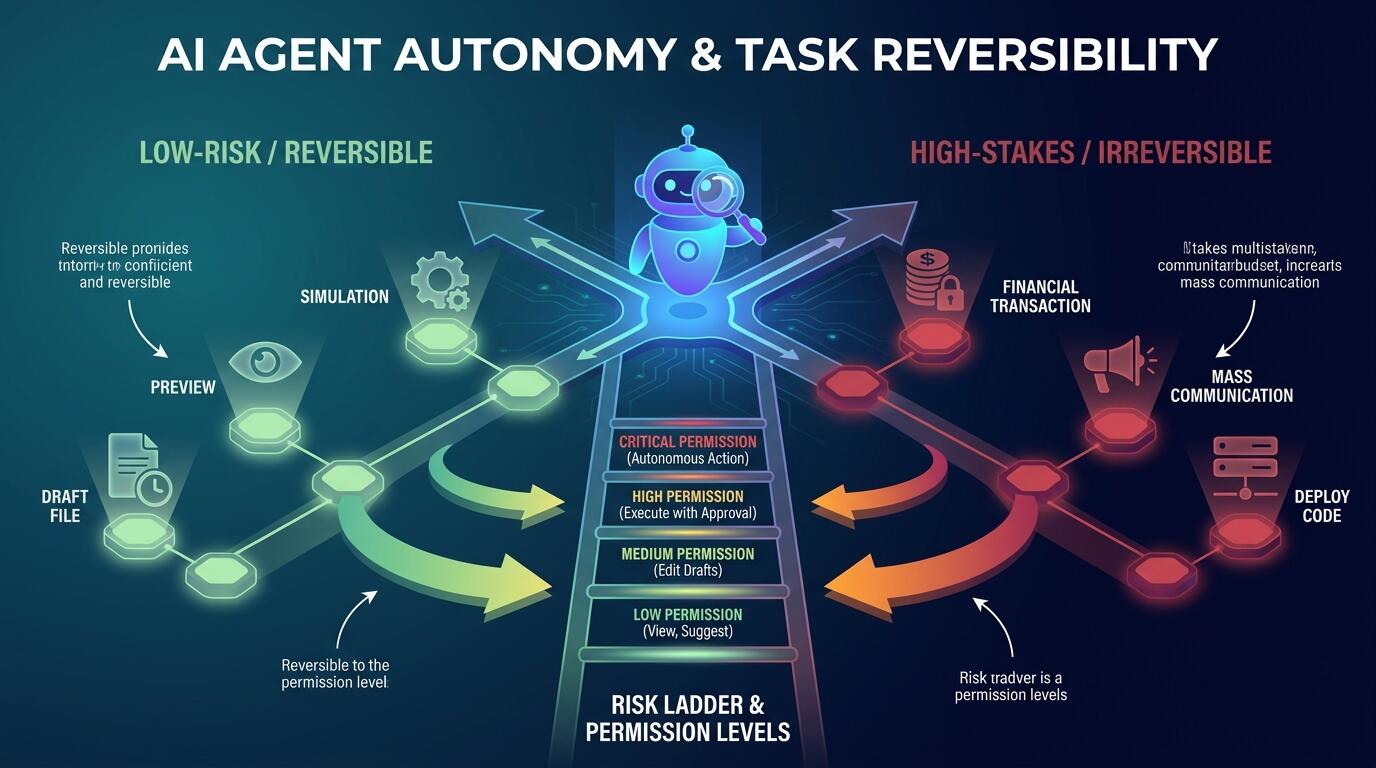
ALT: AI agent autonomy scaled by task reversibility — a framework for safe, effective autonomous systems
The Problem With Giving Agents Full Control From the Start
You ship an AI agent that can reschedule meetings, send emails, and reorganize a project board. Within hours, it has reorganized an entire client's folder structure, sent a draft email to a live distribution list, and deleted what it classified as "duplicate" calendar events — some of which were not duplicates at all. No single decision looked obviously wrong in isolation. The cascade, however, was a mess you spent the better part of a day cleaning up.
This scenario is not hypothetical. It is a pattern that emerges repeatedly across teams building AI agents in production, including in the systems we run at Darius. The core failure is not a model failure. It is a design failure: the system granted the same level of autonomy to actions with radically different blast radii. Renaming a draft file and sending a message to a thousand people are not equivalent operations, and an autonomous agent must not treat them as such.
The principle that fixes this is straightforward to state and surprisingly easy to implement poorly: agent autonomy should scale with task reversibility. The less reversible an action, the more human oversight — or at minimum, explicit confirmation — the agent should require before proceeding.
Why Reversibility Has Become the Central Design Axis for Autonomous AI Systems
Agent autonomy is the degree to which an AI system can select and execute actions without human input at each step. Reversibility is the property of an action that determines whether it can be undone completely, partially, or not at all. The intersection of these two properties is where most agentic system failures live.
Until recently, most AI deployments were effectively read-only: the model would generate a response, a human would decide what to do with it. The model had no agency because it had no ability to act on the world directly. That has changed sharply. Modern agent frameworks now give language models tool-use capabilities — they can call APIs, write to databases, send communications, execute code, and trigger financial transactions. The autonomy is real, and so are the consequences.
The industry has not caught up with this shift at the design-principle level. Most teams are still borrowing mental models from traditional automation: if the logic is correct, let it run. But agent behavior is probabilistic, not deterministic. A rule-based automation that renames files according to a fixed schema will behave the same way on every run. An agent interpreting a natural-language instruction about "cleaning up old files" has genuine latitude in what it chooses to delete — and that latitude is the source of risk.
What has emerged in engineering practice, documented in discussions across the AI infrastructure community, is a growing recognition that autonomy must be earned incrementally, and that reversibility is the clearest axis along which to calibrate it. This is not a theoretical argument. It is the practical consequence of running agents against live systems and watching what breaks.
The Mechanism: How Reversibility Should Govern Autonomy Allocation
Agent autonomy allocation is best understood as a risk-management decision made at design time, not a capability question. The question is not "can this agent handle this task?" but "what is the cost of an incorrect action, and can we recover from it?"
Defining the Reversibility Spectrum
Reversibility exists on a spectrum, not a binary. At one end are fully reversible actions: creating a draft, generating a preview, writing to a staging environment, or flagging an item for review. These can be undone with no lasting consequence. In the middle are partially reversible actions: moving a file (recoverable from trash for some window of time), sending a message to a small internal group (retractable via follow-up), or modifying a database row with a retained change history. At the far end are irreversible actions: sending a public announcement, executing a financial transfer, permanently deleting records, or triggering a webhook that fires downstream processes.
Most real agent workflows contain actions from all three zones. The design mistake is treating them uniformly.
The Autonomy Ladder
A useful mental model is what practitioners sometimes call the autonomy ladder — a set of escalating permission levels tied directly to reversibility class:
- Full autonomy: Agent acts, logs, and continues. Reserved for fully reversible actions where the cost of a mistake is near zero.
- Asynchronous review: Agent acts, flags for human review, and continues to the next step. Appropriate for partially reversible actions where a short review window exists.
- Synchronous confirmation: Agent pauses, presents its proposed action, and waits for explicit approval. Required for irreversible or high-consequence actions.
- Escalation: Agent surfaces a decision it cannot confidently classify and requests human judgment before forming any plan.
The key insight is that these are not quality levels — a "better" agent does not operate exclusively at full autonomy. A well-designed agent moves fluidly between levels depending on what it is about to do next.
Why Context Shifts the Reversibility Assessment
Reversibility is not a static property of an action type — it is also a function of context. Sending a Slack message to a private channel in a test workspace is trivially reversible. Sending the same message type to a customer-facing channel during an active incident is not. A well-designed agent must evaluate reversibility in context, not just by action category.
This contextual assessment is one of the places where agent design gets genuinely hard. It requires the system to maintain a representation of its operating environment — which workspace it is in, who the recipients are, what the current system state is — and to factor that into its autonomy-level selection. Teams that skip this step and classify actions purely by type end up with agents that behave safely in testing and dangerously in production, often for the same nominal action. This is closely related to challenges we document in failure modes of AI drafting pipelines, where contextual misclassification is a frequent root cause of downstream errors.
The Compounding Risk of Sequential Irreversibility
One of the most dangerous failure modes in agentic systems is what might be called sequential irreversibility: a chain of individually low-risk actions that, in combination, produce an irreversible outcome. Each step looks safe in isolation. The agent reorganizes a folder (reversible), renames files according to a new schema (reversible), and then an automated downstream sync picks up those renamed files and overwrites the remote backup with the new names (irreversible). No single action in the agent's plan was flagged as high-risk. The compound effect was catastrophic.
Designing against this requires tracking state across the action sequence, not evaluating each action in isolation. The autonomy level for a given action should account for what that action enables downstream — not just its immediate reversibility.
Evidence and Competing Approaches: How Teams Are Handling This Today
The principle of scaling autonomy with reversibility is gaining traction, but implementation approaches vary significantly. A comparison of the dominant approaches reveals meaningful trade-offs:
| Perspective / Approach | Strengths | Trade-offs | Best Fit |
|---|---|---|---|
| Flat autonomy (full auto by default) | Fast execution, minimal friction | High blast radius on mistakes; difficult to audit or recover | Narrow, well-bounded tasks in sandboxed environments |
| Rule-based action gating | Predictable, auditable, easy to reason about | Brittle at edge cases; hard to maintain as action space grows | Teams with stable, well-defined action catalogs |
| Reversibility-scaled autonomy | Proportionate risk control; adapts to context | Requires robust action classification and state tracking | Production agents with diverse action types |
| Human-in-the-loop (always) | Maximum safety | Defeats the purpose of autonomy; poor UX at scale | High-stakes regulatory contexts with low action volume |
| Confidence-threshold gating | Dynamic; can incorporate model uncertainty | Model self-assessment is unreliable; false confidence is a known failure mode | Experimental setups with human fallback |
The reversibility-scaled approach is not without implementation costs. Classifying actions correctly requires deliberate taxonomy work. Maintaining context across a multi-step plan adds engineering overhead. And the system needs a coherent way to surface confirmation requests to users without creating so much friction that the agent becomes useless.
A pattern we consistently see in teams that succeed at this: they start by mapping their action space explicitly — every API call, every write operation, every external communication — and assigning each a reversibility class before writing any agent logic. This taxonomy becomes the foundation of the gating system, and it makes the subsequent implementation significantly more tractable. The approach also connects naturally to how you structure editorial rules for agents — specificity at the rule level prevents ambiguity at the execution level.
The industry-level discourse, documented in sources including the LinkedIn analysis by Edward Clark on autonomous infrastructure and the Meléndez piece on autonomy versus authority in AI agents, consistently lands on the same conclusion: autonomy without authority boundaries is not a feature; it is a liability. The question is not whether to constrain autonomy, but how to constrain it in ways that preserve utility.
Where This Principle Is Heading and What It Means for Your Architecture
Reversibility-scaled autonomy is not a temporary workaround for immature models. It is a durable design principle that will become more important, not less, as agents take on more consequential tasks.
Several directions are shaping how this plays out in practice. First, agent frameworks are beginning to expose native action-classification hooks — the ability to annotate tool definitions with metadata about reversibility, cost, and required confirmation level. Teams that design their action catalogs with this metadata from the start will be able to adopt these framework features without a painful retrofit.
Second, regulatory and compliance pressure is moving toward explicit audit requirements for autonomous AI actions. This makes the logging and confirmation trail that reversibility-gating produces not just good engineering practice but a compliance artifact. Teams building for enterprise contexts should treat every synchronous confirmation event as a record, not just a UX moment.
Third, the trust model for agents is shifting. Early deployments focused on capability — can the agent do the task? The next phase of deployment focuses on predictability — can the operator rely on the agent to behave safely at the boundary of its authorization? Reversibility-scaled autonomy is a concrete answer to the predictability question because it makes the agent's decision boundary legible to the humans responsible for it.
For teams currently designing or scaling agentic systems, the actionable implications are:
- Audit your action catalog and assign reversibility classes before you write gating logic. The taxonomy is the hard part; the implementation follows from it.
- Instrument every autonomy-level transition. If your agent silently decides not to confirm an action it previously would have confirmed, you need to know.
- Design your confirmation UX as a first-class surface, not an afterthought. If users start clicking through confirmation prompts without reading them, the gating provides false safety.
- Test specifically for sequential irreversibility by running integration tests that chain actions and check compound outcomes, not just individual action correctness.
- Revisit your reversibility classifications as your production environment changes. Context shift can move an action from reversible to irreversible without any change to the action itself.
If you want a concrete example of how this kind of principled design applies to a real production system, the agent pipeline behind a daily AI briefing is a useful reference — it illustrates how retrieval, verification, and publication steps each require different autonomy levels precisely because their reversibility properties differ.
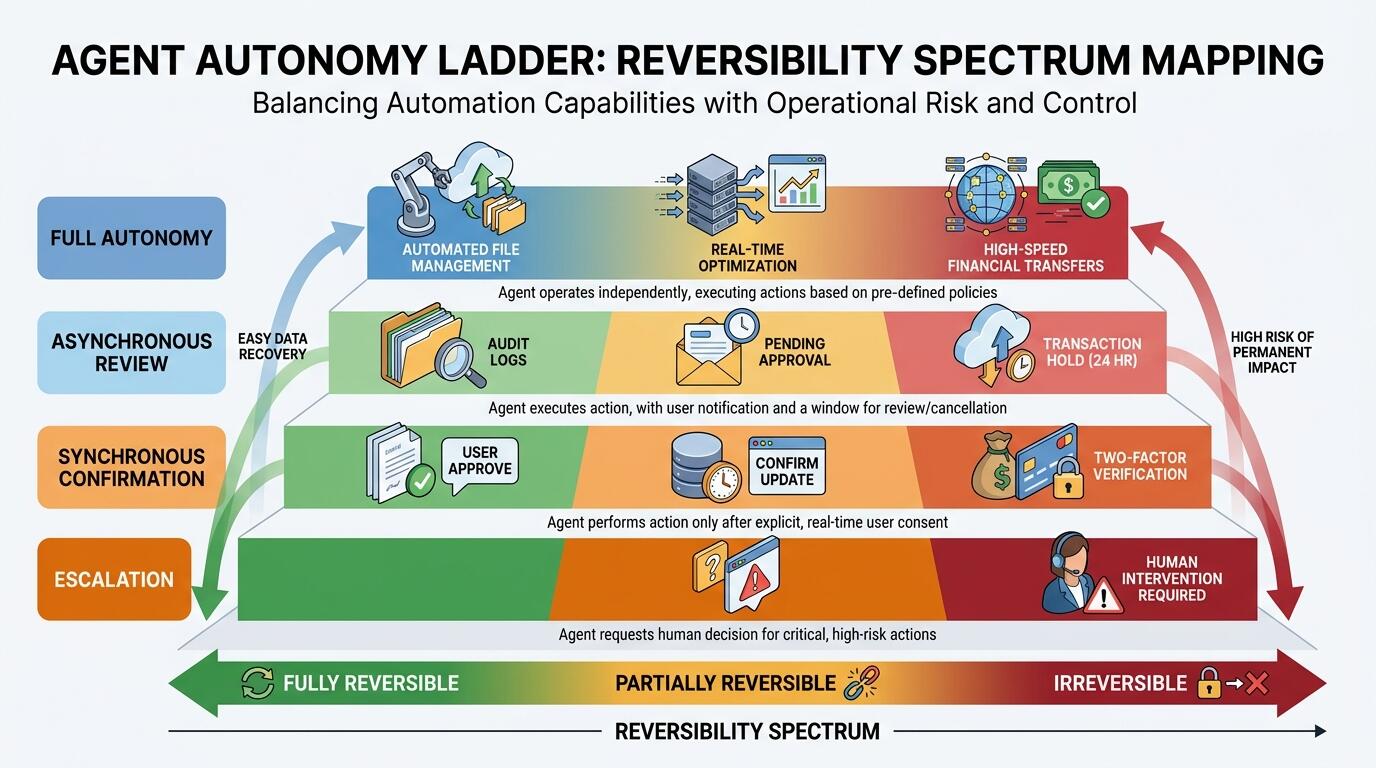
ALT: Diagram showing agent autonomy levels mapped to reversibility spectrum from fully reversible drafts to irreversible external communications and financial actions
Questions & Answers
Q1: How do you practically classify an action's reversibility before building the gating logic?
Start by documenting every action in your agent's tool catalog and answering three questions for each: Can this action be undone completely with no external consequence? If not, how long is the recovery window, and what does recovery require? Does this action trigger downstream processes you do not control? Use the answers to assign each action to a reversibility class — fully reversible, partially reversible, or irreversible — and treat that classification as a first-class design artifact that must be reviewed whenever the tool catalog changes.
Q2: Is reversibility-scaled autonomy compatible with high-throughput agent workflows where human confirmation adds latency?
Yes, with careful design. The key is reserving synchronous confirmation only for genuinely irreversible actions, which in most workflows are a small fraction of total operations. Fully reversible actions run at full autonomy with no latency cost. Partially reversible actions can use asynchronous review — the agent logs the action and continues, and a human can intervene within a defined window. Only the small subset of irreversible actions requires a pause. In practice, this means the overhead is proportionate to actual risk, not uniformly applied across all operations.
Q3: How much engineering overhead does implementing reversibility-scaled gating actually add to an agent project?
The taxonomy and classification work is front-loaded and typically takes meaningful time to do rigorously — but it pays back quickly in reduced incident response time and simpler debugging when things go wrong. The gating logic itself is usually modest: a middleware layer that checks reversibility class before executing each tool call, and routes accordingly. The ongoing cost is maintaining the classification taxonomy as the action catalog evolves. Teams that treat this as a living document rather than a one-time exercise find the maintenance burden manageable and the safety benefits compounding over time.
Wrapping Up
Agent autonomy is not a dial you turn up as models get better. It is a property you allocate deliberately, action by action, based on the consequences of being wrong. The reversibility of a task is the clearest signal available for making that allocation.
Key Takeaways:
- Reversibility is a spectrum, not a binary — design your autonomy levels to match the full range, not just the extremes.
- Sequential irreversibility is a distinct and underappreciated failure mode — chain-level risk can exceed the sum of step-level risks.
- Action classification is the hard part — invest in the taxonomy before building the gating logic, and you will save significant debugging time.
- Confirmation UX is a safety system, not a formality — if users stop reading confirmation prompts, the gating is providing false assurance.
- Context shifts reversibility — the same action type can move between risk classes depending on the operating environment, and your agent must account for this.
The practical next step for most teams is an action catalog audit: list every tool your agent can invoke, classify each by reversibility, and check whether your current autonomy model is actually calibrated to those classifications. Most teams discover mismatches quickly — and fixing them is straightforward once the taxonomy exists.
If you are building or operating AI products and want concise, technically grounded intelligence on exactly this kind of design decision, subscribe to Darius — each issue covers five to ten AI developments with primary sources and production-system context, so every item connects directly to your next engineering decision.
References & Further Reading
- CodeByMeléndez. "AI Agent Autonomy vs. Authority: The Missing Principle".
https://codebymelendez.com/en/insights/autonomia-vs-autoridad-agentes-ia - Clark, Edward. "Autonomy in AI Requires Deliberate Infrastructure". LinkedIn.
https://www.linkedin.com/posts/edwardclark_lets-give-the-ai-agent-full-autonomy-and-activity-7506759309406584832-LCOg - Rewirenow. "Beyond automation: how AI agents learn, plan, and earn trust".
https://rewirenow.com/en/resources/blog/beyond-automation-how-ai-agents-learn-plan-and-earn-trust/ - IEEE. "Standards for Autonomous and Intelligent Systems".
https://www.ieee.org/ - National Institute of Standards and Technology (NIST). "AI Risk Management Framework".
https://www.nist.gov/
Note: Standards and frameworks may be updated; please check the latest official documents or consult professional advisors.