Open models
Open weights, licenses and small models you can run locally. Every brief item about Open models, newest first, each with its primary source.
Timeline 92 items
-
Oct 12 · Mon · 3 items
- Open source huggingface.co ↗Qwen releases Qwen-Image-2.1-Turbo weights: a 7B image model that generates in 8 steps, under a research license
Take · Eight steps means far faster generation on the same GPU, so a backend like PandaClaws that produces and edits covers in bulk is a good place to test its speed and quality. But it ships under a research license, not Apache 2.0: have someone read the terms before production, and don’t assume downloadable weights mean commercial use is allowed.
From the Oct 12 brief · item 01 → - Open source huggingface.co ↗Tencent releases Youtu-Parsing-Omni, a 5B omni-modal parsing model scoring 96.96 overall on OmniDocBench v1.6
Take · File understanding in my AI Cloud Drive runs as separate pipelines per format, so one 5B model that takes PDFs, screenshots, audio and video is worth a comparison on real user files, tested alongside LightOnOCR-3 from 10-09. It has a custom license, so confirm commercial use first.
From the Oct 12 brief · item 02 → - Open source huggingface.co ↗Amazon releases Strands decider models in 2B, 12B and 26B-A4B sizes under Apache 2.0
Take · Liquid AI, Cloudflare and now Amazon have shipped decision models within a week, so the category is real. For agent calls like which tool to use, whether arguments are valid and whether to block, I’d try the 2B version on routing in AI Interview first and, as the card advises, set confidence thresholds from my own traffic; the local server has no auth, so don’t expose it beyond the machine.
From the Oct 12 brief · item 03 →
-
-
Oct 11 · Sun · 1 item
- Open source blog.cloudflare.com ↗Cloudflare open-sources Clef-omni, a multimodal decision model, and cuts Clef-flash input from $0.09 to $0.038 per million tokens
Take · Read alongside Liquid AI’s d1 from 10-09, decision models are becoming a category of their own: moderation, classification and routing only need one answer picked, not a generative model. I’d run a comparison with Clef-omni for image and video moderation in PandaClaws; anyone on Clef-flash should note the context is now 24k.
From the Oct 11 brief · item 05 →
-
-
Oct 10 · Sat · 1 item
- Open source developers.googleblog.com ↗Google open-sources ML Drift, its on-device GPU inference engine, under Apache 2.0, with up to 12% lower memory overhead for Gemma
Take · Paired with EmbeddingGemma 2 from 10-07, on-device semantic search now has both the model and the engine. Products like AI Cloud Drive can trial local embedding on the web via WebGPU and keep privacy-sensitive files on the user's device; projects still on the TFLite GPU delegate should schedule a migration.
From the Oct 10 brief · item 06 →
-
-
Oct 9 · Fri · 3 items
- Open source huggingface.co ↗LightOn open-sources LightOnOCR-3 in 0.8B, 1B and 4B sizes under Apache 2.0, scoring up to 86.3 on olmOCR-Bench
Take · The 0.8B is less than a point behind the 4B, which makes it attractive for document parsing in AI Cloud Drive: I'll run a comparison on the scans and table-heavy PDFs users upload most, to see whether some parsing can move from a cloud API onto our own machines.
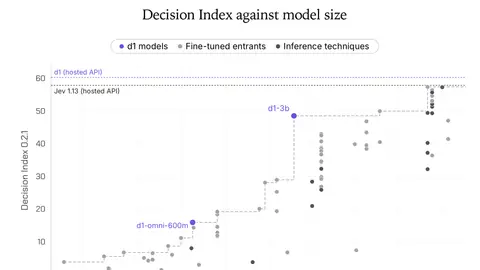
From the Oct 9 brief · item 06 → - Open source huggingface.co ↗Liquid AI releases open d1 decision models: d1-3B answers in one forward pass, 8 ms per question on an RTX 4090
Take · Yes-or-no calls like moderation, routing or whether to hand off to a human don't need a generative model every time. I'll try d1-3B on PandaClaws' pre-publish compliance checks, but only as an evaluation until the license is clear.
From the Oct 9 brief · item 07 → - Research huggingface.co ↗NVIDIA fine-tunes Nemotron to gold-level IOI 2026 (535.4/600) and IMO 2026 (30/42) results, releasing weights and training data
Take · Most teams won't run a 550B model; the part worth taking is the method: on IOI 2025 the Nano model (30B total, 3B active) went from 280 after SFT to 468 with test-time strategies like GenCorrect. If you build coding products, try a generate-then-self-correct layer on your own eval set first.
From the Oct 9 brief · item 08 →
-
-
Oct 7 · Wed · 2 items
- Model release mistral.ai ↗Mistral Large 4 enters public preview: 1T total, 49B active, $1.36 per million input tokens, weights by month end
Take · At $1.36 in and $4.18 out, it's worth running PandaClaws' long-form generation and multilingual rewriting against it. But this is a preview with no weights or license yet, so I'd benchmark it on my own eval set through the API now and only weigh self-hosting once the weights and license terms land at month end.
From the Oct 7 brief · item 01 → - Open source developers.googleblog.com ↗Google open-sources EmbeddingGemma 2: a 270M-to-740M multimodal embedding model, 14% better on code retrieval, Apache 2.0
Take · This one maps straight onto my AI Cloud Drive: with images, video, recordings and documents in one vector space, a single query can search across file types without a separate model per format. I'd swap the 270M text version in against my current embedder first, then load the vision module as needed; truncating to 128 dimensions cuts index storage, but measure the recall loss on your own retrieval set first.
From the Oct 7 brief · item 02 →
-
-
Oct 6 · Tue · 1 item
- Open source huggingface.co ↗Aleph Alpha open-sources Kolibri: a 78B MoE with 3.46B active per token, validated to 1M-token context, Apache 2.0
Take · About 3B active per token, one GPU, Apache 2.0: this is the shape of model that suits privately deployed long-document Q&A like my AI Cloud Drive. But it only covers German and English, so don't drop it into Chinese workloads; what I want from it is a real throughput number for sliding-window attention plus long context on my own hardware before choosing the next self-hosted model.
From the Oct 6 brief · item 01 →
-
-
Oct 5 · Mon · 1 item
- Open source huggingface.co ↗Ai2 open-sources AstaBrief 8B, which writes a cited research report in one pass, about 3.5x faster than its Claude-powered mode
Take · Retrieve-then-write-a-cited-answer is the most common request in my AI Cloud Drive's document Q&A. An 8B model that does it in one call means private deployment and a much lower bill. I'll compare citation accuracy on my own documents before replacing the large-model call.
From the Oct 5 brief · item 02 →
-