Google pairs Gemini 4 Argon with the Z3 constraint solver to find Go bounds panics: all three planted bugs found plus three latent ones, two of which fuzzing missed
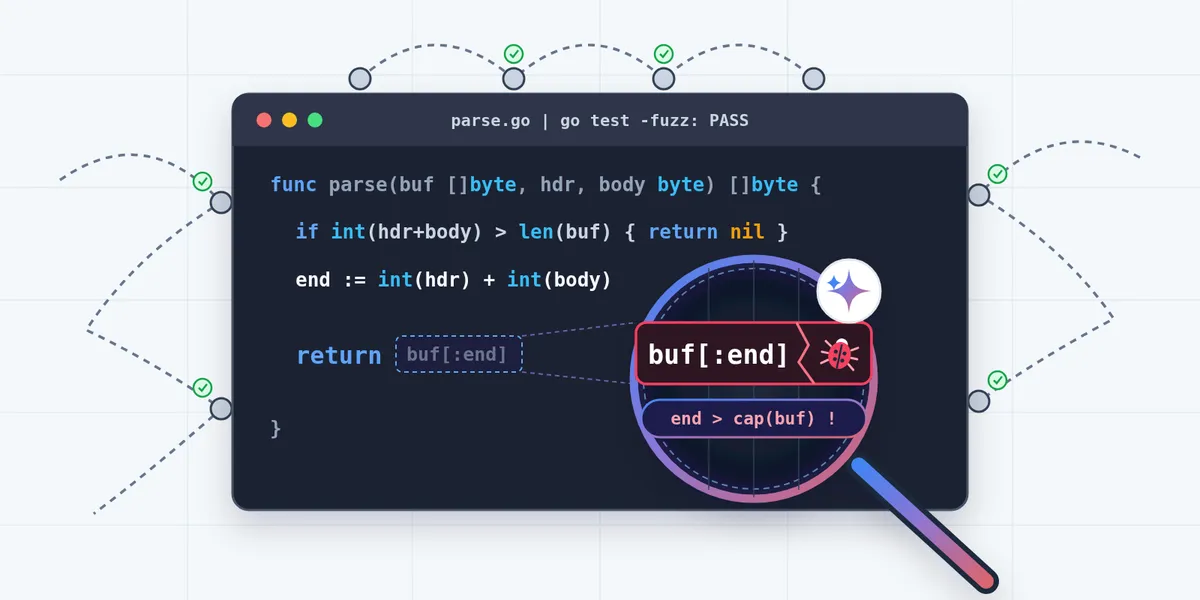
A practical take on lightweight formal methods: have the model turn the bounds checks the compiler leaves behind into solver constraints, then reproduce with go test.
// Key points
- Go's SSA prove pass first removes bounds checks it can prove safe; only the surviving runtime.panicBounds traps, with the disassembly, go to Argon, which writes a Z3 script for each.
- When Z3 returns sat it yields concrete input bytes that go test replays; any panic is a real bug regardless of whether the model's encoding was sound. An unsat result only means maybe correct.
- It takes about a minute per function, dominated by Argon's translation, with Z3 itself finishing in milliseconds; it found three latent bugs in skill-lint.
- Unseeded go test -fuzz missed two of the three planted crashes across repeated 60-second runs.
Builder's takeThe appeal is that every finding is real, so false positives cost almost nothing, which makes it a good CI complement to fuzzing. Our upload and parsing services in Go are exactly where these bounds bugs live; I would start with a few parser functions, aiming not for proofs but only for real, reproducible crashes.
// Background · from #Coding agents
Full timeline →- Nov 13 Google releases Gemini 4 Hydrogen at $1.50 input and $7.50 output per million tokens, scoring 51 on the Artificial Analysis Intelligence Index, just above Argon's 50
- Nov 13 AWS publishes an enterprise rollout guide for Codex on Amazon Bedrock: sign in through IAM Identity Center and call GPT-5.6 Sol, Terra or Luna on Bedrock
- Nov 12 AWS releases AWS Emulator: SDK and CLI calls return locally in milliseconds with no AWS account needed, with source published under CC0