What a Technical Co-Founder Actually Contributes Beyond Coding
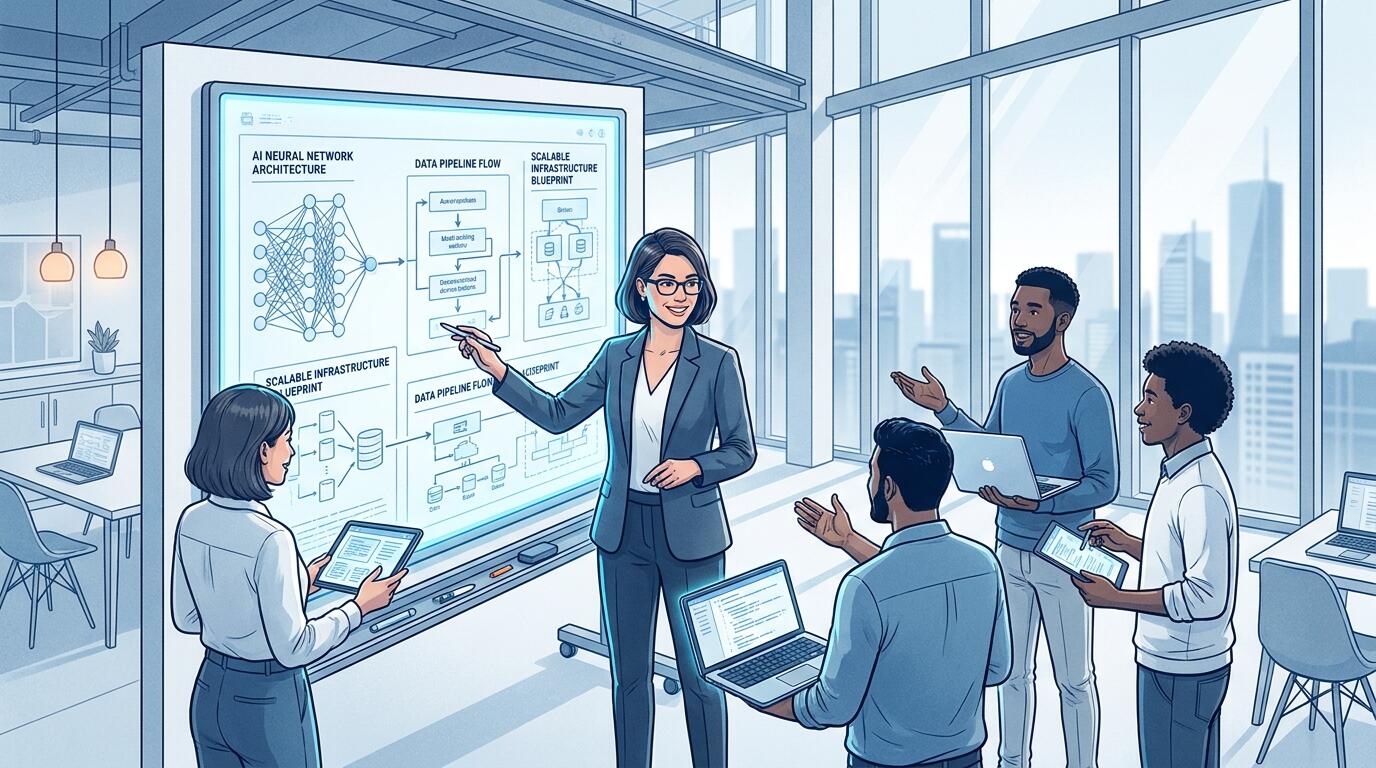
ALT: Technical co-founder contributing beyond coding with AI architecture and systems design leadership
What Founders Get Wrong About Technical Co-Founders
Most founders searching for a technical co-founder are looking for someone who can write code. That instinct is understandable — visible output feels measurable, and shipping a working prototype feels like proof of value. But in practice, the founders who build durable, scalable products quickly learn that the code itself is rarely where the leverage lives.
A technical co-founder is an executive-level partner who shapes how a company thinks about, builds, and scales technology — from early architecture decisions to team structure to the systems that hold everything together under real-world load. The coding is almost incidental to that role.
This article breaks down the specific, often invisible contributions that a technical co-founder makes beyond writing software. Each item was selected because it represents a recurring gap we see between startups that ship confidently and those that stall, rebuild, or burn through engineering budgets on avoidable rework. If you are a founder evaluating a technical partner, a CTO clarifying your own mandate, or an engineering leader stepping into a co-founder role, this list will help you name and communicate the full scope of what genuine technical leadership delivers.
The Core Contributions: What Technical Leadership Actually Looks Like
Architectural Decision-Making That Survives Growth
Architectural decision-making is the practice of choosing how a system is structured so that it can evolve without constant rework — and it is one of the highest-leverage things a technical co-founder does. Early architecture choices determine whether a product can handle ten times the load without a full rewrite, whether new features take days or months to implement, and whether the engineering team stays productive as it grows.
A pattern we consistently see is that products built without deliberate architectural intent hit a wall early. The system works fine at low scale, then becomes increasingly expensive to change as complexity compounds. A technical co-founder who has shipped production systems recognizes these inflection points in advance and makes structural choices — around data models, service boundaries, API contracts, and deployment topology — that preserve optionality rather than closing it off.
For AI-powered products specifically, architecture carries additional weight. Decisions about where models sit in the stack, how inference is served, how data pipelines feed training and evaluation loops, and how the system degrades gracefully when a model returns unexpected output are all architectural concerns that cannot be patched in later without significant cost. Understanding how to design a scalable AI architecture for production is not a nice-to-have — it is the foundation everything else stands on.
Best for: Startups in early-to-mid stages where foundational decisions are still being made, or products approaching a scale threshold where the current architecture is showing strain.
Watch out: Good architectural thinking requires real context — a technical co-founder who designs in the abstract without understanding the business model, the user behavior, and the actual load profile will over-engineer in some places and under-invest in others.
Technology Strategy and Build-vs-Buy Judgment
Technology strategy is the ongoing discipline of deciding which tools, platforms, and infrastructure components a company builds itself versus buys, integrates, or operates as managed services — and a skilled technical co-founder is the person who keeps this judgment calibrated as the business evolves.
Every build-vs-buy decision carries an ROI calculation, even if it is rarely made explicit. Building in-house gives control and differentiation but costs engineering time and ongoing maintenance. Buying or integrating third-party services reduces upfront effort but introduces vendor dependencies, cost structures that may not scale, and constraints on how the product can evolve. A technical co-founder who has operated at the intersection of business and engineering knows how to make these trade-offs consciously rather than by habit or convenience.
In our work with clients on AI-powered products, this judgment surfaces constantly — around LLM providers, vector databases, observability tooling, authentication layers, and data infrastructure. The right call in one context is wrong in another, and the difference often comes down to where the product's actual differentiation lies. Spending engineering effort on infrastructure that a vendor already does well is a form of waste; building something proprietary on top of commodity infrastructure is often where the value lives.
Best for: Any startup with limited engineering bandwidth where every hour of engineering work needs to be pointed at the right problem.
Watch out: This judgment degrades quickly if the technical co-founder loses touch with the current vendor landscape. Keeping it sharp requires active engagement with what is available, what has changed, and what peers in adjacent spaces are actually using.
Hiring, Team Design, and Engineering Culture
A technical co-founder is responsible for building the team that builds the product — and team design is a compounding investment. The engineers a company hires early, the practices it instills, and the culture it establishes around code quality, system ownership, and technical communication create the conditions for everything that follows.
According to research by the National Bureau of Economic Research on startup team composition, the quality and alignment of early technical hires has a measurable effect on a company's trajectory that persists well beyond the founding stage. A technical co-founder who hires well, onboards thoughtfully, and creates an environment where engineers do their best work is generating a return on every dollar of salary the company spends.
This contribution is easy to undervalue because it does not produce a visible artifact. But the engineering culture a technical co-founder establishes — around how decisions get made, how technical debt is managed, how disagreements are resolved, how new systems get documented — determines whether the team stays effective under pressure or becomes a source of friction and attrition.
Best for: Companies moving from solo or small technical teams toward a multi-engineer organization where culture and practices need to be intentional.
Watch out: Engineering culture is fragile and path-dependent. A technical co-founder who is excellent individually but does not invest in team health will create a bus-factor problem and a retention challenge as the company scales.
Risk Identification and Technical Due Diligence
A technical co-founder serves as an early-warning system for the company, identifying technical risks — in the product, the infrastructure, and the external dependencies — before they become costly incidents or blockers.
Risk identification in a technical context covers a wide range: security vulnerabilities in a system design, data pipeline fragility that could corrupt model outputs, single points of failure in critical infrastructure, compliance gaps in how data is stored and processed, and third-party dependencies that could change pricing or availability without notice. A practitioner who has shipped production systems has a calibrated sense for which risks are theoretical and which are the ones that tend to actually cause problems at scale.
This contribution also extends to vendor and partner due diligence. When a startup is evaluating an infrastructure provider, a data partner, or an acquisition target, having a technical co-founder who can assess the actual quality and maintainability of a system — beyond what a pitch deck claims — is a significant strategic asset. According to the IEEE, software systems that lack documented architecture and test coverage carry substantially higher long-term maintenance costs, and a technical co-founder with due diligence experience knows exactly what to look for.
Best for: Startups handling sensitive data, operating in regulated industries, or relying on third-party technical components in their critical path.
Watch out: Risk identification without risk prioritization is noise. The contribution is most valuable when the technical co-founder can distinguish between risks that need immediate action and those that are acceptable to carry for now.
Product-Technology Alignment and Roadmap Shaping
A technical co-founder translates business goals into engineering priorities — and does so in both directions, ensuring that product decisions are grounded in technical reality and that technical investments are pointed at genuine business leverage.
A pattern we consistently see in early-stage companies is a growing gap between the product roadmap and the engineering team's actual work. Product owners prioritize features; engineers deal with the underlying complexity those features create. Without someone who genuinely understands both domains, this gap produces missed timelines, scope conflicts, and decisions made with incomplete information on both sides.
A technical co-founder bridges this gap by participating in roadmap planning with an understanding of what things actually cost to build, what the downstream consequences of different approaches are, and where technical investment now will unblock future product velocity. This is not about slowing product down for engineering convenience — it is about making product decisions with full information so that speed does not come at the cost of stability or compounding debt.
Best for: Product-led companies where engineering capacity is the constraint and sequencing decisions carry significant strategic weight.
Watch out: A technical co-founder who defaults to "we can build anything" without surfacing the real cost and trade-offs is not serving the product function — they are deferring a reckoning that will arrive later and more expensively.
Execution Leadership from Idea to Live Product
A technical co-founder is responsible for taking an idea from concept to a running, production-ready system — and that journey involves far more than development. It involves defining what "done" means, coordinating deployment infrastructure, establishing monitoring and alerting, managing the transition from development to production, and ensuring the system behaves correctly under real conditions.
This end-to-end delivery capability is what distinguishes a technical co-founder from a senior engineer. The ability to ship a live product rapidly without sacrificing system integrity is a practiced skill — it requires judgment about what to build fully and what to stub, how to manage incremental deployment risk, and how to run a team under the time and resource constraints that early-stage companies operate under.
In practice, execution leadership means making dozens of small decisions well under uncertainty: when to refactor versus when to ship, how to sequence delivery to create value early, how to keep a team aligned and unblocked when requirements are still evolving. These decisions compound into either a culture of confident delivery or a culture of chronic delay, and the technical co-founder sets that pattern.
Best for: Any company at the moment of transitioning from prototype to production, or scaling a system that was built under early-stage constraints.
Watch out: Execution speed without quality discipline creates technical debt that eventually taxes every future sprint. The best technical co-founders maintain a minimum quality floor even when moving fast.
Investor and Stakeholder Communication on Technical Matters
A technical co-founder is the company's credibility anchor on technical matters in investor conversations, board discussions, and enterprise sales processes. This is a contribution that is easy to overlook until the moment it is needed — and then it is often decisive.
Investors evaluating technical products are assessing the team's ability to build what they claim they can build, anticipate the problems that will arise, and make sound decisions under uncertainty. A technical co-founder who can speak clearly and confidently about system design, AI architecture, scaling strategy, and technical risk management projects the kind of competence that accelerates trust and shortens diligence cycles.
This communication function is also internal. A technical co-founder who can translate complex engineering realities into language that non-technical co-founders, board members, and investors can understand creates alignment and reduces the friction that often builds between technical and business stakeholders in growing companies.
Best for: Any company at a fundraising stage, in a complex enterprise sales process, or operating with a mixed technical and non-technical founding team.
Watch out: Technical credibility in investor conversations is undermined quickly by overclaiming or by inability to answer follow-on questions with specificity. The contribution is built on genuine depth, not polished presentation.
AI and Emerging Technology Evaluation
A technical co-founder is the person responsible for evaluating whether and how emerging technologies — particularly in AI — should be incorporated into the product, and for making those integration decisions in a way that creates genuine value rather than technical noise.
The current landscape of AI tooling, foundation models, and infrastructure is evolving at a pace that makes this evaluation function genuinely demanding. According to the Association for Computing Machinery (ACM), the gap between AI research capability and production-ready deployment continues to narrow, but the implementation challenges — around reliability, latency, cost, and safety — remain substantial. A technical co-founder with hands-on experience shipping AI systems understands these gaps from direct experience, not from reading about them.
This evaluation function extends to knowing when not to use a new technology. A pattern we consistently see is companies adding AI features because of market pressure rather than because those features solve a real user problem well. A technical co-founder with good judgment can distinguish between AI integration that creates durable product value and AI integration that creates complexity without commensurate return.
Best for: Products where AI is central to the value proposition, or where AI capabilities are being considered as a product enhancement.
Watch out: Technology evaluation is only valuable if it leads to a decision. A technical co-founder who can evaluate without committing — who always finds reasons to wait for the technology to mature — is not serving the company's need to move.
Quick Comparison at a Glance
| Contribution | Best For | Key Strength | Limitation |
|---|---|---|---|
| Architectural Decision-Making | Early-stage and scaling products | Prevents expensive rewrites, preserves optionality | Requires deep business context to avoid over-engineering |
| Technology Strategy and Build-vs-Buy | Resource-constrained engineering teams | Maximizes ROI on engineering spend | Judgment degrades without active engagement with vendor landscape |
| Hiring, Team Design, and Culture | Companies growing from solo to multi-engineer | Compounds value across every engineering hire | Difficult to correct if poor culture is established early |
| Risk Identification and Due Diligence | Regulated industries, data-sensitive products | Catches costly problems before they materialize | Risk identification without prioritization becomes noise |
| Product-Technology Alignment | Product-led companies with constrained capacity | Keeps product decisions grounded in real cost and trade-offs | Can slow product velocity if not balanced with commercial urgency |
| Execution Leadership | Idea-to-production transitions | Delivers live, stable systems under startup constraints | Speed without quality discipline creates long-term debt |
| Investor and Stakeholder Communication | Fundraising, enterprise sales | Builds technical credibility quickly | Requires genuine depth — presentation alone does not hold up to scrutiny |
| AI and Emerging Technology Evaluation | AI-centric or AI-enhanced products | Distinguishes genuine value from technology noise | Can produce analysis paralysis if not paired with commitment |
How to Evaluate Whether Your Technical Co-Founder Is Delivering
The right technical co-founder is not defined by a single profile — the specific mix of contributions that matter most depends heavily on where the company is in its development and what its most pressing constraints are.
If you are pre-product, the highest-value contributions are architectural decision-making and execution leadership. The foundational choices being made right now will determine the cost of every feature and every scaling event that follows. A technical co-founder who can get a system to production cleanly and quickly, while making structural decisions that do not need to be undone later, is generating enormous compounding value.
If you are post-launch and growing, the center of gravity shifts toward team design, product-technology alignment, and risk management. The question is no longer whether you can build — it is whether you can build consistently, scale the team, and keep the system stable as load and complexity increase.
A common misconception is that a technical co-founder's value is proportional to how much they code personally. In early stages, hands-on coding is often appropriate and necessary. But as the company grows, the leverage shifts dramatically toward the decisions, structures, and team that the technical co-founder creates — not the code they personally write. A technical co-founder who does not make this transition becomes a bottleneck rather than a multiplier.
Founders evaluating a technical partner should look for evidence of shipped production systems, not just technical fluency. The ability to demonstrate end-to-end delivery — from architecture to live deployment — is the signal that distinguishes a practitioner from a theorist. For companies building at the intersection of AI and full-stack systems, this hands-on production track record is particularly important, because the challenges that arise in that space cannot be navigated from first principles alone.

ALT: Engineering leader and technical co-founder reviewing AI systems architecture and full-stack product delivery roadmap with founding team
Common Questions
Q1: How do you evaluate a technical co-founder's contribution if you are non-technical?
Evaluating a technical co-founder without a technical background is genuinely difficult, but there are practical signals. Focus on evidence of shipped production systems — live products you can examine — rather than credentials or code samples. Ask how they have made build-vs-buy decisions, how they have structured teams, and how they communicate technical trade-offs. A strong technical co-founder should be able to explain their reasoning clearly to a non-technical audience without losing accuracy or glossing over complexity.
Q2: Is architectural expertise more important than hands-on coding ability in a technical co-founder?
Both matter, but their relative importance shifts over time. In early stages, a technical co-founder who can both architect and execute personally — shipping working systems rapidly — is highly valuable. As the company scales, architectural judgment and the ability to lead and multiply a team become the dominant factors. According to the IEEE Software Engineering Body of Knowledge (SWEBOK), software architecture decisions made early in a system's lifecycle have disproportionate influence on long-term maintainability and cost, which is why architectural capability is a foundational requirement rather than a secondary one.
Q3: How long does it typically take a technical co-founder to deliver measurable value?
A technical co-founder operating at full effectiveness should deliver measurable structural value — a working production system, a clear technical roadmap, initial team design — within the first few months of engagement. The compounding benefits of good architectural decisions and team culture take longer to materialize, but the early signals of high-quality technical leadership are visible quickly: systems ship on time, decisions are made with clear reasoning, and the engineering team operates with confidence rather than chronic firefighting.
The Bottom Line
A technical co-founder's most important contributions are not lines of code — they are the decisions, structures, and team conditions that determine whether a company can build well, build fast, and build durably over time.
Three things define genuine technical co-founder value: first, architectural and strategic judgment that prevents expensive mistakes before they happen; second, execution capability that turns ideas into live, production-ready systems without unnecessary waste; and third, the ability to build and maintain the team and culture that carries the product forward as the company grows.
For founders evaluating a technical partner, the practical test is whether the person in front of you has tangible evidence of shipping production systems — not just designing them, not just advising on them, but actually delivering them under the constraints of real-world products. That practitioner-level track record is what separates a technical co-founder who multiplies your ability to build from one who adds complexity to it.
If the analysis above resonates with your situation — whether you are a founder looking for technical partnership, an engineering leader clarifying your strategic mandate, or a team preparing to build an AI-powered product — the next step is to find a partner who has operated at every layer of this stack.
Visit the Darius portfolio and technical insights hub to explore real shipped projects, architectural case studies, and practical guidance for building production-ready AI systems. Whether you are navigating your first launch or scaling an existing product, get in touch to explore how deep technical partnership can accelerate what you are building.
References
- National Bureau of Economic Research. "Founding Team Composition and Startup Performance".
https://www.nber.org - IEEE Computer Society. "Software Engineering Body of Knowledge (SWEBOK)".
https://www.ieee.org