Verifying Claims Against Primary Sources: A Practical Checklist
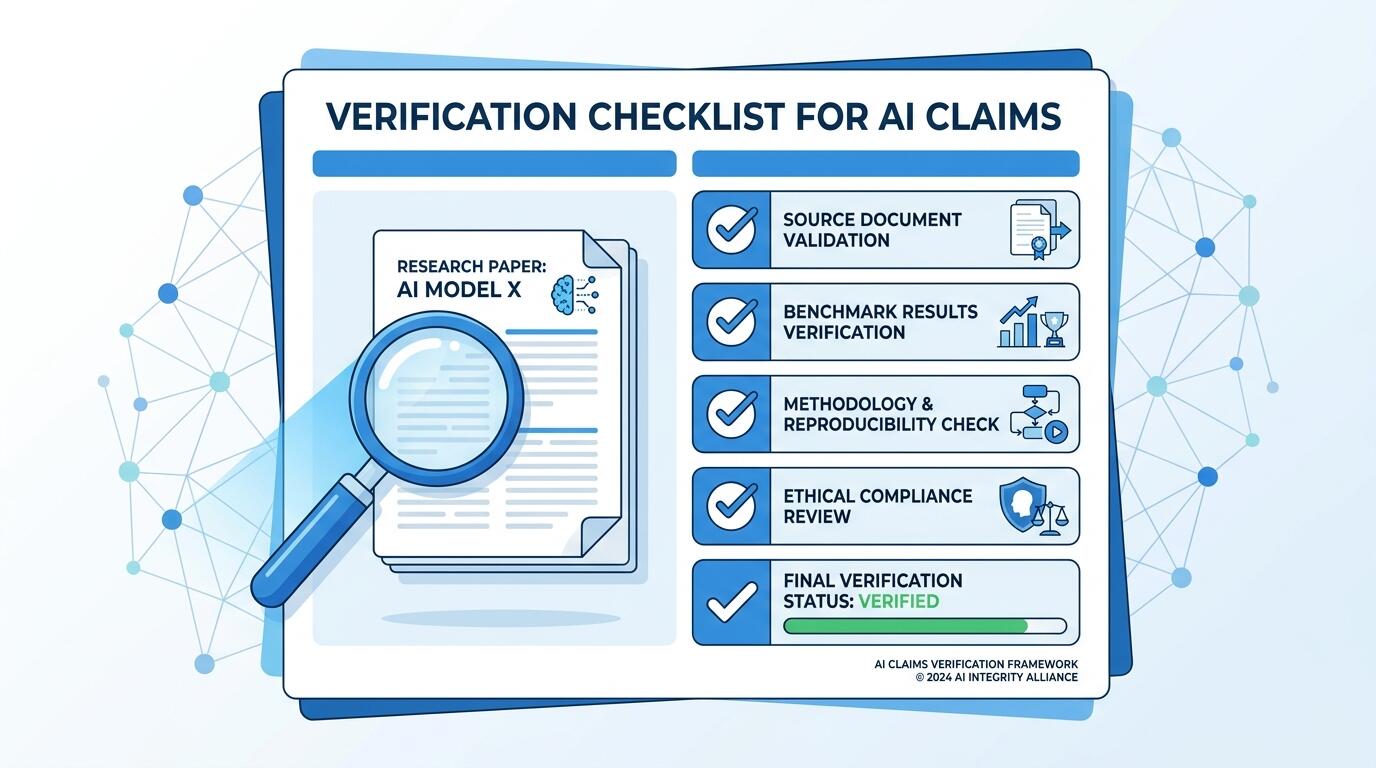
ALT: Practical checklist for verifying AI claims against primary sources before publishing or shipping
Why Every AI Builder Needs a Source Verification Checklist
The single most common question I get from engineers and product leads who follow AI news is: "How do you know if a claim about a new model, benchmark, or capability is actually true?" The honest answer is that most published AI claims — in blog posts, social media threads, even press releases — are not directly verifiable without tracing them back to a primary source. A primary source, in this context, is the original, firsthand record of a claim: the research paper, the official documentation, the raw benchmark result, or the company's direct statement — not a summary, a tweet about the paper, or a newsletter paraphrase of a tweet.
This checklist was assembled from a pattern I consistently see in production AI work. When a team ships a feature or makes an architectural decision based on a secondhand claim that turns out to be distorted, the cost is real — wasted engineering cycles, misaligned product roadmaps, or worse, misleading users. The items below are drawn from the verification discipline I apply every time I write for Darius, a bilingual AI briefing written by an engineering director actively running AI products in production. Each item is practical, sequenceable, and applies equally whether you are evaluating a vendor's capability claim, a benchmark result, or a research finding you plan to cite in a design document.
The list is organized roughly in the order you would use it — from initial triage to final cross-check — though each step can also stand alone when you only have time for a partial review.
The Verification Checklist: Eight Steps to Confirm Any AI Claim
Locate the Original Document, Not a Summary
The first step in verifying any claim is identifying whether what you are reading is the primary source or a derivative. A primary source is any document that reports original findings, decisions, or data directly from the people who produced them — a preprint, a technical report, an official changelog, a dataset card, or a company's own blog post authored by the team that ran the experiment. A secondary source is anything that describes or interprets those original documents: a news article, a newsletter summary, an analyst report, a social media thread.
Most AI misinformation travels through chains of secondhand paraphrase. One accurate paper becomes a slightly distorted blog post, which becomes a further compressed tweet, which becomes a bold claim repeated in a product pitch deck with no source attached. Breaking that chain means going back to the document where the claim was first made.
Best for: Any claim about model capabilities, benchmark scores, or research findings that you plan to act on or republish.
Watch out: Not everything labeled "original" is truly primary. A company's marketing page citing its own research is still worth locating — but verify that the research itself is accessible, not just asserted.
Confirm the Author's Direct Relationship to the Work
Once you have the candidate primary source, check who wrote it and whether they were directly involved in producing the result being claimed. An author who ran the experiments is a stronger source than a PR writer summarizing internal results. A paper with a named research team at a named institution carries more weight than an anonymous technical post.
According to library research guides published by academic institutions, evaluating authorship and institutional affiliation is a core dimension of primary source credibility. The question is not whether the author is famous, but whether they had direct access to the data, the system, or the decision being reported.
Best for: Claims about model training procedures, proprietary benchmark results, or architectural decisions where the details matter.
Watch out: Institutional affiliation can lend false credibility. A paper from a well-known lab still needs to be read for methodology, not just accepted on the basis of the logo.
Check Whether the Methodology Is Exposed
A claim without a visible methodology is not verifiable, only assertable. For AI capability claims specifically, methodology exposure means: What was the evaluation set? How was it constructed? Was it held out, or could the model have been trained on it? What metrics were used, and how are they defined? Were comparisons made under identical conditions?
This step is where I spend the most time when reviewing benchmark claims for the Darius briefing. The pattern I consistently see is that headline numbers in AI press releases frequently omit the conditions under which they were achieved — cherry-picked tasks, non-standard prompting, or comparisons against older model versions. The methodology section of the original paper, if it exists, usually tells a different story than the abstract.
Best for: Any quantitative claim — accuracy, latency, cost per token, hallucination rate — that is being used to justify a build-or-buy decision or a product feature claim.
Watch out: Some high-quality work is published without full methodology disclosure for legitimate reasons (proprietary data, safety considerations). In those cases, treat the claim as directionally useful but not precisely replicable.
Verify the Date and Version of the Source
AI moves fast enough that a claim verified six months ago may no longer reflect the current state of a model, API, or tool. Primary source verification includes confirming the publication date and, where applicable, the version of the software, model, or specification being described.
This matters in two directions. A claim from a recent paper may be superseded by a new model version that performs differently. Conversely, an older claim may be cited as if it applies to the current version of a product when the product has changed substantially. The agent pipeline behind a daily AI briefing specifically tracks source timestamps at the retrieval stage precisely because stale claims presented as current are one of the most common failure modes in AI content.
Best for: Claims about production APIs, model versions, pricing, or capability benchmarks where the current state is what matters for decision-making.
Watch out: Version drift is subtle. A paper describes GPT-4 as of its training cutoff; an API changelog may supersede those findings without explicitly saying so.
Cross-Reference Against at Least One Independent Source
A single primary source is not the same as a confirmed fact. Cross-referencing means finding a second independent party — not a site that cited the first source, but one that independently measured, reported, or documented the same phenomenon.
For AI claims, independent cross-references might include: a reproduction study, a third-party benchmark (such as those maintained by independent evaluation organizations), a competing vendor's technical disclosure that corroborates the underlying finding, or a practitioner's documented real-world result. The key word is "independent" — two sites that both cite the same original paper do not constitute two sources.
Best for: High-stakes claims that will influence architectural decisions, vendor selection, or public-facing product statements.
Watch out: In fast-moving areas of AI, independent reproductions may not exist yet for the most recent results. In that case, flag the claim as unconfirmed rather than treating it as settled.
Distinguish Between "The Paper Claims" and "This Is True in Practice"
Research papers report results under controlled conditions. Production systems operate under different constraints — variable inputs, real user behavior, latency requirements, cost ceilings. One of the most persistent errors I see in AI product teams is treating a paper's benchmark result as a production performance guarantee.
Verifying a claim against a primary source tells you what the authors found under their conditions. It does not tell you what you will find in yours. The responsible verification step is to label the claim with its scope: "In the authors' evaluation on dataset X, the model achieved Y." That is a verified claim. "This model achieves Y" in general is not, unless you have also run your own evaluation.
Best for: Any capability claim you plan to surface to users or use in a product specification.
Watch out: This distinction is easy to lose in fast-moving discussions. Build the habit of mentally appending "under what conditions?" to any quantitative claim you encounter.
Trace Quoted Statistics to Their Originating Study
Specific numbers — "X% reduction in hallucination rate," "Y million parameters," "Z tokens per second" — carry authority precisely because they sound precise. But cited statistics in AI content frequently travel without their original context, and sometimes without their original meaning.
The verification step here is to trace any quoted statistic back to the study or dataset that produced it. This often reveals that the number applies to a different task, a different model size, a different language, or a different time period than implied by the article citing it. Per guidance from library information literacy frameworks, evaluating whether a statistic's original context matches its current usage is a fundamental check for source quality.
Best for: Any situation where you are about to repeat a specific number in documentation, a pitch, or a technical decision memo.
Watch out: Some statistics are so widely repeated that their original context has been forgotten even by people who work in the field. That is precisely when the trace-back matters most.
Check for Conflicts of Interest in the Reporting Entity
The final check is structural: who benefits from this claim being believed? A benchmark result published by the vendor whose model tops that benchmark is a primary source in the sense that it is original reporting — but it is also a source with a direct financial interest in the outcome. That does not make it false, but it does mean the methodology deserves extra scrutiny.
Conflicts of interest in AI claims are common and often undisclosed. An "independent" evaluation funded by a single vendor, a benchmark constructed by the team whose model was optimized for it, or a case study authored by a company's marketing team are all examples where the primary source status of the document does not eliminate the need for skepticism about its framing. Understanding where a drafting or reporting pipeline can fail — including at the conflict-of-interest stage — is as important as the factual verification steps above.
Best for: Evaluating vendor claims, sponsored research, and any benchmark where the producing organization also has a product competing in that benchmark.
Watch out: Conflict of interest does not automatically invalidate a source. It is a flag for closer reading, not a reason to discard the evidence outright.
Quick Comparison at a Glance
| Verification Step | Best For | Key Strength | Limitation |
|---|---|---|---|
| Locate the original document | All claims before action or republishing | Breaks the chain of paraphrase | Requires time to find the actual source |
| Confirm author's direct relationship | Research and proprietary benchmark claims | Filters out PR-authored "research" | Affiliation alone does not guarantee accuracy |
| Check methodology exposure | Quantitative capability claims | Reveals hidden conditions | Some legitimate work withholds methodology |
| Verify date and version | Production API and model claims | Catches stale information | Version changes may not be clearly documented |
| Cross-reference independently | High-stakes architectural decisions | Reduces single-source risk | Independent reproductions may not yet exist |
| Distinguish paper vs. production reality | Claims surfaced to users | Preserves appropriate scope | Adds friction to fast-moving discussions |
| Trace quoted statistics to origin | Any specific number you plan to repeat | Restores lost context | Some statistics have deeply obscured origins |
| Check for conflicts of interest | Vendor and sponsored research claims | Surfaces structural bias | Requires background knowledge of funding relationships |
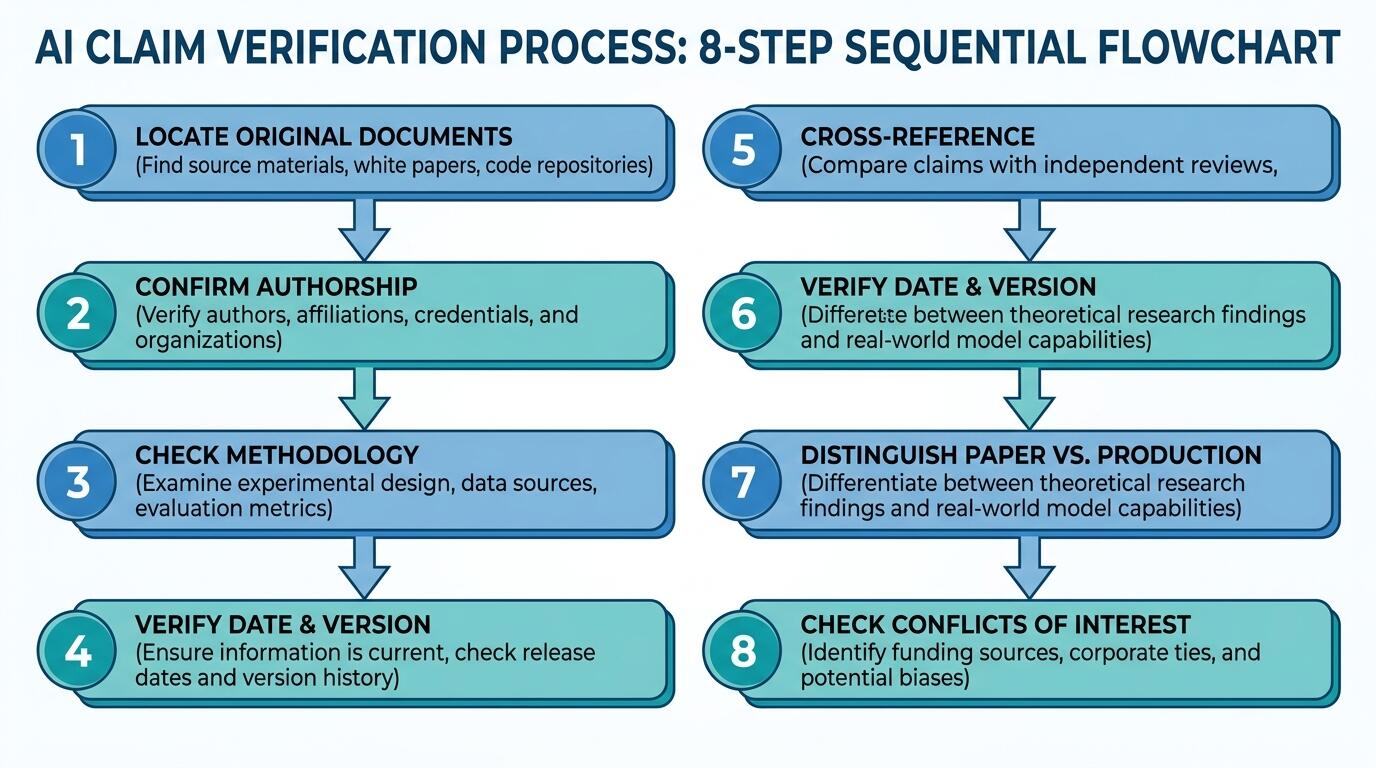
ALT: Flowchart showing eight steps for verifying AI claims against primary sources, from locating original documents to checking conflicts of interest in AI benchmarks
How to Choose the Right Verification Steps for Your Situation
Not every claim warrants all eight steps. The right scope of verification depends on the cost of being wrong.
If you are writing internal documentation that will inform a low-stakes feature experiment, steps one (locate the original) and three (check methodology) are usually sufficient. If you are making a vendor selection that will commit significant engineering time, all eight steps are worth the investment. If you are publishing content that others will rely on — as I do with the Darius briefing — the bar should be at least steps one through five for every claim that appears with a specific number attached.
A common misconception is that verification is about finding reasons to distrust sources. It is not. The goal is to understand the exact scope and conditions of a claim so that you can use it appropriately. A well-conducted study with exposed methodology and a clear conflict-of-interest disclosure is more useful than an unattributed claim that happens to confirm your priors — even if the disclosed study is less conclusive than you would like.
For practitioners building in bilingual markets (where the same claim may be translated and re-summarized multiple times across languages before it reaches your team), the risk of scope distortion compounds at every translation step. Running the checklist against the source in its original language, when possible, is worth the extra effort.
People Also Ask
Q1: How do you find the primary source for an AI capability claim?
Finding the primary source for an AI capability claim typically means searching for the original paper, technical report, or official documentation where the result was first published. Start with the reference section of the article you are reading. If no citation exists, search the model or organization name alongside the specific metric or capability on preprint servers such as arXiv, or on the organization's official research page. If neither yields the source, treat the claim as unverified until it can be traced.
Q2: Is a company's own blog post a reliable primary source?
A company blog post authored by the team that ran an experiment or built a system qualifies as a primary source in the sense that it is direct, firsthand reporting. However, it is a primary source with a potential conflict of interest, which means the methodology and conditions described should be evaluated with the same rigor you would apply to a peer-reviewed paper. An official technical report that exposes its evaluation setup is more useful than a marketing post that announces a result without explaining how it was measured.
Q3: How much time does rigorous claim verification realistically take?
For a single quantitative claim, a minimal verification pass — locating the original document and checking whether a methodology is described — typically takes a few minutes if the source is well-cited, and up to an hour if the claim has traveled far from its origin. Full verification against all eight checklist steps, including independent cross-referencing, can take significantly longer for novel claims in fast-moving areas. In practice, prioritize depth of verification proportionally to the cost of being wrong: production decisions warrant full checks; casual reading may warrant only a quick source trace.
Key Takeaways
- Primary source verification is a habit, not a one-time audit. The discipline of tracing claims to their origin needs to be built into how you consume and share AI information, not treated as a special procedure reserved for high-stakes moments.
- Methodology is the most informative part of any AI capability claim. A number without a method is an assertion. A method without a number is a framework. Both together constitute a verifiable claim.
- Date and version context are non-negotiable in AI. The field moves fast enough that a claim accurate at publication can become misleading within months. Always timestamp the scope of what you are citing.
- Conflicts of interest are structural, not personal. They do not disqualify a source, but they do require closer reading of methodology and framing. Disclosure is a sign of integrity; absence of disclosure is a warning sign.
- Scale your verification effort to the cost of being wrong. Not every claim needs eight steps, but every claim that drives a production decision or gets published deserves at least the first three.
Your next step: apply this checklist to the next AI claim you encounter that would influence a real decision — a vendor evaluation, a feature specification, or a piece of content you plan to share with your team.
If you are building AI products and want a source of AI news that already applies this verification discipline — with firsthand sourcing, methodology notes, and production-context commentary — subscribe to the Darius bilingual briefing at the Darius website. Each issue selects and verifies a curated set of AI developments, with analysis drawn from real production systems, so you can convert information into actionable judgment rather than noise.
Sources & Citations
- Otterbein University Library. "Evaluating Sources: Primary, Secondary, and Tertiary Sources."
https://otterbein.libguides.com/ld.php?content_id=50851691 - Plan 204 Research Guide. "Evaluating Primary Sources."
https://plan204.weebly.com/evaluating-primary-sources.html - Community High School District 117 Library. "Evaluating Sources and Information Literacy Guide."
https://libguides.chsd117.org/c.php?g=1020122&p=7970496
Note: Library guides and institutional resources are periodically updated; please check the latest official documents or consult professional advisors for current guidance.