A Technical Founder's Guide to Evaluating RAG Vendors This Quarter
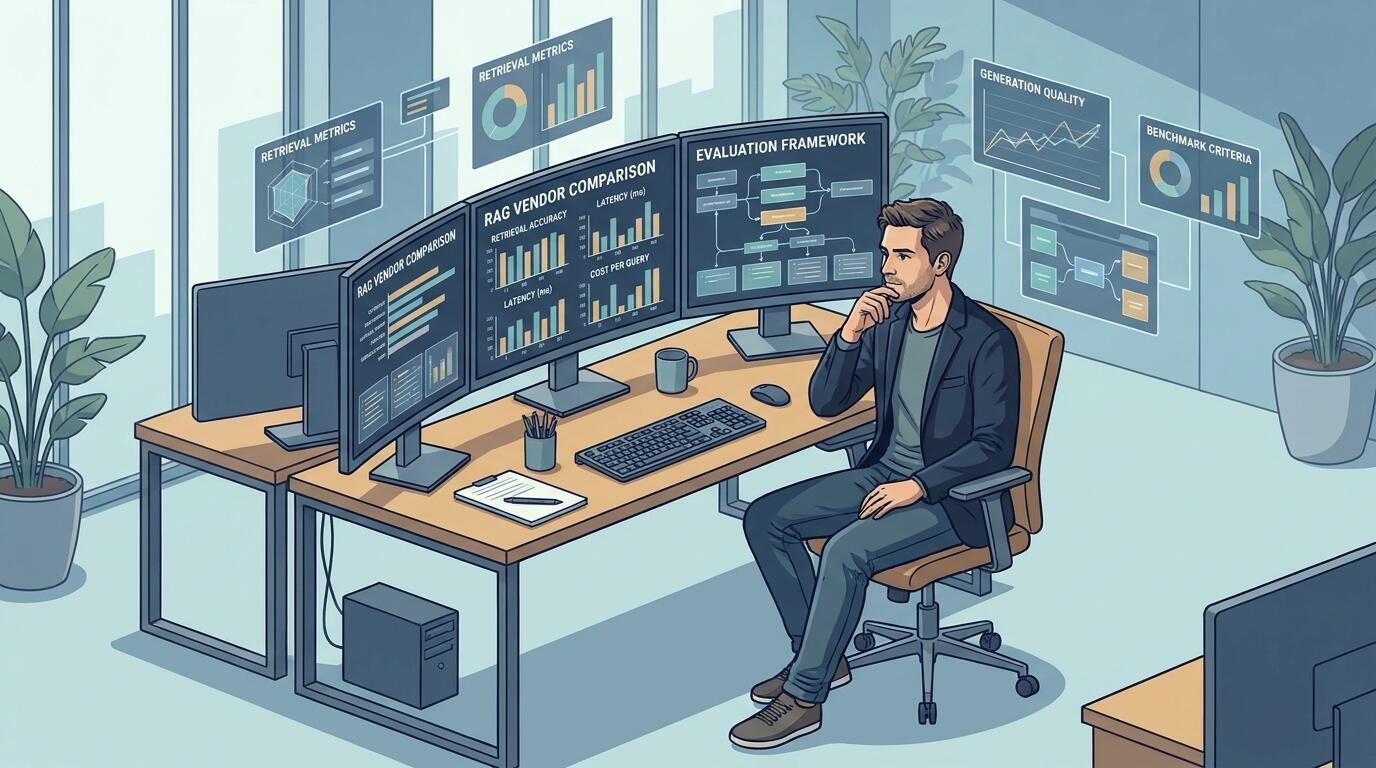
ALT: Technical founder evaluating RAG vendors using a structured framework for AI product selection
What You'll Actually Know After Reading This RAG Vendor Evaluation Guide
Key Conclusion: Evaluating RAG vendors is not a procurement exercise — it is an architectural decision that compounds over time. This guide walks technical founders through the criteria that matter in production: retrieval quality, latency profiles, chunking control, observability, and vendor lock-in risk. By the end, you will have a working framework to shortlist vendors, run a meaningful proof-of-concept, and avoid the evaluation mistakes that cause teams to re-platform six months into a contract.
Choosing a retrieval-augmented generation (RAG) vendor is one of the higher-stakes technical decisions a founding team makes this year. The market is dense, the marketing is nearly identical across vendors, and the failure modes only become visible under real workloads. This guide is for technical founders, lead engineers, and architects who need a structured, no-hype method to compare RAG platforms before signing anything.
Before You Start: Prerequisites and What to Have Ready
Effective RAG vendor evaluation begins before you open a single product demo. The teams that evaluate well arrive with their own data, their own success metrics, and a clear picture of their current retrieval bottleneck — rather than letting a vendor define the problem for them.
The most common pattern we see in evaluations that go wrong: a team enters vendor calls without a reference corpus, agrees to run benchmarks on vendor-supplied datasets, and ends up comparing scores that have no relationship to their actual production distribution. Vendors optimize their demo environments. Your job is to make the evaluation environment mirror your real workload.
Before starting the steps below, confirm you have the following in place.
Checklist before starting:
- A representative sample of your production document corpus (a few hundred to low thousands of documents, covering your typical length, format, and domain distribution)
- A set of ground-truth question-answer pairs derived from that corpus — ideally annotated by a domain expert, not generated purely by an LLM
- A defined primary retrieval metric: are you optimizing for recall@k, mean reciprocal rank (MRR), answer faithfulness, or end-to-end latency? Pick one primary signal before vendor conversations begin
- A rough architecture diagram of your current or intended stack — embedding model, vector store, reranker, and LLM — so you can ask specific integration questions
- A named technical decision-maker with authority to say no, and a rough timeline for when a decision needs to be made
- Legal clearance on whether you can send a sample of your corpus to a third-party vendor's evaluation environment; if not, you need on-premise or VPC deployment options from day one
Time and effort: a rigorous vendor evaluation — covering discovery, POC setup, benchmark runs, and reference checks — is a qualitatively significant time commitment for at least one senior engineer. Do not treat it as a background task. If it is not someone's primary focus for a defined window, the evaluation will be shallow and the decision will default to whoever had the best sales process, not the best product.
Step-by-Step: How to Evaluate RAG Vendors This Quarter
Step 1: Define Your Retrieval Requirements Before Talking to Anyone
Retrieval-augmented generation is an architecture pattern, not a product — and different vendors make fundamentally different trade-offs in how they implement it. Before any vendor conversation, write down the answers to three questions: What types of documents does your system need to retrieve from? What is the acceptable end-to-end latency for a query response? What is the cost envelope per query at your expected monthly volume?
These three parameters — corpus characteristics, latency budget, and cost ceiling — will immediately disqualify a non-trivial portion of the vendor landscape. A vendor optimized for sub-second retrieval over a small, well-structured knowledge base is a different product from one designed for multi-hop reasoning over a large, heterogeneous enterprise corpus.
Tip: Write your requirements in a one-page brief and share it with vendors before the first call. Vendors who respond with tailored technical answers are worth your time; vendors who respond with a generic deck are telling you something important about their sales motion.
Step 2: Audit Chunking and Indexing Strategies
Chunking strategy is one of the most consequential and least-discussed variables in RAG quality. A RAG vendor that gives you no control over how documents are segmented before indexing is a vendor that will fail silently on your long-form, structured, or multi-section content — and the failure will look like "retrieval is just not that accurate" rather than "our chunks are the wrong size for this corpus."
Ask vendors specifically: What chunking methods do you support — fixed-size, sentence-boundary, semantic, hierarchical, or document-structure-aware? Can chunk size and overlap be configured per corpus or per document type? Do you support parent-document retrieval or recursive chunking? Can you bring your own embeddings, or are you locked into the vendor's embedding model?
This last question matters more than it looks. Embedding model quality is advancing rapidly, and a vendor that requires you to use their proprietary embedding layer is betting that their model will remain competitive. In practice, the teams we see with the most retrieval flexibility are those who retained control of the embedding step and plugged it into a vendor's indexing and retrieval layer, rather than outsourcing the entire pipeline.
Tip: Run your ground-truth QA pairs against the vendor's default chunking configuration and against your own preferred configuration. The delta between those two runs tells you how much retrieval quality depends on configuration access versus the vendor's underlying technology.
Step 3: Benchmark Retrieval Quality on Your Own Data
Benchmarking on vendor-supplied datasets is nearly useless for production decisions. Your domain has its own vocabulary, its own query patterns, and its own document structure — none of which are captured in generic RAG benchmarks. The only signal that matters is how the system performs on your corpus, with your queries.
Set up a structured evaluation using your ground-truth QA pairs. Measure at minimum: recall@k (does the correct document appear in the top k retrieved chunks?), answer faithfulness (does the generated answer accurately reflect what the retrieved context says?), and answer relevance (does the generated answer actually address the question asked?). Frameworks like RAGAS — developed by researchers for systematic RAG evaluation — provide a structured way to compute these metrics programmatically across vendors.
For each vendor, run the same set of queries against the same indexed corpus. Control for LLM choice if possible: use the same generation model across vendors so you are isolating retrieval quality, not LLM quality. The retrieval step is where vendors differentiate; the generation step is increasingly commoditized.
Tip: Include adversarial queries in your test set — questions where the answer is not in the corpus, ambiguous queries, and queries that require synthesizing information across multiple documents. These stress tests reveal how a vendor handles retrieval failure, which is as important as how they handle retrieval success.
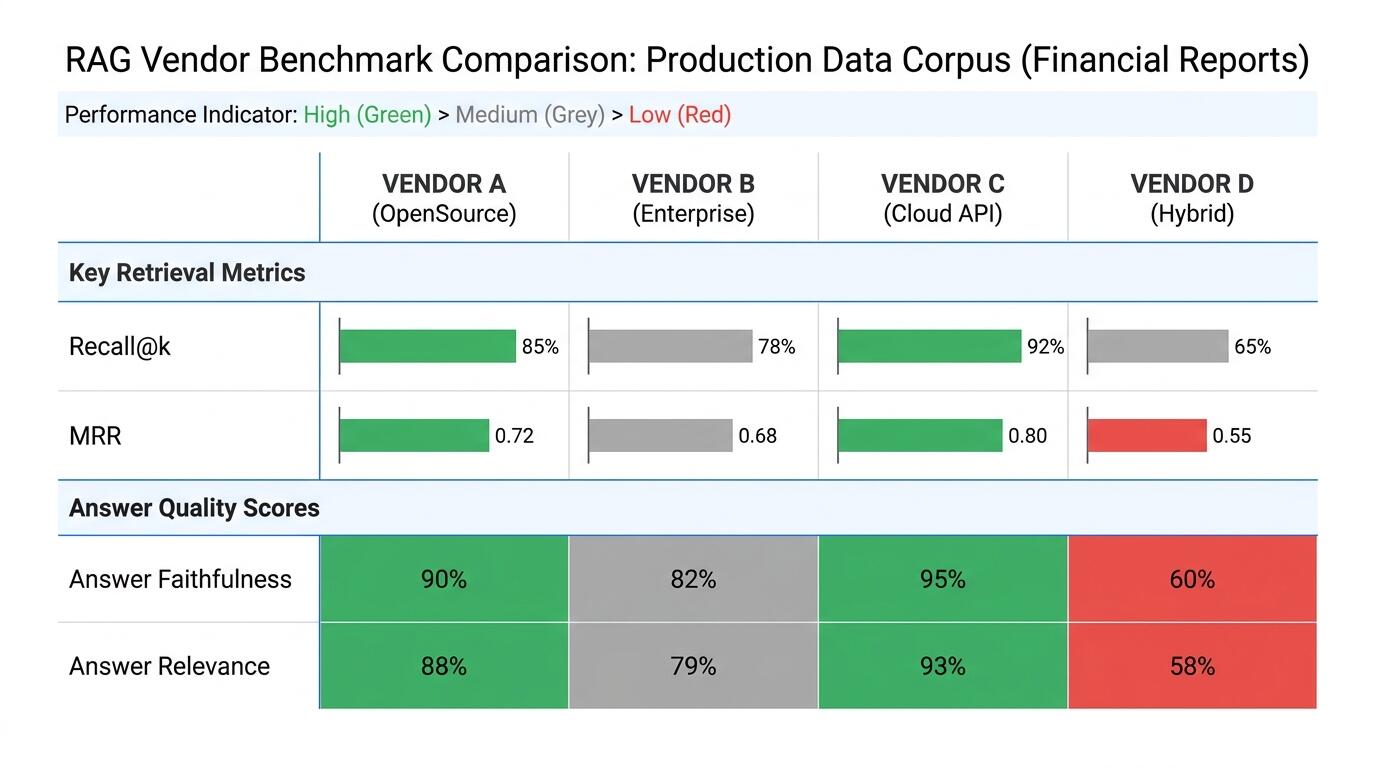
ALT: Side-by-side RAG vendor benchmark comparison showing retrieval quality metrics on production data corpus
Step 4: Stress-Test Latency and Throughput Under Realistic Load
Latency numbers from a vendor demo are measured in ideal conditions: a small corpus, a warm cache, and a single concurrent user. Your production environment is none of those things. Before committing to a vendor, you need to understand latency behavior under the load profile your application will actually generate.
Run load tests with concurrent query patterns that match your peak usage — not average usage. Measure p50, p95, and p99 latencies, not just averages. Pay specific attention to how latency degrades as corpus size grows: a vendor that performs well at tens of thousands of documents may exhibit non-linear latency growth at millions. Ask the vendor directly: at what corpus size does retrieval latency begin to degrade meaningfully, and what is the mitigation strategy?
Also probe the reranking step separately. Many RAG systems insert a cross-encoder reranker after initial retrieval to improve precision. Rerankers add latency — sometimes substantially. A vendor who bundles reranking into their pipeline without exposing its latency contribution is obscuring a variable that will matter when you are debugging a slow query in production.
Tip: Ask the vendor for reference customers with a corpus size and query volume comparable to yours, and ask those references specifically about latency behavior at scale, not about general satisfaction.
Step 5: Evaluate Observability and Debugging Capabilities
Poor observability in a RAG system means debugging retrieval failures by guessing. The ability to inspect what was retrieved, why it was scored the way it was, and what the model saw before generating an answer is not a nice-to-have — it is the difference between a system you can improve iteratively and one you are flying blind in production.
Ask vendors: Can I see which chunks were retrieved for a given query, along with their similarity scores? Can I trace a failed answer back to a retrieval miss versus a generation failure? Is there a native logging layer, or do I need to instrument everything myself? Are there built-in tools for identifying systematic retrieval failures across a query log, or only per-query inspection?
A pattern we consistently see in teams that ship reliable RAG systems: they chose vendors or open-source components that gave them chunk-level retrieval traces from day one, and they built a lightweight human review loop — even just a spreadsheet — to classify retrieval failures by type during the early weeks in production. This operational discipline compounds into a much higher-quality system within a few sprint cycles. For a deeper look at how retrieval, verification, and publication steps interact in a real pipeline, see the agent pipeline behind a daily AI briefing — the failure modes in structured retrieval workflows translate directly to RAG system design.
Tip: Ask the vendor to walk you through how they would help you debug a specific retrieval failure scenario. The quality of that answer tells you more about their observability story than any feature checklist.
Step 6: Assess Integration Depth and Lock-In Risk
Vendor lock-in in RAG systems is more nuanced than it appears. The obvious lock-in is proprietary index formats — if your indexed data lives in a vendor-specific format, migration is expensive. But the subtler lock-in is workflow and API coupling: if your application logic is deeply integrated with a vendor's SDK, query API, or metadata schema, switching costs compound even if the underlying data is portable.
Evaluate: Does the vendor use open standards for vector storage (e.g., open-schema metadata, standard embedding dimensions)? Is their API compatible with common orchestration frameworks, or does it require a custom integration path? What does data export look like — can you get your indexed vectors and metadata out in a standard format? What is the vendor's track record on API stability and deprecation notice?
If you are weighing build-versus-buy at the infrastructure layer, the build vs. buy framework for AI infrastructure is a useful complement to this vendor evaluation process — particularly for teams uncertain about where to draw the boundary between vendor-managed and self-managed components.
Tip: Request a written data portability policy before signing. Vendors who cannot articulate a clear export path are implicitly telling you that exit costs are not a priority for them.
Step 7: Validate Commercial Terms Against Technical Risk
Commercial terms and technical architecture are not separate conversations — they are the same conversation. The most common mistake we see at contract stage is a team that negotiated a good monthly rate but did not read the terms around data handling, model updates, and SLA calculation.
Scrutinize: Does the vendor's data processing agreement specify which region your data is stored and processed in? Is there a clause allowing the vendor to use your queries or documents to improve their models? What is the SLA for retrieval uptime, and how is downtime defined — is a degraded retrieval response that returns results counted as "up"? What is the vendor's policy on unilateral changes to the underlying embedding or retrieval model, and what notice period is required?
Model update policies deserve special attention. A vendor who updates their embedding model unilaterally — without requiring you to re-index — will silently degrade your retrieval quality if your index was built on the previous model version. This is a real operational risk that is rarely discussed in sales conversations but appears regularly in production post-mortems. If you are also evaluating other AI development tools as part of a broader stack decision, the framework for evaluating AI development tools before signing a contract covers the contractual risk layer in more depth.
Tip: Have a lawyer who understands AI data processing review the DPA before signing, not just a general counsel reviewing standard SaaS terms.
Common Mistakes and Troubleshooting in RAG Vendor Evaluations
| Symptom | Likely Cause | How to Fix |
|---|---|---|
| Vendor benchmarks look great but production performance is disappointing | Evaluation used vendor-supplied datasets, not production data | Re-run benchmarks exclusively on your own corpus and ground-truth QA pairs |
| Retrieval quality degrades after vendor updates their model | No contractual notice requirement for model changes; index built on old embeddings | Require written notice policy in contract; build re-indexing into your operational runbook |
| Debugging a retrieval failure takes hours of manual inspection | Vendor observability is query-level only, with no chunk-level trace | Require chunk-level retrieval traces and similarity scores as a go/no-go criterion before POC |
| Latency is acceptable at demo scale but unacceptable at production volume | Load testing skipped or run at unrealistically low concurrency | Run load tests at p95 concurrency with your actual corpus size before any commitment |
| Migration to a new vendor is unexpectedly expensive after 12 months | Index format is proprietary; no data export policy was reviewed upfront | Request written data portability policy and test export procedure before signing |
| Chunking defaults produce poor retrieval on structured documents | Vendor's default chunking is fixed-size and not document-structure-aware | Require configurable chunking as a feature requirement; test with your specific document types in the POC |
Pro Tips for Better RAG Vendor Evaluation Results
Run a shadow evaluation against an open-source baseline. Before finalizing any vendor decision, run the same benchmark against an open-source RAG stack — pgvector or Weaviate for storage, a public embedding model, and a standard reranker. The delta between the vendor's performance and your own baseline stack tells you what you are actually paying for. In a pattern we consistently see, teams often discover that the gap is smaller than expected on their specific corpus, which either validates the vendor's value-add or prompts a more serious build-versus-buy conversation.
Disaggregate the evaluation into retrieval and generation layers separately. Most RAG systems conflate retrieval quality and generation quality in their reported metrics. A vendor claiming high answer accuracy may be compensating for weak retrieval with a stronger LLM, or masking a strong retrieval system with a weak generation step. Measure retrieval recall independently of answer quality to know which layer you are actually buying.
Weight the vendor's product velocity, not just current capabilities. The RAG vendor landscape is evolving rapidly. A vendor with a strong roadmap and a track record of shipping meaningful capability improvements quarterly is a different long-term bet than a vendor whose core architecture has been static. Ask directly: what has shipped in the last two quarters, and what is on the roadmap for the next two?
Conduct reference checks with engineers, not sales references. Sales-supplied references are customers who agreed to be called. Ask instead to be connected directly with the engineering team at a reference customer, or find references independently through community channels. The questions that matter: what is your most persistent retrieval failure mode, and how has the vendor helped you address it?
Do not mistake API simplicity for production readiness. A vendor with a clean three-line integration API may have achieved that simplicity by hiding configurability. If you cannot control chunking, embedding model selection, retrieval parameters, or reranker behavior through the API, you are trading long-term retrieval control for short-term integration convenience — and that trade compounds negatively as your corpus grows and your query distribution evolves.
A common misconception worth addressing directly: many teams assume that higher embedding model quality automatically produces better end-to-end RAG performance. In practice, retrieval quality is more sensitive to chunking strategy, corpus preprocessing, and reranker configuration than to embedding model choice, particularly on domain-specific corpora where a well-tuned smaller model often outperforms a larger general-purpose one on your specific data.
Common Questions
Q1: How should a technical founder weight retrieval quality versus integration simplicity when choosing a RAG vendor?
Retrieval quality is the primary axis for evaluation — integration simplicity is a developer experience concern that can usually be addressed with a thin abstraction layer, but retrieval quality directly determines whether your product works for users. Prioritize vendors that perform best on your specific corpus and query distribution, even if their integration requires more engineering effort. Integration complexity is a one-time cost; retrieval quality is a permanent baseline.
Q2: Are open-source RAG stacks a viable alternative to managed RAG vendors for production workloads?
Open-source RAG stacks — combining tools like Weaviate, Qdrant, or pgvector with open embedding models and orchestration frameworks — are genuinely production-ready for many workloads. The decision is primarily about operational burden versus configurability. Managed vendors reduce infrastructure overhead but constrain flexibility; open-source stacks give full control but require your team to own reliability and scaling. Teams with strong infrastructure competency and non-standard retrieval requirements often find open-source stacks more cost-effective at scale.
Q3: How long does a rigorous RAG vendor evaluation realistically take, and what is the right depth for a seed-stage versus growth-stage company?
A rigorous evaluation covering discovery, POC setup, benchmark runs, and reference checks is qualitatively a multi-week effort for at least one senior engineer. Seed-stage teams should run a leaner evaluation focused on retrieval quality and exit costs, and accept more risk on operational maturity. Growth-stage teams with significant production query volume should invest in a full load test and contractual due diligence. Both stages should run benchmarks on their own data — skipping that step is the highest-risk shortcut regardless of company stage.
Wrapping Up
Evaluating RAG vendors is an architectural decision that compounds over time, and the teams that evaluate well treat it as an engineering project rather than a procurement checklist. Here are the core takeaways from this guide:
- Define your retrieval requirements — corpus characteristics, latency budget, and cost ceiling — before any vendor conversation begins. These three parameters will disqualify a meaningful portion of the market immediately.
- Benchmark exclusively on your own data and ground-truth QA pairs. Vendor-supplied benchmarks are optimized for their system; only your data reflects your production distribution.
- Evaluate chunking control, observability, and data portability as go/no-go criteria — not as nice-to-haves. These are the variables that determine whether you can improve the system over time and exit cleanly if needed.
- Load-test at p95 concurrency with your actual corpus size before committing. Demo-environment latency is not a reliable predictor of production latency.
- Review data handling terms, model update policies, and the DPA with the same rigor you apply to technical benchmarks. Commercial terms and architecture risk are the same conversation.
The right vendor is not the one with the best marketing — it is the one that performs best on your data, gives you the observability to improve it, and does not trap you in a configuration you cannot exit.
If this guide surfaces questions about where your current retrieval stack falls short or how to structure a POC for your specific use case, the next step is to run a time-boxed benchmark sprint with your own corpus before any vendor conversation goes to procurement.
If this guide was useful, subscribe to Darius — a bilingual AI briefing written by real AI product builders, curating 5–10 signal-rich updates per issue with hands-on analysis from production environments. Whether you are selecting vendors, tuning retrieval, or scaling an AI system, Darius filters the noise and surfaces what actually matters.
Sources & Further Reading
- RAGAS Project. "RAGAS: Evaluation Framework for Retrieval-Augmented Generation Systems".
https://www.ragas.io - IEEE. "IEEE Standards for Artificial Intelligence and Machine Learning Systems".
https://www.ieee.org - National Institute of Standards and Technology (NIST). "AI Risk Management Framework".
https://www.nist.gov - The Linux Foundation. "Open Source AI and Data Governance Resources".
https://www.linuxfoundation.org
Note: Standards and frameworks may be updated; check the latest official documents or consult professional advisors before making contractual or architectural decisions.