Source Discipline: Why the Pipeline Only Accepts Primary Announcements
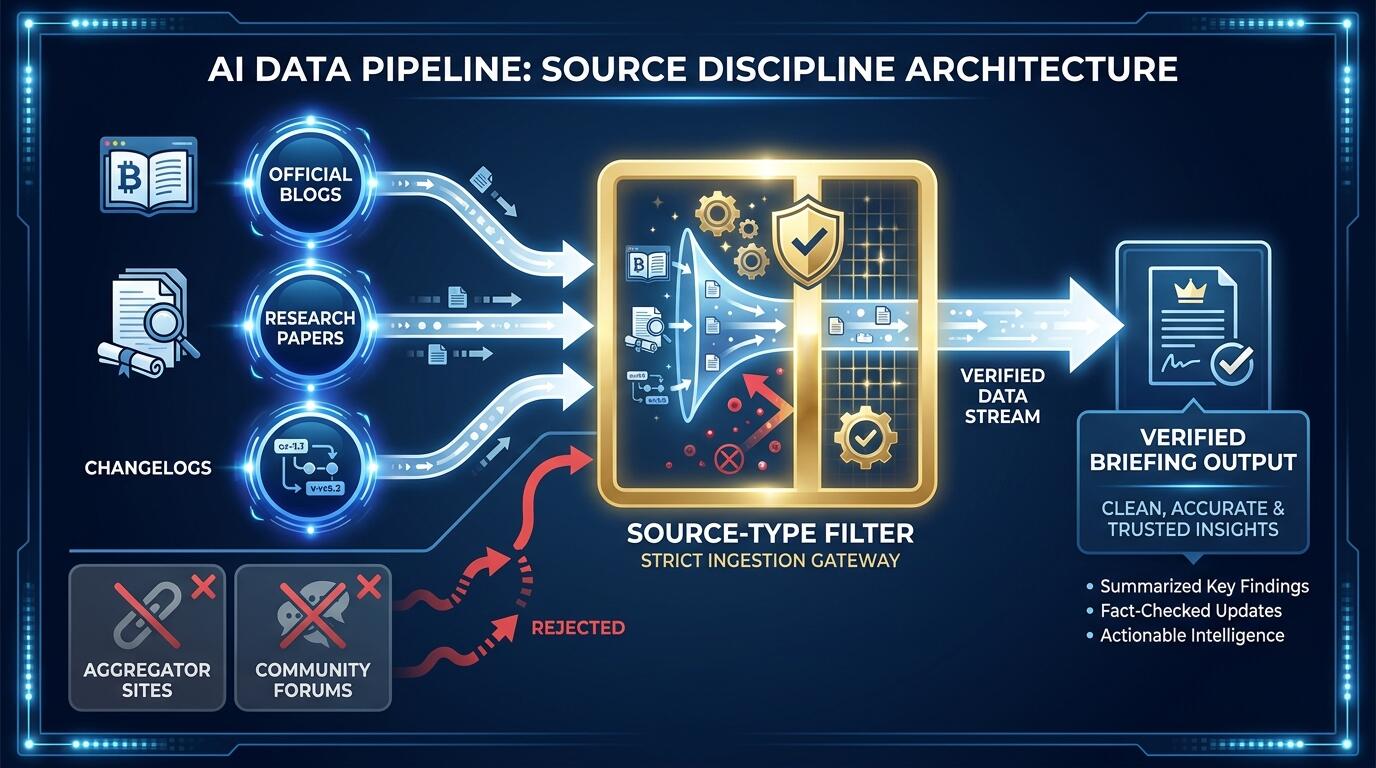
ALT: Source discipline in AI pipelines enforcing primary announcements for accurate briefing delivery
Why Primary Sources Are a Non-Negotiable Engineering Constraint
Source discipline — the practice of accepting only primary, first-party announcements into an information pipeline — is the single most important quality gate for any AI briefing system that claims to be authoritative. In the crowded field of AI news, secondary coverage, aggregator summaries, and opinion-layered rewrites move faster than original announcements. The temptation to pull from these intermediaries is real, especially when building automated retrieval pipelines at scale. But in our work building and operating AI products, one pattern repeats without exception: the moment you relax source constraints, signal quality degrades in ways that compound silently and are expensive to detect after the fact.
The thesis here is direct — a pipeline that ingests secondary sources is not just less accurate; it is structurally incapable of delivering first-mover insight. For engineers and technical leads building AI briefing or monitoring systems, understanding why this constraint exists at the architectural level (not just as an editorial preference) is the difference between a product that compounds in value and one that becomes a sophisticated echo chamber.
The State of AI Information Infrastructure Today
The AI information landscape is defined by high-velocity publishing and structural information asymmetry. Research labs, model providers, and developer platforms ship announcements at a pace that outstrips any human editorial team working alone. This has created a large secondary market — newsletters, aggregators, and commentary blogs that repackage primary content for broader audiences. On the surface, this looks like a distribution system. In practice, it is a mutation system.
Every repackaging step introduces at least one of the following: selective omission of technical qualifications, editorial framing that shifts emphasis, latency from the original event, and in many cases, factual errors introduced through paraphrase. Per IEEE standards on information quality and data provenance — a body of work that informs how engineers think about data pipeline integrity — source proximity is a primary determinant of downstream reliability. The further an information artifact travels from its origin, the more it accumulates what engineers working in data pipelines call "lineage noise."
The current state of AI media compounds this problem. Many widely-read technical publications operate on summary-and-link models where writers process secondary accounts rather than original announcements. When an automated pipeline ingests these outputs, it often cannot distinguish between a writer who read the original paper and one who read a Twitter thread summarizing it. Without an explicit source-type filter at the ingestion layer, the pipeline has no basis for that distinction either.
This is the context in which source discipline becomes an architectural requirement rather than a stylistic one. The briefing systems that AI product builders should trust — and the ones worth building — are those where the pipeline begins at the mouth of the river, not somewhere downstream. At Darius, this principle is embedded into how each item in every issue is sourced: every entry traces back to a first-party announcement, paper, or official changelog, with no aggregator layers in between.
The Mechanics of Source Degradation
Understanding why secondary sources fail requires examining the specific mechanisms through which quality erodes. These are not abstract concerns — they map directly to failure modes in production AI briefing systems.
Semantic Drift Through Paraphrase
Semantic drift is the gradual, usually unintentional alteration of technical meaning that occurs when content is rewritten rather than quoted directly. In AI reporting, this manifests as benchmark results stripped of their evaluation conditions, model capability claims detached from their scope limitations, and API changes described in terms of user experience rather than technical contract. A pipeline that ingests these rewritten descriptions will encode the drifted meaning — and downstream reasoning, whether by a human reader or an LLM summarizer, will operate on corrupted ground truth.
The practical consequence: an engineering team reading a briefing built on secondary sources may ship product decisions based on capability claims that the original announcement explicitly qualified. When the gap surfaces, tracing it back to the source chain is a significant debugging effort that most teams do not have time for in-flight.
Temporal Displacement and Stale Signal
Temporal displacement is the lag introduced when a pipeline waits for secondary coverage to emerge before ingesting a story. Secondary articles typically appear hours to days after a primary announcement. For fast-moving AI developments — model releases, API deprecations, competitive capability shifts — this lag means the briefing arrives after the window where it could change a decision. The signal becomes historical record rather than actionable intelligence.
A pattern we consistently see in teams that rely on curated secondary feeds: they learn about significant model updates not from the update itself but from the conversation that follows. By then, the relevant engineering or product response time has often passed.
Attribution Collapse and Provenance Loss
Attribution collapse occurs when a pipeline cannot trace a claim back to its original source. This is the most dangerous failure mode because it is invisible at read time. A briefing item that says "a leading model provider has updated its context window" carries no provenance. The reader cannot verify it, the editor cannot audit it, and the pipeline cannot update it when conditions change. In contrast, a pipeline built on primary sources — official developer documentation, research preprints, official changelogs — maintains a complete attribution chain that supports both verification and correction.
This is why the full architecture of a production AI briefing agent treats source type as a first-class field in the data schema, not a metadata annotation added after ingestion. When source type is structural, filters and audits can run automatically.
Amplification of Errors Under Automation
Error amplification is a compounding dynamic unique to automated pipelines. In manual editorial workflows, a human editor may catch a factual error introduced by a secondary source before it reaches readers. In automated pipelines operating at volume and speed, an error ingested from a secondary source propagates to summaries, embeddings, and retrieval indices before any human reviews it. The error does not just reach readers — it contaminates the system's own knowledge representation.
Per the principles underlying IEEE data quality frameworks, automated systems require stricter input constraints than manual ones precisely because the feedback loops for error detection are slower relative to the propagation speed.
Evidence and Comparative Approaches to Source Policy
Different pipeline architectures handle source constraints in different ways. The trade-offs are real, and the right fit depends on what the system is actually optimizing for.
| Perspective / Approach | Strengths | Trade-offs | Best Fit |
|---|---|---|---|
| Primary-only ingestion | Maximum accuracy, full provenance, no semantic drift | Slower discovery for niche topics; requires broader crawl coverage | Authoritative briefings where accuracy outweighs volume |
| Curated secondary feed | Higher volume, faster setup, good for trend signals | Provenance loss, semantic drift risk, aggregator bias | General interest newsletters, not technical decision support |
| Hybrid with source-type tagging | Balances coverage with transparency | Complexity in classification; tagging errors degrade trust | Teams with bandwidth to maintain classification quality |
| Fully automated aggregation | Maximum throughput | Lowest accuracy; no meaningful source discipline possible | Monitoring dashboards, not briefings |
In practice, the primary-only approach is the only one that survives the accuracy requirement for a product whose value proposition is precision. Secondary source policies consistently produce briefing items that require correction, and correction cycles in production are costly — not just in editorial time, but in reader trust.
A concrete illustration of this trade-off: when a major model provider updates its API rate limits, the primary announcement (official documentation or developer blog) contains the exact parameters, the effective date, and the migration path. Secondary coverage condenses this into a single sentence that typically omits at least one of those three elements. An engineering team reading the condensed version makes a plan with incomplete information. The gap surfaces at migration time, not at reading time.
The evidence from operating AI briefing products confirms what the engineering intuition suggests: the cost of a primary-only pipeline (more infrastructure for crawling, more discipline in source classification) is front-loaded and bounded. The cost of allowing secondary sources is back-loaded, unbounded, and largely invisible until trust is already damaged. As we document in our editorial rules for the Darius pipeline, writing editorial rules that an agent can actually follow requires making source-type constraints explicit and machine-readable — vague instructions do not survive the transition to automation.
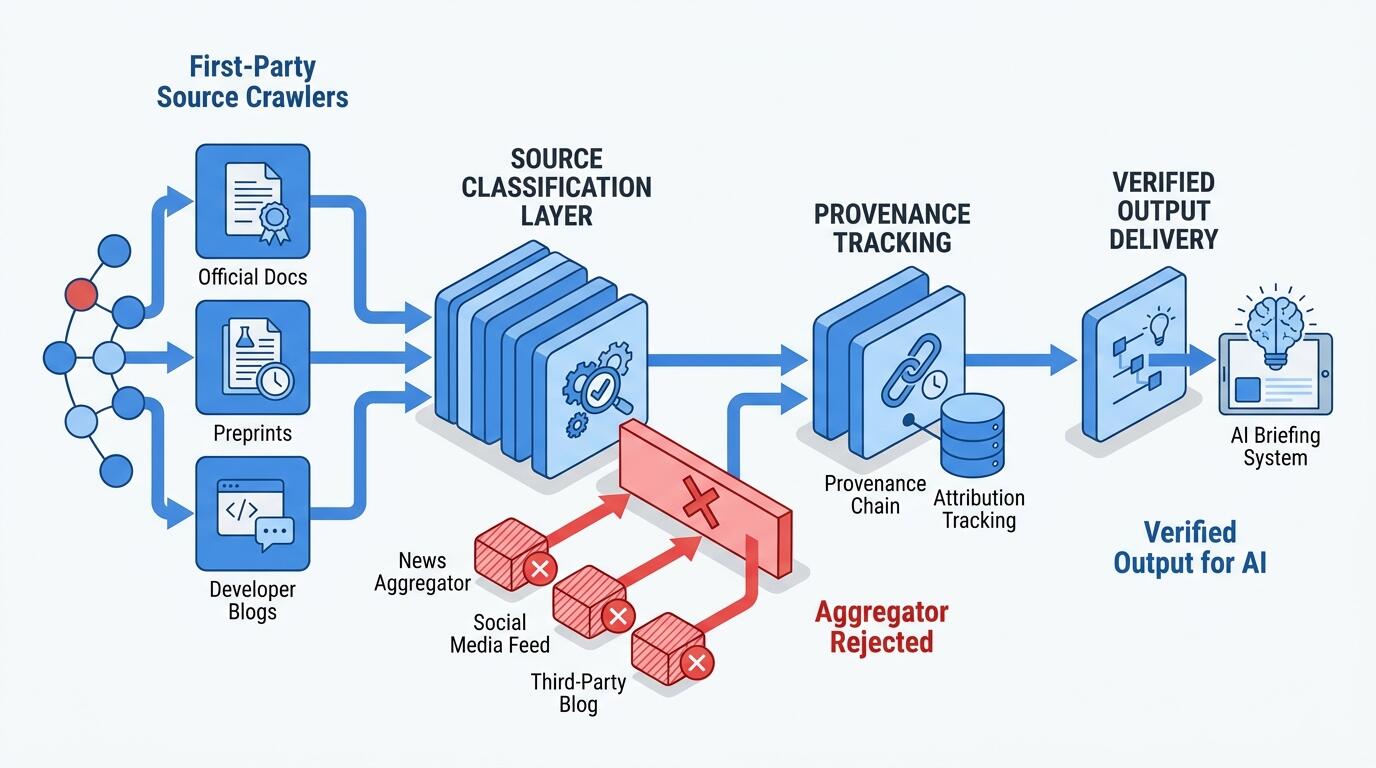
ALT: Diagram showing primary source ingestion pipeline with source-type filters enforcing source discipline for AI briefings
Where Source Policy Is Heading and What It Means for Builders
Source discipline is moving from an editorial best practice to an engineering specification, driven by two converging trends. First, generative AI is being integrated into more information workflows — both for summarization and for answering questions from briefing content. When LLMs operate on briefing data, the quality of that data directly conditions the quality of AI-generated outputs. Garbage-in, garbage-out applies with particular force when the garbage was processed through multiple rewrite layers before entering the system.
Second, the AI information space is becoming increasingly contested. As more model providers, research labs, and developer platforms compete for attention, secondary coverage is growing faster than primary announcement volume. Builders who do not enforce source discipline will find their pipelines increasingly dominated by commentary and opinion — content that is high in quantity and low in verifiability.
For engineering teams building or evaluating AI briefing and monitoring systems, the actionable implications are these:
- Treat source type as a schema field, not a metadata annotation. Classification must be enforced at ingestion, not applied retroactively.
- Build provenance tracking into the data model from day one. Every item should carry a traceable chain back to its first-party origin.
- Audit source distribution periodically. A pipeline that starts primary-only can drift over time as crawl targets expand. Scheduled audits catch this before it becomes a quality problem.
- Prefer systems where the source constraint is documented and transparent. If you cannot read the source policy of a briefing product, you cannot evaluate its reliability.
The direction is clear: as AI-generated content floods secondary channels, the provenance gap between primary and secondary sources will widen. Systems built on primary-only ingestion will compound in value; those built on secondary aggregation will face escalating noise floors.
Frequently Asked Questions FAQ
Q1: How does a primary source pipeline handle topics where no official announcement exists yet?
A primary-source pipeline handles pre-announcement topics by limiting coverage to what is verifiably documented — preprints, official developer posts, and public changelogs — and abstaining from inference or aggregation of rumor. This constraint does reduce coverage volume for speculative stories, but it is the correct trade-off for a briefing product whose value rests on accuracy. Speculation covered as fact creates more downstream cost than a gap in coverage. The discipline to say nothing until a primary source exists is itself a quality signal.
Q2: Are automated pipelines inherently worse at source discipline than human editorial workflows?
Automated pipelines are not inherently worse — they are different in their failure modes. Human editors can apply contextual judgment but introduce inconsistency at scale. Automated pipelines can enforce source-type rules consistently but require those rules to be precisely specified in machine-readable form. The key is making source constraints explicit at the schema level rather than relying on implicit editorial judgment. When source-type classification is automated and auditable, machine pipelines can match or exceed human consistency.
Q3: How much additional infrastructure does a primary-only policy require compared to aggregator-based ingestion?
The infrastructure overhead of a primary-only policy is real but bounded. It requires broader crawl coverage of first-party domains, a source classification layer, and periodic audits to detect drift. The ongoing operational cost is lower than the alternative, however: aggregator-based pipelines require continuous monitoring for accuracy, more frequent corrections, and eventually, a loss of reader trust that is expensive to rebuild. Front-loading source discipline at the architecture stage is the lower total-cost approach over the lifecycle of the product.
Wrapping Up
Source discipline — the commitment to accepting only primary, first-party announcements into an information pipeline — is not an editorial preference. It is an architectural constraint that determines whether a briefing product can deliver accurate, actionable intelligence at the speed AI builders need.
Three points are worth carrying forward from this analysis. First, secondary sources degrade quality through specific, well-understood mechanisms — semantic drift, temporal displacement, attribution collapse, and error amplification — each of which has a direct cost in production. Second, primary-only ingestion is the only pipeline architecture consistent with a precision-first value proposition; hybrid approaches require ongoing classification quality that most teams cannot sustain. Third, as generative AI becomes more embedded in information workflows, source provenance becomes a first-order quality determinant, not a secondary concern.
The next step for builders is to audit existing briefing or monitoring pipelines against these criteria: Where does each ingested item originate? Is source type tracked as a structured field? When was the source distribution last reviewed? For teams evaluating external briefing products as inputs to their own systems, the same questions apply. A product that cannot answer them is not operating with source discipline.
If you are building AI products and need intelligence that passes this bar, the source policy should be the first thing you evaluate — before volume, before frequency, before design.
If you're building AI products and want frontier intelligence that traces to primary sources and ships with production-grounded judgment — not aggregator noise — subscribe to Darius, the bilingual AI briefing written by engineers running real AI systems. Every item in every issue links to a first-party source and comes with a practitioner's read. Visit the Darius website to start reading the latest issue.
References & Further Reading
- IEEE. "IEEE Standards on Data Quality and Information Provenance."
https://www.ieee.org/ - Internet Engineering Task Force (IETF). "Standards and Best Practices for Data Pipeline Integrity."
https://www.ietf.org/ - arXiv. "Preprint Repository for AI and Machine Learning Research — Primary Source for Model Announcements."
https://arxiv.org/ - Association for Computing Machinery (ACM). "ACM Digital Library — Peer-Reviewed Computing and AI Research."
https://www.acm.org/
Note: Standards and guidelines in this domain evolve alongside the technology. Consult the latest official publications from the cited organizations for current specifications.