A Solo Engineer's Checklist for Keeping Three Products Online
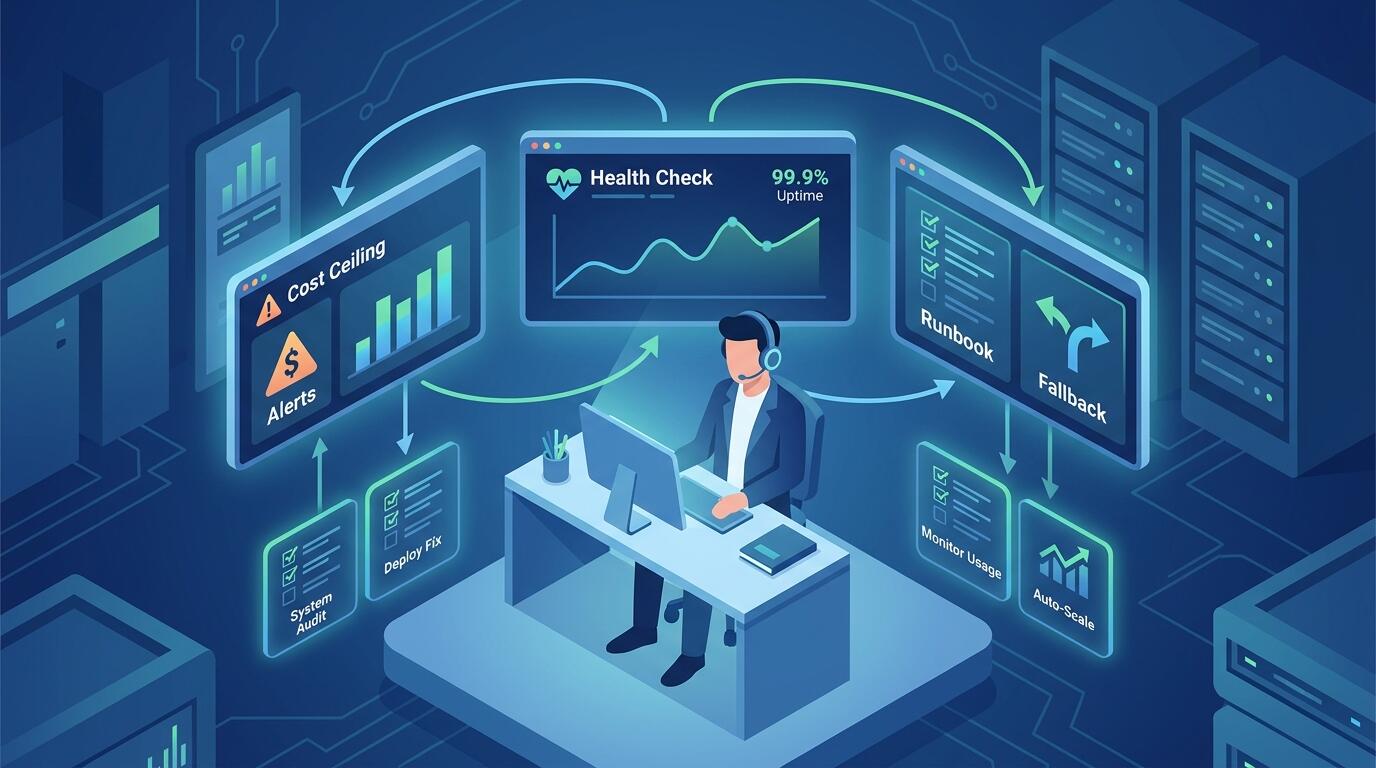
ALT: Solo engineer reliability checklist for keeping three AI products running in production
What It Actually Takes to Keep Three AI Products Online as One Engineer
Running a single production AI product is already a test of your operational discipline. Running three of them — with real users, real data, and real billing — exposes every gap in your system design, your alerting setup, and your own mental model of what "healthy" looks like. At some point, most solo engineers in this position stop relying on instinct and start building a deliberate checklist.
This list is drawn from the direct experience of maintaining three AI products simultaneously. It is not a theoretical framework assembled from conference talks. Every item here corresponds to a failure mode encountered in production, or a near-miss that made the gap obvious. The list is designed to be actionable: you can audit your current setup against it in an afternoon and know exactly where you are exposed.
The items are organized around the operational lifecycle — from service health and dependency monitoring through cost containment and incident readiness. Some will be already in place; others will feel overdue the moment you read them. That recognition itself is useful.
The Checklist: Nine Practices That Keep Multiple AI Products Online
Separate Health Checks per Product, Not per Infrastructure Layer
A health check that confirms your server is running tells you almost nothing about whether your AI product is actually working. The check that matters is one that exercises the product's actual capability — a real inference call, a short retrieval, a test generation — and verifies that the output is structurally valid. When you run three products, the temptation is to share a single uptime monitor across a shared backend. Resist this. Each product needs an endpoint or scheduled probe that represents its specific user-facing function.
Best for: Engineers who have migrated to shared infrastructure to cut costs and may have inadvertently created a single health signal for three distinct user experiences.
Watch out: Synthetic health checks can pass while a model endpoint returns degraded output — empty responses, malformed JSON, or stale embeddings. Pair your liveness check with a lightweight output-quality assertion whenever feasible.
A Per-Product Spend Ceiling Enforced at the API Layer
AI API costs are the operational variable that can move fastest and most unexpectedly. A spike in one product — caused by a prompt loop, a sudden traffic surge, or a misconfigured retry — should not be able to drain the budget allocated to the other two. The practical implementation is simple: define a hard spending cap per product using your provider's budget controls, and treat that cap as a first-class configuration value, not an afterthought.
This is one of the patterns that becomes non-negotiable when you are running multiple products. Shared API keys with no per-product attribution are a liability; they make cost forensics slow and make cap enforcement impossible. Assign distinct API keys or projects per product from day one.
Best for: Any engineer billing AI API usage across multiple products from a single account, especially in early-stage products where usage patterns are unpredictable.
Watch out: Hard caps that trigger mid-request can create confusing error states for users. Design your error handling to surface a clean degradation rather than a raw API error when a cap is hit.
Dependency Version Pinning with Explicit Upgrade Windows
AI libraries, SDK wrappers, and model client packages release updates frequently, and those updates occasionally introduce breaking changes in default behavior — prompt formats, response schemas, tokenization differences. The discipline of pinning every dependency to an explicit version, and scheduling deliberate upgrade windows rather than accepting automatic updates, is one of the highest-leverage reliability practices a solo engineer can adopt.
When you operate three products, an unpinned dependency can propagate a breaking change across all three simultaneously. A lockfile is not enough on its own; you need a process that reviews changelogs before merging any dependency update and runs your integration tests against the new version in a staging environment before promoting to production.
Best for: Teams and solo engineers who have experienced a "silent breakage" — where a dependency update changed behavior without throwing an explicit error, and the failure only surfaced through degraded output or user complaints.
Watch out: Pinning creates its own risk — security vulnerabilities in older versions go unpatched. Treat upgrade windows as mandatory, not optional.
Structured Logging with Product-Level Tags on Every Request
When something breaks at 2 AM across one of three products, the difference between a ten-minute fix and a two-hour investigation is almost always the quality of your logs. Structured logging — where every log entry is a machine-parseable object with consistent fields — is table stakes. The addition that matters when running multiple products is a product-level tag on every request, so you can instantly filter by product, correlate errors to a specific user journey, and measure latency distributions independently per product.
Understanding where an AI pipeline fails before users report it is significantly easier when your logs carry enough context to reconstruct the full request-response cycle — including the model called, the prompt version, the token count, and the response latency. This context is cheap to write at request time and expensive to reconstruct after the fact.
Best for: Engineers who are currently logging at the infrastructure level (server logs, container stdout) but lack application-level visibility into what each AI product is actually doing on behalf of each user.
Watch out: Log volume compounds quickly across three products. Define a retention policy and a sampling strategy for high-frequency, low-signal events before your storage costs become a problem of their own.
A Runbook for Each Product's Most Likely Failure Modes
A runbook is a documented, step-by-step procedure for responding to a known failure scenario. For each of your products, identify the three to five failure modes most likely to page you — model endpoint unavailability, cost cap breach, embedding freshness staleness, webhook delivery failure, database connection exhaustion — and write the response procedure for each. The runbook does not need to be long; a numbered list of diagnostic steps and remediation actions is sufficient.
The real value of runbooks is not that they make incidents faster when you are sharp and rested. It is that they make incidents manageable when you are tired, stressed, or have not touched a particular product in two weeks. When you are the only engineer responsible for three systems, cognitive load during an incident is your primary failure risk.
Best for: Solo engineers who have survived at least one incident by improvising and recognized afterward that the same steps could have been written down in advance.
Watch out: Runbooks that are not kept current become worse than useless — they send you down a path that no longer matches your system. Treat runbook updates as part of your post-incident process, not as optional documentation work.
Model Fallback Configuration for Each Inference Path
Every AI product that calls an external model endpoint is exposed to that provider's availability and rate-limit behavior. For each inference path in each product, define a fallback: a secondary model, a cached response strategy, or a graceful degradation that returns a useful partial result rather than an error. The fallback does not need to be equivalent to the primary path — it needs to be good enough to keep the product functional for users until the primary path recovers.
This is relevant to the broader question of how to ship fast without sacrificing product reliability, because fallback configuration is one of the few reliability investments that pays back immediately in production. A primary path outage becomes an invisible event to users rather than a visible failure.
Best for: Products where the core user interaction depends on a single model call with no alternative path — the highest-risk configuration for a solo engineer to be running without a fallback.
Watch out: Fallback models may produce meaningfully different output quality or cost profile. Test your fallback path regularly so you know what your users actually experience when it activates.
A Weekly Operational Review Covering All Three Products
Running three products means that any one of them can drift into a degraded state slowly enough that no single alert fires, but obviously enough that attentive users notice. A weekly operational review — thirty minutes, covering key metrics for all three products — is the mechanism that catches slow-moving problems before they become urgent. Review your error rate trends, cost trends, latency trends, and any user-reported issues for the week.
The discipline of reviewing all three products together, rather than reactively triaging whichever one is loudest, also gives you a calibrated view of which product is consuming disproportionate operational attention and may need architectural investment. This kind of visibility is what makes build-versus-buy decisions for AI infrastructure legible — you can see clearly where you are spending engineering time versus where you are spending money.
Best for: Solo engineers who find themselves always in reactive mode, addressing the most recently broken thing rather than making deliberate prioritization decisions.
Watch out: Weekly reviews only work if you have the metrics to review. If you are missing structured logging or per-product cost attribution, the review devolves into a gut-check rather than a data-informed assessment.
Staged Rollout for Every Prompt and Model Change
Prompt changes and model version upgrades are deployments. They carry the same risk profile as code changes — potentially higher, because the output of a model is harder to validate automatically than the behavior of deterministic code. For each of your products, establish a staged rollout process: a canary percentage of traffic, an evaluation window, and a rollback mechanism. The evaluation window should include at least one human review of representative outputs before full rollout.
Running three products makes this discipline especially important because the temptation to batch prompt changes across products — shipping improvements to all three at once — is real and dangerous. A regression that affects all three products simultaneously is a much harder incident than a regression in one.
Best for: Engineers who have experienced a prompt change that degraded output quality for all users before the issue was caught, and who want a process that limits blast radius on future changes.
Watch out: Staged rollouts require that you can route a defined percentage of traffic to a new prompt or model version independently. If your current architecture does not support this, that infrastructure investment should be near the top of your backlog.
Automated Cost Anomaly Alerts, Not Just Billing Alarms
A billing alarm tells you when you have already exceeded a threshold. A cost anomaly alert tells you when your spend is deviating from its expected trajectory — before you breach a threshold. For each product, define a baseline spend pattern and configure an alert that fires when current spend deviates meaningfully from that baseline within a defined window (hourly or daily). The goal is to catch a runaway loop or unexpected traffic spike within minutes, not at the end of a billing cycle.
This is one of the patterns that does not exist in most default cloud or API provider setups — you often have to build it yourself or configure it explicitly. For engineers running three products, the asymmetry of this investment is clear: a few hours of setup can prevent a cost incident that would otherwise consume days of investigation and financial exposure.
Best for: Engineers who have experienced unexpected billing surprises from AI API usage and want a proactive signal rather than a reactive one.
Watch out: Anomaly detection on small-volume products can produce false positives — a legitimate traffic spike can look identical to a cost anomaly. Tune your sensitivity based on each product's actual usage variance, not a single threshold applied across all three.
Quick Comparison at a Glance
| Item | Best For | Key Strength | Limitation |
|---|---|---|---|
| Per-product health checks | Engineers on shared infrastructure | Catches product-specific failures invisible at the infra layer | Synthetic checks can miss output quality degradation |
| Per-product spend ceilings | Multi-product API billing | Prevents cross-product cost contamination | Hard caps can create poor user error experiences if unhandled |
| Dependency version pinning | Any production AI product | Eliminates surprise breakage from upstream changes | Requires active upgrade windows to avoid security drift |
| Structured logging with product tags | Engineers needing incident forensics | Makes cross-product debugging fast and precise | Log volume can generate storage costs at scale |
| Per-product runbooks | Solo engineers handling incidents alone | Reduces cognitive load during high-stress incidents | Runbooks that go stale can mislead rather than guide |
| Model fallback configuration | Single-model-dependency products | Converts provider outages from user-visible to invisible | Fallback output quality may differ from primary |
| Weekly operational review | Reactive engineers in always-firefighting mode | Surfaces slow-moving degradation before it escalates | Requires working metrics infrastructure to be useful |
| Staged rollout for prompt/model changes | Engineers shipping frequent prompt updates | Limits blast radius of regressions | Requires traffic-routing infrastructure to implement |
| Automated cost anomaly alerts | Engineers with AI API cost exposure | Catches cost spikes in minutes, not days | Needs per-product baseline tuning to avoid false positives |
How to Choose What to Prioritize First
The checklist above is complete, but not everything on it deserves equal urgency. The right starting point depends on where your current exposure is highest.
If you have never experienced an AI-specific incident, start with the foundational observability items: per-product health checks, structured logging with product tags, and cost anomaly alerts. These three together give you the minimum viable visibility to detect most failure modes before users report them.
If you have experienced incidents but they took too long to resolve, the runbooks and model fallback configuration are your highest-leverage investments. Runbooks directly reduce mean time to resolution; fallbacks directly reduce the duration of user-visible impact.
If your primary anxiety is cost, the combination of per-product spend ceilings and cost anomaly alerts addresses both the preventive and the detective dimension of cost risk. These should be configured before you scale any product's user base.
A common misconception in this space is that reliability engineering for AI products is fundamentally different from reliability engineering for conventional software. The underlying principles — observability, blast-radius containment, documented response procedures, staged rollouts — are the same. What is different is that the output of an AI product is probabilistic and harder to validate automatically, which means human review steps and qualitative output checks need to be built explicitly into processes that are fully automated in conventional software engineering.
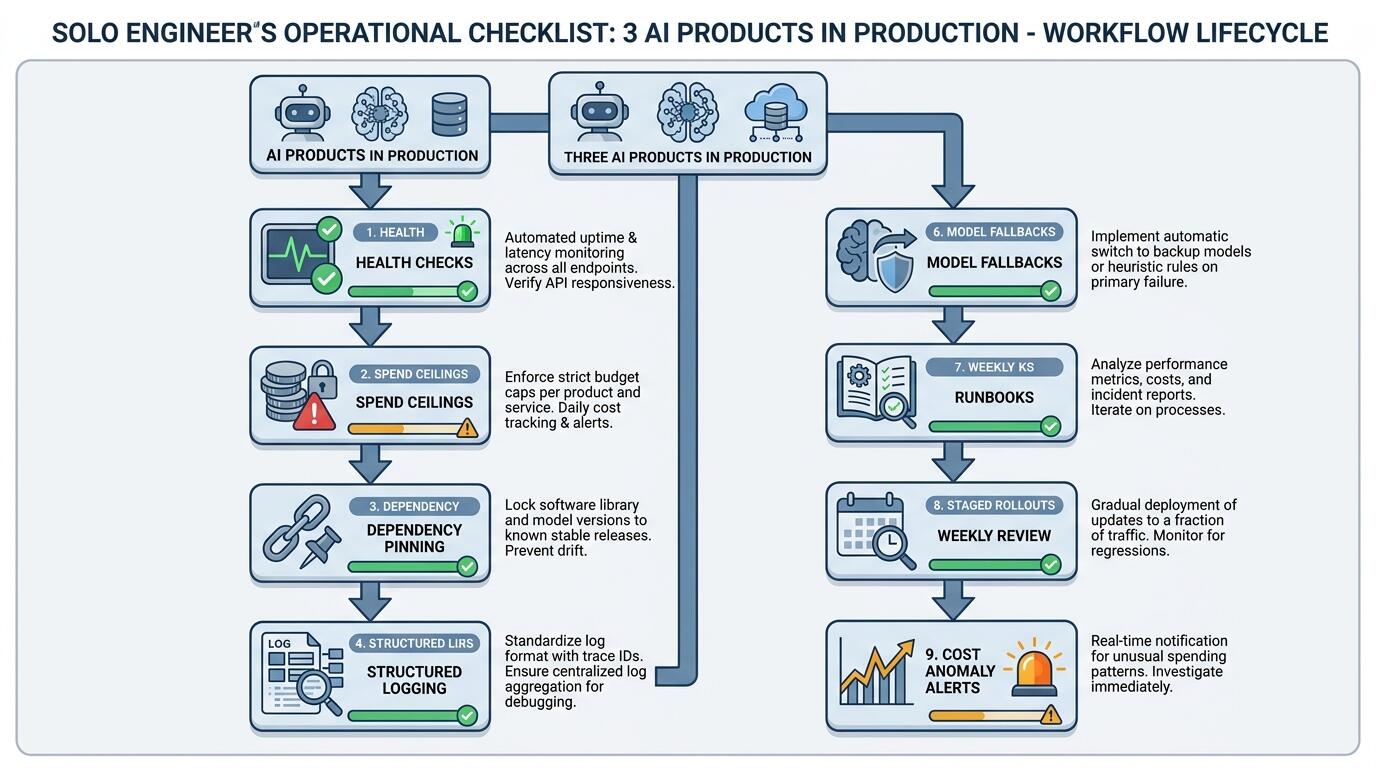
ALT: Diagram showing a solo engineer's operational checklist workflow for keeping three AI products reliable and online in production environments
Questions & Answers
Q1: How should a solo engineer prioritize reliability work when maintaining multiple AI products simultaneously?
Prioritize based on failure impact, not effort. Start with the two or three items that would cause the most user-visible harm or the fastest cost exposure if absent — typically per-product health checks, spend ceilings, and cost anomaly alerts. Once foundational detection is in place, move to response capability: runbooks and fallback configurations. Stage the rollout work last, as it requires the most infrastructure investment and pays back primarily in preventing future incidents rather than managing current ones.
Q2: Are per-product API keys and budget controls actually enforced by major AI API providers?
Most major AI API providers offer project-level or key-level usage controls, though the enforcement granularity and latency varies by provider. Hard spending caps — which reject requests once a threshold is reached — are generally available, while soft limits that alert without blocking may require additional configuration. The key discipline is not relying on provider-side enforcement alone: instrument your own spend tracking at the application layer so you have a signal that fires faster than the provider's billing aggregation window. Engineer this as a defense-in-depth approach rather than a single gate.
Q3: How much time does a weekly operational review actually take when managing three AI products?
A well-structured weekly review across three products typically takes thirty to forty-five minutes when your metrics infrastructure is in place. The time breaks down as roughly ten to fifteen minutes per product, covering error rate trends, cost trends, latency, and any user-reported issues. The review is significantly faster when you have a shared dashboard rather than navigating three separate monitoring tools. The investment in that dashboard setup pays back in every subsequent review. Without metrics infrastructure, the same review takes longer and produces less reliable conclusions.
The Bottom Line
Keeping three AI products online as a solo engineer is not a matter of heroic effort — it is a matter of systematic coverage. The three core points this checklist delivers are these: observability must be per-product rather than per-infrastructure-layer, because shared signals mask product-specific failures; cost controls must be enforced proactively rather than monitored retroactively, because AI API spend moves faster than billing cycles; and incident response must be documented in advance rather than improvised under pressure, because cognitive load during incidents is itself a failure mode.
The checklist is not something you implement once and archive. It is a live operational standard that needs review every time you make a significant architectural change, onboard a new model provider, or add a meaningful new user journey to any of the three products. Treat each item as a question you answer about your current system state, not a box you check once.
The engineers who sustain this kind of multi-product operation over time are the ones who invest in the boring, unsexy infrastructure — logging, runbooks, spend ceilings — before they need it, rather than after an incident makes the gap obvious. If you are building and operating AI products at this level of intensity, the insights published on Darius are written directly for your context.
If you are building AI products and want to stay current on the technical signals that actually matter in production, subscribe to the Darius bilingual AI newsletter — each issue selects five to ten AI developments anchored to primary sources, with hands-on interpretation from someone running real products with real users, real data, and real billing. Visit the Darius website to explore past issues and the engineering blog, and stay calibrated on this field alongside engineers who are doing the same work.
Sources & Further Reading
- IEEE (Institute of Electrical and Electronics Engineers). "IEEE Standards for Software and Systems Engineering — Reliability and Observability Practices".
https://www.ieee.org/ - NIST (National Institute of Standards and Technology). "Site Reliability and AI Systems Engineering Guidelines".
https://www.nist.gov/ - ISO (International Organization for Standardization). "ISO/IEC Standards for Information Technology — Service Management and Dependability".
https://www.iso.org/ - ACM (Association for Computing Machinery). "ACM Digital Library — Research on AI Systems Reliability, Cost Management, and Operational Engineering".
https://www.acm.org/
Note: Standards and guidelines may be updated; please check the latest official documents or consult professional advisors.