A Small Team's Guide to Fallback Design in Agent Systems

ALT: Small engineering team designing fallback logic for AI agent systems in production
What Fallback Design in Agent Systems Actually Gets You
The single question most small teams ask when operationalizing agents is: what happens when the agent fails? The honest answer is that without deliberate fallback design, an agent failure becomes a user-facing incident, a lost job, or a silent data corruption — none of which you find out about at a convenient time. This guide is for engineering teams of one to five people who are building or already running agent-based AI systems in production and need a realistic, cost-efficient approach to making those systems degrade gracefully rather than collapse completely.
Fallback design in agent systems is the discipline of specifying, in advance, what a system should do when any component — a model call, a retrieval step, a tool invocation, or an orchestration layer — produces an error, a timeout, or an output that fails a quality gate. Done well, it is the difference between a system that operators trust and one they babysit.
Before You Start: Prerequisites and Preparation for Fallback Planning
Effective fallback design begins before you write a single conditional branch. You need a clear picture of your agent's dependency graph, your team's operational capacity, and the failure modes that matter most to your users.
What you need going in:
A complete map of every external call your agent makes. This means every LLM API call (including which provider and which model tier), every vector store or search query, every downstream tool or webhook, and every structured data source. If you cannot draw this graph on a whiteboard in under ten minutes, you are not ready to design fallbacks — you are still in the mapping phase.
A written definition of acceptable output quality. Fallbacks trigger not only on hard errors (HTTP 500, connection timeout) but on soft failures: an LLM response that is too short, a retrieved document set that is below a relevance threshold, a parsed JSON object missing a required key. You need to decide what "good enough" looks like before you can detect that you have fallen below it.
An honest assessment of your team's on-call capacity. A fallback that requires human intervention within five minutes is not viable for a team of two with no dedicated ops rotation. Design your fallbacks to match the operational reality you actually have, not the one you wish you had.
A staging or shadow environment where agent runs can be replayed. You will iterate on fallback logic frequently; doing that iteration in production against live user traffic is a failure mode in itself.
Checklist before starting:
- Dependency graph of all external calls documented
- Quality criteria for each agent output type written down
- Failure budget defined: which failures are acceptable, which are user-facing
- Staging environment available for replay testing
- Basic structured logging in place (you need to observe failures before you can handle them)
- Team alignment on who owns fallback logic and who gets paged
Time investment is proportional to system complexity. A single-step agent with one LLM call and one retrieval step can have a solid fallback skeleton in a working day. A multi-step pipeline with parallel tool calls and conditional branching will take meaningfully longer, and that time is worth spending before, not after, your first production incident.
Step-by-Step Fallback Design for Agent Systems
Step 1: Classify Your Failure Modes Before Writing Any Code
The first step in fallback design is taxonomy, not implementation. Classify every failure your agent can encounter into one of three categories: hard failures (the system cannot proceed and must stop or escalate), soft failures (the system can proceed with degraded output), and silent failures (the system produces output that looks valid but is incorrect). Each category requires a different response strategy.
Hard failures include API unavailability, authentication errors, and unrecoverable parsing errors. Soft failures include low-confidence outputs, missing optional context, and partial tool results. Silent failures — the most dangerous — include hallucinated content that passes your output schema check, retrieved documents that are technically relevant but outdated, and truncated reasoning that produces a plausible-looking but wrong answer.
Tip: Most teams spend all their fallback effort on hard failures, because those are the ones that throw exceptions. Silent failures are usually where real product quality is lost. Build explicit quality checks — not just error catching — into every step.
Step 2: Define Fallback Tiers for Each Dependency
A fallback tier is a ranked list of alternatives the system tries in sequence when a dependency fails. For each external dependency in your agent, define at least two tiers: a primary path and a degraded path. For critical dependencies, define three.
For an LLM call, a common three-tier structure is: primary model (highest capability, highest cost), a smaller or alternative model from the same or a competing provider, and a rule-based or template response that makes no model call at all. The third tier sounds drastic, but for many agent tasks — summarization, classification, extraction — a deterministic fallback produces acceptable output far more often than you might expect, and it costs nothing to run.
For retrieval, the tier structure might be: primary vector search with reranking, keyword-based BM25 search without reranking, and a static FAQ or knowledge-base document served directly. For tool calls, tiers might be: live API call, cached result from the last successful call, and a graceful no-op that tells the agent to proceed without that tool's output.
Understanding where a drafting pipeline fails and what checks catch it is directly applicable here — the failure taxonomy from a content pipeline transfers well to any multi-step agent architecture.
Tip: Write the tier definitions as a configuration table, not as scattered conditionals in your code. A table is reviewable, testable, and changeable without touching orchestration logic.
Step 3: Implement Output Quality Gates at Each Step
Quality gates are programmatic checks that evaluate whether a step's output meets the minimum standard required to proceed. A quality gate is not the same as error handling — an LLM can return HTTP 200 and still produce output that should trigger a fallback.
For each agent step, define at least one quality gate. Simple gates check structural properties: does the output parse as valid JSON, does it contain required keys, is the response length above a minimum threshold? More sophisticated gates check semantic properties: does the output address the user's query, is the confidence score above a threshold, does the output contradict a known fact from your knowledge base?
The practical implementation for small teams is usually a lightweight validation function that runs immediately after each step and returns a pass/fail signal with a reason code. The reason code feeds into your logging system so you can see, at a glance, which quality gates are firing most often and what the distribution of failure reasons looks like.
Tip: Start with structural gates — they are cheap to implement and catch a surprisingly large percentage of actionable failures. Add semantic gates incrementally, prioritizing the steps where silent failures have caused real user impact.
Step 4: Design Your Escalation and Human-in-the-Loop Path
Every fallback chain needs a terminal state. When all tiers have been exhausted and quality gates are still failing, the system must do something deliberate: surface the failure to the user with a clear message, queue the job for human review, or write the failure to a dead-letter queue for later processing. Silently discarding failed jobs or returning empty results without any signal is not a fallback — it is a silent failure at the system level.
For small teams, the practical escalation path is often simpler than it sounds. A Slack message to a shared channel, a row written to a monitoring table, or a webhook to a lightweight alerting service is sufficient to start. The key properties are: the escalation must fire reliably (do not put it behind a condition that itself depends on the failing component), it must contain enough context to reconstruct what happened (input, step that failed, reason code, tier that was active), and it must be actionable by whoever receives it.
Human-in-the-loop design — where a human reviews and approves agent output before it is used — is underused as a fallback strategy because teams think of it as a performance cost. In practice, for low-volume but high-stakes agent tasks, human review as a fallback tier is both economically rational and a source of valuable training data.
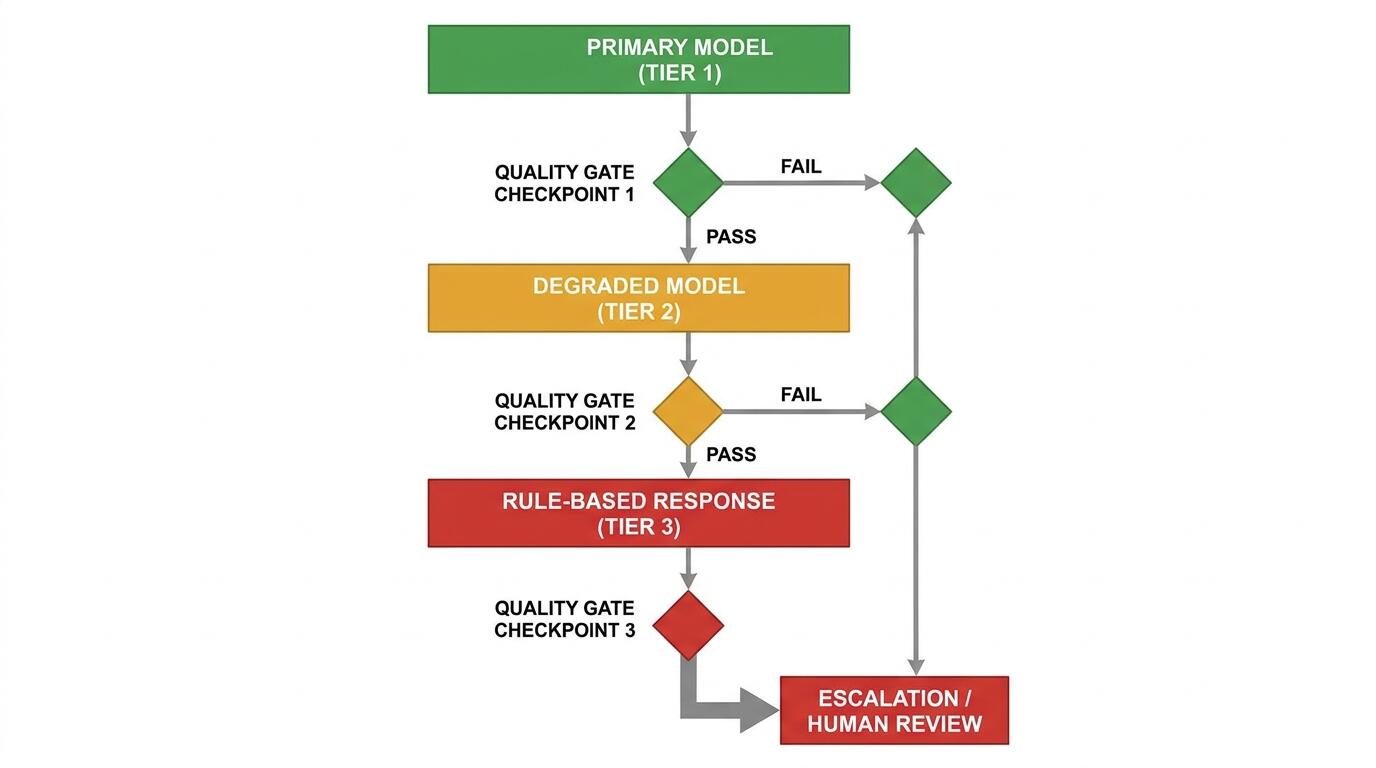
ALT: Diagram showing a three-tier fallback design in an AI agent pipeline, with quality gates at each step and escalation path for small engineering teams
Step 5: Build Replay and Recovery Capability from Day One
A fallback handles a failure in the moment. Replay capability handles it after the fact — it lets you re-run a failed agent job once the underlying problem is resolved, without requiring the user to resubmit or the operator to reconstruct the input manually.
Replay requires two things: durable storage of the original input and the step-level execution trace, and an idempotent agent implementation (running the same input twice produces the same output or at least does not produce a worse one). For small teams, this does not mean building a full workflow engine. It means storing the job input and a structured log of each step's input and output to a database or object store before the job begins, and designing each step so that partial progress can be resumed or safely re-run from the beginning.
The economic argument for replay is straightforward. Without it, every unrecoverable failure is a complete loss — the agent's work is discarded, the user is disrupted, and the cost of the failed run is sunk. With replay, a transient API outage becomes a delay, not a failure. For AI agents that involve meaningful compute or API spend per run, this matters to your unit economics in a direct way. The cost structure of running agents at scale makes clear how quickly unrecovered failures compound into real budget waste.
Tip: Store execution traces in append-only logs rather than mutable state. This makes replay logic simpler and gives you an audit trail for debugging without extra instrumentation.
Step 6: Test Your Fallbacks Deliberately and Regularly
Fallback logic that has never been exercised in a controlled setting will fail in an uncontrolled one. Build explicit fallback tests into your test suite — not just happy-path integration tests, but tests that intentionally inject failures at each dependency and verify that the correct tier activates and that the quality gate catches the right conditions.
For small teams without dedicated QA infrastructure, the minimum viable fallback test suite covers three scenarios: the primary path fails completely (API down), the primary path succeeds but output fails the quality gate, and all tiers exhaust without producing acceptable output. Each scenario should verify both the system's behavior (which fallback tier activated) and the operational signal (escalation fired with correct context).
Run these tests in CI against a mocked dependency layer. Do not rely on production incidents to exercise your fallback logic — that is an expensive and often embarrassing way to discover that your escalation path has a bug.
Tip: Chaos-style injection does not require a sophisticated framework at small team scale. Wrapping your API clients in a thin shim that can return configurable errors is sufficient and takes an afternoon to implement.
Step 7: Instrument, Observe, and Iterate Based on Real Failure Data
Fallback design is not a one-time design exercise. It is an ongoing operational practice informed by real failure data from production runs. Instrument your agent so that every fallback activation, every quality gate failure, and every escalation is recorded with enough context to analyze trends.
The metrics that matter most for small teams are: fallback activation rate by dependency (which dependency triggers fallbacks most often), tier distribution (how often users are getting degraded-tier output versus primary-tier output), and mean time to recovery after an escalation. These three numbers tell you where to invest your reliability work next. For teams operating agents at any meaningful volume, this kind of instrumentation is the foundation of a defensible reliability posture — and it directly informs how you think about shipping fast without compromising on output quality.
Tip: Review fallback activation data in your regular team sync, not just during incidents. Patterns that show up in weekly data are often signals of degrading upstream dependencies that will cause incidents if ignored.
Common Mistakes and Troubleshooting in Agent Fallback Design
| Symptom | Likely Cause | How to Fix |
|---|---|---|
| Fallbacks never activate, but users report bad outputs | Quality gates are checking structure only; silent failures pass undetected | Add semantic quality checks beyond schema validation; sample outputs manually on a regular cadence |
| Fallback activates but escalation is never received | Escalation path depends on the same failing component (e.g., a database write that is itself down) | Route escalation through a separate, independent channel; decouple the signal from the failing system |
| Agent retries indefinitely, causing cascading latency | Retry logic has no backoff or max attempt ceiling | Implement exponential backoff with jitter and a hard maximum retry count per tier |
| Replay fails because inputs are not stored before execution begins | Execution trace written after the first step, which already failed | Write the full input to durable storage atomically before any agent step begins |
| Fallback tier produces output that fails the same quality gate as the primary | Quality gate criteria are calibrated for primary-tier output quality, not for the degraded tier | Define separate, tier-appropriate quality thresholds; accept lower quality explicitly at lower tiers |
| Team cannot reproduce a production failure for debugging | Execution traces are incomplete or stored in mutable state that was overwritten | Use append-only logging for all step inputs and outputs; include correlation IDs that span the full run |
Pro Tips for Better Fallback Results
Treat your fallback configuration as a product artifact, not implementation detail. Fallback tiers, quality thresholds, and escalation routing should be defined in a versioned configuration that product stakeholders can read and approve. This surfaces assumptions that would otherwise live only in code and makes it much easier to update policy without code changes.
Prefer explicit degradation over silent degradation. When a user receives tier-two output, it is often better to tell them that the result was produced with reduced capability (and perhaps offer to retry later) than to serve the degraded output with the same confidence signal as primary output. This is counterintuitive — teams worry it will undermine trust — but in practice, transparency about degradation builds more durable trust than discovered inconsistency.
Model your fallback cost, not just your happy-path cost. The economic case for robust fallback design is often made in terms of reliability, but it is equally a cost argument. An agent that falls back to a cheaper model tier recovers gracefully and saves on API spend for the failure case. Build a simple cost model that accounts for the expected distribution of tier activations — it will change how you prioritize fallback investment.
Do not conflate retries with fallbacks. A common misconception is that retry logic is fallback design. Retries are appropriate for transient errors — a rate limit hit, a momentary timeout — where the same call is likely to succeed if attempted again. Fallback design handles structural failures where the same call is unlikely to succeed and a different strategy is needed. Conflating the two leads to retry storms against a degraded dependency and delayed escalation of real failures.
Version your fallback logic alongside your agent version. When you update your primary model or retrieval strategy, your fallback tiers may need to be updated too. A fallback that routes to a model that is no longer appropriate for the output quality you now expect is effectively no fallback at all. Treat fallback configuration as a first-class dependency of your agent, not an afterthought.
Questions & Answers
Q1: How do you decide which steps in an agent pipeline need fallback tiers versus just error handling?
Every step that can produce output used downstream — not just steps that call external APIs — needs a fallback plan. Error handling catches hard failures that throw exceptions; fallback design addresses the broader question of what happens when a step produces output that is structurally valid but substantively insufficient. Prioritize fallback design for steps where failure is invisible to the caller, where the downstream impact of bad output is high, and where the dependency has a history of unreliability in your environment.
Q2: Is it worth building fallback logic before your agent system has meaningful production traffic?
Yes, but scope it appropriately. Before reaching production volume, you should at minimum define your failure taxonomy, implement structural quality gates, and ensure that hard failures surface as explicit signals rather than silent no-ops. Full multi-tier fallback logic with semantic gates and replay capability can be added incrementally. The patterns described in this guide — particularly the dependency mapping and quality gate definitions — are design artifacts that take only a few hours to produce and save a disproportionate amount of incident response time later.
Q3: How much operational overhead does maintaining fallback logic add for a small team?
The upfront investment is real but bounded. Mapping dependencies, writing quality gate functions, and setting up basic instrumentation can typically be done within a few working days for a moderately complex agent. Ongoing maintenance is low if you treat fallback configuration as a versioned artifact and review the fallback activation metrics regularly. The hidden cost that catches teams off guard is not the maintenance — it is the incident response time saved, which does not appear in any upfront estimate but consistently justifies the investment once you have experienced your first complex failure without this infrastructure in place.
The Bottom Line
Fallback design in agent systems is not a luxury reserved for large engineering teams with dedicated reliability engineers. It is a foundational practice that small teams need precisely because they lack the operational capacity to absorb production incidents gracefully. The three things to hold onto from this guide are: classify your failures before you code your responses, define tiered alternatives for every external dependency rather than binary pass/fail handling, and instrument your fallbacks from day one so that real failure data drives your next iteration.
The next concrete action is to draw your agent's dependency graph, identify the three dependencies most likely to produce silent failures, and write quality gate definitions for each. That exercise alone, done before you write fallback code, will surface the assumptions that matter most and sequence your implementation work correctly.
For teams who want to go deeper on the operational patterns behind production AI systems — retrieval verification, agent pipeline design, and the real economics of running agents at scale — there is a growing body of first-hand engineering writing worth following.
If you are building AI products and want a curated, practitioner-written briefing on what actually matters in AI engineering, subscribe to the Darius bilingual newsletter and explore the engineering blog at Darius — every issue is selected and interpreted by an engineering director running multiple AI products in production, so you get signal without the noise.
Sources
- IEEE. "IEEE Standards for Artificial Intelligence — Reliability and Fault Tolerance Frameworks".
https://www.ieee.org/ - ACM. "ACM Digital Library — Research on Fault-Tolerant Distributed Systems and Agent Architectures".
https://www.acm.org/ - NIST. "NIST Artificial Intelligence Risk Management Framework".
https://www.nist.gov/
Note: Standards and frameworks may be updated; please check the latest official documents or consult professional advisors.