What Breaks First When One Person Owns Every Service
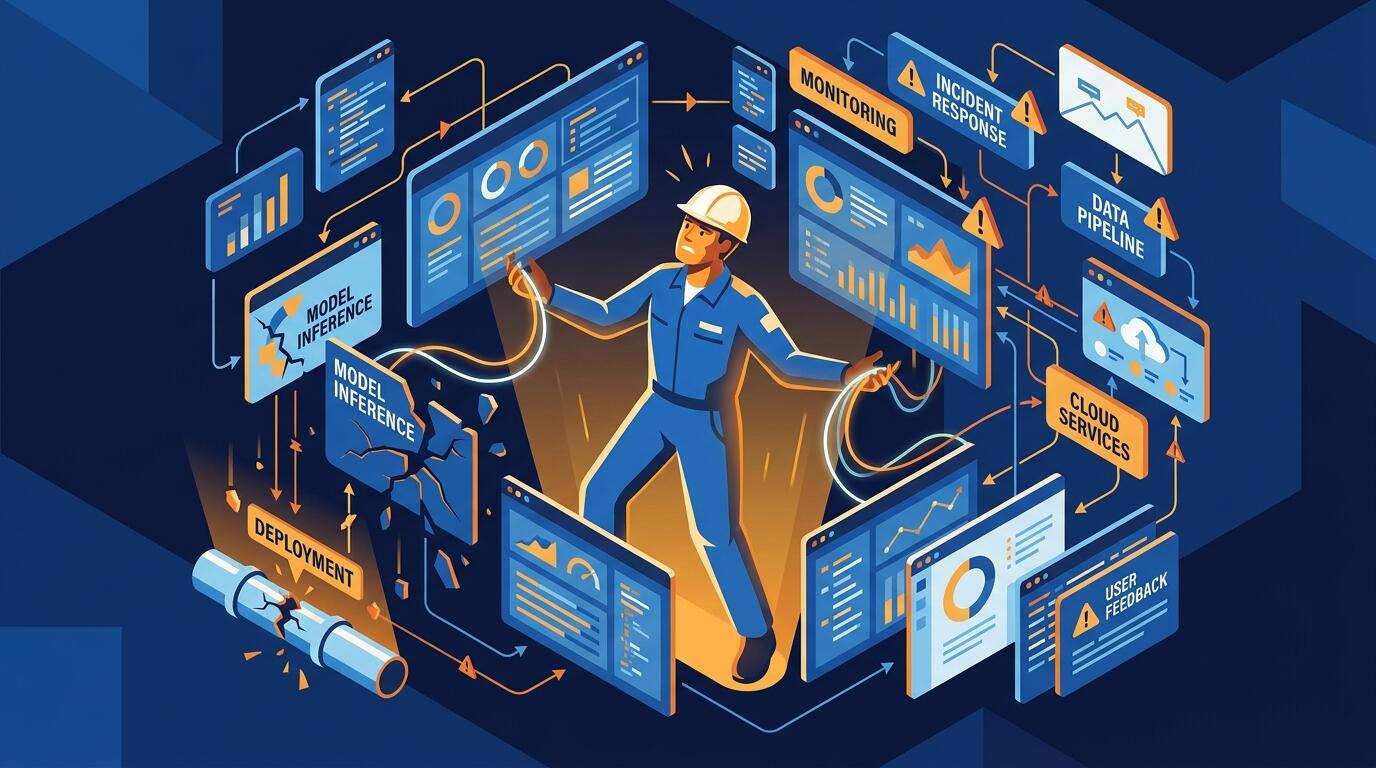
ALT: One engineer juggling multiple AI services, showing what breaks first under full ownership
When Single-Owner Service Models Begin to Crack
Single-owner service architecture — a setup where one person is fully responsible for designing, deploying, monitoring, and maintaining every service in a system — is a pattern that emerges naturally in small teams and solo AI projects. It feels efficient early on. There are no handoff delays, no coordination overhead, no conflicting opinions about how a pipeline should run. But a pattern we consistently see across AI product builds is that this arrangement holds together only until it doesn't, and when it breaks, it tends to break in the same places, in the same order.
This guide is for engineers, technical leads, and product builders who are either currently running every service themselves or are about to hand off ownership to a single person. Understanding where single-service ownership fails — and why it fails in that specific sequence — is the foundation for deciding how to structure your team before the cracks become outages.
Before You Start: Recognizing the Single-Owner Pattern in Your Stack
Single-owner service architecture is a system design where one individual holds operational accountability for every service — from ingestion pipelines and model inference layers to monitoring dashboards and incident response. Before diagnosing where it breaks, you need to confirm you are actually running this pattern.
What you need to assess beforehand:
A clear map of your services. List every distinct component your system relies on — not just the ones you built, but the third-party APIs, managed databases, scheduled jobs, and alert channels that connect them. Without this map, you cannot reason about ownership boundaries.
An honest account of who gets paged. When something fails at 2 AM, whose phone rings? If the answer is consistently one name, that is your single owner. If there is no on-call rotation because the team is too small to have one, that is also a single-owner signal.
Some baseline familiarity with service-level concepts. You do not need a formal SRE background, but you should understand what "service degradation" means versus "service failure," and how those two states produce different consequences for users.
An estimate of your current deployment cadence. How often do you push changes? How long does a rollback take? These determine how much blast radius a single owner is managing per week.
Checklist before starting:
- Map every service your system depends on, including upstream third-party dependencies
- Identify who holds operational accountability for each service today
- Document your current alert routing and on-call coverage
- Note which services have no runbook, no documentation, or no backup contact
- Assess your deployment frequency and mean time to recovery on recent incidents
The time investment for this assessment is modest — a few focused hours if your stack is small, longer if your services have grown organically without documentation. Do it before a production incident forces you to do it under pressure.
Diagnosing the Failure Sequence: How Single-Owner Ownership Collapses Step by Step
The failure of single-owner service models is not random. It follows a consistent sequence. Each step degrades a different capability, and each degradation makes the next one harder to recover from.
Step 1: Map the Hidden Knowledge Surface
The first thing that breaks is not uptime. It is knowledge distribution. When one person owns every service, the mental model of how the system works lives entirely in one head. Documentation, if it exists at all, lags behind reality because the owner always knows the current state and never feels the friction of being a newcomer to their own system.
To surface this risk concretely, ask the owner to write a runbook for any three services they manage — the kind of runbook a competent engineer with no prior context could use to diagnose and resolve a common failure at 3 AM. In our experience working with AI product teams, this exercise almost always reveals that the runbook does not exist, or that it describes a version of the service that no longer matches production.
Tip: Treat the absence of an accurate runbook as a production risk, not a documentation debt. Reschedule the conversation accordingly.
Step 2: Identify the Cognitive Load Ceiling
Cognitive load — the total mental effort required to hold the system's state, recent changes, pending incidents, and upcoming work in active memory — has a ceiling for any individual. Single ownership compounds this load rapidly as the number of services grows, because every service adds not just maintenance work but also ongoing mental overhead: remembering its quirks, its failure modes, its dependencies.
In practice, this ceiling shows up as subtle quality degradation before it shows up as a visible incident. Decisions get made with less deliberation. Changes get deployed with less review. Monitoring alerts get tuned more aggressively to reduce noise, which means real signals start getting suppressed. The owner is not cutting corners deliberately — they are rationing attention across more surface than one person can fully cover.
To identify where you are relative to this ceiling, count the number of distinct services your owner actively changes in any given month, and separately count the number of services they are expected to monitor but rarely touch. The second category is where surprises originate.
Tip: Services that are monitored but rarely changed are the most dangerous in a single-owner model. Familiarity fades, but accountability does not.
Step 3: Audit the Deployment and Rollback Pipeline
The third failure point is the deployment process itself. When one person owns every service, they typically also own the deployment tooling — which means the deployment process is often optimized for their specific workflow, their local environment, and their personal knowledge of undocumented steps. What looks like a clean CI/CD pipeline often has a critical manual step that only the owner knows to perform.
Audit your deployment pipeline by attempting a dry-run deployment with someone who has never touched that service before. Note every point where they would need to ask the owner a question. Each question is a single point of failure. If the owner is unavailable — on leave, ill, in a different time zone, or simply overwhelmed with another incident — that question has no answer.
For AI products specifically, this risk is compounded by the fact that model deployment often involves steps that are meaningfully different from standard software deployment: model registry interactions, prompt version management, embedding index updates. These steps are rarely covered by generic deployment documentation. For a deeper look at how these pipeline stages can fail and where checks should be inserted, the piece Where an AI Drafting Pipeline Fails, and the Checks That Catch It covers specific failure modes in AI-native pipelines that apply directly here.
Tip: A deployment pipeline that only works when the owner performs it is not a pipeline — it is a manual process with cosmetic automation around it.
Step 4: Stress-Test the Incident Response Coverage
Incident response is where single ownership produces its most visible failures. When one person is the designated expert for every service, any incident that occurs while they are unavailable becomes an incident without an owner. The team can observe the failure but cannot confidently intervene.
Stress-test this by running a tabletop exercise: simulate a mid-severity incident in one of your core services and ask the rest of the team to describe, step by step, how they would investigate and resolve it without the owner's involvement. Do not let the owner participate. The gaps in this exercise are your actual incident response coverage gaps.
For AI products, the incident response surface is wider than in traditional software because failures are often non-obvious. A model that returns subtly wrong outputs with high confidence looks healthy on standard infrastructure metrics — latency, error rate, throughput — but is silently degrading user trust. A single owner who is also handling three other priorities at the same time is unlikely to catch this early.
Tip: Non-obvious AI failures — model drift, prompt regression, retrieval quality degradation — require dedicated monitoring logic, not just infrastructure health checks.
Step 5: Assess Dependency on the Owner's External Relationships
Single owners of AI services frequently manage not just internal services but also the external relationships those services depend on: API vendor accounts, rate limit negotiations, support tickets with model providers, access to private beta features. These relationships are often informal and undocumented — they exist as email threads, Slack DMs, and verbal agreements the owner remembers.
When the owner leaves or is unavailable, these relationships do not transfer automatically. Access credentials may be tied to personal accounts. Vendor contacts may only recognize the owner's name. Rate limit exceptions negotiated informally may not be documented in any contract.
Audit every external dependency your system has and confirm that access, credentials, and contact information are stored in a location that does not require the owner to retrieve them.
Tip: External dependency documentation is the most commonly skipped audit item because it feels administrative. It becomes urgent exactly once — the day the owner is unavailable.
Step 6: Evaluate the Bus Factor of Your Knowledge Graph
The bus factor — a term used in software engineering to describe the minimum number of people whose sudden unavailability would put a project at serious risk — is often cited informally but rarely measured. For a single-owner service model, the bus factor is definitionally one. The question is not whether this is a risk but how large the blast radius is when it materializes.
To evaluate the blast radius, rank your services by two dimensions: how critical they are to user-facing functionality, and how much undocumented knowledge the owner holds about them. Services that score high on both dimensions are your highest-risk assets.
The tension between shipping speed and structural quality is real in this context — teams that move fast under a single owner often do so by accumulating exactly this kind of undocumented, person-specific knowledge. The speed is real. So is the risk.
Tip: A bus factor of one is not inherently a crisis — it is a known risk that needs to be explicitly managed, not ignored.
Step 7: Design the Transition Plan Before You Need It
The final step is not reactive — it is structural. Once you have mapped where single ownership is fragile, you need a transition plan that distributes knowledge and accountability before the failure occurs, not after. This is harder than it sounds because single owners often resist documentation efforts (time pressure) and knowledge-sharing sessions (perceived as inefficient) precisely because they are already overloaded.
The most effective transition plans we have seen work incrementally: pick the highest-risk service from your Step 6 ranking, pair the owner with a second engineer for the next incident in that service, require that both sign off on the next deployment, and make the runbook a precondition for any future change rather than a follow-up task. Repeat until the bus factor for that service is at least two.
For teams building AI products where the infrastructure is evolving rapidly, the decision about which services to build deep ownership around versus which to externalize is a recurring strategic question — the build vs. buy framework for AI infrastructure is a useful lens for deciding where internal ownership depth is worth the investment.
Tip: Transition plans that require the owner to do extra work on top of their current load will fail. Structure the transition as a replacement of existing work, not an addition to it.
Common Mistakes and Troubleshooting in Single-Owner Service Audits
| Symptom | Likely Cause | How to Fix |
|---|---|---|
| Runbooks exist but are consistently out of date | Owner updates the system but not the documentation because they never need the documentation themselves | Require runbook review as a merge requirement on any service change, not as a periodic task |
| Audit reveals no obvious gaps, but incidents keep happening | The audit was conducted with the owner present, who filled in missing context in real time | Repeat the audit without the owner — simulate their absence explicitly |
| Second engineer is assigned to a service but never actually intervenes | Ownership remains psychological with the original owner; the second engineer defers automatically | Require the second engineer to lead the next two deployments and the next incident response independently |
| External API access is documented but credentials are still in the owner's personal accounts | Access management was treated as an operations detail rather than an ownership risk | Migrate all credentials to team-managed vaults; audit that every external account has at least two team members with access |
| Monitoring alerts are mostly suppressed or routed to a single channel the owner ignores | Alert fatigue from an alert system tuned to minimize noise rather than surface real signals | Separate alert tiers by severity and route critical alerts to a channel the owner cannot mute unilaterally |
| Transition plan stalls after one service is documented | Owner returns to baseline workload and documentation effort is deprioritized | Make transition milestones part of sprint planning, not a background initiative |
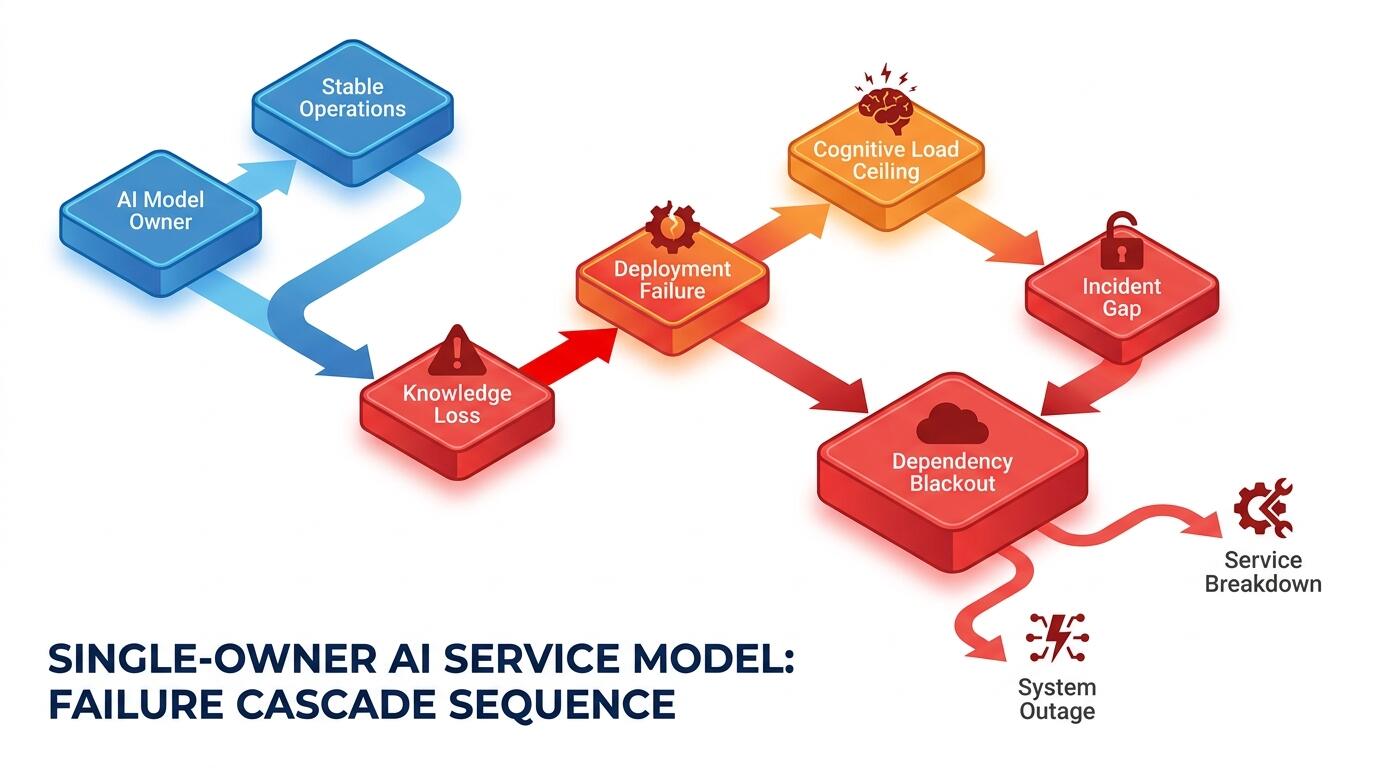
ALT: Diagram showing the failure cascade when one engineer owns every AI service in production, including knowledge gaps and deployment risks
Pro Tips for More Resilient Service Ownership Structures
Write documentation as if you will be hit by a bus on Friday. This is not a thought experiment — it is the actual standard that runbooks need to meet. If the document would require a phone call to interpret, it does not meet the standard. Test this by having someone unfamiliar with the service use the runbook without asking any questions and noting every point where they get stuck.
Ownership rotation at low stakes is better than ownership transfer at high stakes. Transferring a service during a crisis is the worst time to discover the gaps in documentation. Rotate ownership of low-criticality services on a regular schedule so that the team builds familiarity with services they do not currently own, before they need to own them under pressure.
Treat monitoring configuration as a first-class artifact. A common misconception is that monitoring is a supporting concern that can be set up once and left alone. In AI systems, monitoring configuration requires active maintenance — alert thresholds that were appropriate when the model was first deployed may no longer reflect current behavior after fine-tuning, prompt changes, or traffic shifts. Ownership of a service includes ownership of its monitoring logic.
Separate being the expert from being the only responder. The single owner should be the deepest expert on their services — that expertise is valuable and should be preserved. The problem is not expertise concentration; it is response concentration. Structure on-call so that a non-expert can perform initial triage and escalate, rather than requiring the expert to be the first responder for every issue.
A common misconception to address directly: many teams assume that single-owner service models are a temporary state that will naturally resolve as the team grows. In practice, the knowledge asymmetry that accumulates under single ownership tends to deepen over time, not self-correct. The owner's advantage compounds — they know the system better and better, which makes it less and less likely that anyone else will successfully take ownership of any part of it. The transition plan must be deliberate and scheduled, not anticipated as a natural evolution.
Questions and Answers
Q1: How do you know when a single-owner service model has become structurally risky rather than just inefficient?
Single-owner service architecture becomes structurally risky — as opposed to merely inefficient — when the owner's absence for any reason would prevent the team from safely deploying, monitoring, or recovering any service. The practical test is straightforward: ask whether a competent engineer on your team, given access to your documentation, could handle a mid-severity incident in your three most critical services without contacting the owner. If the honest answer is no, the model has crossed from inefficient to risky.
Q2: Is distributing service ownership always worth the overhead in small or early-stage AI teams?
Distributing ownership does carry real overhead — shared context, coordination time, joint decision-making. For very early-stage teams running a single AI product with a small number of services, concentrated ownership is often a rational tradeoff. The tipping point occurs when the number of services or the criticality of individual services grows to the point where the owner's unavailability would produce a customer-facing impact. At that point, the overhead of distributed ownership is lower than the risk of a concentrated single point of failure. The U.S. Small Business Administration's guidance on business planning explicitly identifies key-person dependency as a structural business risk worth addressing proactively.
Q3: How long does it realistically take to reduce a bus factor of one to a bus factor of two for a complex AI service?
Reducing the effective bus factor for a single complex AI service — one with undocumented deployment steps, informal external dependencies, and service-specific monitoring logic — typically requires sustained effort over multiple sprint cycles, not a single documentation sprint. The timeline depends heavily on how much undocumented knowledge exists and how available the original owner is to transfer it. Teams that integrate this as part of regular sprint work, rather than treating it as a one-time project, tend to make more durable progress. Expect the first service to take longer than subsequent ones, as the process itself needs to be established before it can be repeated efficiently.
Final Thoughts
Single-owner service architecture is a pattern that solves a real problem — coordination overhead — by creating a different, less visible problem: concentrated fragility. The core insight is that what breaks first is not uptime. It is knowledge. And knowledge failures cascade into deployment failures, incident response gaps, and external dependency blackouts long before any infrastructure metric reflects the problem.
Key takeaways:
- The first thing that fails in a single-owner model is knowledge distribution, not system availability
- Cognitive load ceilings produce subtle quality degradation before visible outages
- Deployment pipelines that only work when the owner executes them are not automated — they are manual processes with automation aesthetics
- Non-obvious AI failures require dedicated monitoring logic that a single overloaded owner is unlikely to maintain accurately over time
- Transition plans must be deliberate and scheduled; knowledge asymmetry compounds over time rather than self-correcting
If you recognize your team's current state in any of the steps above, the next concrete action is the audit in Step 1: map your services, map your ownership, and identify which services would be unrecoverable without the current owner's direct involvement. That map is the foundation for every structural decision that follows.
If you are building AI products and need a reliable signal on how engineering teams are solving these ownership and architecture problems in production today, Darius filters the AI developments worth your attention each week, with first-hand judgment from engineers running real systems — not editorial opinion. Visit the Darius briefing to subscribe and get each issue delivered with source links and practical context you can act on directly.
Sources and Further Reading
- UK Department for Education Digital. "Top tips on service ownership".
https://dfedigital.blog.gov.uk/2020/02/06/top-tips-on-service-ownership/ - U.S. Small Business Administration. "Plan your business".
https://www.sba.gov/counseling/plan-your-business/ - IEEE — Institute of Electrical and Electronics Engineers. Standards and technical guidance on software engineering practices and systems reliability.
https://www.ieee.org/
Note: Standards and official guidance may be updated; please verify the latest documents directly with the issuing organization or consult qualified advisors.