Semantic Search at Scale: What It Really Costs to Index 10,000 Files Today

ALT: Semantic search at scale indexing 10,000 files with vector embeddings and AI architecture cost analysis
The Real Economics of Semantic Search at Scale — What No One Tells You Before You Index
Semantic search at scale is one of those capabilities that looks elegant in a demo and brutally expensive in production. The moment you move beyond a few hundred documents and start thinking about indexing tens of thousands of files, a set of cost and architecture decisions emerge that most tutorials simply skip. If you're a startup founder, CTO, or product engineer evaluating whether to build a document intelligence feature, a codebase search tool, or a knowledge retrieval system, this article is the honest breakdown you need before committing resources.
The core conclusion: indexing ten thousand files with semantic search is achievable for most teams, but the true cost is rarely just the embedding API bill. It spans compute, storage, re-indexing overhead, latency requirements, and — often most expensively — the engineering hours required to get retrieval quality to a level your users will actually trust. Getting these tradeoffs right from the start is the difference between a feature that ships and one that stalls in a prototype.
Who Should Read This — and Who Shouldn't
Applicable Scenarios:
- Teams actively planning a retrieval-augmented generation (RAG) pipeline, document search product, or enterprise knowledge base that will index thousands of files
- Engineering leads who need to present an infrastructure cost estimate to stakeholders before committing to a build
- Founders evaluating whether to build semantic search in-house or procure a managed solution for their AI product
Not Applicable/Cautions:
- Teams with fewer than a few hundred documents — at that scale, a traditional keyword search may deliver better results with far less overhead, and the economics of semantic indexing rarely justify themselves
- Projects where documents change so frequently (think near-real-time data feeds) that the re-indexing cost structure described here becomes a moving target requiring a fundamentally different architecture
What Semantic Search Actually Means — and Why Scale Changes Everything
Semantic search is a retrieval method that finds documents based on meaning rather than exact keyword matches. Unlike traditional full-text search — which looks for literal string overlap — semantic search converts both your query and your documents into high-dimensional numerical vectors called embeddings, then finds documents whose vectors are closest to the query vector in that space. The result is a system that can match "quarterly revenue decline" to a document discussing "falling sales figures," even if the words never overlap.
This distinction matters enormously in practice. A pattern that emerges consistently in work with clients building document retrieval systems is that teams underestimate semantic search precisely because the demo looks so simple: upload a few files, call an embedding API, run a vector similarity search, and retrieval feels magical. The complexity — and the cost — only becomes visible when you try to do that reliably for ten thousand files and keep it working over time.
According to research published by Towards Data Science on scaling semantic search to millions of documents, the architecture decisions made at the indexing stage are the primary determinant of both retrieval quality and long-term operational cost. The choice of embedding model, chunking strategy, vector store, and indexing pipeline design all compound one another — a suboptimal choice in one layer creates rework across all others.
The current landscape of embedding providers, vector databases, and open-source tooling has matured significantly, which is genuinely good news. But that maturity has also produced an overwhelming menu of options, each with different cost profiles, latency characteristics, and quality trade-offs. For a team indexing ten thousand files today, navigating that menu without a clear framework is where engineering time and budget quietly disappear.
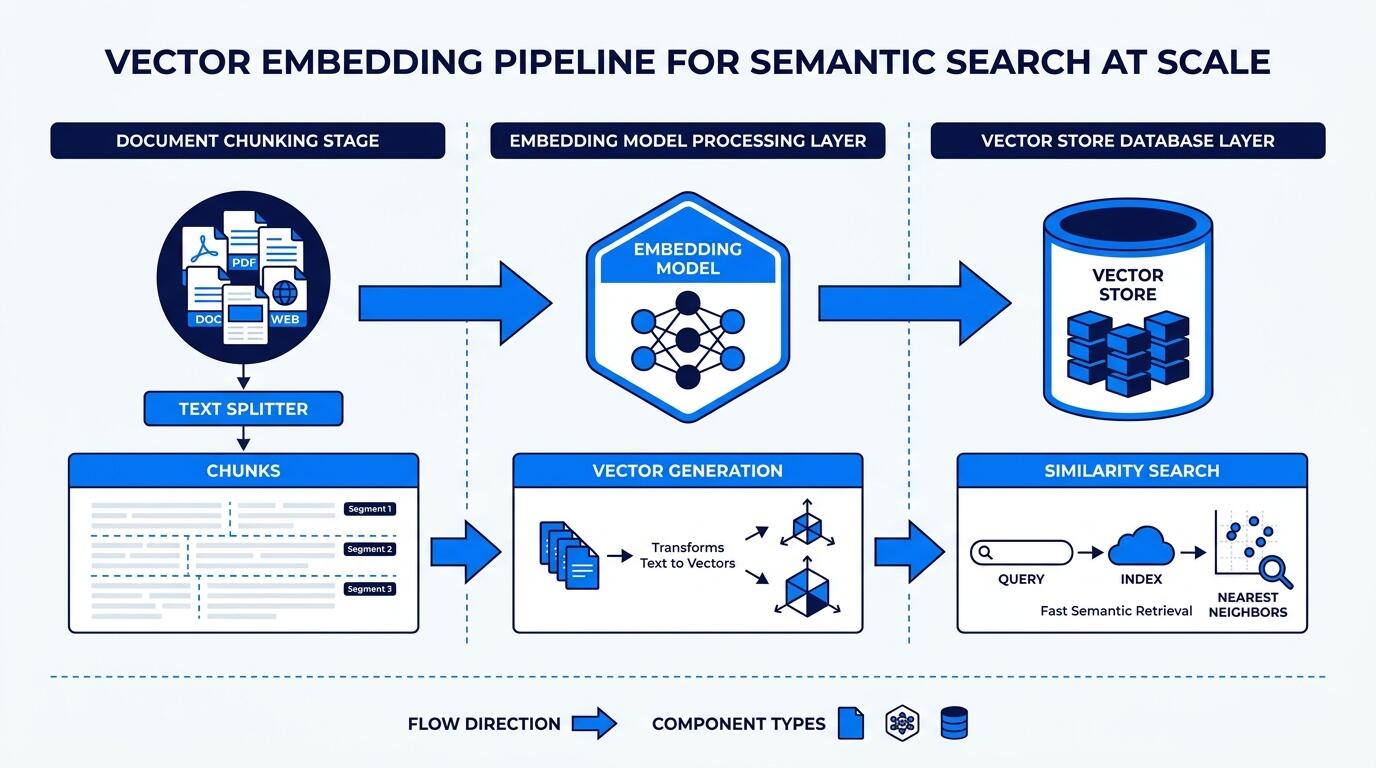
ALT: Vector embedding pipeline architecture for semantic search at scale showing chunking, embedding model, and vector store layers for document indexing
Breaking Down the True Cost of Indexing 10,000 Files
Getting Started: Three Steps to a Realistic Cost Estimate
Step 1: Audit Your Document Corpus
Before touching any tooling, spend time characterizing your ten thousand files. How large is each file on average? What formats are they in — PDFs, Word documents, plain text, Markdown, HTML? Are they clean text or do they require OCR (optical character recognition, the process of converting scanned images to text)? This audit typically takes a day or two but directly shapes every downstream cost. A corpus of ten thousand dense PDFs with tables and images has a radically different processing profile than ten thousand short Markdown notes.
Step 2: Choose Your Chunking Strategy and Estimate Token Volume
Chunking is the process of splitting each document into smaller segments before embedding them — because embedding models have input size limits, and smaller, more focused chunks generally produce better retrieval results. A common approach is fixed-size chunking with overlap (e.g., splitting by paragraph or sentence groups). The output of your chunking strategy determines your total token count, which is the primary billing unit for commercial embedding APIs. Estimating this accurately before you run the pipeline is the single most impactful cost-control step.
Step 3: Model a Full Lifecycle Cost, Not Just the First Run
The first indexing pass is one-time. But documents change, new files arrive, and embedding models get updated. Build a model that accounts for re-indexing frequency — even a modest weekly refresh cadence on a large corpus can make your monthly embedding cost significantly higher than the initial one-time index. Factor in vector storage, query-time compute, and the engineering hours to maintain the pipeline. This full-lifecycle view is what makes the real cost visible.
Comparing the Major Cost Layers in Semantic Indexing at Scale
Every semantic search system at scale involves the same fundamental layers. The cost profile of each layer differs substantially depending on the architectural choices made. The table below maps the major layers to their cost drivers and key trade-offs across three representative approaches: fully managed cloud (using a provider like OpenAI for embeddings and a managed vector database), self-hosted open-source (running an open-source embedding model and vector store on your own infrastructure), and a hybrid approach.
| Cost Dimension | Fully Managed Cloud | Self-Hosted Open-Source | Hybrid Approach |
|---|---|---|---|
| Embedding generation cost | Pay-per-token API pricing; predictable but can be significant at scale | GPU/CPU infrastructure cost; high upfront, lower per-document over time | API for critical paths; self-hosted for bulk re-indexing |
| Vector storage cost | Managed vector DB subscription (e.g., Pinecone, Weaviate Cloud); scales with index size | Infrastructure cost for self-hosted Weaviate, Qdrant, or Milvus; more control | Mix of managed and self-hosted tiers based on query frequency |
| Retrieval latency | Generally excellent; providers optimize for this | Depends heavily on infrastructure sizing; tunable but requires effort | Can be optimized per use-case with careful routing |
| Re-indexing flexibility | Limited by API rate limits and cost per token | High flexibility; no per-token charge for re-runs | Moderate; batch re-indexing self-hosted, incremental via API |
| Engineering maintenance overhead | Low; provider handles model updates and scaling | High; your team owns upgrades, monitoring, and performance tuning | Medium; split responsibility by layer |
| Retrieval quality ceiling | Tied to provider's model choices; high baseline quality | Dependent on model selection; can match or exceed managed if tuned well | Potentially highest; best model per task with full control |
The pattern that consistently emerges in work with clients at this scale is that teams optimizing purely for minimizing the initial embedding API bill often underestimate vector storage costs and, especially, re-indexing overhead. A system that re-embeds frequently because of document churn can accumulate API costs that dwarf the first-run bill within a few months.
Understanding the Hidden Cost Layers
Chunking quality has a direct impact on retrieval cost. Poor chunking — for instance, splitting documents at arbitrary character counts that break sentences mid-thought — produces embeddings with degraded quality, which means your retrieval system needs to retrieve more candidates to find the right answer, which increases query-time latency and, in some architectures, cost. According to LlamaIndex's documentation on semantic search over documents, chunk size and overlap strategy are among the most impactful parameters for retrieval precision, and they cannot be set once and forgotten — they often need iteration as you understand your corpus better.
Metadata filtering reduces retrieval cost at query time. A semantic search system that can first filter by structured metadata (document type, date range, department, or owner) before running vector similarity search operates on a much smaller candidate set. This is a design pattern that pays compounding dividends at scale: as your index grows from ten thousand to fifty thousand documents, metadata pre-filtering keeps query latency and compute cost from growing proportionally. Building metadata extraction into your ingestion pipeline from day one is one of the highest-leverage architectural investments you can make.
Hybrid search — combining semantic and keyword retrieval — is increasingly the production standard. As noted in "Semantic Search: How It Works and Why Hybrid Wins" from The AI Engineer Substack, pure vector similarity search can miss exact-match queries that keyword search handles trivially (product codes, names, identifiers). A hybrid system that blends BM25 (a standard keyword ranking algorithm) with vector similarity retrieval generally outperforms either alone. The cost implication: hybrid search requires maintaining two parallel indices, which adds storage and complexity. But the retrieval quality improvement is typically worth it for production systems serving real users.
Embedding model selection is a long-term bet, not a one-time pick. The embedding model you choose determines how you encode both your documents and your queries. Switching models later means re-embedding your entire corpus — which at ten thousand files is manageable, but at hundred-thousand scale becomes a significant cost event. Evaluating models rigorously before committing, including running retrieval quality benchmarks on a sample of your actual corpus rather than relying solely on public leaderboards, is a practice that distinguishes teams who ship stable systems from those who find themselves re-architecting six months in. For a deeper look at how to approach this kind of tooling evaluation before committing, the guide on how to evaluate AI development tools before signing a contract provides a practical framework for exactly this decision.
Ingestion pipeline reliability is an operational cost that rarely appears in initial estimates. Ten thousand files rarely arrive as a clean batch. In practice, file formats are inconsistent, some documents fail to parse, OCR quality varies, and the pipeline needs error handling, retry logic, and observability. Teams building machine learning pipelines that scale past prototype stage understand that the ETL (extract, transform, load) layer — the part that processes raw files into clean chunks ready for embedding — is often where the most engineering hours are actually spent. Budget for it explicitly.
Advanced Considerations: When Standard Approaches Break Down
Multilingual corpora require explicit model selection. Many embedding models are trained primarily on English text and degrade noticeably on other languages or mixed-language documents. If your ten-thousand-file corpus spans multiple languages, you need an embedding model with documented multilingual support, and you should benchmark retrieval quality per language, not just overall. Treating multilingual retrieval as a simple add-on to an English-optimized system is a pattern that reliably produces poor user experience in production.
Long documents require a retrieval architecture decision, not just a chunking decision. A common misconception is that chunking "solves" the long document problem. In reality, chunking transforms it into a different problem: how do you ensure that when a relevant chunk is retrieved, the surrounding context needed to answer the query is also available? Approaches like parent-document retrieval (retrieving the parent document when a child chunk matches) and sentence-window retrieval (expanding retrieved chunks with neighboring sentences) add architectural complexity but significantly improve answer coherence for long-form content.
The build-vs.-buy question deserves a dedicated analysis at this scale. At ten thousand files, both paths are viable, but the right answer depends heavily on your team's machine learning infrastructure experience, your sensitivity to vendor lock-in, and your expected index growth rate. The decision framework for building vs. buying AI infrastructure is worth working through explicitly rather than defaulting to whichever option feels most familiar.
Re-indexing triggers need to be explicitly designed. A common misconception is that a semantic index is built once and remains valid. In practice, indexes need updates when documents change, when new files arrive, when the embedding model is updated, or when retrieval quality degrades below an acceptable threshold. Without explicit re-indexing triggers and a monitoring strategy, indexes silently go stale, and retrieval quality degrades in ways that are frustratingly hard to diagnose.
Frequently Asked Questions FAQ
Q1: How do I estimate the embedding API cost for indexing 10,000 files before I run the pipeline?
Estimating embedding cost before running the pipeline starts with sampling. Take a representative subset of your documents — across different file types and lengths — run them through your chunking strategy, and measure the average token count per document. Multiply that average by your total document count to estimate total tokens. Then apply the pricing from your chosen embedding provider. Running this estimate on a sample rather than guessing from document count alone typically produces a cost estimate accurate enough to inform architectural decisions.
Q2: Is a managed vector database always the right choice for a ten-thousand-file index?
A managed vector database is not always the right choice — it depends on your team's operational maturity and expected growth. At ten thousand files, a well-configured self-hosted vector store such as Qdrant or Weaviate running on modest infrastructure handles the index comfortably, and the operational overhead is manageable for a team with basic DevOps experience. The case for managed solutions strengthens when the index is expected to grow substantially, when the team lacks infrastructure expertise, or when retrieval latency SLAs (service level agreements — defined performance guarantees) are strict and unpredictable traffic patterns make self-hosted capacity planning difficult.
Q3: How long does it typically take to build and validate a semantic search pipeline for 10,000 files?
The initial indexing pipeline — from raw files to a queryable vector index — can be assembled in days by an experienced engineer using current tooling. The harder part is achieving retrieval quality that satisfies real users, which typically requires multiple iteration cycles on chunking strategy, embedding model selection, and retrieval configuration. A realistic timeline from first commit to a production-quality system is several weeks to a few months, with the variance driven almost entirely by corpus complexity, retrieval quality requirements, and the team's prior experience with vector search infrastructure.
Summary
Indexing ten thousand files with semantic search is not a moonshot — current tooling makes it accessible to any engineering team with reasonable AI infrastructure experience. But the total cost of doing it well is consistently higher than the embedding API bill alone suggests. Three points bear repeating:
First, the architecture decisions made at ingestion time — chunking strategy, embedding model selection, metadata design — have compounding effects on both retrieval quality and long-term operational cost. Getting them right early avoids expensive rework.
Second, hybrid search combining vector similarity with keyword retrieval is the production standard for good reason. Building toward it from the start, rather than treating it as a future upgrade, produces a system that handles the full range of real user queries.
Third, re-indexing is a recurring operational cost, not a one-time event. Designing explicit triggers, monitoring for retrieval quality degradation, and budgeting engineering time for pipeline maintenance are what separate systems that remain useful from those that quietly become liabilities.
If you're in the planning stage for a semantic search system, the next concrete step is a document corpus audit paired with a small-scale retrieval quality benchmark on your actual data — not a proof of concept on sample data from a tutorial.
Ready to move from planning to shipping? Explore production AI architecture, systems design insights, and real-world engineering perspectives at the Darius website — built by a practitioner who has shipped live AI-powered products and can help you do the same.
Sources & Further Reading
- Towards Data Science. "Master Semantic Search at Scale: Index Millions of Documents with Lightning-Fast Inference Times".
https://towardsdatascience.com/master-semantic-search-at-scale-index-millions-of-documents-with-lightning-fast-inference-times-fa395e4efd88/ - LlamaIndex. "What Is Semantic Search Over Documents?".
https://www.llamaindex.ai/glossary/semantic-search-over-documents - The AI Engineer Substack. "Semantic Search: How It Works and Why Hybrid Wins".
https://theaiengineer.substack.com/p/what-is-semantic-search-f45 - IEEE. IEEE Standards and Technical Publications on Information Retrieval and AI Systems.
https://www.ieee.org/ - ACM (Association for Computing Machinery). Research and Publications on Information Retrieval, Vector Search, and AI Systems.
https://www.acm.org/
Note: Standards and best practices in AI and vector search evolve rapidly. Verify current model benchmarks, API pricing, and tooling recommendations against official provider documentation and up-to-date research before making infrastructure commitments.