How to Build Machine Learning Pipelines That Scale Past Prototype Stage

ALT: Engineering team building scalable machine learning pipelines beyond prototype stage into production systems
What You'll Achieve: Production-Grade ML Pipelines That Actually Scale
Key Conclusion: Building machine learning pipelines that scale past the prototype stage requires deliberate architectural decisions, not just better models. This guide walks through the engineering disciplines — from data versioning and modular orchestration to monitoring and deployment automation — that separate a weekend demo from a production ML system capable of handling real-world load, team growth, and evolving requirements.
Every ML project starts the same way: a Jupyter notebook, a promising accuracy metric, and genuine excitement. The problem is that most teams treat the prototype as the foundation, then wonder why everything breaks when they try to scale. This guide is for founders, CTOs, and engineers who are past that excitement and ready to build ML infrastructure that actually works in production.
Before You Start: Prerequisites and Preparation for Scaling ML Pipelines
Scaling a machine learning pipeline is not primarily a modeling problem — it is a systems engineering problem. Before diving into the steps below, you need an honest assessment of where your current pipeline stands and what gaps exist between your notebook experiments and a production-grade system.
What you need to bring to this process:
A working prototype is the minimum starting point. You should have at least one trained model producing meaningful outputs, a defined problem statement, and some understanding of how your system will be consumed — whether via API, batch job, embedded inference, or otherwise. Equally important is clarity on your data: where it comes from, how frequently it changes, and who owns it.
On the tooling side, you do not need a specific stack, but you do need familiarity with version control (Git at minimum), a basic understanding of containerization (Docker is the industry standard), and exposure to at least one cloud platform or on-premise compute environment. Teams that have never thought about infrastructure will face a steeper ramp — that is fine, but be honest about it.
From a team perspective, someone needs to own the reliability of the pipeline, not just the accuracy of the model. In a pattern seen consistently across early-stage AI teams, the most common failure mode is a data science team that ships a model with no one assigned to keep it running. Define ownership before you build.
Effort and timeline: Scaling an ML pipeline from prototype to production is a meaningful investment. The complexity depends on data volume, team size, and system requirements — but plan for iterative progress rather than a single "production launch" event.
Checklist before starting:
- A trained, evaluated model with documented performance characteristics
- Source data accessible and queryable in a consistent format
- Version control in place for code (and ideally for data and model artifacts)
- At least one team member accountable for infrastructure and reliability
- A defined inference interface — batch, real-time API, or embedded
- Basic observability tooling in your environment (logs, at minimum)
- Clear understanding of your scaling trigger — traffic volume, data freshness, team size, or compliance requirements
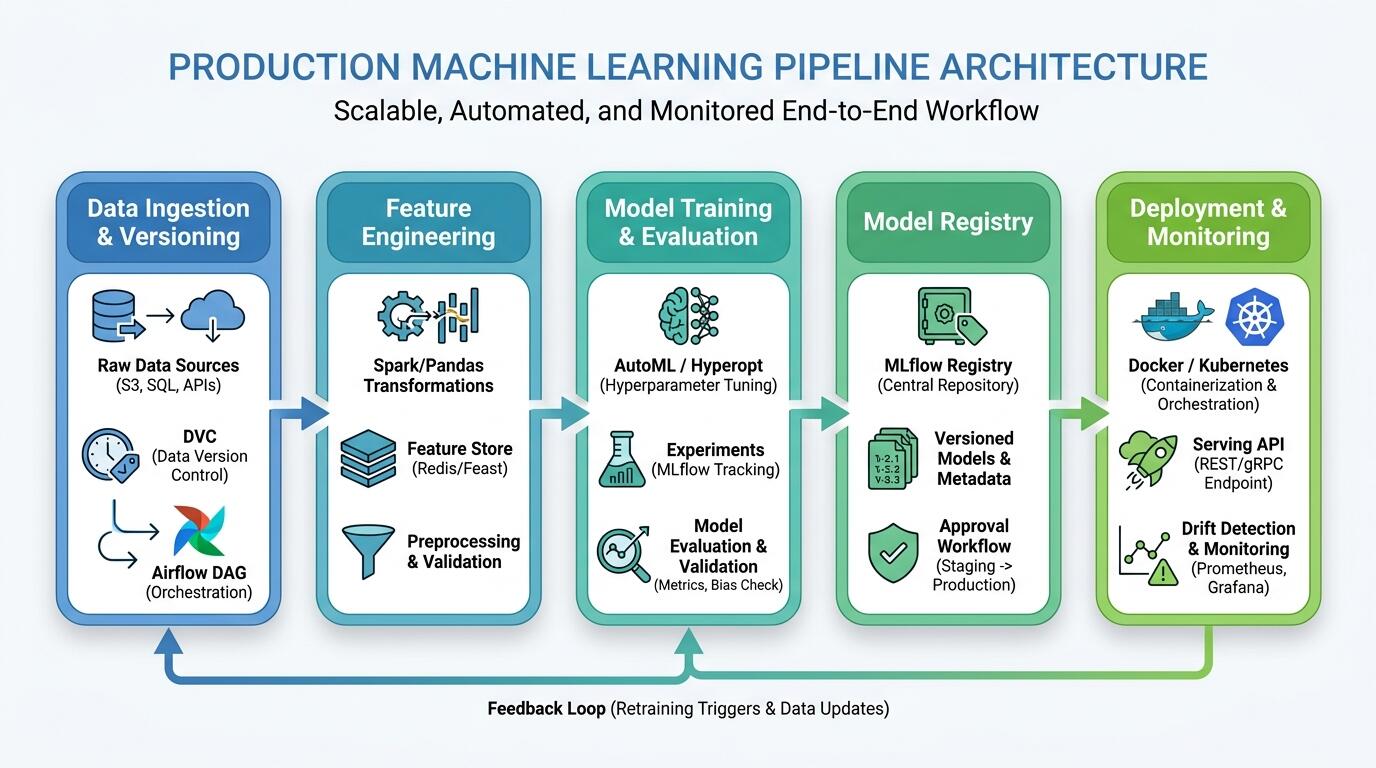
ALT: Architectural diagram of a production machine learning pipeline with data versioning, orchestration, model registry, deployment, and monitoring components
Step-by-Step: How to Build Machine Learning Pipelines That Scale Past Prototype Stage
The following steps represent the engineering sequence that separates durable ML systems from brittle ones. In practice, these steps are often iterative — you may revisit earlier ones as your system matures — but the order reflects logical dependency.
Step 1: Decouple Your Data Layer from Your Training Code
The first and most consequential architectural decision in a production ML pipeline is treating data as a versioned, independent artifact — not a static file your training script reads from disk.
In prototype environments, data handling is typically hardcoded: a CSV path, a database query embedded in a notebook, or a static S3 prefix. This works once. It fails repeatedly. At scale, your training data will change — new records arrive, labels get corrected, upstream systems evolve. If your training code is tightly coupled to a specific data state, you lose the ability to reproduce past experiments or trace failures back to their source.
The solution is to adopt a data versioning strategy. Tools built around this concept (such as DVC, or data versioning layers within MLflow) let you track exactly which dataset snapshot trained which model. Per guidance from the IEEE on reproducible ML systems, reproducibility requires not just code versioning but data and environment versioning in tandem.
Tip: Start by defining a clear data contract — the expected schema, data types, null handling rules, and update frequency — for every dataset entering your pipeline. Enforce this contract with validation checks before any training run begins.
Step 2: Modularize Your Pipeline into Discrete, Testable Components
A production ML pipeline is not a script — it is a directed graph of discrete components, each with defined inputs, outputs, and failure behavior. Modularization is what makes a pipeline testable, debuggable, and maintainable as team size and complexity grow.
Break your pipeline into at minimum four logical components: data ingestion and validation, feature engineering, model training and evaluation, and artifact packaging. Each component should be independently runnable, independently testable, and independently deployable. If changing your feature engineering logic requires you to rerun data ingestion, your pipeline is not modular enough.
In working through this challenge with teams building their first production AI systems, the pattern that emerges consistently is that early-stage pipelines treat feature engineering and model training as a single step. Separating them — and explicitly persisting the feature store output as a versioned artifact — dramatically reduces debugging time when model performance degrades.
Tip: Write unit tests for each component in isolation before wiring them together. A component that cannot be tested in isolation will be nearly impossible to debug in a composed pipeline.
Step 3: Adopt a Pipeline Orchestration Framework
Pipeline orchestration is the practice of scheduling, sequencing, and managing dependencies between pipeline components in a way that handles failures gracefully and supports observability. Without orchestration, production ML pipelines are managed through cron jobs, shell scripts, and tribal knowledge — all of which fail at scale.
Orchestration frameworks — Apache Airflow, Prefect, Kubeflow Pipelines, and Metaflow are widely adopted examples — provide DAG-based workflow definitions, retry logic, logging, and dependency management out of the box. The choice of framework matters less than the discipline of using one. Pick the tool that fits your team's existing infrastructure and skill set; avoid the temptation to build a bespoke orchestrator.
The key architectural principle here is that your orchestrator should own scheduling and dependency resolution, but not business logic. Orchestration code should read like a configuration — which steps run, in what order, with what retry policy — not like implementation code.
Tip: Define your pipeline as code from day one, even if you are starting with a simple two-step flow. A pipeline defined in code is versioned, reviewable, and reproducible. One defined through a GUI will drift.
Step 4: Implement a Model Registry and Artifact Management System
A model registry is a centralized system for tracking trained model versions, their associated metadata (training data snapshot, hyperparameters, evaluation metrics), and their deployment status. Without a model registry, production ML systems accumulate what practitioners call "model debt" — running models whose provenance is unknown, making safe updates impossible.
MLflow Model Registry and similar systems (including cloud-native options from major providers) provide a structured way to promote model versions through lifecycle stages — from candidate to staging to production — with full audit trails. This is not optional infrastructure for teams operating at scale; it is the equivalent of a release management system for software.
The model registry also enables safe rollback. When a newly deployed model underperforms in production, the ability to revert to a previous, known-good version in minutes — rather than hours of retraining — is a material business advantage.
Tip: Treat model promotion as a code review equivalent. Require evaluation metrics to meet defined thresholds before any model version moves to production status. Automate this gate rather than relying on manual approval alone.
Step 5: Build Deployment Infrastructure That Supports Multiple Serving Patterns
Production ML systems serve predictions in multiple modes: low-latency real-time inference via REST APIs, high-throughput batch scoring, and increasingly, streaming inference over event queues. Your deployment infrastructure needs to support the serving pattern your use case demands — and ideally, allow you to change it as requirements evolve.
Containerization (Docker) and container orchestration (Kubernetes, or managed equivalents) are the foundation of portable, scalable ML serving infrastructure. A model packaged as a container image with a consistent inference interface can be deployed to any environment — cloud, on-premise, or edge — without environment-specific rewrites.
Separate your model serving layer from your application layer. The inference API should expose a stable contract (defined input schema, defined output schema) that the rest of your application treats as a black box. This decoupling means you can update, retrain, and redeploy the model without touching application code.
Tip: Implement A/B testing or canary deployment patterns from the start. Routing a small percentage of traffic to a new model version before full rollout is the lowest-risk way to validate production performance against a live audience.
Step 6: Instrument Your Pipeline for Observability and Data Drift Detection
A model that was accurate at training time will degrade in production as the real world changes. Observability in ML systems means monitoring not just infrastructure health (CPU, memory, latency) but model health — specifically, whether the statistical properties of incoming data still match what the model was trained on.
This phenomenon — where the distribution of production inputs shifts away from the training distribution — is called data drift, and it is one of the primary causes of silent model degradation. Standard application monitoring tools do not catch it. You need ML-specific monitoring that tracks feature distributions, prediction distributions, and downstream business metrics over time.
According to documentation published by the ACM on reliable ML systems, the absence of monitoring for distribution shift is one of the most common and costly gaps in production AI deployments. Catching drift early allows retraining before degradation becomes visible to end users.
Tip: Define alerting thresholds for both technical metrics (p99 inference latency, error rates) and model metrics (prediction distribution shifts, confidence score distributions) before your first production deployment. Alerts you define after an incident are always too late.
Step 7: Automate Retraining and Continuous Delivery for Models
The final step in building a pipeline that truly scales is closing the loop: automating the retraining cycle so the pipeline responds to model degradation or new data without requiring manual intervention at every step.
Continuous training pipelines work similarly to continuous integration pipelines in software engineering. A trigger — a schedule, a data volume threshold, or a drift alert — initiates a retraining run. The new model is evaluated against held-out data and the current production model. If it meets promotion criteria, it advances through the model registry and is deployed via the same deployment infrastructure built in Step 5.
This automation does not eliminate human oversight. It eliminates the latency and variability of purely manual processes. Teams that implement continuous training consistently report faster recovery from model degradation and more predictable model performance over time.
Tip: Implement a champion-challenger framework — continuously training challenger models against the production champion — even when performance is acceptable. The best time to have a ready replacement is before you need one urgently.
Common Mistakes and Troubleshooting in Scaling ML Pipelines
| Symptom | Likely Cause | How to Fix |
|---|---|---|
| Model performs well in testing but degrades quickly in production | No data drift monitoring; training data does not reflect production distribution | Implement distribution monitoring on input features; establish a regular retraining cadence |
| Pipeline works locally but fails in production environment | Environment inconsistencies between development and production | Containerize all pipeline components; use environment specification files (e.g., requirements.txt, conda.yaml) committed alongside model artifacts |
| Cannot reproduce a past model's results | No data versioning; training data has changed since original run | Adopt a data versioning tool; snapshot and version training datasets alongside model artifacts in the model registry |
| Retraining pipelines time out or exhaust compute resources | Monolithic training jobs that cannot be distributed or parallelized | Refactor training into modular steps; use distributed training frameworks where data volume justifies it |
| Team cannot identify which model version is running in production | No model registry; deployment is ad hoc | Implement a model registry immediately; tag every deployed artifact with version, training run ID, and evaluation metrics |
| Inference latency spikes under load | Serving infrastructure not designed for target throughput | Load test the serving layer before production launch; scale serving horizontally using container orchestration |
| Pipeline failures are silent — no one knows until users complain | Insufficient alerting and observability | Add structured logging and metric emission to every pipeline component; configure alerts for failure states and anomalous metric values |
Pro Tips for Better Results When Scaling ML Pipelines
Treat your feature store as a shared infrastructure asset, not a per-model utility. One of the highest-leverage architectural decisions an ML platform team can make is centralizing feature computation. When features are computed once, stored consistently, and shared across models, you eliminate duplicated logic, reduce training-serving skew, and dramatically speed up experimentation. Teams that skip this step end up with five models that each compute "user purchase recency" in slightly different ways — and none of them are easy to debug.
Version your inference contracts, not just your models. A model's input and output schema is as much a production artifact as the model weights themselves. When you change a feature, add an output field, or alter preprocessing logic, downstream consumers break if the contract is not explicitly versioned. Treat inference APIs with the same versioning discipline you would apply to any public API — deprecation windows, semantic versioning, and migration guides for consumers.
Do not optimize for training speed at the expense of pipeline debuggability. It is tempting to build pipeline components that are as fast as possible by minimizing logging, skipping intermediate artifact persistence, and chaining steps tightly. The hidden cost is that when something goes wrong — and it will — you have no visibility into where the failure originated. Build for debuggability first; optimize for speed where profiling shows it is necessary.
Shadow mode deployment is underused and undervalued. Running a new model in shadow mode — where it receives production traffic and produces predictions, but those predictions are not served to users — is the safest way to validate real-world behavior before committing to a rollout. Shadow deployments surface issues that neither offline evaluation nor staging environments will catch, including latency behavior under real load and edge cases in production data.
A common misconception: more data always improves model performance. In practice, data quality and data relevance matter more than volume. Training on large datasets that include stale, mislabeled, or distribution-shifted records often produces models that perform worse in production than smaller, carefully curated datasets. Data quality gates — automated checks for schema validity, label consistency, and statistical properties — should be first-class components of your ingestion pipeline, not afterthoughts.
Frequently Asked Questions FAQ
Q1: How do you know when a machine learning prototype is ready to be scaled to production?
A machine learning prototype is ready for production investment when three conditions are met: the business problem it solves is validated, the model's performance on held-out data meets a defined acceptable threshold, and there is a committed plan for ongoing data access and maintenance. A prototype that delivers strong offline metrics but has no defined data pipeline, no owner, and no monitoring plan is not production-ready — it is a well-documented proof of concept. Scaling before these conditions are met adds engineering debt without adding business value.
Q2: Is it necessary to use a dedicated ML orchestration tool, or can cron jobs and shell scripts handle pipeline scheduling?
Cron jobs and shell scripts can handle simple, low-frequency pipeline runs in early production stages, but they do not scale reliably. They lack dependency management, structured retry logic, built-in observability, and failure isolation. As pipeline complexity grows — more steps, more data sources, more models — the operational burden of maintaining scripts becomes unsustainable. Adopting an orchestration framework like Apache Airflow or Prefect early introduces a small upfront cost in exchange for a substantially lower maintenance burden over the pipeline's lifetime.
Q3: How much infrastructure investment is needed before a team can run a production-grade ML pipeline?
The investment required depends heavily on scale, compliance requirements, and team size. Small teams can reach a meaningful level of production maturity using managed services — cloud-hosted orchestration, managed model registries, and containerized serving — without building bespoke infrastructure. The essential investments are in tooling discipline (versioning, testing, monitoring) rather than raw infrastructure spend. A pipeline with strong architectural practices running on modest infrastructure will outperform a poorly structured pipeline running on expensive hardware.
The Bottom Line
Building machine learning pipelines that scale past the prototype stage is fundamentally a systems engineering discipline. Three principles underpin everything in this guide: treat data, models, and inference contracts as versioned artifacts; automate the full lifecycle from ingestion through retraining; and instrument every component for observability before you need it.
The teams that scale successfully are not necessarily those with the most sophisticated models. They are the teams that treat their ML infrastructure with the same engineering rigor they would apply to any production software system — with clear ownership, automated testing, versioned artifacts, and defined runbooks for failure scenarios.
The practical next step is an honest audit of your current pipeline against the checklist in this guide. Identify the highest-risk gaps — typically data versioning, monitoring, and deployment automation — and address them in order of operational impact rather than technical interest.
For founders and technical leaders evaluating how to structure this investment, the question is not whether to build production ML infrastructure, but when and in what sequence. Starting with the architectural foundations — data decoupling, modular components, and a model registry — delivers compounding returns on every subsequent improvement.
If you are ready to move your ML system from promising prototype to a production pipeline that holds up under real-world pressure, Darius brings hands-on expertise in AI architecture, systems design, and end-to-end product engineering to help you get there. Explore technical deep-dives, architecture insights, and practical guidance at the Darius website — and reach out when you are ready to build something that ships.
Sources & Further Reading
- IEEE. "Reproducibility and Reliability in Machine Learning Systems".
https://www.ieee.org - ACM. "Engineering Reliable Machine Learning Pipelines for Production".
https://www.acm.org - The Linux Foundation. "MLOps and Open Source ML Pipeline Infrastructure".
https://www.linuxfoundation.org - NIST. "AI Risk Management Framework and Production AI Systems Guidance".
https://www.nist.gov
Note: Standards and technical guidance documents may be updated; please check the latest official publications or consult qualified technical advisors for your specific production context.