Semantic Search 101: What Recall and Precision Mean for Your Files
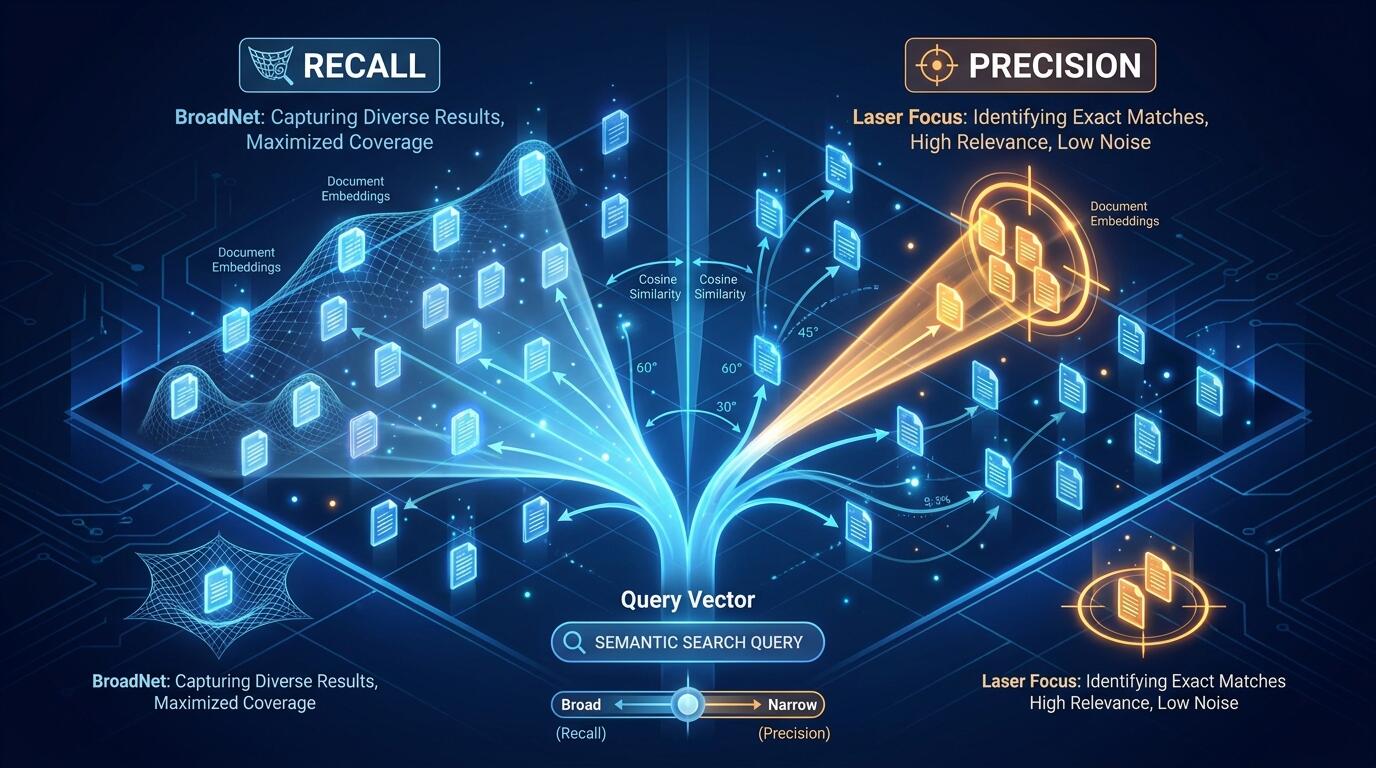
ALT: Semantic search recall and precision explained for AI product builders managing file retrieval systems
Why Recall and Precision Define the Real Cost of Semantic Search
Key Conclusion: Semantic search is a retrieval approach that uses vector embeddings to find documents by meaning rather than exact keyword matches — but its practical value hinges entirely on two metrics: recall (how much relevant content you surface) and precision (how little irrelevant content you return). For AI product builders managing file corpora, misunderstanding either metric leads to retrieval pipelines that waste compute, frustrate users, and quietly degrade the quality of every downstream decision your system makes.
Building a semantic search layer over a file corpus feels like a solved problem right up until you ship it. The embeddings work, the vector store responds in milliseconds, and your demo retrieves exactly the document you typed. Then production arrives: users phrase queries differently, edge-case files surface constantly, and the support tickets start. What went wrong is almost always traceable to a failure to reason clearly about recall and precision before the architecture was locked. These two metrics are not abstract academic concepts — they are the primary levers that determine whether your retrieval pipeline returns value or noise, and they pull in opposite directions in ways that force real engineering trade-offs.
Who This Guide Is For
Applicable Scenarios:
- Teams building RAG (retrieval-augmented generation) pipelines where document retrieval quality directly affects LLM output quality
- Product engineers designing file search features over large, heterogeneous document corpora (contracts, internal wikis, research archives, support tickets)
- Technical leads evaluating or auditing an existing semantic search implementation before scaling infrastructure spend
Not Applicable/Cautions:
- Teams whose retrieval needs are fully met by exact-match or BM25 keyword search over small, controlled vocabularies — the complexity overhead of vector search may not be warranted
- Scenarios where ground-truth relevance judgments cannot be collected or approximated — without those, you cannot measure recall or precision and therefore cannot tune the system responsibly
The Problem Keyword Search Cannot Solve
Semantic search is a retrieval paradigm that represents both queries and documents as dense vectors in a high-dimensional embedding space, then retrieves results by geometric proximity (typically cosine similarity or dot product) rather than token overlap. This is the fundamental departure from classical keyword search, and it matters for file retrieval because real users do not query with the exact words that appear in the documents they need.
Consider a contract repository. A user asks: "What are our obligations if the vendor goes bankrupt?" The relevant clause probably uses terms like "insolvency," "liquidation," or "material adverse change" — none of which appear in the query. A BM25 index returns nothing useful. A well-tuned semantic search pipeline, using embeddings that have internalized the semantic relationship between "goes bankrupt" and "insolvency proceedings," surfaces the clause reliably.
This capability is genuinely valuable. But it introduces a new failure mode: the model can return documents that are semantically plausible but factually wrong for the user's purpose. A clause about vendor termination rights might score high cosine similarity to that bankruptcy query — both involve contracts ending — yet be completely irrelevant. The embedding model does not know the difference. Your retrieval metrics do.
The broader context here matters for planning. The shift toward AI-native file management is accelerating, and retrieval quality increasingly determines the ceiling on what your AI features can accomplish. If you are building RAG systems, the retrieval step is not a commodity — it is the bottleneck. As we explored in the agent pipeline behind a real production AI briefing, retrieval quality gates every downstream step: verification, synthesis, and final output quality all degrade proportionally when recall or precision fails at the retrieval layer.
Core Content: Measuring and Tuning Your Retrieval Pipeline
Three Steps to Establish a Retrieval Baseline
Step 1: Build a Small but Honest Evaluation Set
Before tuning anything, you need ground truth. Select a representative sample of queries — ideally drawn from real user behavior or anticipated use cases — and manually label which documents in your corpus are relevant to each query. This does not need to be exhaustive; even a set of several dozen query-document relevance judgments is enough to give you directional signal. The critical constraint is honesty: the labels need to reflect what a real user would consider useful, not what the system currently returns.
Step 2: Compute Recall and Precision at a Fixed Retrieval Depth
With your evaluation set in hand, run your retrieval pipeline and score it. Recall at k (commonly written as Recall@k) measures the fraction of all relevant documents that appear in your top-k results. Precision at k (Precision@k) measures the fraction of your top-k results that are actually relevant. A system with high Recall@10 but low Precision@10 is returning almost everything useful — buried in noise. A system with high Precision@10 but low Recall@10 is returning a clean result set that misses most of what the user needs. Neither failure mode is acceptable at production scale, but they require opposite interventions.
Step 3: Establish a Retrieval Budget and Define Your Acceptable Trade-off
Your retrieval pipeline has a compute cost per query. Returning a larger candidate set (higher k) improves recall but increases the cost of any downstream re-ranking or LLM processing. Define the retrieval depth your system can afford, then tune within that constraint — not the other way around. A pattern we consistently see in production systems is that teams start by maximizing recall without a budget ceiling, then scramble to cut costs after launch. Establishing the budget first forces the right architectural conversation early.
Comparing Retrieval Strategies: Lexical, Semantic, and Hybrid
The choice of retrieval strategy determines the baseline recall-precision profile before any tuning. The following comparison assumes a heterogeneous file corpus typical of enterprise or SaaS contexts.
| Comparison Dimension | Lexical (BM25) | Dense Semantic (Single-vector) | Hybrid (BM25 + Dense) |
|---|---|---|---|
| Recall on paraphrase queries | Low — misses synonyms and reformulations | High — captures semantic equivalence | High — semantic component covers gaps |
| Precision on specific entity queries | High — exact token match is unambiguous | Moderate — similar entities can bleed in | High — lexical component anchors entities |
| Infrastructure complexity | Low — inverted index, no GPU required | Moderate — vector store, embedding inference | High — two pipelines, fusion layer required |
| Latency profile | Fast, predictable | Moderate, scales with index size | Higher, depends on fusion implementation |
| Cold-start behavior (new documents) | Immediate on indexing | Requires embedding inference before indexing | Requires both steps |
| Cost to tune recall/precision | Adjust BM25 parameters | Adjust similarity threshold, reranker | Tune each component plus fusion weights |
The practical takeaway from this comparison is that hybrid retrieval consistently outperforms either approach alone on real-world file corpora, but the complexity and operational cost are meaningfully higher. The ROI calculation depends on your query distribution: if your users predominantly issue keyword-style queries (product codes, names, specific dates), lexical search may be sufficient, and the semantic layer adds cost without proportional benefit.
Recall vs. Precision: The Fundamental Tension
Recall measures completeness. In information retrieval, recall is defined as the number of relevant documents retrieved divided by the total number of relevant documents that exist in the corpus. A recall of 1.0 means you found every relevant document. A recall of 0.5 means you missed half of them. For a legal team searching for every contract clause that touches a regulatory obligation, low recall is catastrophic — what they do not find can expose the organization to liability.
Precision measures accuracy. Precision is defined as the number of relevant documents retrieved divided by the total number of documents retrieved. A precision of 1.0 means every result you returned was relevant. A precision of 0.3 means seven out of ten results were noise. For a user asking a specific question in a RAG interface, low precision means the LLM receives irrelevant context and hallucinates or hedges — and the user loses trust in the system.
The tension between them is structural. Most retrieval systems have a similarity threshold that controls how aggressively they filter candidates. Lowering the threshold (accepting lower-similarity documents) increases recall at the cost of precision. Raising it does the reverse. There is no free parameter adjustment that improves both simultaneously — any claimed "best of both worlds" solution is actually a re-ranking strategy, not a threshold trick.
Re-ranking as the Primary Precision Tool
A re-ranker is a second-pass model (typically a cross-encoder or an LLM prompted to score relevance) that takes the high-recall candidate set from your initial retrieval step and re-orders it by estimated relevance before the final results are returned or passed to a downstream LLM. This architecture — often called a "retrieve and re-rank" pipeline — is the practical answer to the recall-precision tension in production systems.
The first-stage retriever is optimized for recall: retrieve broadly, miss as little as possible. The re-ranker is optimized for precision: from that broad candidate set, surface only what is genuinely relevant. The cost trade-off is real — running a cross-encoder over a large candidate set adds latency and inference cost — but for high-stakes file retrieval, this two-stage pattern almost always delivers better user outcomes than a single-stage dense retrieval approach. If you are evaluating whether to build this infrastructure or use a managed retrieval service, the analysis in this build-vs-buy framework for AI infrastructure is a useful starting point.
Embedding Model Choice and Its Recall Ceiling
A fact that surprises many teams early in their semantic search work: the embedding model you choose sets a hard ceiling on recall that no amount of threshold tuning or re-ranking can overcome. If the model's latent space does not represent the semantic relationship between a query and a relevant document in a way that produces high cosine similarity, the document will simply never be retrieved — it will not appear in any candidate set for a re-ranker to consider.
This means embedding model selection is an architectural decision, not a configuration detail. Models trained on general web text perform differently than models fine-tuned on domain-specific corpora (legal, medical, financial, code). In our work building retrieval systems over specialized document sets, the single highest-leverage improvement has consistently been replacing a general-purpose embedding model with a domain-adapted one — not tuning retrieval thresholds, not adding a re-ranker, not scaling the vector index. Get the embedding right first.
What Chunking Strategy Does to Your Precision Score
Every file must be split into chunks before embedding — the embedding model has a context window limit, and even if it did not, embedding an entire document as a single vector loses too much intra-document nuance. But chunking decisions have a direct and often underestimated effect on precision.
Chunks that are too small (a single sentence) produce embeddings that lack sufficient semantic context. The retrieved chunk may be technically relevant but too narrow to be useful to a downstream LLM or a human reader. Chunks that are too large dilute the signal — the embedding averages over many topics, and the chunk scores moderately for many queries but precisely for none. The practical approach is to treat chunk size as a hyperparameter and sweep it against your evaluation set, measuring Precision@k at each candidate size. A pattern we consistently observe is that domain-specific optimal chunk sizes differ substantially from the defaults in most vector database quickstart guides.
Advanced Considerations for Production Retrieval
Handling Corpus Drift and Embedding Staleness
File corpora are not static. Documents are added, updated, and deleted continuously in production. A challenge specific to semantic search — and not present in lexical systems — is embedding staleness: if a document is updated after its embedding was generated, the stored vector no longer reflects the current content. For corpora with frequent updates, this drift can silently degrade retrieval quality in ways that are difficult to detect without regular re-evaluation against your ground truth set.
The mitigation is an embedding refresh policy, not a one-time indexing job. Treat embeddings as derived artifacts that need versioning and scheduled regeneration, not as static index entries. The operational cost of this policy is real and should be factored into your infrastructure budget.
The Precision Trap in RAG Architectures
A common misconception among teams new to RAG is that precision matters less when an LLM is doing the final synthesis — the model will "figure out" which of the retrieved chunks are actually relevant. This is demonstrably false in practice. LLMs are sensitive to context quality: irrelevant retrieved chunks do not simply get ignored; they consume context window space and introduce semantic interference that measurably degrades answer quality. Precision in the retrieval layer is not a UX nicety — it is a direct input to generation quality and per-query cost. Lower precision means more tokens in the context window, which means higher inference cost and lower answer quality. The two failure modes compound.
Evaluation Cadence and the Cost of Ignoring It
Teams that build an evaluation set for launch and never revisit it accumulate invisible technical debt in their retrieval pipeline. Query distributions shift as users discover new use cases. Corpus composition changes as new files are ingested. An embedding model that performed well at launch may underperform on the corpus as it exists six months later. Establish a retrieval evaluation cadence — even a lightweight monthly re-run against your static ground truth set — as a non-negotiable part of your production operations.
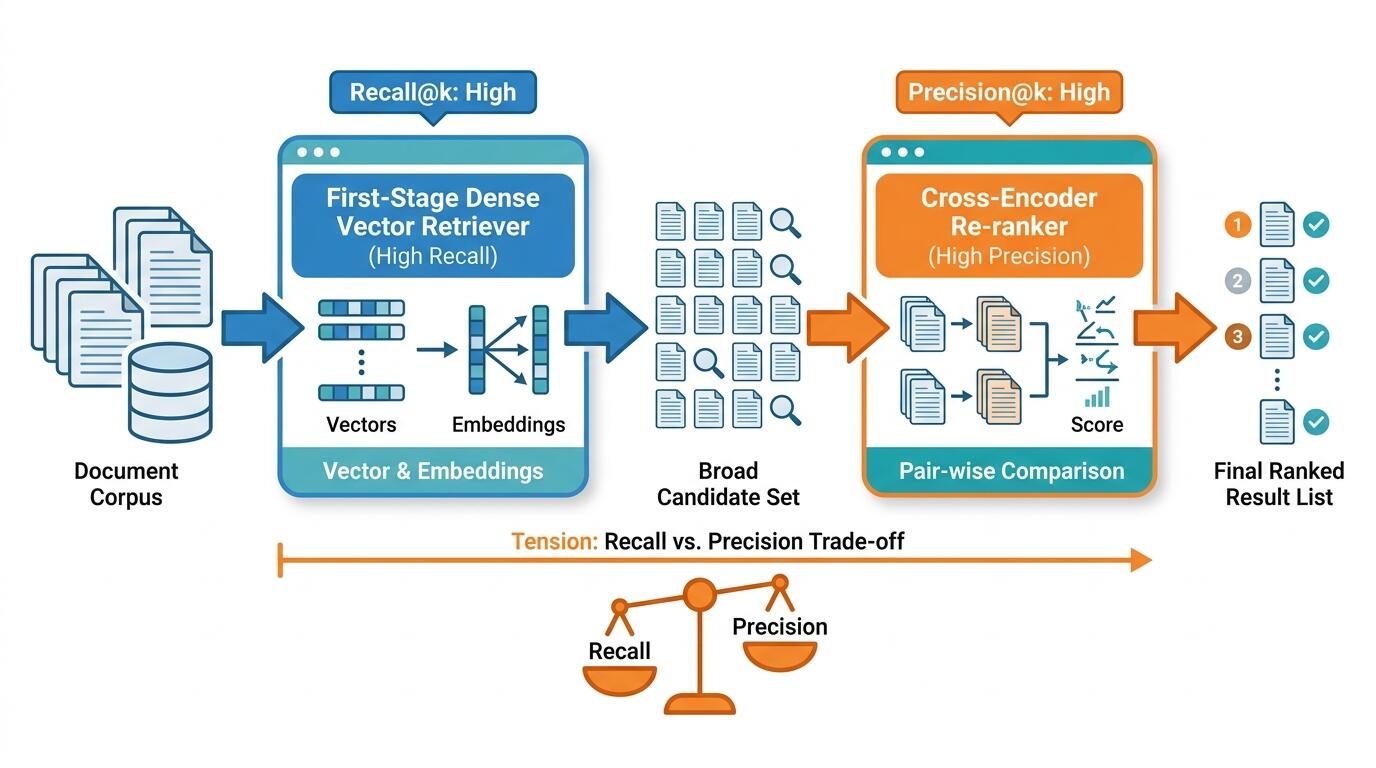
ALT: Diagram of a semantic search retrieval pipeline showing the trade-off between recall and precision for file retrieval in AI systems
Questions & Answers
Q1: How do I know if my semantic search system has a recall or a precision problem?
The fastest diagnostic is to run a small evaluation set against your live system and compute Recall@k and Precision@k separately. A recall problem manifests as users reporting that documents they know exist are not surfacing in results — or, in a RAG system, as frequent "I don't know" responses when the answer is clearly in the corpus. A precision problem manifests as noisy, irrelevant results appearing consistently in the top positions, or as LLM responses that drift into hallucination despite the corpus containing the right answer.
Q2: Is hybrid retrieval always worth the added complexity over pure dense semantic search?
Not always. Hybrid retrieval (combining BM25 and dense vector search) consistently outperforms either approach alone on diverse, real-world query distributions — but the operational overhead is real. For corpora with highly technical or entity-dense content (product catalogs, legal citations, code repositories), the lexical component of a hybrid system often provides disproportionate precision gains because exact entity matching is something dense embeddings handle poorly. For corpora queried primarily through natural-language paraphrasing, a single-stage dense retrieval system with a good re-ranker may deliver sufficient quality at lower operational cost.
Q3: How much does improving retrieval precision actually affect per-query cost in a RAG pipeline?
The cost impact is direct and compounding. Each irrelevant document in the retrieved candidate set consumes context window tokens when passed to an LLM. In practice, moving from a low-precision retrieval setup (where a substantial fraction of the context window contains irrelevant chunks) to a high-precision one can meaningfully reduce the average tokens per query — and inference cost scales with token count. Beyond raw compute cost, lower precision increases the probability of degraded outputs, which drives user re-queries and support volume. The ROI case for investing in re-ranking infrastructure or embedding model quality is usually stronger than it initially appears on a per-query cost basis alone.
Final Thoughts
Semantic search is not a feature you ship once — it is a measurement discipline you maintain continuously. The recall-precision trade-off is not a bug in the design of retrieval systems; it is an inherent property of probabilistic similarity search that requires deliberate, ongoing management.
Key Takeaways:
- Recall and precision are opposing forces in semantic search; optimizing for one degrades the other unless you introduce a second-stage re-ranking layer.
- The embedding model you choose sets a hard ceiling on achievable recall — domain-adapted models consistently outperform general-purpose ones on specialized file corpora.
- Chunking strategy has a direct and measurable effect on precision; treat chunk size as a hyperparameter and validate it against a real evaluation set.
- In RAG architectures, low retrieval precision is not a UX issue — it is a direct driver of higher inference cost and lower generation quality.
- Embedding staleness and corpus drift are production problems, not launch-day concerns; budget for ongoing re-evaluation and index refresh.
Your next step is concrete: if you do not have a retrieval evaluation set, build one this week. Even a small, manually labeled set of query-document relevance judgments will give you more actionable signal than any amount of qualitative user feedback. Once you have baseline Recall@k and Precision@k numbers, every subsequent architecture decision — model selection, chunking, re-ranking — becomes measurable rather than speculative.
If you are building AI products and want to stay current on retrieval architecture, embedding model developments, and practical RAG patterns without wading through noise, subscribe to Darius — each issue covers the AI developments that actually matter for product and engineering decisions, with first-hand analysis from someone running these systems in production.
Sources & Citations
- AI TLDR. "Recall vs Precision in Vector Search Explained".
https://ai-tldr.dev/learn/embeddings-vector-databases/similarity-search-indexing/recall-vs-precision-vector-search/ - The AI Engineer (Substack). "Semantic Search: How It Works and Why Hybrid Wins".
https://theaiengineer.substack.com/p/what-is-semantic-search-f45 - YouTube. "What is Semantic Search?"
https://www.youtube.com/watch?v=ww0QkBh173k - IEEE (Institute of Electrical and Electronics Engineers). Standards and technical literature on information retrieval evaluation metrics, including precision and recall in document retrieval systems.
https://www.ieee.org/