Advanced Tactics for Reducing Storage and Embedding Costs Together

ALT: Engineer reducing AI embedding and vector storage costs with advanced optimization tactics
Why Cutting Embedding and Storage Costs Requires a Joint Strategy
Key Conclusion: Reducing storage and embedding costs in AI systems is not two separate problems — it is one compounded infrastructure challenge. Teams that optimize them independently leave significant savings on the table. The most effective approach treats vector dimensionality, storage tier selection, model choice, and retrieval architecture as a single design surface, making trade-off decisions that compound across both cost categories simultaneously.
If you operate an AI product in production, you have almost certainly noticed that embedding generation and vector storage costs grow together. Scale one, and the other follows. Shrink one carelessly, and you degrade retrieval quality in ways that only surface at inference time, far from where the budget decision was made.
The pattern we consistently see across production AI systems is that teams either optimize for embedding cost alone — switching to a cheaper model without adjusting their storage layout — or they compress storage without reconsidering whether their embedding pipeline still justifies the data volume being stored. Neither approach captures the compounding savings available when both are addressed as a unified problem.
This article is a practitioner's guide to the advanced tactics that work when you treat storage and embedding costs as joint variables. It assumes you already understand the basics and are looking for the nuanced, sometimes counterintuitive moves that experienced AI infrastructure engineers rely on.
Who This Guide Is For
Applicable Scenarios:
- You are running a retrieval-augmented generation (RAG) system or semantic search pipeline with meaningful production traffic
- Your vector database or object storage bill is growing faster than your user base
- You have already done basic cost hygiene (removed unused indexes, right-sized your instance) and are looking for the next layer of savings
- You are an engineering lead or architect making decisions about embedding model selection and storage architecture simultaneously
Not Applicable/Cautions:
- If you are in early-stage prototyping with negligible data volume, most of these tactics introduce premature complexity
- If your retrieval quality is already marginal, dimensionality reduction and aggressive quantization carry real risk — measure before you cut
- These tactics assume you control your embedding pipeline and storage architecture; managed black-box solutions limit how much you can apply
The Compounding Cost Structure of Embedding-Based AI Systems
Embedding-based AI systems carry costs at two distinct layers: the compute cost of generating embeddings and the storage cost of persisting them, alongside the query cost of searching over them at runtime. What makes this expensive at scale is not either layer in isolation — it is the multiplicative relationship between them.
Embedding generation cost is primarily a function of model size and call volume. Every document chunk you index, every user query you process, every re-indexing event triggered by a pipeline update — each incurs a per-token or per-request charge from your embedding provider, or an equivalent compute cost if you self-host. Teams that index aggressively without a retention policy accumulate a hidden ongoing liability: re-indexing costs that recur whenever the model is updated or the corpus changes.
Vector storage cost scales with three variables: the number of vectors, their dimensionality, and the overhead of the index structure (HNSW graphs, IVF partitions, and similar). A 1536-dimensional float32 vector consumes roughly 6 KB of raw storage. At a million vectors, that is approximately 6 GB before any index overhead — and production HNSW indexes routinely add 20–40% on top of that. Vector databases charge for this either through managed storage pricing or through the compute cost of keeping the index in memory for low-latency retrieval.
The compounding dynamic appears when you increase data volume: more vectors mean more embedding API calls during indexing, more storage, more index memory, and higher per-query scan costs. This is why teams that optimize only one side of the equation rarely see the cost curve flatten in a meaningful way. The tactics below address both sides in combination, which is where the real leverage lives.
For a detailed look at how this plays out in a real pipeline — including retrieval architecture, verification steps, and publication — see The Agent Pipeline Behind a Daily AI Briefing: Retrieval, Verification, Publication — The Full Report, which walks through how these decisions compound in an actual production system.
Core Tactics: Reducing Both Costs in Concert
Three-Step Quick Start for Joint Cost Reduction
Step 1: Profile Your Actual Cost Drivers Before Touching Anything
Instrument your pipeline to measure where money is actually spent — not where you assume it is. Break down embedding API spend by pipeline stage (indexing vs. query-time) and by corpus segment (high-churn vs. stable content). Simultaneously, pull your vector storage metrics: total vector count, average dimensionality, index type, and memory allocation. This baseline, which should take a competent engineer a few hours to assemble, will reveal whether your spend is dominated by generation volume, storage volume, or index memory — and that diagnosis determines which tactics to prioritize.
Step 2: Apply Dimensionality and Quantization Changes Together
Once you have the baseline, model a reduction in embedding dimensionality — moving from 1536 to 768 or 512 dimensions if your chosen model supports Matryoshka Representation Learning (MRL) — and calculate the combined savings: smaller vectors mean less storage, lower index memory, and faster ANN search, which reduces query compute cost. Pair this with scalar quantization (float32 to int8) for an additional storage reduction without retraining. Run a retrieval quality benchmark on a representative query set before deploying to production. The step typically takes a few days end-to-end including benchmarking.
Step 3: Implement Tiered Storage and Selective Re-Indexing
Move infrequently queried vectors to cheaper storage tiers — cold object storage for archival corpora, warm storage for content accessed occasionally. Implement a staleness policy that governs when re-indexing is triggered, rather than re-indexing the entire corpus every time a model is updated. Selectively re-index only the documents most sensitive to model version changes (typically recent, high-value content) and defer or skip re-indexing of stable archival content. Combined with the dimensionality changes from Step 2, this is typically where the largest sustained cost reductions appear.
Comparing the Primary Optimization Levers
Different tactics apply to different cost drivers. The table below compares the main approaches across the dimensions that matter most in production.
| Comparison Dimension | Dimensionality Reduction | Scalar/Binary Quantization | Tiered Storage Architecture |
|---|---|---|---|
| Primary cost reduced | Storage + query compute + embedding API | Storage + index memory | Storage + retrieval infra cost |
| Impact on retrieval quality | Moderate risk; benchmark required | Low to moderate risk; model-dependent | Minimal risk for cold data |
| Implementation complexity | Medium — requires MRL-capable model | Low — post-hoc on existing vectors | Medium — requires access pattern data |
| Re-indexing required | Yes, if changing model or dimensions | No — can be applied to existing index | No — routing/tiering change only |
| Best suited for | High-dimensionality, large corpora | Memory-constrained deployments | Mixed-freshness corpora |
| Ongoing maintenance burden | Low after initial migration | Very low | Medium — tier policies need tuning |
Deep Dive: The Tactics That Actually Move the Needle
Matryoshka Representation Learning and Variable Dimensionality
Matryoshka Representation Learning (MRL) is a training technique that produces embedding models capable of generating semantically meaningful vectors at multiple dimensionality levels from a single model call. With an MRL-capable model, you can truncate a full-dimensional embedding to a lower-dimensional prefix without a separate model inference — the shorter vector retains most of the semantic information of the full-length one.
In practice, this means you can store lower-dimensional embeddings for the bulk of your corpus while keeping full-dimensional embeddings only for the content where retrieval precision is most critical. The storage saving is linear with dimensionality reduction: halving dimensions halves raw vector storage and approximately halves HNSW index memory. The embedding API cost saving is also real, because you can avoid re-indexing the entire corpus with a separate smaller model — the same model call produces both.
The key discipline here is benchmarking. Truncated embeddings degrade retrieval quality in domain-specific or highly technical corpora faster than in general-purpose ones. In our work across AI product pipelines, we have found that moving from 1536 to 768 dimensions is typically safe for general content retrieval, but moving to 256 or 128 dimensions requires careful validation against real production queries — not synthetic benchmarks.
Scalar and Binary Quantization: The Fastest Win
Scalar quantization converts float32 vectors (4 bytes per dimension) to int8 representations (1 byte per dimension), achieving a 4x reduction in raw storage with modest retrieval quality loss. Binary quantization goes further, representing each dimension as a single bit — a 32x reduction — but with more substantial precision loss that requires reranking strategies to compensate.
The important operational point is that quantization can often be applied post-hoc to an existing index without re-embedding your corpus. Several vector databases support in-place quantization of stored vectors. This makes scalar quantization one of the highest-leverage, lowest-risk tactics available: it reduces both storage costs and the memory footprint of your index (which directly affects the instance size and cost of your vector database), with no upstream changes to your embedding pipeline.
Binary quantization is worth considering when retrieval speed and storage cost are paramount and you can afford a two-stage retrieval: a fast approximate pass over binary vectors to retrieve a candidate set, followed by rescoring with full-precision vectors for the top candidates. This hybrid approach recovers most of the precision loss at the cost of increased retrieval latency and slightly more complex infrastructure.
Corpus Segmentation and Tiered Indexing
Not all content in a production AI system deserves the same storage tier or the same retrieval performance profile. A pattern we consistently see in mature deployments is that a small fraction of the corpus — typically recent, frequently queried content — accounts for the large majority of retrieval hits. The remainder is queried rarely but must be available for recall completeness.
Tiered indexing formalizes this: maintain a hot index of high-churn, high-query-frequency content in your primary vector store with full-precision, full-dimensionality embeddings and fast approximate nearest neighbor (ANN) search. Move stable, infrequently queried content to a cold tier — lower-cost object storage with on-demand or batch retrieval — using compressed or quantized embeddings. For archival content, exact nearest neighbor search over compressed vectors is often acceptable given the lower latency requirements.
The savings compound with the dimensionality and quantization tactics above: cold-tier vectors can be both lower-dimensional and quantized, minimizing storage cost, while hot-tier vectors are kept at higher precision only where it is justified by query patterns.
Embedding Caching and Deduplication
Embedding API costs are also a function of how many unique inputs you process. Two underutilized tactics address this directly. First, semantic deduplication — before indexing, cluster near-duplicate documents and index only canonical representatives — reduces both the volume of embedding calls and the number of stored vectors without affecting retrieval coverage for distinct queries. Second, query-side embedding caching reduces the per-request embedding API cost for repeated or near-identical queries, which is particularly impactful in high-traffic applications where many users ask semantically similar questions.
Implementing a query cache with a semantic similarity threshold (rather than exact string matching) requires a small amount of careful engineering, but the cost reduction for popular query patterns can be significant. The cache lookup itself can be implemented efficiently using a small, fast embedding model for the similarity check, reserving the primary (more expensive) model only for genuinely novel queries.
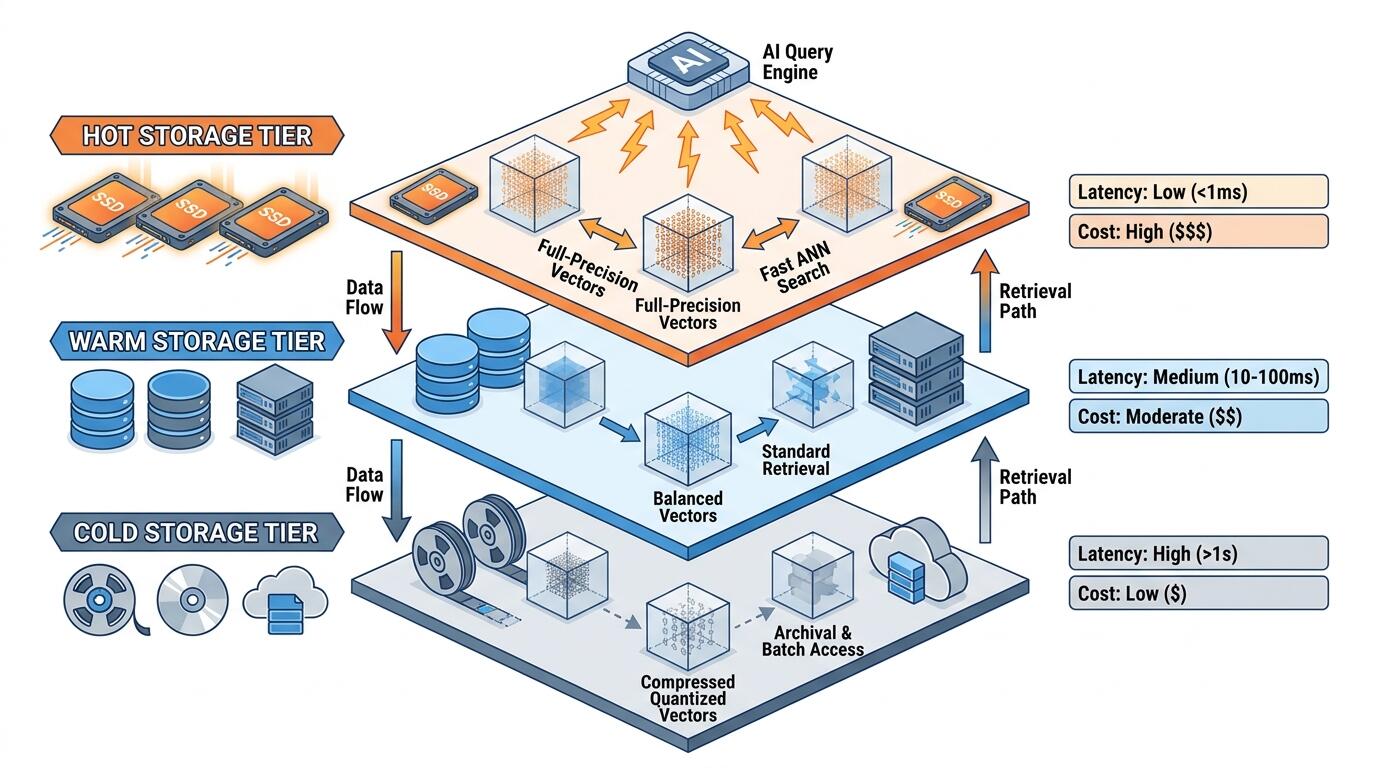
ALT: Diagram showing tiered vector storage architecture with hot, warm, and cold layers for AI embedding cost reduction
Embedding Model Selection as a Cost Architecture Decision
Model selection is often framed as a quality decision, but it is fundamentally also a cost architecture decision. Larger embedding models produce higher-quality representations but cost more per token, consume more memory if self-hosted, and produce higher-dimensional vectors that inflate storage costs. Smaller, distilled models are cheaper per inference and produce lower-dimensional vectors — but the quality gap matters depending on your domain.
The practical decision framework we apply in our work: benchmark two or three candidate models on your actual production query distribution and corpus, not on academic benchmarks. For many business document retrieval use cases, a well-tuned mid-tier model produces retrieval quality indistinguishable from a top-tier model at a fraction of the cost. The savings from choosing a smaller model compound across embedding API costs, vector storage (lower dimensionality), and index memory.
For teams weighing whether to self-host an embedding model versus using a managed API — a decision with significant cost implications at scale — the build vs. buy framework for AI infrastructure offers a structured way to think through the total cost of ownership on both sides of that decision.
Advanced Considerations and Common Misconceptions
Misconception: Quantization Always Hurts Retrieval Quality Significantly
Scalar quantization applied to well-distributed embedding spaces typically causes only a small precision drop — often 1–3% on standard benchmarks. The real risk is with poorly calibrated quantization ranges or with embedding models that produce vectors with uneven dimensional distributions. Before dismissing quantization as too risky, run a controlled recall experiment on your production queries. Most teams that have done so find scalar quantization is safe for their use case.
Misconception: Tiered Storage Means Slower Retrieval for Everything
Tiering only affects the cold-path retrieval latency. If your tier segmentation is calibrated correctly — routing the queries that users actually care about response time for to the hot tier — the user-facing latency impact is minimal. The key is instrumenting query patterns before you design the tier boundary, not after.
Special Case: Frequently Updated Corpora
For pipelines where the corpus changes frequently — news ingestion, real-time document processing — the re-indexing cost can dominate total embedding API spend. In these cases, the highest-value optimization is often architectural: moving to an incremental indexing pattern (index only new or changed documents, with a compaction step at lower frequency) rather than full corpus re-indexing. Combined with a staleness policy that tolerates slightly older embeddings for stable documents, this can reduce re-indexing API costs substantially.
Relationship with Retrieval Architecture
Dimensionality and quantization choices have implications beyond cost — they affect the ANN algorithms and index structures that perform well. Lower-dimensional spaces favor different HNSW parameter settings than higher-dimensional ones. Binary quantization works best with Hamming distance metrics rather than cosine similarity. When you change embedding characteristics, revisit your index configuration in parallel to avoid inadvertently degrading retrieval performance in ways that are not immediately obvious from cost metrics alone.
People Also Ask
Q1: How do you reduce vector storage costs without retraining embedding models?
Scalar quantization is the most practical path: it converts existing float32 vectors to int8 representations, achieving a 4x storage reduction with minimal retrieval quality loss and without requiring any new model inference. Binary quantization offers up to 32x reduction but requires a two-stage retrieval strategy to compensate for precision loss. Both techniques can typically be applied post-hoc to existing indexes in vector databases that support in-place quantization, making them accessible to teams that cannot afford a full re-indexing cycle.
Q2: Is Matryoshka Representation Learning (MRL) production-ready for cost reduction?
MRL-capable embedding models are available from several major providers and are suitable for production use in general-purpose retrieval workloads. The truncated-dimension embeddings they produce retain most semantic quality at half or quarter dimensionality for typical document retrieval tasks. Teams should validate truncated embeddings against their specific domain and query distribution before deploying, as technical or highly specialized corpora can show more pronounced quality degradation at reduced dimensions than general-purpose benchmarks suggest.
Q3: What is the cost impact of tiered storage for vector databases, and how long does migration take?
Tiered storage can reduce storage costs meaningfully for corpora where a large fraction of vectors are infrequently queried — the savings scale with the ratio of cold-to-hot data. Migration timelines depend on corpus size and pipeline complexity, but a well-scoped tiering implementation for a mid-sized production system typically takes one to three engineering weeks, including instrumentation of query access patterns, policy definition, and validation of retrieval coverage across tiers.
Summary
Reducing storage and embedding costs together is achievable without sacrificing retrieval quality, but it requires treating the two cost dimensions as a unified optimization problem rather than addressing them sequentially or in isolation.
Key Takeaways:
- Profile your actual cost breakdown across embedding generation, vector storage, and index memory before applying any optimization — the diagnosis determines the tactics.
- MRL-based dimensionality reduction and scalar quantization can be applied together for compounding storage savings, and should be benchmarked against real production queries before deployment.
- Tiered storage architecture separates hot and cold corpus segments, reducing infrastructure costs for archival or infrequently queried content without affecting latency for high-priority retrievals.
- Embedding caching and semantic deduplication reduce the volume of API calls directly, addressing generation costs at the source.
- Embedding model selection is a cost architecture decision: benchmark smaller models on your actual domain before assuming a larger model is necessary.
The next step is straightforward: pull your current embedding API spend breakdown and your vector database storage and memory metrics, and identify which of the three dominant cost drivers — generation volume, storage dimensionality, or index memory — is largest. That prioritization determines where to start.
If this article helped you think more clearly about your AI infrastructure costs, subscribe to Darius — a bilingual briefing written by engineers who run AI products in production. Every issue selects the AI developments that actually matter for builders, with first-hand context and actionable interpretation, not noise.
References & Further Reading
- ZNetLive Blog. "Reduce Cloud Storage Costs without Sacrificing on Performance".
https://www.znetlive.com/blog/how-to-reduce-cloud-storage-costs-without-sacrificing-on-performance/ - Akka. "15 Techniques to Lower the Cost of AI".
https://akka.io/blog/lowering-the-cost-of-ai - Microsoft Azure Storage Blog. "Leverage the Cloud to Cut File Data Costs: Comparison of Alternatives".
https://techcommunity.microsoft.com/blog/azurestorageblog/leverage-the-cloud-to-cut-file-data-costs-comparison-of-alternatives/3799614 - IEEE. IEEE Standards and Publications on AI and Machine Learning Infrastructure.
https://www.ieee.org/
Note: Standards and technical guidance may be updated; check the latest official documents or consult qualified advisors for decisions affecting production systems.