Questions to Ask Any AI Vendor Before You Commit Budget
ALT: Engineering leader reviewing critical questions to ask AI vendors before committing budget decisions
Why the Questions You Ask an AI Vendor Determine Everything That Follows
Committing budget to an AI vendor is one of the highest-stakes procurement decisions a technical organization makes today — and the cost of choosing wrong is measured not just in dollars, but in months of lost engineering time, brittle integrations, and delayed products. The right questions to ask any AI vendor before you commit budget are the difference between a partnership that compounds your capabilities and a dependency that quietly holds your roadmap hostage.
This article exists because a pattern emerges repeatedly in the work of evaluating AI vendors alongside clients: organizations ask about pricing and features, then skip past the questions that would reveal architectural risk, data governance exposure, and long-term lock-in. That gap — between what buyers ask and what they should ask — is where expensive mistakes are made. What follows is a structured, practitioner-tested framework for interrogating any AI vendor with the rigor the decision deserves.
Who Should Use This Evaluation Framework
Applicable Scenarios:
- Engineering leaders and CTOs at startups and growth-stage companies evaluating AI APIs, platform vendors, or managed model providers for production use
- Product and technical teams integrating third-party AI capabilities into a customer-facing product where reliability, latency, and compliance are non-negotiable
- Founders making a first significant AI infrastructure commitment and needing to separate credible vendors from polished demos
- Engineering teams already mid-evaluation who want to stress-test their process before signing
Not Applicable/Cautions:
- Teams running internal experiments or proof-of-concepts with no production commitment — the due diligence depth here is calibrated for budget-commitment decisions, not exploratory hackathons
- Organizations with a dedicated procurement and legal function that handles vendor risk independently — this guide is designed for builders doing their own technical due diligence, not as a substitute for legal or compliance counsel
The Structural Problem With How AI Vendor Evaluations Get Done
Most AI vendor evaluations follow a predictable and insufficient path: a sales demo, a features checklist, a pricing negotiation. The demo is impressive — by design. The checklist confirms capabilities exist — on paper. The negotiation secures a discount that feels like a win. Then six months into production, the real costs surface: unexpected rate limits that throttle your throughput, model versioning policies that silently change outputs, data retention clauses that create compliance exposure, and a support structure that doesn't match the urgency of a production incident.
The structural problem is that buyers evaluate AI vendors the way they evaluate SaaS tools — on feature parity and price — rather than the way they should evaluate infrastructure — on reliability contracts, data sovereignty, operational maturity, and architectural alignment. AI capabilities, unlike static software features, change constantly. Models are updated, deprecated, or fine-tuned in ways that propagate directly into your product's behavior. That dynamic makes vendor evaluation a fundamentally different exercise.
The evaluation framework in this guide is organized around five domains — each targeting a category of risk that commonly goes unexamined. For teams also thinking about the broader architecture decisions that surround AI vendor selection, evaluating AI development tools before signing a contract provides a complementary lens on toolchain and platform decisions that often intersect with vendor commitments.
The Questions That Actually Reveal Vendor Quality
Step 1: Establish Technical Transparency Before Touching Commercial Terms
Before any pricing discussion, your first move should be to pressure-test how the vendor talks about their own system. Ask: "How does your model versioning work, and what notice do we receive before a model update changes behavior?" A technically credible vendor will give you a precise answer — versioning schemes, deprecation timelines, and the mechanism by which they communicate breaking changes. A vendor that responds with vague reassurances ("our models only get better") is signaling that you have no contractual or operational protection against output drift.
Follow this immediately with: "What are your SLA commitments for availability and latency at production scale, and what is your remediation process when those SLAs are breached?" Availability SLAs are table stakes. The more revealing question is what happens after a breach — credit policies, escalation paths, and whether those commitments appear in the contract or only in marketing materials. This step typically takes thirty to sixty minutes of pre-meeting research — reviewing documentation, reading API changelogs, and scanning developer forums — before the vendor conversation itself.
Step 2: Map Data Governance to Your Actual Compliance Posture
The second step is to conduct a precise data governance interrogation. Ask: "Is our data used to train or fine-tune your models, and if so, under what conditions and with what opt-out mechanisms?" This is not a minor point — in many regulated industries and jurisdictions, the answer determines whether the vendor is legally usable at all. Ask specifically about data residency: "In which regions is our data stored and processed, and do we have a choice?" For teams building products subject to regional data protection frameworks, the answer needs to match your obligations, not the vendor's infrastructure convenience.
According to Fisher Phillips, a law firm with published guidance on AI vendor contracts, organizations should explicitly confirm whether vendor agreements address data ownership, model training rights, and liability allocation — because standard commercial agreements often leave these terms ambiguous in ways that favor the vendor. This step should involve your legal or compliance function if one exists; if not, the technical lead needs to read the actual data processing agreement, not just the summary.
Step 3: Stress-Test Operational Maturity Through Incident Scenarios
Ask the vendor: "Walk me through how you handled a significant production outage or degradation event in the past year — what was the incident response process, how were customers notified, and what changed afterward?" This question has no correct answer format — it has revealing answer formats. A vendor with genuine operational maturity will describe a specific process, mention post-mortems, and point to their status page history. A vendor that deflects, generalizes, or claims they've had no significant incidents should be treated with skepticism.
A closely related question: "What is your rate limit and throttling policy at production scale, and how does it change under peak load?" Rate limiting is one of the most common sources of production surprises with AI APIs — throughput that works fine in testing degrades under real load, and the behavior is often described only in documentation footnotes rather than prominently disclosed. Get this in writing and model it against your expected traffic patterns before signing.
Comparing AI Vendor Evaluation Dimensions Across Vendor Types
Different categories of AI vendors carry different risk profiles. The comparison below maps the key evaluation dimensions against three common vendor archetypes: large model API providers (e.g., major cloud AI services), specialized AI platform vendors, and managed AI service providers who offer consulting plus capability.
| Evaluation Dimension | Large Model API Providers | Specialized AI Platform Vendors | Managed AI Service Providers |
|---|---|---|---|
| Model versioning transparency | Variable — check changelog frequency | Often more stable, feature-specific | Vendor-managed; confirm SLA terms |
| Data governance clarity | Policies are published; read carefully | Often more customizable; verify contracts | Depends heavily on the specific provider |
| Production SLA strength | Standard tiers available; enterprise SLAs negotiable | Typically narrower scope, stronger within it | Often bundled with professional services |
| Rate limit flexibility | Tiered; often requires enterprise plan | Usually higher limits; confirm under load | Customizable; negotiate explicitly |
| Lock-in risk | High (proprietary APIs, pricing changes) | Moderate (specialized integrations) | Moderate to high (relationship dependency) |
| Incident transparency | Status pages common; depth varies | Less public history; ask directly | Depends on contract terms |
The Five Domains of AI Vendor Due Diligence
Domain 1 — Technical Architecture Fit
Technical architecture fit is the degree to which the vendor's system design aligns with the demands of your production environment. Beyond asking about model capabilities, ask: "Does your system support fine-tuning, retrieval-augmented generation, or custom prompt management at scale, and what does that workflow look like in practice?" Many vendors support these capabilities in demo environments and constrain them in production in ways that aren't immediately apparent.
Probe also for the underlying infrastructure: "Is your service built on shared multi-tenant infrastructure, and what isolation guarantees apply to my workload?" For latency-sensitive or security-sensitive applications, the answer to this question can be disqualifying. For teams building machine learning systems that need to scale beyond prototype stage, the architectural decisions made during vendor selection directly shape what's possible later — an insight explored in depth in the guide on how to build machine learning pipelines that scale past prototype stage.
Domain 2 — Data Sovereignty and Compliance
Compliance risk in AI vendor relationships is commonly underestimated because it's invisible until it isn't. Ask for the vendor's current compliance certifications — SOC 2 Type II, ISO 27001, HIPAA BAA availability, and relevant regional certifications — and verify which of those apply to the specific service tier you're purchasing, not the vendor's broadest enterprise offering.
A question that consistently separates mature vendors from emerging ones: "If we need to terminate this agreement and migrate to another provider, what does our data offboarding process look like, and what is the contractual timeline for data deletion?" Vendors that have thought seriously about this question have an answer. Vendors that haven't have a retention problem you'll discover later.
Domain 3 — Commercial Sustainability and Lock-In Risk
Lock-in risk in AI vendor relationships operates on two levels: technical lock-in through proprietary APIs and data formats, and commercial lock-in through pricing structures that become punitive at scale. Ask directly: "How has your pricing changed over the past two years, and what contractual protections exist against material price increases during our agreement term?"
Evaluate the vendor's business model candidly. A vendor offering dramatically below-market pricing without a clear monetization path is carrying a different kind of risk than an established player with transparent pricing. Per CX Today's analysis of AI vendor commitment criteria, understanding the long-term commercial model of a vendor — not just current pricing — is essential to avoiding budget surprises as your usage scales.
Domain 4 — Support Structure and Escalation Paths
Ask: "What is your support response time commitment for production-critical incidents, and what does the escalation path look like from a first-line ticket to an engineer who can actually resolve our issue?" This is a question where the answer in the contract and the answer in practice can diverge significantly. Ask for references from existing customers who have experienced a production incident and how it was handled.
Find out whether the vendor assigns a technical account manager or customer success engineer to your account, and what their technical depth is. For AI systems, production issues are frequently ambiguous — output degradation, unexpected behavior, latency spikes — and require someone who can engage at the model and infrastructure level, not just reset API credentials.
Domain 5 — Roadmap and Model Evolution
Ask: "What is your model deprecation policy, and what is the minimum notice period before a model version we depend on is retired?" This is increasingly important as AI capabilities evolve rapidly and vendor roadmaps accelerate. A vendor with a ninety-day deprecation notice gives your engineering team a meaningful runway; a vendor with a thirty-day notice may require significant replanning to execute a migration.
Also ask: "How do you communicate breaking changes versus non-breaking improvements to model outputs?" The answer reveals whether the vendor treats AI models the way engineers expect software to behave — with versioning, changelogs, and semantic signaling about stability — or whether they treat updates as universally positive and expect customers to absorb the cost of behavioral change.
Advanced Considerations for High-Stakes Vendor Decisions
Several evaluation scenarios carry elevated risk and require additional scrutiny beyond the core framework.
When the vendor also builds your integration layer. Some AI vendors offer professional services or managed implementations on top of their platform. This arrangement can accelerate time to value — and it can also create a situation where the vendor controls both the capability and the implementation, making it harder to evaluate true performance and harder to switch. If this is the structure on offer, insist on clear contractual separation between platform services and implementation services, and ensure your team has full access to the integration codebase.
When you're evaluating a vendor in a fast-moving capability category. In areas where the technology itself is evolving rapidly — multimodal AI, real-time inference, autonomous agents — vendor claims about capabilities are often accurate as of the demo and ambiguous in production timelines. Apply extra pressure to questions about production readiness versus research-grade functionality: "Is this capability generally available, in limited preview, or on your roadmap?" is a question that should be asked about every feature you're planning to depend on.
Common misconception: enterprise SLA means production-grade reliability. A frequently observed mistake is treating an enterprise contract tier as a proxy for genuine reliability. Enterprise pricing typically unlocks better rate limits, priority support, and contractual commitments — but it doesn't guarantee that the underlying infrastructure has been tested at your specific workload profile. Always supplement contract review with load testing before full deployment, and build your architecture with the assumption that any AI vendor service will experience periods of degraded performance.
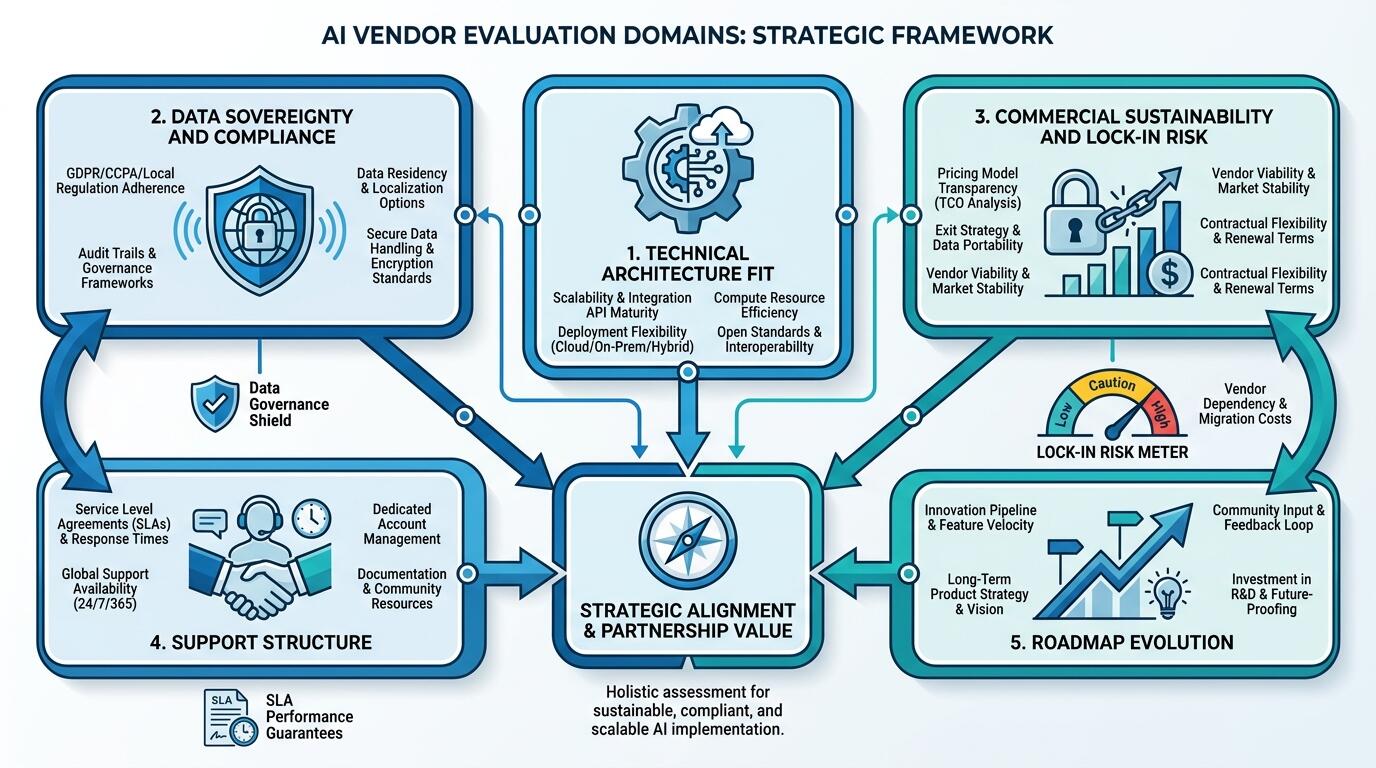
ALT: Technical architecture diagram illustrating AI vendor evaluation domains including data governance, SLAs, and lock-in risk assessment for enterprise decisions
Frequently Asked Questions FAQ
Q1: How do you evaluate an AI vendor's data governance without legal expertise?
Start with the vendor's publicly available data processing agreement and privacy policy — specifically the sections on training data rights, data retention, and subprocessor lists. Ask the vendor directly whether your data is used to train models and request opt-out documentation. For regulated industries, map vendor data residency commitments to the specific frameworks your product must comply with — GDPR, CCPA, HIPAA — before any integration work begins. If gaps appear, treat them as blocking issues, not negotiation starting points.
Q2: Are published SLAs sufficient to assess AI vendor reliability?
Published SLAs are a necessary but incomplete signal of reliability. An SLA defines the commitment; it does not guarantee the operational maturity to meet it consistently. Supplement SLA review by examining the vendor's public status page history for patterns of incidents, asking for references from customers with similar workload profiles, and conducting your own load and reliability testing in a staging environment before committing production traffic. The vendor's incident response process — how they communicate, escalate, and post-mortem outages — is often more revealing than the SLA percentage itself.
Q3: What does AI vendor lock-in actually cost, and how do you estimate it before signing?
Lock-in cost is the effort required to migrate to an alternative if the vendor raises prices, degrades service, or exits the market. Estimate it by auditing how much of your integration logic depends on vendor-specific APIs versus open standards, how much proprietary prompt engineering or fine-tuning is tied to the vendor's format, and how portable your training or evaluation data is. Build a rough migration scenario before you sign — not because you expect to migrate, but because the exercise reveals dependencies that should be minimized by design. Early-stage teams can find structured guidance on managing AI architecture costs in the article on how early-stage startups should approach AI system design on a lean budget.
Key Takeaways
The questions you ask an AI vendor before committing budget are not a compliance exercise — they are the primary mechanism by which technical leaders protect their teams, products, and organizations from preventable risk. Three principles anchor this framework.
First, evaluate AI vendors as infrastructure, not as software. The dynamic nature of AI systems — models that change, capabilities that evolve, pricing that scales nonlinearly — requires the same scrutiny you would apply to a cloud infrastructure commitment, not a SaaS subscription. Static feature checklists miss the risks that matter most.
Second, the most revealing questions are the ones vendors are least prepared for. Technical transparency about versioning and deprecation, specific incident history, data offboarding timelines, and lock-in migration scenarios are all questions that separate vendors who have built systems at production scale from vendors who have built systems that demo well. Discomfort or vagueness in response to these questions is signal, not noise.
Third, no contract substitutes for architectural discipline. Even with a strong vendor agreement in place, build your AI systems with abstraction layers that reduce the surface area of vendor-specific dependencies. The goal is not to eliminate vendor relationships — it is to ensure that your product's core capabilities remain under your control regardless of what any individual vendor does.
The combination of rigorous vendor interrogation and thoughtful system design is what separates AI investments that compound over time from those that become expensive technical debt.
Ready to design AI systems that don't depend on a single vendor's decisions? Visit the Darius website to explore proven approaches to AI architecture, systems design, and end-to-end product delivery — and reach out to start a conversation about turning your AI investment into a production-ready system.
References & Further Reading
- Fisher Phillips. "The Essential Questions to Ask Your AI Vendor Before Deploying Artificial Intelligence."
https://www.fisherphillips.com/en/insights/insights/essential-questions-to-ask-ai-vendor-before-deploying-artificial-intelligence - CX Today. "6 Questions to Ask Your AI Vendor Before You Commit."
https://www.cxtoday.com/ai-automation-in-cx/6-questions-to-ask-your-ai-vendor-before-you-commit-contentguru-cs-0026/ - LinkedIn / Bennett Spooner. "5 Questions to Veto AI Vendors Before You Waste Budget."
https://www.linkedin.com/posts/bennett-spooner_the-fastest-way-to-waste-your-companys-budget-activity-7490863799479025664-9LH3 - IEEE (Institute of Electrical and Electronics Engineers). Standards and publications on AI system reliability, software engineering, and risk management.
https://www.ieee.org
Note: Standards and regulatory guidance evolve continuously. Verify the current versions of any referenced standards or compliance frameworks directly with the issuing organization before making procurement or architectural decisions.