How Early-Stage Startups Should Approach AI System Design on a Lean Budget

ALT: Early-stage startup team designing AI system architecture on a lean budget whiteboard session
Why Lean AI Architecture Is the Defining Skill for Startup Survival
Building an AI-powered product with limited runway is less about choosing the fanciest model and more about making a hundred disciplined architectural decisions before you write a single line of production code. Early-stage startups that approach AI system design strategically — treating every infrastructure dollar as a vote for or against product-market fit — consistently outpace competitors who burn budget on over-engineered solutions before validating a single assumption.
This topic deserves a deeper look right now because the barrier to deploying AI has dropped dramatically. API-based foundation models, managed vector databases, and serverless compute have made sophisticated AI capabilities accessible without a data science team or a dedicated GPU cluster. But accessibility is not the same as affordability at scale, and the pattern we consistently see in early-stage work is founders mistaking "easy to start" for "cheap to grow." The gap between a scrappy prototype and a production-ready, cost-efficient AI system is precisely where architectural thinking pays the highest dividend.
The Current Landscape: Abundant Options, Dangerous Defaults
The state of AI tooling today is simultaneously encouraging and treacherous for budget-constrained founders. A startup can integrate a large language model into a product within a day, spin up a retrieval-augmented generation pipeline over a weekend, and deploy a working demo to the cloud before the first investor meeting. The tooling ecosystem has never been more generous at the prototype stage.
The danger lies in the defaults. Most developer-facing AI services are priced to attract experimentation and then scale their revenue as you scale your usage. Token costs, embedding API calls, vector store queries, and cloud inference endpoints compound quickly once a product moves from demo traffic to real users. According to research covered in Building AI-Driven Growth Systems on a Startup Budget, many early-stage teams underestimate ongoing AI infrastructure costs by a significant margin — not because they are careless, but because the cost model of AI systems is fundamentally different from traditional SaaS infrastructure. With SaaS, you pay for compute and storage. With AI, you pay for every inference, every embedding, every retrieval, and every reranking step — each of which can fan out unpredictably under real load.
The market has also produced an abundance of frameworks, each promising to simplify AI development. Orchestration layers, agent runtimes, prompt management platforms, and evaluation harnesses all compete for a place in the startup's stack. While some of these tools are genuinely valuable, adopting too many of them early creates a fragile dependency graph that makes the system harder to debug, harder to optimize for cost, and harder to hand off to a growing team.
The pragmatic response to this landscape is not to avoid AI tooling — it is to adopt it deliberately, one decision at a time, with a clear understanding of what each component costs at realistic scale.
The Architectural Decisions That Make or Break a Lean AI System
Early-stage AI system design is not primarily a research problem. It is an architectural and economic problem. The decisions that separate sustainable AI products from expensive prototypes cluster around five underlying mechanisms.
Choosing the Right Model for the Job
Model selection is the single highest-leverage cost decision in AI system design, and the most common mistake is defaulting to the most capable model available. Flagship large language models from major providers offer impressive general capability, but they carry a price-per-token premium that is rarely justified for narrow, well-defined tasks. A pattern we consistently see is that production workloads can almost always be decomposed: a smaller, faster, cheaper model handles routing or classification, a mid-tier model handles structured extraction, and the expensive frontier model is reserved only for tasks where nuanced reasoning genuinely moves a business outcome.
The principle here is task-model fit — matching the complexity of the model to the complexity of the task. A lean AI architecture is one where each inference call is made by the cheapest model capable of producing an acceptable result for that specific step, not the smartest model available.
Caching as a First-Class Architectural Concern
Semantic caching is a technique that stores the outputs of AI inference calls and serves them when sufficiently similar inputs arrive, bypassing the model entirely. For most early-stage products, a meaningful share of user queries are semantically redundant — the same question rephrased, the same document type processed, the same intent expressed differently. Without caching, each of those requests generates a billable inference call. With caching, a large fraction of them are served from storage at a fraction of the cost.
Treating caching as an afterthought — something to add when costs get out of control — is a structural mistake. The right time to design a caching layer is before the system goes into production, when the data model and API contracts are still flexible. In our experience advising early-stage technical teams, retrofitting a caching strategy into an existing AI pipeline is significantly more disruptive than building it in from the start.
Retrieval-Augmented Generation Over Fine-Tuning
Retrieval-Augmented Generation (RAG) is an architectural pattern in which a language model is paired with an external knowledge store, allowing it to ground its outputs in specific, retrievable documents rather than relying solely on knowledge baked into its weights. For most early-stage startups, RAG is the correct alternative to fine-tuning, not because fine-tuning is never valuable, but because it requires curated datasets, compute time, evaluation infrastructure, and a model management discipline that is premature at the pre-product-market-fit stage.
A well-designed RAG system lets a startup update its knowledge base by updating documents — not by retraining a model. That agility is critical when the product's use case is still evolving. As noted in How to Start a Lean, AI-Native Startup in 2025, the leanest AI-native teams are those that stay close to managed APIs and retrieval patterns, reserving custom model work for the stage where a specific capability gap has been proven to matter commercially.
Observability Before Optimization
A lean AI system without observability is an expensive black box. Observability in AI systems means logging inputs, outputs, latency, token usage, and downstream user behavior in a way that connects model behavior to product outcomes. This is not the same as general application monitoring — it requires AI-specific tooling or custom instrumentation that tracks prompt versions, model versions, retrieval quality, and cost per user action.
The reason observability must come before optimization is that without it, cost reduction efforts are guesswork. Teams that log everything from day one can identify, with precision, which features consume disproportionate inference budget, which prompts are underperforming, and where caching would yield the highest return. Teams that skip this step spend engineering time optimizing the wrong things.
Infrastructure Right-Sizing and Serverless-First
Serverless compute is an infrastructure model where the cloud provider allocates resources on demand and bills per execution, rather than per reserved instance. For AI workloads at early-stage scale, serverless is almost always the correct default. It eliminates idle costs, handles bursty traffic without manual scaling, and defers infrastructure complexity until scale actually demands it.
The instinct to provision dedicated GPU instances or reserved cloud capacity before validating demand is a budget mistake that we see frequently. Managed inference APIs and serverless function wrappers around them will serve most early-stage products at a fraction of the cost of self-hosted infrastructure, and they preserve engineering bandwidth for product development rather than DevOps.
Evidence and Approach Comparison: How Different Strategies Play Out
The right AI system design strategy depends on the startup's stage, use case, and team composition. The comparison below contrasts the most common approaches:
| Perspective / Approach | Strengths | Trade-offs | Best Fit |
|---|---|---|---|
| Full API-first stack (managed models, managed vector DB) | Fastest time to production; minimal DevOps burden; predictable capability | Per-call costs scale with volume; vendor dependency; limited customization | Pre-PMF startups; first production release; small engineering teams |
| Hybrid RAG + API inference | Strong knowledge grounding; updatable without retraining; cost-effective for document-heavy use cases | Requires embedding pipeline management; retrieval quality tuning takes iteration | Products with proprietary data; customer-specific knowledge bases |
| Fine-tuned smaller model | Lower per-inference cost at scale; specialized capability; reduced latency | High upfront data and training cost; requires MLOps discipline; premature without validated use case | Post-PMF; narrow, high-volume, well-defined tasks; teams with ML expertise |
| Self-hosted open-source model | Maximum cost control at high volume; no data privacy concerns with third-party APIs | Significant infrastructure and operational overhead; requires GPU provisioning expertise | High-volume, compliance-sensitive workloads; later stage with dedicated ML infrastructure |
According to guidance from How to Build an AI MVP Without Blowing Your Budget, the most common budget overrun in early AI product development comes from premature infrastructure sophistication — teams building for a scale they have not yet reached. The principle that emerges consistently across well-executed lean AI builds is: validate the use case with the simplest stack that works, then optimize the architecture once you understand your real cost drivers.
The IEEE, as the leading professional body for software and systems engineering, has published guidance on system architecture decision-making that reinforces this phased approach — complexity should be introduced in response to demonstrated need, not anticipated need.
Where Lean AI Architecture Is Heading and What It Means for Founders
Lean AI system design is becoming a core competency for early-stage technical leadership, not a niche specialization. As foundation model costs continue to decline and retrieval tooling matures, the competitive advantage in AI product development is shifting from "who has access to the best model" to "who has the architectural judgment to deploy AI efficiently at the right abstraction layer."
Several trends are reinforcing this shift. Smaller, distilled models are becoming competitive with much larger predecessors on domain-specific benchmarks, which strengthens the case for task-model fit. Managed vector databases and embedding services are commoditizing the retrieval layer, reducing the infrastructure burden of RAG architectures. And the tooling for AI observability is maturing, making cost attribution and quality measurement more accessible to teams without dedicated ML engineers.
For startup founders and CTOs, the practical implications are immediate. First, resist the temptation to equate AI sophistication with AI spending. The most defensible AI products are often built on disciplined, boring infrastructure choices — cheap inference, aggressive caching, clean retrieval pipelines — not on expensive, opaque model ensembles. Second, invest early in observability. The teams that understand their cost-per-outcome from the first week of production are the ones that can optimize, fundraise, and scale with confidence. Third, treat AI architecture as a living document. What is correct at launch is rarely correct at Series A. Design for replaceability — loosely coupled components, clear interface boundaries, and minimal lock-in to any single provider or model.
The founders and technical leaders who internalize these principles are not just saving money. They are building a foundation for AI products that can actually survive contact with real users at real scale.
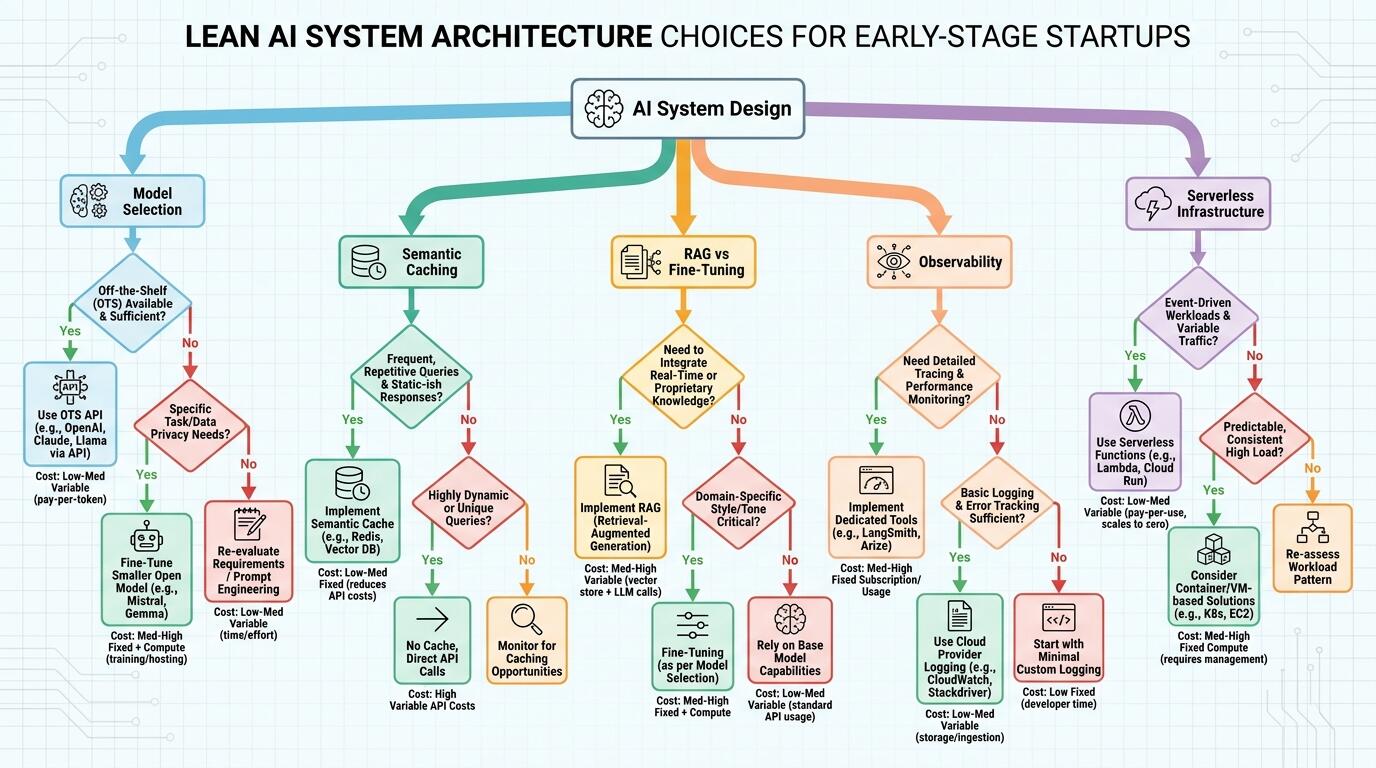
ALT: Decision tree diagram illustrating lean AI system architecture choices for early-stage startups on a budget, covering model selection, caching, RAG, observability, and serverless infrastructure
Questions & Answers
Q1: How should an early-stage startup decide between using a large language model API and building a custom model?
Early-stage startups should default to large language model APIs for their first production release. Custom model development requires curated training data, ML infrastructure, and ongoing maintenance — none of which is justified before product-market fit is confirmed. API-first development lets the team validate product assumptions quickly. Once a specific task is high-volume and well-defined, migrating to a smaller, specialized model becomes economically rational and architecturally straightforward.
Q2: Is retrieval-augmented generation a practical option for startups without dedicated ML engineers?
Retrieval-Augmented Generation is one of the most accessible AI architectural patterns for small technical teams. It requires no model training, relies on managed embedding and vector storage services, and can be implemented with standard software engineering skills. The core challenge is retrieval quality tuning — ensuring the right documents surface for a given query — which is an engineering problem, not a research problem. Most early-stage teams can operate a production RAG system without ML expertise.
Q3: How much should a lean startup budget for AI infrastructure in the early stages?
Specific figures vary by use case, usage volume, and provider pricing, which changes frequently. The pragmatic approach is to start with API-based managed services and establish a cost-per-user-action baseline before any infrastructure commitments. Aggressive semantic caching, task-appropriate model selection, and serverless compute can reduce AI infrastructure spend substantially compared to an unoptimized default stack. Design the system to measure costs at the feature level from day one so budget decisions are data-driven, not guesswork.
Summary
Early-stage startups can build competitive, production-ready AI systems without large infrastructure budgets — but only if architectural discipline is applied from the start, not retrofitted after costs spiral.
Key Takeaways:
- Task-model fit is the highest-leverage cost decision: match model complexity to task complexity, reserving expensive frontier models for reasoning tasks that genuinely require them.
- Semantic caching should be a first-class architectural concern, designed into the system before go-live, not bolted on after the invoice arrives.
- Retrieval-Augmented Generation is the correct default knowledge integration pattern for pre-PMF startups — it is faster, cheaper, and more agile than fine-tuning.
- Observability from day one is non-negotiable: teams that cannot attribute costs to features cannot optimize, prioritize, or credibly forecast AI infrastructure spend.
- Serverless-first infrastructure eliminates idle costs and preserves engineering bandwidth for product development at the stage when both are most constrained.
The next step is an honest architectural audit of your current or planned AI stack against these five principles. If any layer is over-engineered for your current scale or under-instrumented for cost visibility, that is where the work starts.
Explore the portfolio, insights, and work at the Darius website to see how engineering leadership meets real-world execution in AI product development. Whether you're building from zero or scaling an existing system, Darius is the technical partner who ships.
Sources
- Talha Fakhar. "Building AI-Driven Growth Systems on a Startup Budget".
https://talhafakhar.medium.com/building-ai-driven-growth-systems-on-a-startup-budget-91d43dd87352 - Henry Shi. "How to Start a Lean, AI-Native Startup in 2025".
https://henrythe9th.substack.com/p/how-to-start-a-lean-ai-native-startup - Sourcedesk. "How to Build an AI MVP Without Blowing Your Budget".
https://www.sourcedesk.io/blog/what-is-an-ai-mvp-how-us-startups-can-test-ai-ideas-without-blowing-their-budget - IEEE. "IEEE Standards and Publications on Software and Systems Engineering".
https://www.ieee.org - National Institute of Standards and Technology (NIST). "AI Risk Management and Technology Guidance".
https://www.nist.gov