Case Study: How Primary-Source Discipline Shaped This Quarter's Briefing
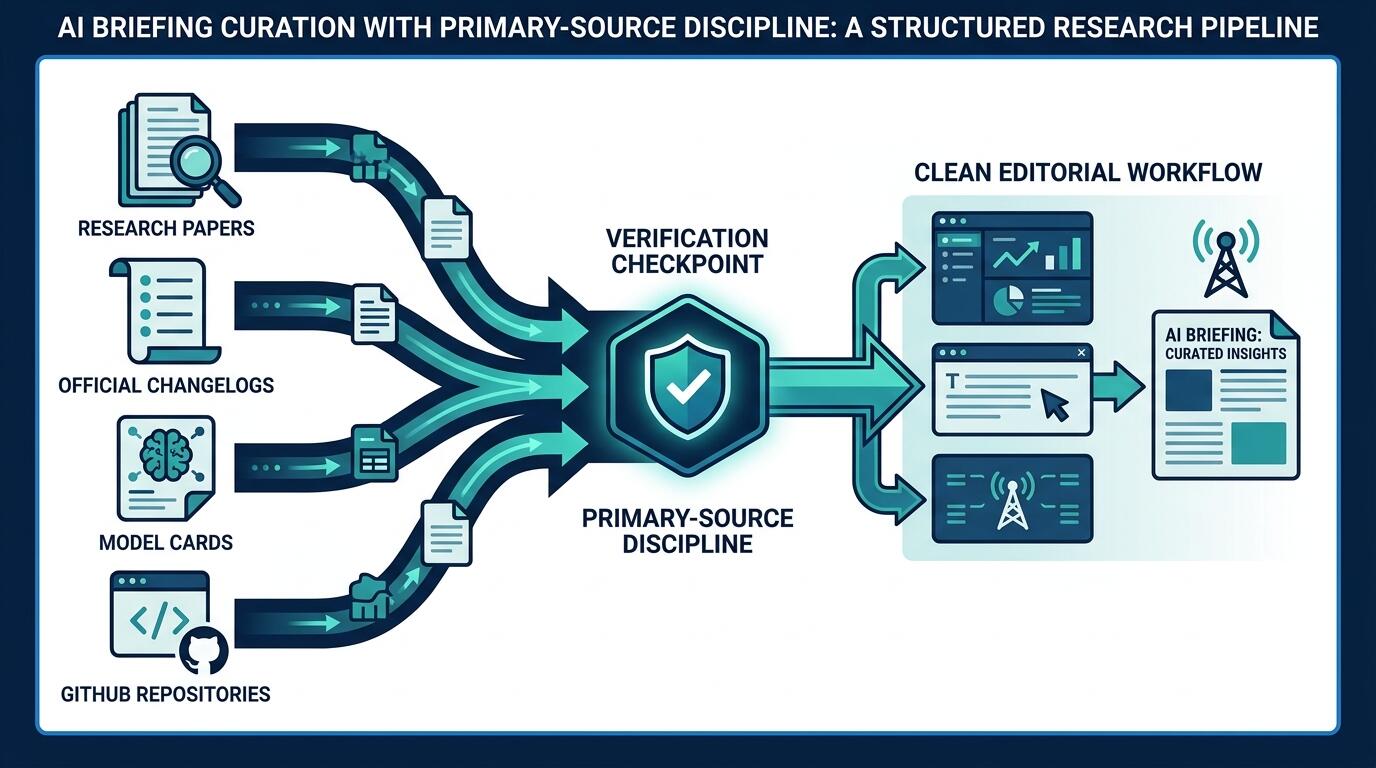
ALT: Primary-source discipline in AI briefing curation — how verified sources shape actionable builder decisions
Primary-Source Discipline vs. Aggregated Reporting: Which Actually Serves AI Product Builders?
The single question AI product builders ask most often about the information they consume is this: can I act on this, or do I need to go verify it myself? The honest answer depends entirely on how the information was sourced in the first place. Primary-source discipline — the practice of tracing every claim back to its originating document, announcement, paper, or repository before publishing — produces briefings where readers can skip the verification step. Aggregated reporting, by contrast, often layers interpretation on top of interpretation until the original signal is unrecognizable.
This case study compares two approaches to AI briefing curation: strict primary-source discipline (the method Darius uses) and the more common aggregated-reporting model seen across most AI newsletters and media outlets. The evaluation criteria are signal fidelity, actionability, coverage latency, editorial overhead, and reader trust. The verdict: primary-source discipline is operationally harder but produces materially better outcomes for readers who need to convert information into building decisions — and this quarter's Darius briefing is a concrete demonstration of why.
Evaluation Criteria: What Matters When You're Building, Not Just Reading
Five criteria determine whether an AI briefing genuinely serves product builders or merely occupies their inbox.
Signal fidelity is the degree to which the published claim matches what the original source actually said. A model benchmark cited from a third-party recap rather than the original paper introduces at least one layer of potential distortion. For engineers making architectural decisions, distortion at this layer is costly.
Actionability measures whether a reader can derive a concrete next step from a briefing item without additional research. A briefing entry that identifies a new API capability, links to the official changelog, and notes the relevant pricing or rate-limit change is actionable. One that summarizes a Twitter thread summarizing a blog post about a paper is not.
Coverage latency tracks how quickly a briefing surfaces developments after they become publicly available at the primary source. Counterintuitively, aggregators are not always faster — they often wait for a story to accumulate social proof before covering it, which means primary-source monitors frequently surface developments earlier.
Editorial overhead accounts for the real cost of maintaining a primary-source workflow: monitoring source lists, reading original documents, verifying claims, and writing context that adds rather than dilutes. This matters because overhead shapes what a single-person or small-team publication can realistically sustain.
Reader trust is the long-run outcome variable. Trust accumulates when readers consistently find that briefing claims hold up under scrutiny. It erodes when a single notable error propagates from an aggregator through a briefing and into a product decision.
The Contenders: Two Approaches to AI Briefing Curation
Primary-Source Discipline: Tracing Every Claim to Its Origin
Primary-source discipline, as applied in the Darius briefing, means that no claim about a model release, API change, research finding, or infrastructure shift is published until the original source — the official blog post, the arXiv paper, the GitHub commit, the regulatory filing, the earnings call transcript — has been read and verified directly. Stony Brook University's research library defines a primary source as "a first-hand or contemporary account of an event or topic," and that definition maps cleanly onto the AI briefing context: the original model card is a primary source; a newsletter recapping the model card is not.
In practice, this approach means building and maintaining a curated monitor list of official sources: model lab blogs, research publication feeds, API changelogs, standards body announcements, and relevant regulatory trackers. Each morning's intake passes through a triage layer that asks whether the item has a traceable primary source before it enters the candidate pool. Items without a verifiable origin are held until the source surfaces or dropped entirely.
The agent pipeline behind a daily AI briefing that powers this workflow is itself a product with moving parts: retrieval agents that monitor source feeds, a verification step that cross-references claims against originating documents, and an editorial pass that adds context grounded in real in-production experience rather than secondhand interpretation.
Aggregated Reporting: Speed and Coverage at the Cost of Fidelity
Aggregated reporting is the dominant model for AI newsletters. It works by monitoring high-signal social and media channels — Twitter/X, Hacker News, Reddit, major tech publications — and synthesizing what's trending into a digest. The advantage is horizontal coverage: an aggregator can surface a larger volume of topics per issue because the sourcing work has largely been done by others.
The disadvantage is fidelity. When an aggregator cites a tech blog that cited a tweet that referenced a paper, the chain of inference has three links where error can enter. In fast-moving domains like AI, where model capabilities are frequently overstated and benchmark conditions vary significantly, a single misread at any link in the chain can produce a materially wrong claim in the final briefing.
The research literature on case study methodology, including guidance published by the National Institutes of Health, emphasizes that sourcing discipline is foundational to the integrity of any knowledge product — a principle that applies as directly to briefing curation as it does to academic research.
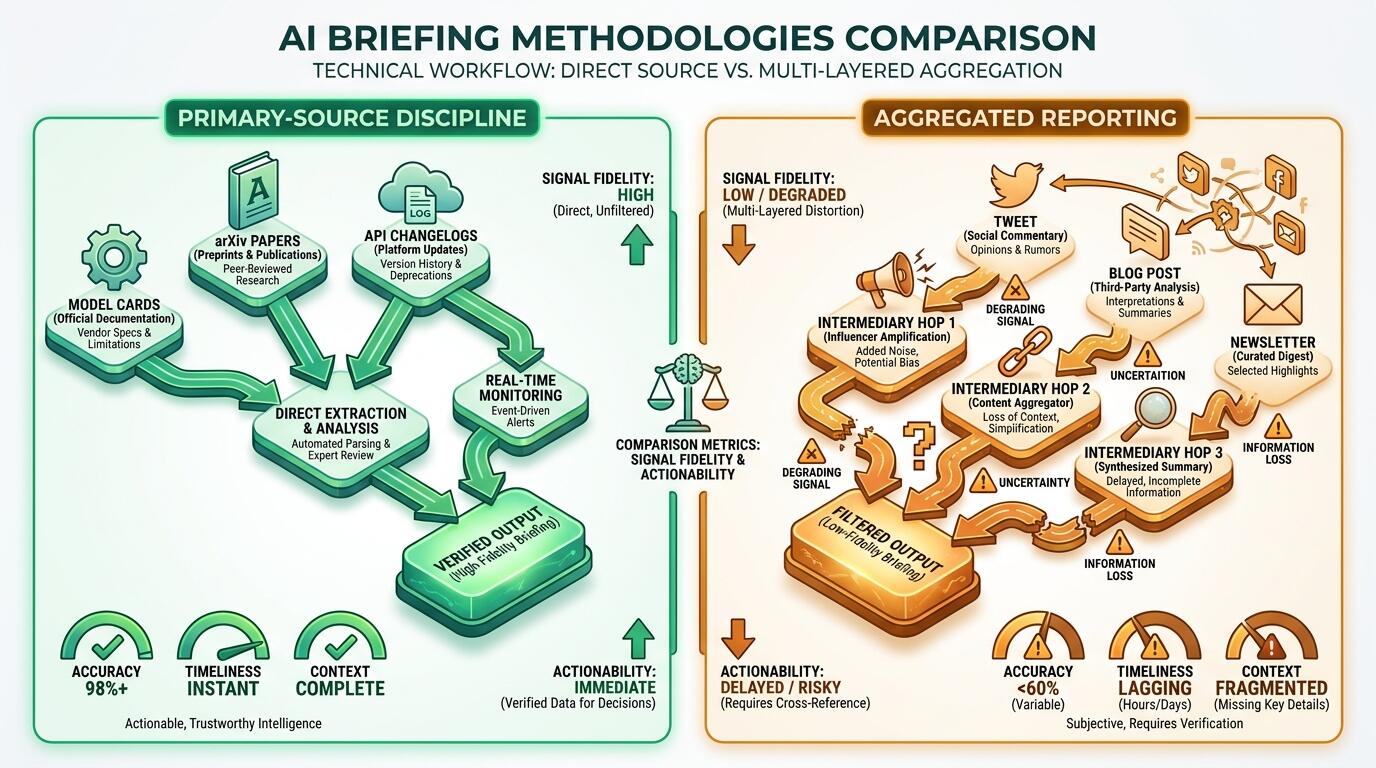
ALT: Side-by-side workflow diagram comparing primary-source AI briefing discipline against aggregated reporting, highlighting signal fidelity and actionability for AI product builders
Head-to-Head Comparison: Primary-Source Discipline vs. Aggregated Reporting
| Criterion | Primary-Source Discipline | Aggregated Reporting |
|---|---|---|
| Signal fidelity | High — claims traced to originating documents | Variable — depends on intermediary quality |
| Actionability | High — context added from in-production experience | Moderate — context often surface-level |
| Coverage latency | Low to moderate — depends on source monitor completeness | Low for trending topics; high for niche technical developments |
| Editorial overhead | High — requires reading originals, not summaries | Low to moderate — synthesis from existing coverage |
| Reader trust (long-run) | High — errors are rare and traceable | Moderate — errors propagate from upstream sources |
| Suitable briefing volume | Lower (5–10 high-quality items) | Higher (10–20+ items per issue) |
The table reveals a fundamental tradeoff. Aggregated reporting wins on volume and breadth; primary-source discipline wins on quality, fidelity, and long-run trust. The right choice depends on what a reader is optimizing for.
For readers who are actively building AI products and need to convert information into decisions — whether to adopt a new model, restructure an API integration, or reconsider an infrastructure assumption — quality and fidelity consistently outperform volume. A briefing with ten items that each require follow-up verification is less useful than one with five items that don't.
The coverage latency comparison is less obvious than it appears. Aggregators are fast for developments that generate immediate social commentary — major model releases, high-profile outages, viral benchmarks. But for the technical developments that matter most to builders — quiet API deprecations, model behavior changes in changelogs, new rate-limit structures — primary-source monitors surface these earlier precisely because they are not waiting for social amplification. Knowing how to evaluate AI development tools before committing often depends on catching exactly these lower-profile signals early.
The editorial overhead gap is real and should not be understated. Maintaining a primary-source workflow for a daily or weekly AI briefing requires a meaningfully larger time investment per item than synthesis from existing coverage. This is the reason most publications default to aggregation: it is operationally cheaper. The Darius briefing absorbs this overhead by keeping item count deliberately constrained — five to ten items per issue, each fully sourced and contextualized, rather than twenty items half-sourced and quickly summarized.
Which Should You Choose? Scenario Recommendations for AI Builders
The choice between consuming a primary-source briefing and an aggregated one is not purely philosophical — it depends on what you are actually trying to do with the information.
If you are making infrastructure or architectural decisions, primary-source discipline is non-negotiable. A claim about a model's context window, latency profile, or pricing structure that turns out to be based on a misread changelog can produce a wrong architectural choice. In this scenario, choose a briefing that traces claims to official sources and explicitly identifies those sources, even if that briefing covers fewer topics per issue.
If you are doing competitive monitoring at a high level, aggregated reporting may be sufficient for the initial signal layer — but verify before acting. Use aggregated briefings to identify what to investigate, then go to primary sources before making decisions.
If you are a solo developer or small team with limited time, the instinct is to reach for the highest-volume briefing to maximize coverage. The better instinct is the opposite: a smaller, higher-fidelity briefing saves time because it eliminates the verification step. Five items you can act on directly are worth more than twenty items that each require thirty minutes of follow-up research.
If you are responsible for keeping a team informed, the fidelity question matters even more. Errors in a briefing that reaches five or ten engineers get multiplied across their individual decisions. A single incorrect benchmark claim distributed in a team briefing can influence multiple parallel workstreams before anyone catches the error.
If you want to understand how a primary-source workflow is actually built and maintained, the operational detail matters as much as the output. Understanding how to write editorial rules that an AI agent can actually follow is the difference between a briefing pipeline that degrades over time and one that holds its quality bar.
Pros of primary-source discipline: high fidelity, actionable items, traceable claims, strong long-run trust, lower total time cost for readers who need to act.
Cons of primary-source discipline: lower item volume per issue, higher editorial overhead for the publisher, risk of missing topics not yet covered by primary sources.
Pros of aggregated reporting: broader topical coverage, lower latency for trending developments, easier to produce at scale.
Cons of aggregated reporting: variable fidelity, higher reader verification burden, errors that propagate from upstream sources without attribution.
People Also Ask
Q1: How does primary-source discipline improve the quality of an AI briefing?
Primary-source discipline improves AI briefing quality by requiring every published claim to be traced to its originating document — a model card, official changelog, research paper, or regulatory filing — before publication. This eliminates the error-compounding effect of citation chains common in aggregated reporting. Research on information sourcing from academic institutions including Stony Brook University defines primary sources as first-hand accounts, and applying that standard to technical briefings means readers receive claims that do not require independent verification before acting on them.
Q2: Is an aggregated AI newsletter sufficient for product-building decisions?
Aggregated AI newsletters are generally not sufficient as the sole information source for product-building decisions. They are useful for identifying trending topics and maintaining broad awareness, but because they synthesize from intermediary sources, fidelity to the original claim is not guaranteed. For decisions involving architecture, API selection, or infrastructure investment — where a single incorrect assumption can produce compounding downstream costs — primary-source verification is required either within the briefing itself or as a mandatory reader step before acting.
Q3: How much additional editorial time does primary-source briefing curation require compared to aggregation?
Primary-source briefing curation requires substantially more editorial time per item than aggregation, primarily because the editor must read and assess originating documents rather than synthesizing from existing coverage. In practice, this overhead is the main reason most AI publications default to aggregation. Briefings like Darius manage this by constraining item volume — publishing five to ten fully-sourced items per issue rather than attempting comprehensive coverage — which keeps total editorial cost proportional while preserving quality per item.
Key Takeaways
- Primary-source discipline means tracing every briefing claim to its originating document — a model card, official changelog, paper, or filing — before publication. This is the single most important quality variable in a technical briefing.
- Aggregated reporting covers more ground but introduces fidelity risk at every link in the citation chain. For competitive awareness, it is adequate; for product decisions, it is not.
- Coverage latency is not an automatic win for aggregators. Niche technical signals — the ones most relevant to builders — often surface earlier through primary-source monitors than through social amplification.
- The editorial overhead of primary-source discipline is real, but the reader's verification burden is correspondingly lower. Fewer high-fidelity items save more total time across a team than many low-fidelity items that each require follow-up.
- The Darius briefing model — five to ten items per issue, each with identified primary sources and in-production context — is a deliberate tradeoff: less volume, significantly more usability per item.
The immediate next step for any builder evaluating information sources is to apply a single test to the last three briefings they read: can they identify the primary source for each claim, and does that source actually say what the briefing reported? The answer will tell them more about the briefing's reliability than any editorial description can.
If you're building AI products and want to skip the noise and reach information you can actually act on, subscribe to the Darius briefing at Darius — five to ten curated items per issue, each with a primary source and a real in-production context, written by an engineering director running three AI products in parallel.
References
- Stony Brook University Libraries. "Home | Using Primary Sources in Research".
https://www.stonybrook.edu/commcms/primary-sources/ - National Institutes of Health, PubMed Central. "Case studies: a guide for researchers, educators, and practitioners".
https://pmc.ncbi.nlm.nih.gov/articles/PMC12458855/ - Glendale Community College Library. "Examples of Primary Sources Based on Discipline".
https://campusguides.glendale.edu/primarysources/examples - IEEE — Institute of Electrical and Electronics Engineers. Standards and publications on information integrity and technical documentation practices.
https://www.ieee.org/
Note: Standards and source definitions may be updated; verify against the latest official documents before applying in formal contexts.