Turning a Personal Portfolio Into a Working Product, Not Just a Résumé
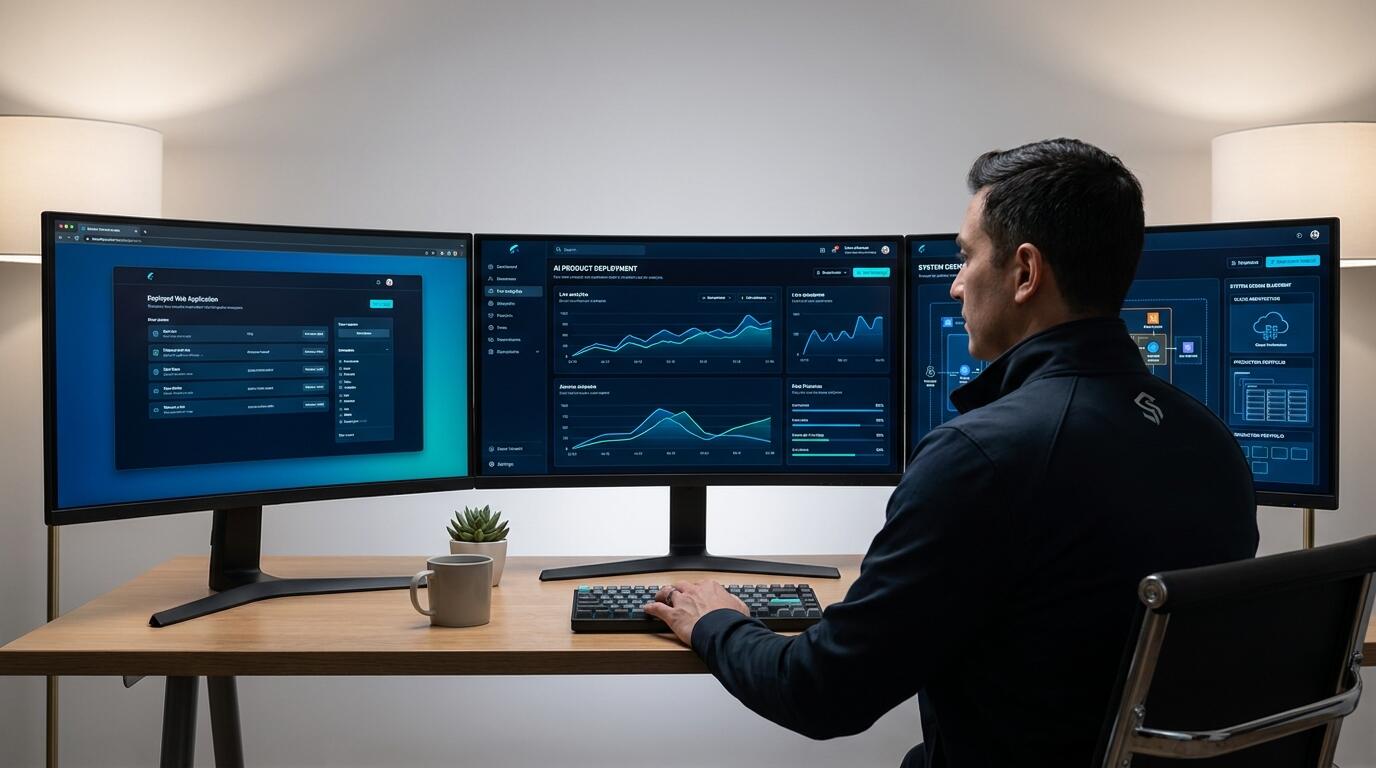
ALT: Engineering leader transforms personal portfolio into a live, production-ready product showcasing real shipped projects
Why Most Technical Portfolios Stay Stuck on the Résumé Level
You've built impressive things. You have GitHub repos, a list of technologies you know, and a CV that reads well. But when a prospective client or co-founder visits your online presence, they land on a static page that tells them what you've done — not what you can do for them today. That gap, between a portfolio as a historical document and a portfolio as a living, working product, is exactly where most technical professionals leave significant value on the table.
Turning a personal portfolio into a working product means treating your own professional presence with the same architectural rigor, product thinking, and execution discipline you would bring to any client engagement. It means shipping something that demonstrates capability in real time, not merely narrating past accomplishments. For engineering leaders, AI architects, and full-stack builders, this distinction is particularly consequential: your audience — founders, CTOs, and product leaders — evaluates you by your output, not your credentials. A portfolio that ships, functions, and solves a real problem is the most credible signal you can send.
Three points anchor everything that follows: first, a working portfolio requires a product mindset from the start; second, it demands real architectural decisions, not cosmetic ones; and third, its value compounds over time in ways a static résumé never can.
Where This Approach Applies
Applicable Scenarios:
- Senior engineers or engineering leaders who want to attract high-quality consulting clients, co-founder relationships, or advisory roles rather than relying on job boards or cold outreach
- AI architects and full-stack developers building a personal brand that must demonstrate technical depth to a discerning, technical audience
- Technical founders whose portfolio doubles as a proof-of-concept, showing investors and partners that they can ship, not just design
Not Applicable/Cautions:
- Early-career developers who have not yet shipped a complete project end-to-end — the foundation needs to exist before it can be productized
- Professionals whose audience is non-technical HR teams or applicant-tracking systems, where keyword-optimized documents still dominate the screening process
The Problem With Portfolios That Only Look Backward
A personal portfolio, in the traditional sense, is a retrospective artifact — a curated record of past work. That model made sense when the primary audience was a recruiter or hiring manager scanning a document. But the market for senior technical talent and consulting has shifted substantially. Founders evaluating a technical partner, investors assessing a builder's credibility, and product leaders choosing an AI architecture consultant are not running the same mental checklist as a recruiter. They want evidence of judgment, not just capability.
According to Virginia Tech's Career and Professional Development center, a portfolio that goes beyond a résumé demonstrates "skills, experiences, and accomplishments in a more dynamic and comprehensive way" than credentials alone. The challenge is that most technical portfolios stop at aesthetic polish: a clean design, a list of projects, maybe a case-study write-up. What they rarely do is function as a product in their own right — something that provides ongoing value, generates organic discovery, and compounds in credibility over time.
The pattern we consistently see, working across technical domains from AI system design to full-stack product development, is that the engineers who attract the best opportunities are not necessarily the ones with the longest list of past projects. They are the ones whose portfolio is itself evidence of the judgment they're selling. A portfolio that demonstrates live, deployed systems — projects that handle real users, real data, and real edge cases — communicates something a bullet point list simply cannot.
According to Ivy Exec's career advisory research, candidates who use portfolio-based presentation consistently outperform résumé-only approaches when the audience is making a judgment about future potential rather than confirming past titles. For a senior technical professional, that audience is almost always a founder, a board, or a sophisticated hiring committee — exactly the people who can recognize the difference between shipped work and theoretical capability.
This is the context in which Darius has been built: not as a static résumé dressed in modern UI, but as a demonstration of what it looks like when an Engineering Director and AI Architect applies the same product discipline to their own professional presence that they bring to client engagements. Three shipped live projects sit at the core of that portfolio — not mockups, not case studies of work buried in an NDA, but functioning products that can be evaluated directly.
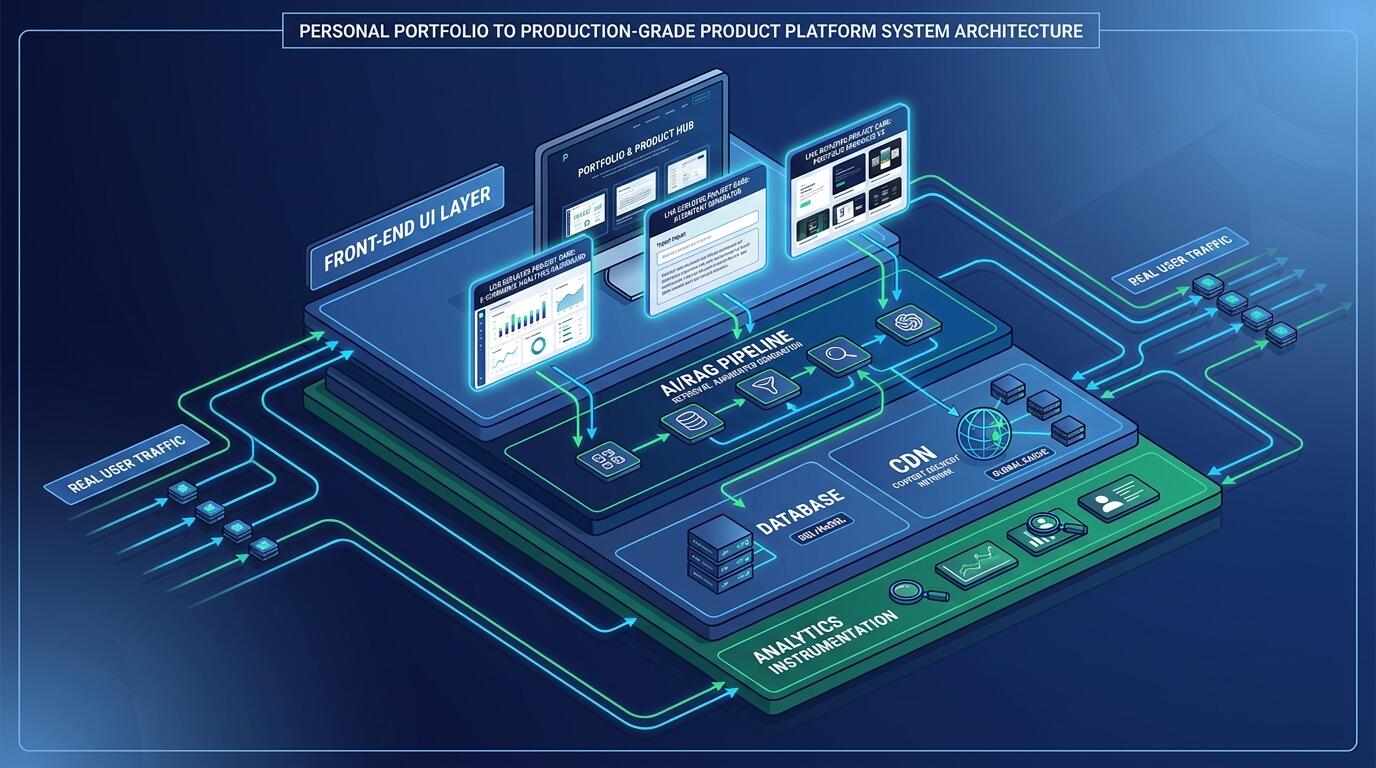
ALT: A working personal portfolio built with AI architecture and systems design principles, demonstrating real shipped products and engineering leadership expertise
Building a Portfolio That Functions as a Product
Three Steps to Shift From Résumé to Working Product
Step 1: Define the Problem Your Portfolio Solves — For Someone Else
The first and most important reframe is treating your portfolio as a product with a user and a use case, not a personal archive. Ask: who visits this, what decision are they trying to make, and what information do they need to make it confidently? A technical founder evaluating a potential AI architecture partner needs to answer the question "can this person ship something like what I need?" That answer should be available within the first thirty seconds on your site. Spend time defining this before writing a single line of code or copy. The architecture of everything that follows depends on clarity here.
Step 2: Ship at Least One Live, Functioning Project That Reflects Your Core Expertise
A portfolio becomes a working product the moment it contains something that functions in production — not a demo, not a screenshot, but a live deployment handling real requests. For an AI architect, this might mean a publicly accessible tool built on a retrieval-augmented generation pipeline. For a full-stack engineer, it might be a SaaS product or a utility with real users. The specifics matter less than the principle: the portfolio must contain evidence of end-to-end execution. Expect this to require meaningful investment of time and infrastructure, but treat it as the highest-ROI work you can do for your own positioning.
Step 3: Instrument, Iterate, and Make the Portfolio Discoverable
A product without users is just a side project. Once live projects exist, the portfolio needs the same instrumentation you would apply to any production system: analytics to understand what resonates, SEO and content to drive organic discovery, and a feedback loop to identify what prospective clients actually care about. This is where content strategy — blog posts, technical case studies, architecture write-ups — compounds the initial investment. Each piece of content is a surface area for discovery; collectively they create a body of work that establishes credibility before a single conversation happens.
Comparing Portfolio Approaches: Static, Polished, and Production-Grade
The difference between portfolio archetypes is significant, and understanding the tradeoffs helps you allocate your effort where it generates the most return. Most technical professionals fall into the first or second category and wonder why their inbound quality doesn't reflect their actual capability.
| Comparison Dimension | Static Résumé-Site | Polished Case Study Portfolio | Production-Grade Working Portfolio |
|---|---|---|---|
| Primary signal to audience | Past titles and employers | Design skill and narrative ability | Execution capability and technical judgment |
| Evidence of shipping | Absent | Indirect (described, not demonstrated) | Direct (live, accessible projects) |
| Organic discoverability | Minimal | Moderate with content effort | High, compounds over time with SEO and technical content |
| Maintenance requirement | Low | Medium | Medium-high, but generates ongoing ROI |
| Audience trust signal | Low for technical decision-makers | Medium | High for founders, CTOs, and engineering leaders |
| Reflects product thinking | Rarely | Partially | Consistently |
The production-grade portfolio demands more upfront work, but the return on that investment is qualitatively different. It shifts the conversation from "tell me about your experience" to "I can see what you build — let's talk about what you can build for us."
What Makes a Portfolio a Genuine Product
Architecture decisions are visible in the product itself. When a senior technical professional ships live projects, the architectural choices they made — technology stack, system design, infrastructure approach — are embedded in the product and can be discussed with specificity. This is the kind of evidence that registers with a CTO or a technical founder. It signals that you understand the full stack of consequences that flow from early decisions, not just the surface-level implementation. For teams evaluating AI architecture work specifically, this signal is essential, and it connects directly to the questions founders should be asking when choosing an AI architecture partner.
Content strategy extends the portfolio's reach without rebuilding it. A working portfolio is not just the projects — it is the body of writing, documentation, and thought leadership that surrounds them. Technical articles that explain architectural reasoning, trade-off analyses, and lessons learned from shipping real systems create multiple discovery pathways for the right audience. They also demonstrate something a project alone cannot: the ability to communicate complex technical thinking clearly, which is a core competency for any engineering leader or consulting partner.
The portfolio's own infrastructure is a demonstration. The choices you make about how to host, deploy, and maintain your portfolio are themselves visible to a technical audience. A portfolio that loads fast, handles edge cases gracefully, and is clearly maintained signals operational discipline. One that breaks on mobile or hasn't been updated in years signals the opposite. Treat your portfolio's infrastructure the way you would treat a client's production system — because for a sophisticated visitor, it is your production system.
Case studies with real architectural depth outperform generic project descriptions. Rather than listing what you built, document how you thought about it. What constraints shaped the design? What trade-offs did you make and why? What would you do differently? These questions, answered honestly and in technical depth, are far more useful to a prospective client than a technology badge list. They also naturally incorporate the kind of reasoning that demonstrates seniority — not just knowing the tools, but understanding when to use them and when not to.
Shipping regularly beats perfecting once. One of the consistent patterns in high-performing technical portfolios is a bias toward shipping and iterating rather than waiting for a project to be "ready." A live but imperfect project is more credible than a polished mockup, because it demonstrates tolerance for production complexity — the messy realities of real infrastructure, real users, and real failure modes. This bias toward execution over perfection is a core signal that sophisticated technical audiences use to distinguish builders from theorists.
Advanced Considerations: When a Portfolio Becomes a Business
The portfolio-as-product approach creates compounding returns, but only if the underlying systems are designed to scale. A common mistake is building a portfolio that works well at first but becomes technically unmaintainable as content and projects accumulate. Apply the same architectural principles you would use for any production system: modular structure, clear separation of concerns, and enough observability to understand what is working.
Misconception: more projects equals more credibility. In practice, three well-documented, genuinely shipped projects with clear architectural thinking communicate more than ten half-finished or poorly documented ones. Depth and completion signal judgment; breadth without depth signals scattered execution. The Darius portfolio is built explicitly on this principle — a focused set of live projects, each demonstrating end-to-end capability.
Misconception: a beautiful design is sufficient differentiation. Design quality matters, but for a technical audience, it is table stakes. What differentiates a portfolio for a CTO or founder is evidence of production-grade thinking: how was the system designed to handle failure? How does it scale? What were the real trade-offs? These questions are answered by documentation and live systems, not by visual design.
The portfolio and the consulting practice reinforce each other. Work done for clients generates insights, patterns, and lessons that feed back into portfolio content. Portfolio content generates inbound from prospective clients who have already self-qualified. This flywheel — consulting work informing content, content attracting consulting work — is the underlying business logic of the portfolio-as-product approach, and it generates compounding returns that a static résumé simply cannot replicate.
Questions & Answers
Q1: How do you decide which projects to include in a working portfolio?
Prioritize projects that demonstrate end-to-end execution over breadth of technology exposure. A single project where you can articulate the problem, the architectural decisions, the trade-offs you navigated, and the outcome in production tells a far more compelling story than a gallery of disconnected experiments. For a technical audience — founders, CTOs, engineering leaders — the quality of your reasoning is more important than the quantity of your output. Aim for three to five deeply documented, genuinely shipped projects rather than an exhaustive archive.
Q2: Is a personal portfolio necessary if you already have strong professional references?
For senior technical professionals seeking consulting engagements, advisory roles, or co-founder relationships, a working portfolio serves a function that references cannot: it lets prospective partners evaluate your judgment independently, before any conversation happens. References validate past performance; a working portfolio demonstrates current capability. LinkedIn's professional community research consistently notes that portfolio-based evidence is increasingly expected alongside references for senior technical roles, particularly in AI and product engineering where the stakes of a wrong hire or wrong partner are high.
Q3: How long does it take to build a portfolio that functions as a real product?
The honest answer depends on the depth of the underlying projects, but a realistic timeline for a production-grade portfolio — with at least one genuinely shipped live project, documented case studies, and a content strategy in place — is several months of consistent effort. The infrastructure and content can be built incrementally, but the core live project should be prioritized early because it is the highest-ROI element. Treat it as an investment with a long return horizon: the compounding effect of inbound discovery and demonstrated credibility accumulates over time, not immediately.
The Bottom Line
A personal portfolio that functions as a working product — rather than a retrospective résumé — is the most credible signal an engineering leader or AI architect can send to a discerning technical audience. Three principles define the difference: the portfolio must contain live, deployed work that can be evaluated directly; it must reflect architectural thinking, not just implementation skill; and it must be treated as a product with real users, real instrumentation, and an ongoing content strategy that compounds its reach over time.
For Tech founders, startup CTOs, and product leaders evaluating a technical partner, these signals matter more than credentials. According to career research from Virginia Tech's professional development center, a portfolio that demonstrates dynamic, real-world capability consistently outperforms static credential presentation for audiences making forward-looking capability judgments. The investment required to build this kind of portfolio is real, but so is the return: a body of work that attracts the right opportunities, qualifies prospective clients before the first conversation, and compounds in credibility with every shipped project and published insight.
The next step is concrete: identify one live project that demonstrates your core expertise, document it with the depth and honesty you would bring to a client case study, and build the infrastructure to make it discoverable. Everything else follows from that foundation.
If you're ready to see what a production-grade technical portfolio looks like in practice — built by someone who has shipped live AI-powered products and engineered complex systems end-to-end — explore the work, case studies, and technical insights at Darius. Whether you're a founder looking for an AI architecture partner or an engineering leader seeking a model for your own professional presence, the portfolio exists to be evaluated, not just read.
References
- Virginia Tech Career and Professional Development. "Beyond the Resume: Using a Portfolio to Showcase Your Skills and Experience".
https://career.vt.edu/blog/2025/05/15/beyond-the-resume-using-a-portfolio-to-showcase-your-skills-and-experience/ - Ivy Exec. "Using a Portfolio to Showcase Your Skills and Experience".
https://ivyexec.com/career-advice/2023/beyond-the-resume-using-a-portfolio-to-showcase-your-skills-and-experience/ - LinkedIn Professional Community. "Resume vs Portfolio: Digital Job Market Essentials".
https://www.linkedin.com/posts/maria-saverino-8b1ba9165_portfolio-vs-resume-what-they-include-and-activity-7484952148779278336-UJyY - IEEE (Institute of Electrical and Electronics Engineers). Professional competency and portfolio standards for engineering practitioners.
https://www.ieee.org/