Integrating OpenAI and Anthropic APIs Into Full-Stack Products in 2026

ALT: Full-stack developer integrating OpenAI and Anthropic APIs into a production web application in 2026
Why OpenAI and Anthropic API Integration Is the Core Engineering Challenge of 2026
The question most product teams are asking right now is not whether to integrate large language model APIs into their stack — it is how to do it without accumulating technical debt, blowing up cost projections, or shipping something that collapses under real user load. Integrating OpenAI and Anthropic APIs into full-stack products in 2026 is no longer an experimental exercise; it is a production engineering discipline with well-defined failure modes, architectural patterns, and hard-won best practices.
This topic deserves deeper analysis now because the tooling has matured faster than the organizational knowledge to use it well. Teams that rushed early implementations are now living with the consequences: inconsistent outputs wired directly into business logic, absent fallback strategies, and cost structures that were never modeled against realistic traffic. Building correctly from the start — or refactoring thoughtfully — separates products that scale from products that quietly fail.
The State of LLM API Integration in Full-Stack Development
Full-stack LLM API integration has moved from prototype novelty to a core infrastructure concern in a relatively short time. OpenAI is a research and deployment company that operates the GPT family of models through a REST-based API, offering capabilities ranging from chat completion and structured output to vision, audio, and tool use. Anthropic is an AI safety company that produces the Claude model family, which has become a serious alternative — and in many use cases a preferred one — due to its large context windows, instruction-following characteristics, and safety-oriented design philosophy.
According to a developer-facing comparison published by Strapi, the LLM API landscape in 2026 includes both providers as leading options for production integrations, with teams frequently evaluating them not as competitors but as complementary tools suited to different task profiles. That shift in framing — from "which one" to "how do we use both" — is the defining trend of this moment.
The architecture of a modern full-stack AI product typically involves a backend service layer that mediates between the client application and one or more model provider APIs. The backend handles prompt construction, context management, rate limiting, cost tracking, and fallback routing. The frontend consumes streaming responses, manages loading states, and renders structured outputs. Neither OpenAI nor Anthropic expose their APIs directly to end users in a well-architected product — the backend abstraction layer is not optional; it is the foundation.
What makes 2026 particularly demanding is the breadth of model capabilities teams must now account for. As detailed in the overview of Anthropic's current model and agent offering, the Claude family now spans models with differing context capacities, latency profiles, and pricing tiers, each suited to different integration patterns. OpenAI's GPT-4 class and reasoning-focused models similarly present a menu of options rather than a single integration target. Choosing the wrong model tier for a given task is one of the most common and costly mistakes in production deployments.
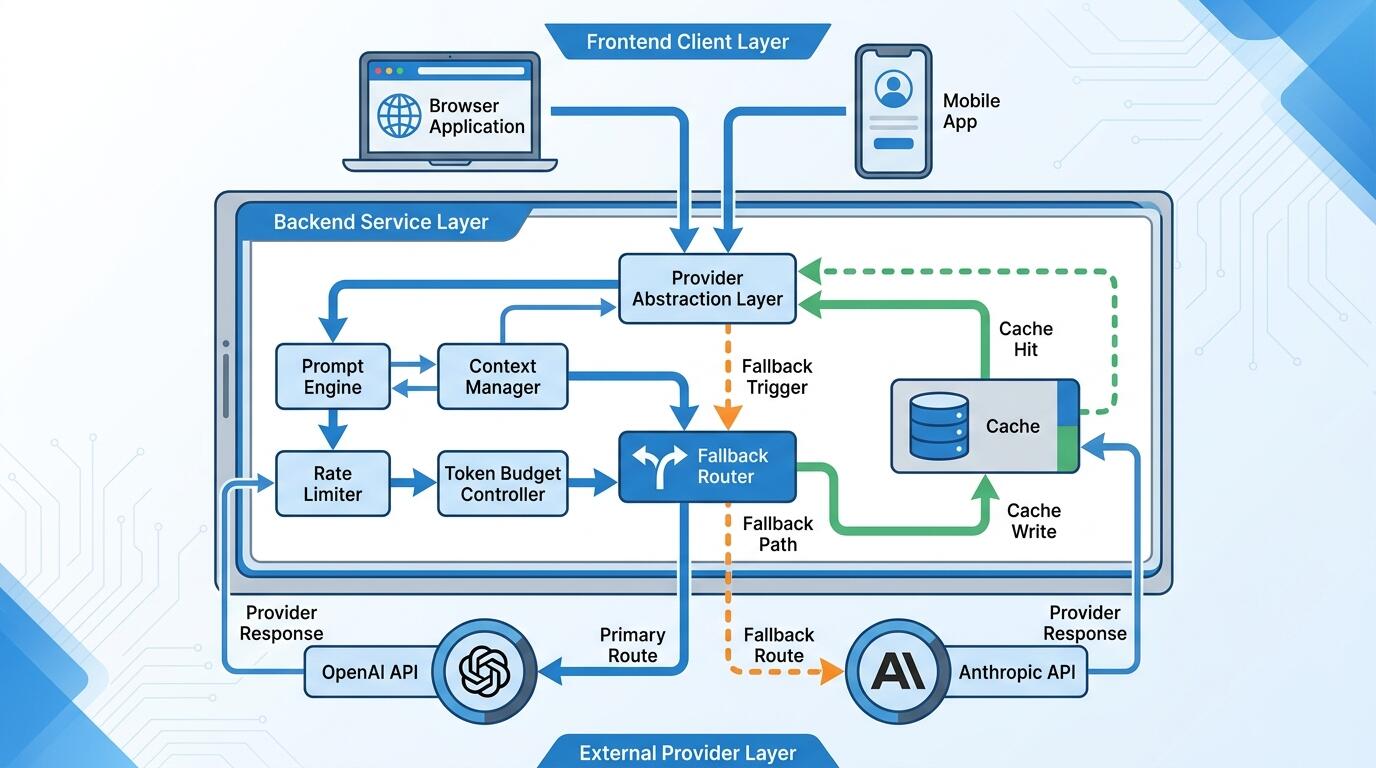
ALT: Architecture diagram showing OpenAI and Anthropic API integration layers in a full-stack product with routing, caching, and fallback logic
The Mechanisms That Make or Break API Integration
Provider Abstraction Is Not a Convenience — It Is a Survival Strategy
Provider abstraction is the practice of wrapping each external model API behind a common internal interface so that the rest of your application has no direct dependency on a specific vendor's SDK or request format. In practice, this means defining your own internal generateCompletion(prompt, options) function — or its equivalent — and having each provider (OpenAI, Anthropic) implemented as a pluggable adapter behind that interface.
A pattern we consistently see in production-ready integrations is that teams who skip abstraction in the name of speed almost always pay for it within a few months. When Anthropic releases a new model with different message formatting requirements, or when OpenAI adjusts a deprecated endpoint, the blast radius of change touches every file that imported the SDK directly. Abstraction converts that from a systemic refactor into a single adapter update.
Prompt Engineering and Context Management
Prompt engineering is the discipline of constructing inputs to a language model in ways that reliably produce the output your application needs. In a full-stack context, this is not a one-time design task — it is an ongoing engineering concern. System prompts, few-shot examples, and retrieved context must all be assembled programmatically, and the assembly logic needs to be version-controlled, tested, and observable.
Context management is where many teams run into their first real production problem. Both OpenAI and Anthropic impose token limits on model inputs, and exceeding those limits silently truncates or errors out requests in ways that are hard to detect without deliberate instrumentation. Managing context windows correctly means tracking token counts at the middleware layer, implementing truncation policies that preserve the most relevant content, and surfacing near-limit warnings in internal monitoring before they become user-facing failures.
Streaming, Latency, and User Experience
Streaming responses — where the model's output is sent token by token rather than as a single completed payload — are essential to acceptable user experience in conversational or long-form generation use cases. Both OpenAI and Anthropic APIs support streaming via server-sent events, but wiring streaming correctly through a full-stack architecture requires deliberate handling at every layer: the backend must maintain an open connection, the client must process incremental chunks, and error handling must account for mid-stream failures without displaying partial garbage to the user.
Latency optimization is a discipline in itself. Caching semantically equivalent prompts, selecting smaller model tiers for latency-sensitive tasks, and pre-warming connections are all techniques with measurable impact. The mistake is treating latency as an afterthought rather than a first-class engineering requirement from the start.
Fallback Routing and Reliability
Multi-provider fallback routing is the practice of automatically retrying a failed or degraded request against an alternative provider or model tier. Given that both OpenAI and Anthropic experience occasional API degradation — a documented reality for any cloud API at scale — a production system that routes exclusively through a single provider is accepting unnecessary availability risk.
A well-designed routing layer tracks provider health, implements exponential backoff for rate limit errors, and can degrade gracefully to a smaller or cached response rather than returning an error to the end user. This is one of the architectural decisions that most clearly separates a hobbyist integration from a production-grade one. For a deeper look at the broader architectural decisions that underpin this kind of design, the analysis of AI system architecture patterns every CTO should evaluate covers the structural frameworks in detail.
Cost Modeling and Token Budgeting
Token budgeting is the practice of setting explicit limits on how many tokens any single request, session, or user can consume within a billing period. Without it, a single misconfigured prompt or a runaway agent loop can generate costs that invalidate an entire month's revenue projection. Effective cost modeling means instrumenting every API call with token counts, aggregating by user and feature, and setting hard limits at the middleware layer before requests reach the model provider.
Evidence and Multi-Angle Comparison
In work across AI product builds, a recurring observation is that teams approach OpenAI and Anthropic integration with meaningfully different mental models, each of which carries distinct strengths and risks. The following comparison captures the most consequential perspectives:
| Perspective / Approach | Strengths | Trade-offs | Best Fit |
|---|---|---|---|
| Single-provider (OpenAI only) | Simpler integration, one SDK to maintain, mature tooling ecosystem | Vendor lock-in, full exposure to outages and pricing changes, miss use-case-specific Claude advantages | Early prototypes, teams with limited API budget or engineering capacity |
| Single-provider (Anthropic only) | Excellent for long-context tasks, strong instruction following, safety-aligned outputs | Smaller ecosystem of third-party tooling, fewer native integrations | Legal, compliance, or document-heavy applications where context depth matters |
| Multi-provider with static routing | Resilience against single-provider outages, task-specialized model selection | More complex integration layer, two SDKs to maintain, prompt parity challenges | Production products where reliability and model-task fit are both priorities |
| Multi-provider with dynamic routing | Maximum resilience, cost optimization via tier selection, A/B testing capability | Highest integration complexity, requires robust observability, potential for inconsistent output formats | Scale-stage products, AI-first platforms, teams with dedicated infra capacity |
| Abstraction layer with provider swapping | Clean architecture, low coupling, easy to add future providers | Requires upfront design investment, abstraction can obscure provider-specific capabilities | Teams planning for long-term maintainability and future model diversity |
According to the developer API comparison published by Strapi, the evaluation criteria that matter most in production settings include not just raw model capability but rate limit generosity, latency consistency, structured output reliability, and SDK quality — all of which vary between providers and even between model tiers within a single provider.
A critical risk pattern that appears repeatedly in real integrations is the assumption that switching between OpenAI and Anthropic is a drop-in substitution. It is not. The two APIs have different message formatting conventions, different behavior around system prompt handling, different token counting libraries, and different approaches to tool use and function calling. Teams that discover this late — after building on the assumption of interchangeability — face significant refactoring work. Building the abstraction layer first, even when it feels like over-engineering for an early product, consistently pays off.
Cost structure is another dimension where qualitative understanding matters more than people expect. Both providers charge by token consumption, but the relationship between application behavior and token consumption is often non-obvious. Features like conversation history, retrieval-augmented generation context injection, and chain-of-thought prompting can multiply token usage by factors that only become visible after a week of real traffic. Understanding the true cost profile of a RAG-augmented feature, for instance, is explored in depth in the analysis of what it actually costs to run a RAG system in production.
Where This Is Heading and What It Means for Your Product
The trajectory of LLM API integration in 2026 points in a clear direction: the engineering complexity is not decreasing, but the abstraction tooling around it is improving rapidly. Frameworks that handle provider routing, prompt versioning, and observability are maturing, and teams that invest in solid architectural foundations now are well-positioned to adopt those tools without rearchitecting their entire stack.
A pattern becoming more common is the emergence of "model orchestration" as a distinct engineering role or responsibility — someone whose job is to own the relationship between the application's AI behavior and the underlying model infrastructure. In organizations that have not formalized this, the responsibility tends to fall ambiguously between product and engineering, and the result is often underinstrumentated integrations that are hard to debug and harder to optimize.
Several actionable principles emerge from current production experience:
- Design your backend AI service layer as an internal API from day one, not as a collection of ad hoc utility functions scattered across your codebase.
- Instrument every model call with structured logging that captures model ID, token counts, latency, and response metadata — not just for debugging but for cost attribution and product analytics.
- Test prompt behavior systematically, not just manually. Regression test suites for prompts, using golden outputs and automated evaluation, are no longer a nice-to-have for production AI features.
- Plan for model deprecation. Both OpenAI and Anthropic routinely retire older model versions, and an integration with no migration path will eventually break in production.
- Treat your system prompts as production code: version-controlled, reviewed, and deployed through your standard change management process.
For teams evaluating whether to build this infrastructure in-house or work with an external architecture partner, the decision framework is worth examining carefully before committing engineering resources.
Frequently Asked Questions FAQ
Q1: How should a full-stack team structure its backend to support both OpenAI and Anthropic APIs without duplicating logic?
The recommended approach is to implement a provider abstraction layer — a single internal service module that exposes a unified interface for model calls, with OpenAI and Anthropic implemented as interchangeable adapters behind it. This pattern, well-established in software engineering as the adapter or strategy pattern, means that prompt assembly, context management, and response parsing are written once against the internal interface, and provider-specific formatting is handled entirely within each adapter. The result is a codebase where switching or adding providers requires no changes to the application layer.
Q2: Are OpenAI and Anthropic APIs interchangeable for the same use cases?
No — OpenAI and Anthropic APIs are not drop-in substitutes for each other, despite surface similarities. They differ in message formatting conventions, system prompt handling, tool-use protocols, and token counting behavior. For tasks requiring very large context windows or high instruction fidelity, the Claude family from Anthropic often outperforms GPT-class models. For tasks requiring tight integration with code execution, vision, or audio, OpenAI's ecosystem is currently more mature. A thoughtful integration selects the appropriate provider per task type rather than assuming universal interchangeability.
Q3: How long does it realistically take to build a production-ready LLM API integration layer from scratch?
The timeline varies by team experience and product scope, but a pattern seen in production builds is that a minimal viable abstraction layer with one provider, basic streaming support, and logging takes on the order of several focused engineering days. Extending it to multi-provider routing, robust error handling, token budgeting, and observability instrumentation typically adds several more weeks. Teams that underestimate this scope tend to ship fragile integrations that require significant rework once they hit real traffic.
Final Thoughts
Integrating OpenAI and Anthropic APIs into full-stack products in 2026 is a mature engineering discipline with clear best practices — and clear failure modes for teams that treat it as a shortcut problem rather than an architectural one.
Key Takeaways:
- Provider abstraction is the single most important architectural decision in any multi-model integration — build the internal interface before writing a single provider-specific API call.
- Context window management, token budgeting, and cost instrumentation are production requirements, not post-launch optimizations.
- OpenAI and Anthropic serve different strengths; multi-provider routing, designed deliberately, outperforms both single-provider lock-in and naive switching.
- Streaming, fallback logic, and systematic prompt testing separate production-grade integrations from prototypes that survive only in low-traffic demos.
- Prompt engineering and system prompt management must be treated as first-class engineering artifacts — versioned, reviewed, and tested.
The next step is an honest assessment of where your current integration stands against these criteria. If you have gaps — absent abstraction, untracked costs, untested prompts — the cost of closing them grows with every week of additional feature development built on a shaky foundation. Engage that assessment now, before the refactor becomes a full rebuild.
Ready to move from assessment to action? Explore how Darius approaches these integration challenges — from architecture design through production deployment — at the Darius portfolio and insights hub, where real shipped AI products demonstrate what a well-architected integration actually looks like in practice.
Sources & Further Reading
- Strapi. "7 Top AI APIs for Developers in 2026".
https://strapi.io/blog/ai-apis-developers-comparison - Anthropic. "Home \ Anthropic".
https://www.anthropic.com/ - Linas Beliūnas. "Anthropic 2026: Every Claude Model, Agent & Tool".
https://linas.substack.com/p/anthropic-claude-2026-every-launch-guide - IEEE. IEEE Standards for AI and Software Engineering.
https://www.ieee.org/
Note: Standards and API specifications may be updated; please check the latest official documentation or consult qualified engineering advisors for current guidance.