Deep Dive Into Nine-Platform Video Distribution From One Source Issue

ALT: Engineer mapping nine-platform video distribution workflow from a single source issue
Why Nine-Platform Video Distribution From One Source Breaks Down
Publishing one piece of video content across nine different platforms simultaneously sounds like a force multiplier — and it is, until something goes wrong. A pattern we consistently see among engineering teams building or operating AI-assisted content pipelines is that the failure mode rarely lives in the source asset itself. It lives in the handoff: the moment one master file gets transformed, reformatted, and routed through nine different ingest systems, each with its own opinionated rules about resolution, aspect ratio, metadata schema, caption format, and publish timing.
This topic deserves a deeper look right now because the tooling landscape for multi-platform video distribution has matured fast, and AI-assisted content operations have pushed a growing number of teams toward exactly this model — produce once, distribute everywhere. The problem is that "produce once" and "distribute everywhere" describe two fundamentally different engineering contracts, and bridging them at scale requires deliberate architecture, not just an extra step in a deployment script.
The State of Multi-Platform Video Distribution Today
Multi-platform video distribution is the practice of taking a single source video asset and delivering it, adapted as needed, to multiple downstream publishing endpoints — a set that can include YouTube, TikTok, Instagram Reels, LinkedIn, X (formerly Twitter), Facebook, a self-hosted CMS, a podcast video feed, and a native app player, among others. Nine platforms is not an exaggeration; for content-focused products and AI briefing operations, this is a realistic scope.
The economics driving this approach are straightforward. Producing high-quality video is expensive in time, attention, and compute. Reusing one source asset across nine surfaces multiplies reach without proportionally multiplying production cost. That logic is sound. Where it breaks is in the assumption that "one source" means "one workflow." In practice, each platform enforces its own ingest contract.
YouTube expects a specific container format, supports detailed chapter metadata, and has its own subtitle standard. TikTok prioritizes vertical 9:16 aspect ratio video, has strict duration limits per account tier, and uses its own API versioning cadence. LinkedIn video behaves differently in organic posts versus document posts versus article embeds. Instagram distinguishes between Feed video, Reels, and Stories, each with different dimension specs and duration caps. A self-hosted CMS may accept only HLS streams. A podcast video feed expects an enclosure tag with an MP4 URL in a valid RSS 2.0 document.
None of these platforms agreed on a common ingest specification. That is the root of the problem, and it is not going to change. The multi-platform distribution challenge is, at its core, an integration surface problem — and the more platforms you add, the combinatorially harder it gets to maintain correctness across all of them.
The current moment adds another layer of complexity: AI-generated and AI-assisted video content is being produced at higher velocity than before. Teams running automated content pipelines — where an agent retrieves information, drafts a script, generates or records a video, and then publishes — are hitting platform integration issues at a pace that manual workflows never exposed. When a human was involved in every publish step, a platform quirk was a one-time irritant. In an automated pipeline, that same quirk becomes a systematic failure that silently drops or corrupts every piece of content downstream.
How the One-Source, Nine-Platform Problem Actually Breaks
Understanding why nine-platform distribution fails requires decomposing the problem into its distinct failure layers. The issue is not one thing; it is at least five things happening at different layers of the stack, often simultaneously.
Format and Codec Incompatibility
Codec incompatibility occurs when the source file's video or audio encoding is not accepted by a downstream platform's ingest API, causing the upload to be rejected, silently transcoded into a degraded format, or stuck in a permanent processing state. A source file encoded in a codec that is well-supported in desktop players may still be rejected by a mobile-first platform that expects H.264 Baseline Profile specifically. The source file looks fine locally. The platform's ingest API says nothing useful. The content simply does not appear.
This is the most common failure mode we see in early-stage multi-platform pipelines. Teams test on two or three platforms, confirm the file works, and then add the remaining platforms without re-validating the codec profile — only to discover the incompatibility in production.
Aspect Ratio and Resolution Mismatch
Aspect ratio enforcement is platform-specific and often silent. A 16:9 landscape video uploaded to a platform that renders content in 9:16 vertical containers will either be letterboxed, cropped, or rejected, depending on the platform's current behavior — and that behavior can change when the platform updates its ingest rules.
The one-source model collides directly with this reality. A true one-source strategy requires either accepting that your content will look sub-optimal on some platforms, or generating platform-specific variants from the source. The former degrades distribution quality; the latter means your "one source" has actually become a source-plus-render-farm, which needs its own management layer.
Metadata Schema Divergence
Metadata schema divergence means that the structured data describing your video — title, description, tags, categories, chapters, captions, thumbnail, publish time, geo-restrictions, age restrictions — is expressed in a different format and validated against a different schema on each platform.
A field that is optional on one platform is required on another. A tag that is 128 characters on one platform is truncated to 60 on another. A chapter marker format that YouTube understands as a timestamp in the description field needs to be expressed as a separate timed metadata track on a different platform. When these divergences are not explicitly mapped, the result is incomplete metadata in production — which affects discoverability, accessibility, and compliance.
Caption and Accessibility Format Fragmentation
Caption format fragmentation is a subtler failure that has compliance implications. Different platforms accept different subtitle formats: WebVTT, SRT, TTML, and platform-proprietary formats are all in active use. A caption file generated once from a transcription service may need to be converted into three or four different formats for distribution across nine platforms. Automation that handles this correctly is not trivial to build, and teams frequently skip it — resulting in videos published without accessible captions on some platforms.
API Rate Limits and Timing Coordination
API rate limit conflicts emerge when a pipeline attempts to publish to nine platforms in rapid succession. Each platform enforces its own rate limits, and some enforce additional per-account publish frequency limits. A naive implementation that fires all nine publish requests in parallel will hit rate limit errors on at least some of them, often non-deterministically. The failures are hard to debug because they are transient and platform-specific, and they produce a class of bug where the same content sometimes publishes successfully and sometimes does not, depending on the exact timing of the run.
This class of problem is where understanding where an AI drafting pipeline fails, and the checks that catch it becomes directly applicable — the same discipline of identifying failure modes and building explicit checks applies to distribution pipelines just as much as to content generation pipelines.
Evidence and Multi-Angle Comparison of Distribution Strategies
Teams approaching nine-platform distribution generally converge on one of three architecture patterns. Each has real strengths and genuine trade-offs, and the best fit depends on the team's existing infrastructure, velocity requirements, and tolerance for operational complexity.
| Perspective / Approach | Strengths | Trade-offs | Best Fit |
|---|---|---|---|
| Manual per-platform publishing | Full control, no integration debt, catches edge cases before they become systematic | Does not scale; operator bottleneck at high content velocity; error-prone with large platform counts | Small teams publishing infrequently, or teams in early validation phase |
| Single distribution middleware (e.g., a unified publish API or SaaS tool) | Abstracts platform differences; reduces per-platform integration work; often includes retry logic | Vendor dependency; middleware abstraction may lag behind platform API changes; cost scales with volume | Mid-sized teams that need coverage quickly and can accept some middleware opacity |
| Custom internal pipeline with per-platform adapters | Full control over format, metadata, timing, and retry logic; can be extended precisely as needed | High initial build cost; ongoing maintenance burden as platforms update their APIs | Teams with dedicated engineering capacity and high-volume, high-reliability requirements |
In our experience working through AI-assisted content pipelines, the middle path — using distribution middleware — is frequently adopted too early and then replaced too late. The middleware abstracts the pain long enough for teams to ship, but then the abstraction layer becomes a ceiling when a specific platform requirement is not supported, or when the middleware vendor's update cadence falls behind a platform's API changes.
The more durable pattern is to use middleware for initial coverage while building internal platform adapters incrementally for the platforms that matter most to your distribution strategy. This hybrid approach is operationally messier but avoids both the scaling ceiling of pure middleware and the full upfront cost of a custom-built pipeline. The question of when to build versus buy — a framework we have explored in depth in the context of AI infrastructure decisions — applies here with equal weight to the distribution layer.
A common pattern we see across teams that have gotten this right: they invest early in a canonical source specification — a defined format for the master video file, a defined metadata schema that is a superset of all downstream platform requirements, and a defined caption format — and they treat all downstream platform adapters as transformations from that canonical source, not as bespoke integrations. This reframes the problem from "nine different integrations" to "one source format plus nine stateless transforms," which is a much more maintainable architecture.
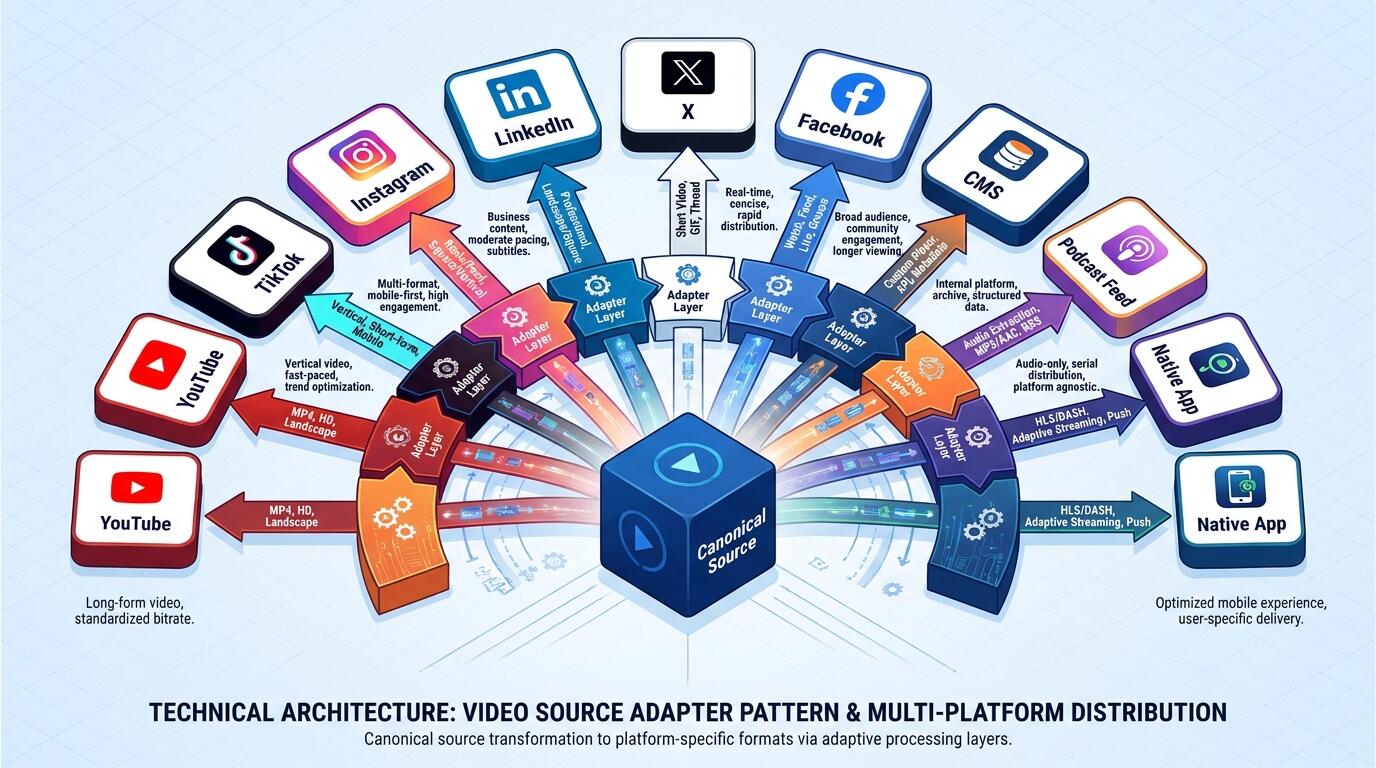
ALT: Architecture diagram showing one canonical video source transforming into nine platform-specific distribution outputs via adapter pattern
Where This Is Heading and What It Means for Builders
The trajectory of nine-platform video distribution is toward more platforms, not fewer, and toward higher automation requirements, not lower. As AI-assisted video production continues to accelerate content velocity, the distribution layer becomes the new bottleneck. Teams that treat distribution as an afterthought will find that their production capacity consistently outpaces their ability to reliably get content in front of audiences.
Several developments are worth watching. First, platform API consolidation is not happening at any meaningful pace. Each platform continues to evolve its ingest API independently, which means the integration surface area is not shrinking. Second, AI-generated video content is beginning to intersect with platform authenticity and provenance requirements, as some platforms are adding metadata fields or watermark requirements related to AI content disclosure. Teams building automated video pipelines should anticipate that compliance metadata will become a first-class concern in the distribution layer, not just an afterthought.
Third, the cost of getting distribution wrong in an automated pipeline is asymmetric: a single misconfigured field in a metadata adapter can cause every piece of content from that pipeline to be incorrectly categorized, inaccessibly captioned, or silently rejected — at whatever velocity the pipeline runs. This is precisely the kind of systemic risk that justifies upfront investment in a well-specified canonical source format and a robust adapter layer with explicit validation.
For builders, the actionable takeaways are concrete:
- Define a canonical source specification before you integrate a single platform. Every downstream adapter should be a validated transformation from that spec.
- Build explicit validation at each adapter output, not just at the source. Platform ingest errors are expensive to debug after the fact.
- Instrument your publish steps individually per platform. A silent failure on platform seven is invisible without per-platform observability.
- Treat caption and accessibility formats as a first-class concern, not a finishing step. They affect compliance and discoverability on every platform.
- Plan for API change management. Every platform in your distribution set will update its ingest API eventually. Your adapter layer should be structured so that updating one platform's adapter does not require touching the others.
For teams thinking about how to ship this kind of infrastructure without sacrificing reliability, the tension between velocity and quality is real — and how to ship fast without sacrificing product quality is a question worth thinking through explicitly before the pipeline is in production.
Questions & Answers
Q1: How do you handle metadata differences when distributing video to nine platforms from one source?
The most reliable approach is to define a single canonical metadata schema that is a strict superset of all nine platforms' requirements. Each platform adapter then performs a validated, deterministic transformation from the canonical schema to the platform-specific format. This ensures that every field is explicitly mapped, required fields are validated before the publish request is made, and changes to one platform's schema affect only that platform's adapter. Skipping the canonical schema step and mapping directly between platforms is a common source of silent data loss in production.
Q2: Are third-party distribution middleware tools reliable enough for a production nine-platform video pipeline?
Third-party distribution middleware tools can be reliable for initial coverage, but they introduce vendor dependency that becomes limiting as requirements grow more specific. Middleware abstractions frequently lag behind platform API updates, and the opacity of the abstraction layer makes debugging platform-specific failures harder. The pattern that tends to work better at scale is using middleware for early coverage while incrementally replacing it with internal platform adapters for the highest-priority platforms — effectively treating middleware as a temporary scaffold rather than a permanent architecture.
Q3: How long does it take to build a stable nine-platform video distribution pipeline from scratch?
Build timelines vary significantly based on team size and platform complexity, but a practical frame is that getting initial coverage across nine platforms — meaning content publishes correctly in the happy path — is achievable in a matter of weeks with focused engineering effort. Building a production-grade pipeline with explicit validation, retry logic, per-platform observability, caption handling, and a documented adapter update process is a multi-month effort. Teams frequently underestimate the second phase because the first phase looks like success until a platform API changes or an edge case is hit in production.
Key Takeaways
Nine-platform video distribution from one source is a tractable engineering problem, but only when it is treated as an architecture problem from the start — not a deployment detail.
Three points anchor everything else in this analysis. First, the root cause of most multi-platform distribution failures is the absence of a canonical source specification. Without it, every downstream integration becomes a bespoke integration, and the complexity scales with each platform added. Second, silent failures are the most dangerous class of bug in an automated distribution pipeline. Per-platform observability and explicit adapter-level validation are not optional for production systems. Third, the distribution layer is increasingly subject to compliance requirements — caption accessibility and AI content provenance metadata are both areas where platform requirements are evolving, and teams building automated pipelines today should design for extensibility in these fields.
The next step, concretely, is to audit your current distribution architecture against these three points before adding more platforms. If you do not have a canonical source spec, write one. If you do not have per-platform publish observability, add it. If your caption and metadata adapters are not validated end-to-end, make that validation explicit.
For builders who want to stay ahead of how AI is reshaping content production and distribution infrastructure — including the engineering decisions and failure modes that matter in practice — subscribe to Darius, a bilingual AI briefing written by an engineering director running three AI products in production. Every issue selects five to ten AI developments with firsthand analysis and primary sources, so you can filter industry noise into decisions you can actually act on.
Sources
- Internet Engineering Task Force (IETF). "HTTP Live Streaming (HLS) Specification".
https://www.ietf.org/ - World Wide Web Consortium (W3C). "WebVTT: The Web Video Text Tracks Format".
https://www.w3.org/ - IEEE. "Standards for Digital Media and Video Processing".
https://www.ieee.org/ - Internet Society (ISOC). "Standards and Protocols for Internet Media Distribution".
https://www.internetsociety.org/
Note: Platform-specific API specifications and ingest requirements are subject to change; always consult the latest official developer documentation for each platform before building or updating a distribution adapter.