What Does It Cost to Keep Three AI Products Online Every Month?
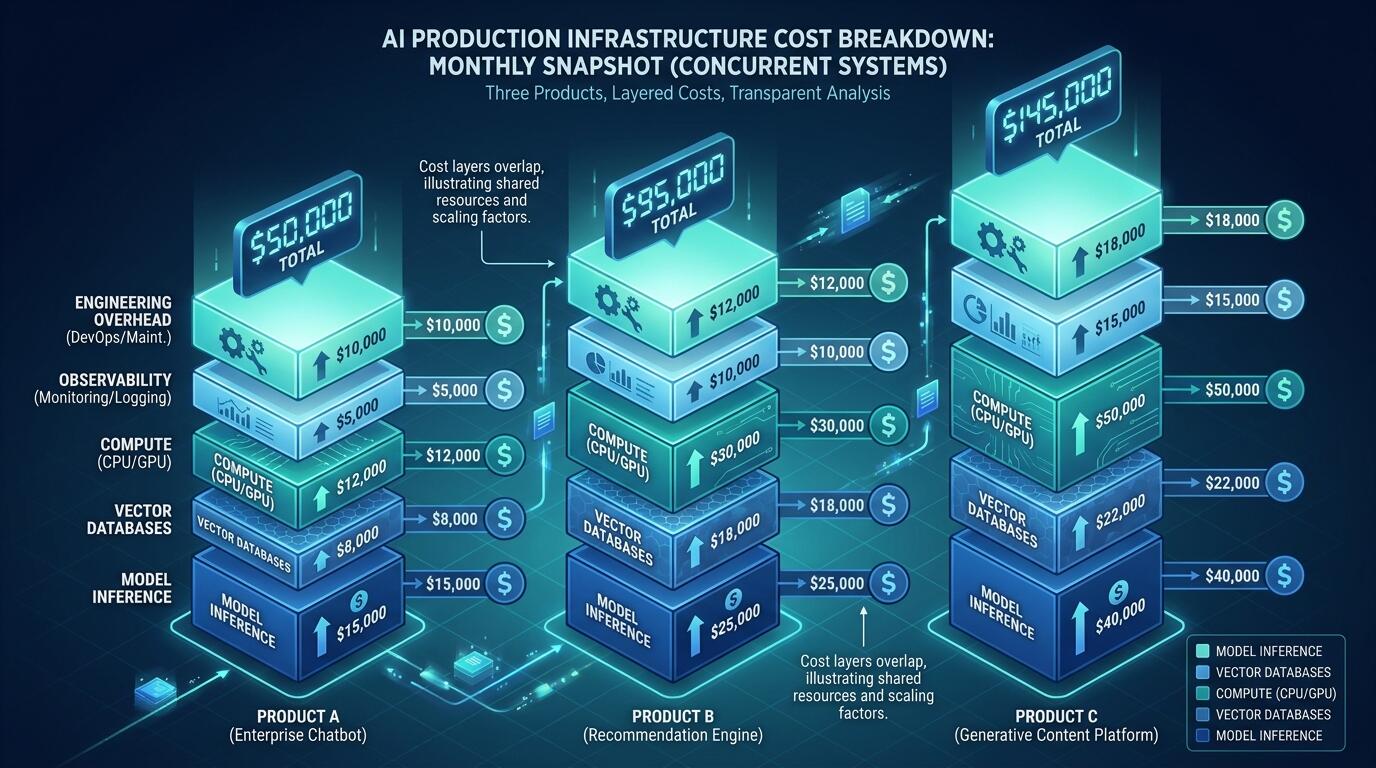
ALT: Monthly AI product infrastructure costs breakdown for three live production systems running simultaneously
The Real Price Tag of Running Multiple AI Products in Production
You ship three AI products. They're live, users are hitting them, and the infrastructure bills start arriving. Suddenly, you realize that the cost of keeping AI products online every month is a category unto itself — distinct from what you spent building them, and far more variable than any spreadsheet you drafted before launch. The central finding here is this: the monthly operational cost of maintaining three concurrent AI products in production typically spans a wide range depending on model usage, infrastructure choices, and team structure — and without deliberate cost architecture, it compounds rapidly.
This question matters right now because AI infrastructure economics have shifted. The market has moved from "we'll figure out pricing later" to a reality where LLM API tokens, vector database queries, GPU-backed inference, and observability tooling each carry a real recurring price. For founders and engineering leaders managing multiple live products simultaneously, the operational cost layer deserves the same rigor as the build cost layer.
How AI Product Infrastructure Costs Became Their Own Discipline
Running AI products in production is a discipline that has matured considerably over the past several years. Early AI deployments often ran on ad hoc infrastructure borrowed from existing web stacks — a few API calls grafted onto a traditional backend. That model broke down quickly once products scaled beyond early adopters. The infrastructure requirements of an AI product — model inference, embedding generation, retrieval pipelines, vector stores, prompt caching, and output monitoring — are categorically different from those of a standard SaaS application.
The current landscape reflects that maturity. Cloud providers now offer dedicated AI infrastructure tiers. Foundation model providers like OpenAI and Anthropic publish tiered API pricing structured around token consumption. Specialized vendors have emerged for vector databases, AI observability, fine-tuning pipelines, and model routing. Each of these is a line item. When you're operating three distinct AI products, you're not just tripling one cost center — you're managing overlapping layers of expenditure across each product's full stack.
According to public pricing information from major foundation model providers, token costs vary significantly by model tier, with more capable models commanding substantially higher per-token rates than their lightweight counterparts. This single variable — which model tier each product uses — can shift monthly spend by an order of magnitude across three products running in parallel.
Infrastructure trends have also pushed costs upward. The move toward retrieval-augmented generation (RAG) architectures, for example, adds vector database hosting, embedding API calls, and chunking compute to the baseline. Real-time features — streaming responses, session persistence, user-specific context — add further infrastructure complexity. Building machine learning pipelines that scale past the prototype stage requires deliberate infrastructure decisions that directly determine how controllable your monthly burn becomes.
Breaking Down the Cost Drivers Across Three Live AI Products
Understanding monthly AI infrastructure costs requires separating the distinct cost mechanisms at work. Three products don't just mean three times one product's cost — they mean three instances of every cost category, each with different usage profiles and scaling characteristics.
Model Inference and API Token Consumption
Model inference cost is the most variable and often the largest single category for products that rely on hosted foundation models. Every user query, every background job that invokes a model, every document summarization or classification task translates directly into token consumption billed at the provider's rate. Across three products with different user bases and usage patterns, this cost is rarely predictable without instrumentation. In practice, one high-traffic product can generate API spend that dwarfs the combined cost of the other two. Without per-product token budgeting and alerting, this category is where budgets most frequently overrun.
Vector Database and Retrieval Infrastructure
Vector databases — purpose-built systems that store and search high-dimensional embeddings — have become foundational infrastructure for AI products using RAG architectures. Hosting costs for vector stores scale with the number of vectors stored and query volume. For three products each maintaining their own knowledge bases, this is three separate storage and query cost centers. Managed services simplify operations but carry premium pricing; self-hosted alternatives reduce per-unit cost but add engineering maintenance overhead.
Compute and Hosting
Standard cloud compute for AI product backends — application servers, databases, queues, caches — follows conventional cloud pricing, but AI products typically require more memory-intensive configurations than equivalent traditional web applications. Streaming inference responses, maintaining session context, and serving large payloads at low latency all push instance sizes upward. Three products running on appropriately sized infrastructure represent a meaningful fixed base cost before any variable usage is factored in.
Observability and Monitoring
AI observability — the tooling needed to monitor model outputs, track prompt performance, detect regressions, and audit user interactions — is a cost category that didn't exist in traditional software operations. Tools in this category typically charge based on logged events or traces per month. Across three products, observability costs accumulate in proportion to combined request volume. Skimping here creates operational blind spots that tend to be expensive to remediate after an incident.
Engineering and On-Call Overhead
Personnel cost is the line item most often excluded from infrastructure cost discussions and most consequential in practice. Running three AI products in production requires ongoing engineering attention: dependency updates, model provider changes, prompt tuning as model behavior drifts, incident response, and cost optimization cycles. The engineering hours devoted to keeping three products stable and performant each month represent real cost, whether they're billed as internal headcount or external contractor time. Early-stage startups approaching AI system design on a lean budget often underestimate this category until they're already absorbing it.
Data Pipeline and Embedding Refresh
AI products that maintain up-to-date knowledge bases or continuously learn from new inputs require periodic re-embedding and index refresh pipelines. Each pipeline run consumes embedding API credits and compute. For three products on different refresh cadences, this creates a series of scheduled cost spikes that need to be budgeted as recurring line items rather than one-time build costs.
Comparing Approaches: What the Trade-offs Actually Look Like
Different architectural and operational strategies produce substantially different monthly cost profiles for teams running multiple AI products. The table below captures the most common approaches and their practical implications.
| Perspective / Approach | Strengths | Trade-offs | Best Fit |
|---|---|---|---|
| Shared infrastructure across all three products | Lower fixed compute cost; simplified operations; single observability stack | Tight coupling creates blast radius risk; harder to optimize per-product | Teams with similar product usage patterns and tight budgets |
| Fully isolated infrastructure per product | Independent scaling; clear cost attribution; failure isolation | Higher fixed overhead; duplicated tooling costs; more operational surface | Products with divergent traffic profiles or compliance requirements |
| Managed AI platform (fully hosted) | Fast to deploy; vendor handles scaling; minimal DevOps overhead | Higher per-unit cost at scale; less control over model selection and cost levers | Early products pre-product/market fit needing speed over optimization |
| Self-hosted models (open-source LLMs) | Eliminates per-token API cost; full control | High upfront GPU infrastructure cost; ongoing model maintenance burden | High-volume, cost-sensitive products where token spend is the dominant cost |
| Hybrid (managed APIs + selective self-hosting) | Balances control and operational cost; best-of-both for specific workloads | Architectural complexity; requires engineering expertise to manage boundary | Teams with sufficient technical depth and clear cost optimization targets |
A pattern consistently seen in practice: teams that ship quickly using fully managed infrastructure often find that their monthly costs become unsustainable as usage grows, triggering an expensive re-architecture effort. The right time to design for cost efficiency is before usage scales, not after. According to general guidance from cloud financial management frameworks (a practice area now commonly referred to as FinOps), cost architecture decisions made at the infrastructure design stage are substantially cheaper to implement than retrofits applied after scale is reached.
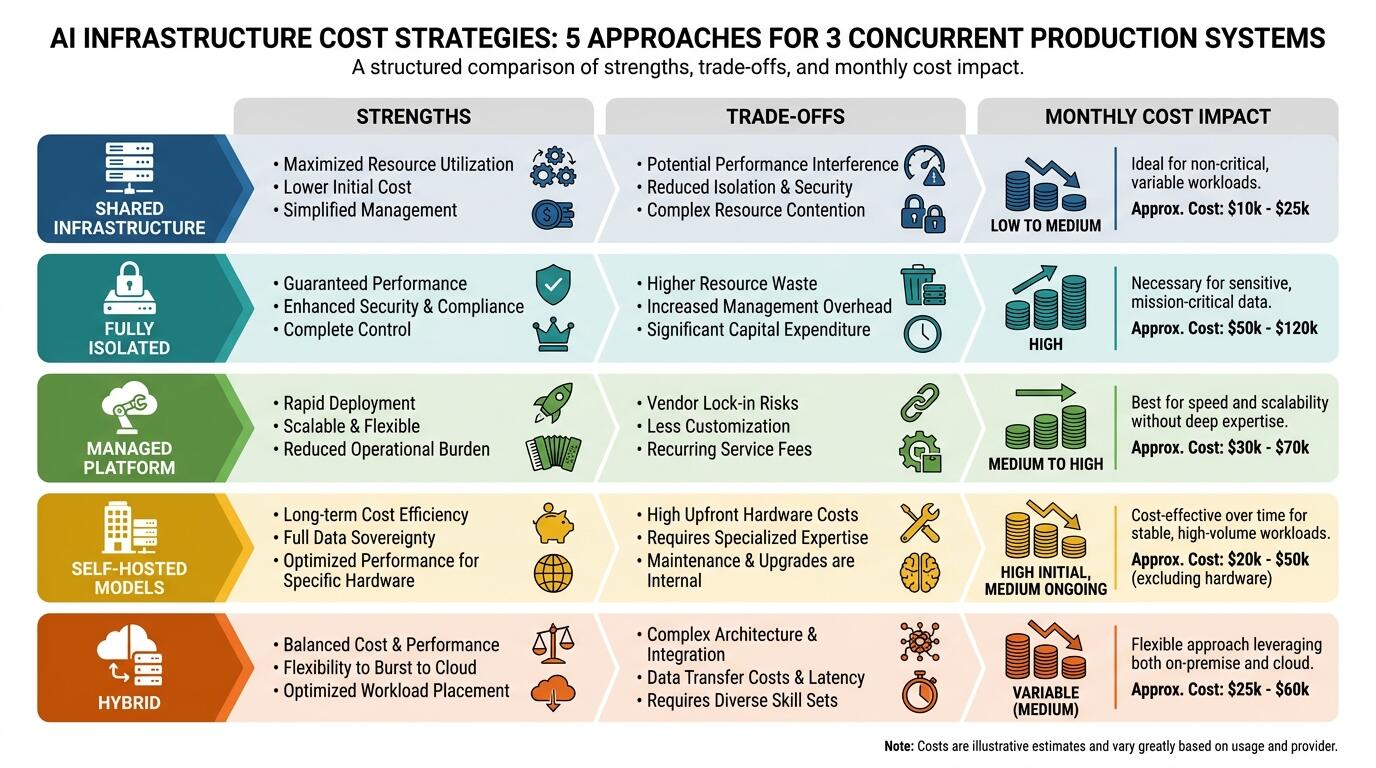
ALT: Comparison diagram of AI product infrastructure cost strategies for three concurrent production systems and monthly operational spend
The most cost-effective teams running three AI products simultaneously tend to implement shared observability and shared deployment pipelines while maintaining logical isolation at the data and inference layer. This gives them consolidated visibility into cross-product cost trends without the operational overhead of fully duplicated stacks. Per the guidance from cloud provider best practice documentation (published by major providers including AWS, Google Cloud, and Azure), tagging resources by product is a baseline practice that enables the per-product cost attribution necessary for intelligent optimization decisions.
Where AI Infrastructure Costs Are Heading and What to Do Now
The economics of running AI products in production are moving in two simultaneous directions: model inference costs are declining on a per-token basis as competition between foundation model providers intensifies, while the architectural complexity — and thus the total infrastructure footprint — of production AI systems is increasing. The net effect for teams running multiple products is roughly stable overall spend, but with significant variation based on how actively costs are managed.
Several forward-looking dynamics are worth accounting for in any multi-product cost strategy. First, model tiering is becoming more granular. Providers are offering a wider range of capability-to-cost ratios, which means the decision of which model tier to route each request through is becoming an optimization lever that sophisticated teams are actively tuning in real time. Second, caching — both prompt caching at the API level and semantic caching at the application layer — is increasingly available and meaningfully reduces token spend for products with repetitive or similar query patterns. Third, the FinOps discipline applied specifically to AI workloads is maturing, with tools designed specifically to attribute, forecast, and constrain AI infrastructure spend across multiple products.
For engineering leaders and founders managing three live AI products today, the most actionable takeaways are:
- Instrument every product for per-token and per-request cost tracking from day one, not as an afterthought
- Design model routing so that lighter, cheaper models handle requests where full capability isn't needed
- Audit shared infrastructure opportunities quarterly — shared embedding pipelines, shared observability stacks, and shared deployment tooling reduce fixed overhead without compromising product independence
- Treat engineering time spent on infrastructure as a cost center with real monthly value, and budget it explicitly
- Evaluate prompt caching eligibility for high-volume, pattern-repetitive workloads across all three products
The fundamental principle is that cost architecture is not an infrastructure concern — it's a product decision. The teams that ship sustainably are those who build cost visibility and cost constraints into the system design from the start.
Frequently Asked Questions FAQ
Q1: How do token costs differ across multiple AI products running simultaneously on the same API provider account?
Token costs accumulate independently based on each product's request volume and the model tier invoked per request. Most major API providers bill at the account level, meaning spend across three products aggregates into a single invoice but isn't automatically separated by product. Engineering teams need to implement custom tagging, per-product API keys, or middleware-level tracking to achieve meaningful per-product cost attribution. Without this attribution, optimizing spend across three products becomes guesswork rather than data-driven decision-making.
Q2: Is shared infrastructure a reliable way to reduce monthly costs when operating three AI products?
Shared infrastructure can materially reduce fixed monthly costs — particularly for compute, observability tooling, and deployment pipelines — but it introduces coupling risks that need to be managed deliberately. The most reliable approach is to share stateless, operationally independent layers (logging, CI/CD, monitoring dashboards) while maintaining isolation at the data, model routing, and user-session layers. Teams that share too aggressively at the data or inference layer often encounter cost savings erased by incident costs when a misconfiguration in one product affects all three.
Q3: How long does it typically take before monthly AI infrastructure costs stabilize for a three-product operation?
Costs rarely stabilize quickly. In the work of engineering leaders managing multiple live AI products, a pattern emerges where the first several months post-launch are characterized by cost volatility as usage patterns establish themselves and infrastructure sizing gets calibrated to real demand. Meaningful cost stability — where monthly variance is predictable and optimization cycles are routine rather than reactive — typically requires deliberate investment in cost instrumentation, model routing logic, and infrastructure right-sizing, all of which take engineering cycles to implement properly.
Summary
Running three AI products in production simultaneously carries a monthly cost profile that is meaningfully higher and more complex than running a single product or than the build cost alone would suggest. Three core points define this territory.
First, the cost categories are distinct and layered: model inference, vector infrastructure, compute, observability, data pipelines, and engineering overhead each contribute independently, and they compound across three products with different usage shapes.
Second, architectural decisions made at build time determine how manageable monthly costs become at scale. Shared observability, model tiering, prompt caching, and per-product cost attribution are design choices, not operational add-ons.
Third, the engineering and leadership capacity required to keep three AI products stable, performant, and cost-efficient is itself a monthly operational expense that demands explicit budgeting.
The recommended next steps are concrete: implement per-product cost tracking before usage scales, design model routing with cost tiers in mind, audit shared infrastructure opportunities quarterly, and treat infrastructure cost management as a first-class engineering function — not a finance team problem.
Getting these foundations right early is what separates AI product operations that scale cleanly from those that require expensive re-architecture under pressure.
Ready to build AI products that are architecturally sound and operationally sustainable from the start? Visit the Darius website to explore real projects, technical insights, and proven approaches to AI architecture and full-stack delivery. Whether you're designing for scale or optimizing what's already in production, Darius brings the engineering leadership to help you ship — and keep shipping.
Sources
- Printful Blog. "How to make money with AI: 10 Methods for 2026".
https://www.printful.com/blog/how-to-make-money-with-ai - The Brilliant Writer via Medium. "10 AI Tools That Actually Help You Make Money Online".
https://medium.com/@thebrilliantwriter/10-ai-tools-that-actually-help-you-make-money-online-3cd5faae53ec - FinOps Foundation. FinOps Framework and Cloud Financial Management Practices.
https://www.finops.org/ - IEEE. Standards and Technical Resources for AI Systems Engineering.
https://www.ieee.org/
Note: Standards and pricing structures may be updated; please check the latest official documentation or consult professional advisors for current figures.