Model Routing Checklist: Five Questions Before You Switch Models
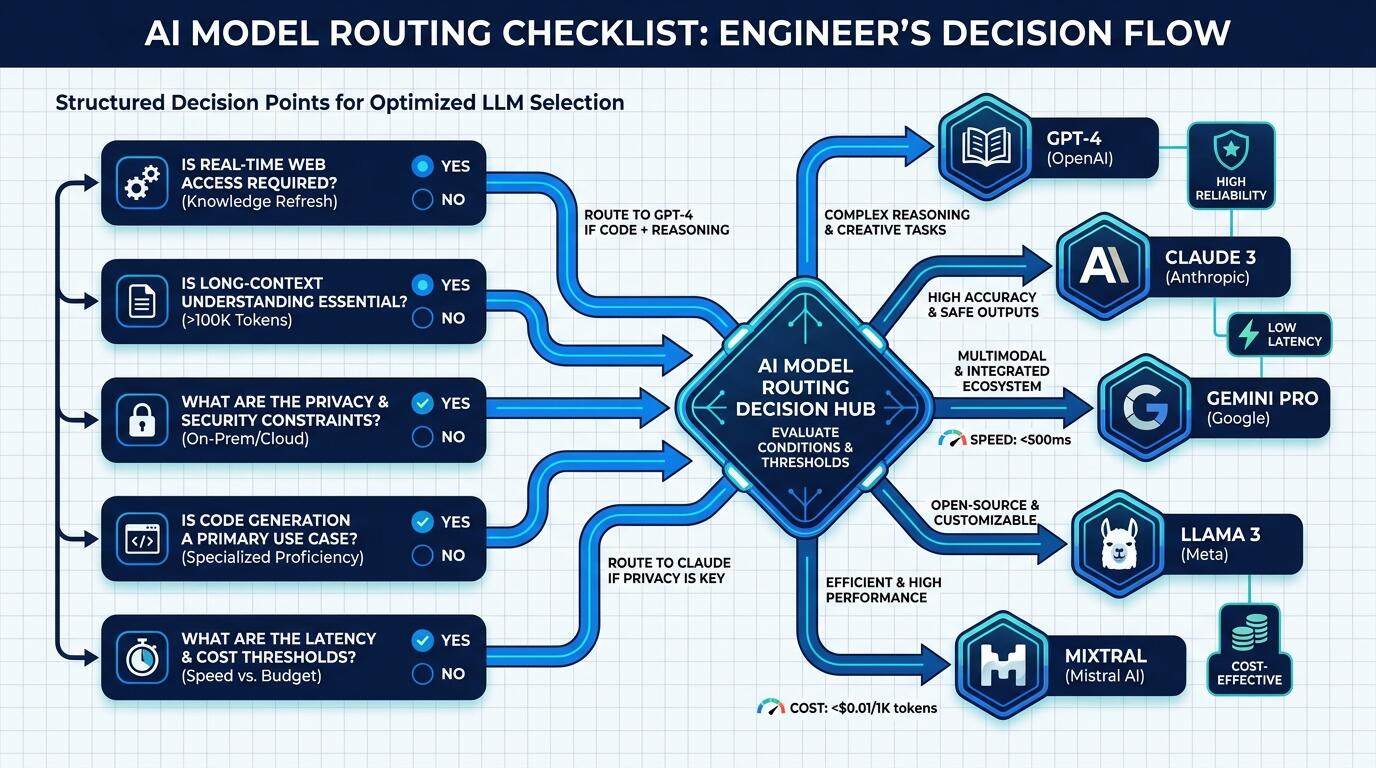
ALT: Model routing checklist showing five decision questions before switching AI language models in production
Before You Switch Models, Answer These Five Questions
The question engineering teams most often ask when a new model drops is not "should we switch?" — it is "how quickly can we switch?" That instinct is understandable given how fast the model landscape moves, but it is also one of the most reliable paths to production incidents, cost overruns, and quality regressions that are embarrassingly hard to explain to stakeholders.
Model routing — the practice of directing requests to different language models based on task characteristics, cost constraints, or quality thresholds — is not a simple drop-in replacement decision. It is an architectural choice with downstream consequences for latency, observability, prompt maintenance, and user experience. A structured pre-switch checklist exists precisely to slow down that instinct long enough to catch the failure modes before they reach production.
The five questions below were assembled from patterns observed consistently across teams building and operating AI products in production environments. They are ordered to surface the highest-risk decisions first. Use them in sequence before any routing change — whether you are moving from one frontier model to another, adding a cheaper fallback tier, or migrating your stack entirely.
The Five Questions: A Pre-Switch Model Routing Checklist
Have You Defined What "Better" Actually Means for This Task?
"Better" is not a model property — it is a task-specific measurement. A model that scores higher on public benchmarks may perform worse on your specific distribution of inputs, output formats, or domain vocabulary. Before switching models, teams need to define the success criteria that apply to their use case: response accuracy on representative samples, format compliance rate, hallucination rate on domain-specific facts, latency at the 95th percentile, or cost per thousand tokens.
Without an explicit definition of "better," any switch is a guess dressed up as a decision. In our experience reviewing AI product architectures, this is the single most common root cause of regressions that only surface weeks after a model change — teams assumed that a newer or larger model would be universally superior, then discovered it had different failure modes on their specific prompt patterns.
Best for: Teams switching models to improve quality metrics, or anyone evaluating a new frontier model release against a current production baseline.
Watch out: Benchmark performance and your internal eval results often diverge significantly. Never substitute a public leaderboard score for a task-specific evaluation on your own data.
Have You Run a Prompt Compatibility Audit?
Prompts are not model-agnostic. Instruction-following behavior, sensitivity to role definitions, tolerance for ambiguous instructions, and default output verbosity all vary meaningfully across model families and versions. A prompt carefully tuned for one model will frequently need revision — sometimes substantial revision — when routed to a different model.
A prompt compatibility audit means systematically running your existing prompt library against the candidate model on a representative sample of inputs, comparing outputs against your defined quality criteria, and flagging prompts that require adjustment before go-live. This is not optional. Skipping this step is one of the most common causes of silent quality degradation after a model switch, because the outputs often look plausible while being subtly wrong in ways that are hard to detect without structured evaluation.
For teams managing complex agent pipelines, this audit extends further. If your system uses chained prompts, tool-calling specifications, or structured output schemas, each component needs to be validated independently against the new model. The article Where an AI Drafting Pipeline Fails, and the Checks That Catch It offers a useful lens on where these failure points concentrate in multi-step workflows.
Best for: Any team with a prompt library of non-trivial complexity — especially those using few-shot examples, structured output requirements, or tool-call specifications.
Watch out: Automated output comparison is not sufficient on its own. Include human review for a sample of outputs, particularly in high-stakes or customer-facing contexts.
Have You Modeled the Full Cost Differential — Not Just Token Price?
Token pricing is the most visible cost lever, but it is rarely the whole picture. A full cost model for a routing switch needs to account for: token throughput under load (a cheaper model with lower throughput may require more parallel instances), latency characteristics and their downstream effects on timeout rates, context window size relative to your prompt footprint, and the engineering cost of prompt re-tuning, evaluation infrastructure, and rollback procedures.
Research on routing between cost tiers — including work documented in "Routing Between Cheap and Expensive LLMs" — consistently shows that the savings from cheaper model tiers are most reliably captured when routing logic is calibrated to task difficulty, not applied as a blanket switch. A blanket switch to a cheaper model often yields lower-than-expected cost savings because the cheaper model handles a meaningful fraction of requests incorrectly, requiring retries, fallbacks, or human remediation that erases the unit cost advantage.
The practical implication: before switching, model your expected cost savings under realistic failure and retry assumptions, not under best-case assumptions. If you cannot model this, you do not yet have enough information to make the decision.
Best for: Teams evaluating a move to a lower-cost model tier, or building tiered routing logic where cheaper models handle simpler requests.
Watch out: Do not confuse input token price with total cost of ownership. Latency, retry rates, and engineering overhead are real costs that belong in the model.
Do You Have Rollback Capability and Observability in Place?
A model switch without rollback capability is a one-way door. Before any routing change reaches production, you need two things in place: the ability to revert the routing decision within minutes without a code deployment, and sufficient observability to know that something has gone wrong quickly enough to trigger that rollback.
Observability for model routing means more than basic error logging. It means tracking output quality signals in near-real time — user correction rates, downstream task failure rates, explicit feedback signals, or automated eval scores on a sample of live outputs. Without these signals, you may not discover a quality regression for days, by which point the blast radius has grown considerably.
This question is frequently underweighted because teams focus on the forward path (the new model is better, let us ship it) and treat rollback as a hypothetical. In practice, the ability to roll back quickly is what separates a manageable production incident from a prolonged outage. If your routing layer is not configurable without a deployment, fix that before switching models — not after.
For teams building or evaluating the infrastructure layer that makes this possible, the decision between custom-built and vendor-provided routing infrastructure is worth examining carefully; the considerations involved are explored in depth in the context of AI infrastructure build-vs-buy frameworks that apply directly to routing layer decisions.
Best for: Any production system where a model quality regression would affect end users, downstream pipelines, or business-critical outputs.
Watch out: Rollback capability is not just a technical concern — it requires that your routing configuration be decoupled from your application deployment cycle. If it is not, that is a pre-requisite fix, not a nice-to-have.
Have You Validated on the Tail of Your Input Distribution?
Aggregate performance metrics on representative samples hide the failure modes that matter most in production. The tail of your input distribution — the unusual, edge-case, or adversarial inputs that appear infrequently but with real consequences — is precisely where model behavior differences manifest most sharply.
A pattern we see consistently: teams run evaluation on their most common input types, get strong results, ship the routing change, and then encounter failures on inputs that were in the data but underrepresented in the eval set. These failures often cluster around domain-specific terminology, inputs with unusual formatting or encoding, requests that fall at the edge of the model's instruction-following capability, or inputs that trigger different safety behaviors across models.
Academic research on universal LLM routing, including work published through venues like OpenReview, highlights that routing correctness degrades significantly at the tail of the task difficulty distribution — precisely the inputs where routing to the wrong model is most consequential. This is not a reason to avoid routing; it is a reason to invest in tail-coverage evaluation before going live.
A practical approach: maintain a dedicated regression set of known-difficult inputs, curated from past production failures and edge cases. Run every candidate model against this set before any routing change, and treat any regression on this set as a blocking issue regardless of aggregate performance improvement.
Best for: Teams with heterogeneous input distributions, or any system that handles long-tail or domain-specific inputs where model behavior varies.
Watch out: Tail-coverage evaluation requires intentional curation — it does not emerge automatically from random sampling of production traffic. Build and maintain this set deliberately.
Quick Comparison at a Glance
| Question | Best For | Key Strength | Limitation |
|---|---|---|---|
| Define "better" explicitly | Quality-focused model switches | Prevents benchmark-to-production mismatch | Requires upfront eval infrastructure investment |
| Prompt compatibility audit | Teams with non-trivial prompt libraries | Catches silent quality regressions before go-live | Time-intensive; often underscoped on first pass |
| Full cost differential model | Cost-tier routing decisions | Exposes hidden costs beyond token price | Requires realistic failure/retry rate assumptions |
| Rollback capability and observability | All production routing changes | Limits blast radius of quality regressions | Requires routing layer decoupled from deployment |
| Tail distribution validation | Heterogeneous or domain-specific inputs | Catches failure modes invisible in aggregate metrics | Requires deliberate curation of edge-case test sets |
How to Choose Where to Start
Model routing decisions are not uniform — the right entry point on this checklist depends on where your team is in the process and what risk you are most exposed to.
If you are in an early evaluation phase and have not yet committed to a switch, start with Question 1. Defining your task-specific success criteria before running any evaluation will structure every subsequent step and prevent the common mistake of anchoring on a vendor benchmark that does not reflect your use case.
If you are preparing for a production switch and already have a candidate model selected, Questions 2 and 5 are typically where the most surprises surface. Prompt compatibility failures and tail-distribution failures are the two failure modes most commonly missed in pre-production testing, and the two most likely to cause incidents that are difficult to diagnose quickly.
If cost reduction is the primary motivation for the switch, do not skip Question 3 in favor of moving faster. The teams that capture the most durable cost savings from model routing are those that model realistic failure scenarios, not optimistic ones.
A common misconception worth addressing directly: model routing is often treated as a one-time architectural decision rather than an ongoing operational practice. In reality, model behavior changes with every model update, and routing logic that was correct six months ago may be suboptimal today. The checklist above should be applied not just at initial adoption but at any significant model version change — including minor updates from the same provider, which can shift behavior in ways that affect production quality.
For teams thinking through how to move quickly on these decisions without introducing unnecessary risk, the principles behind shipping fast without sacrificing product quality apply directly to the pace at which model routing changes should be introduced to production systems.
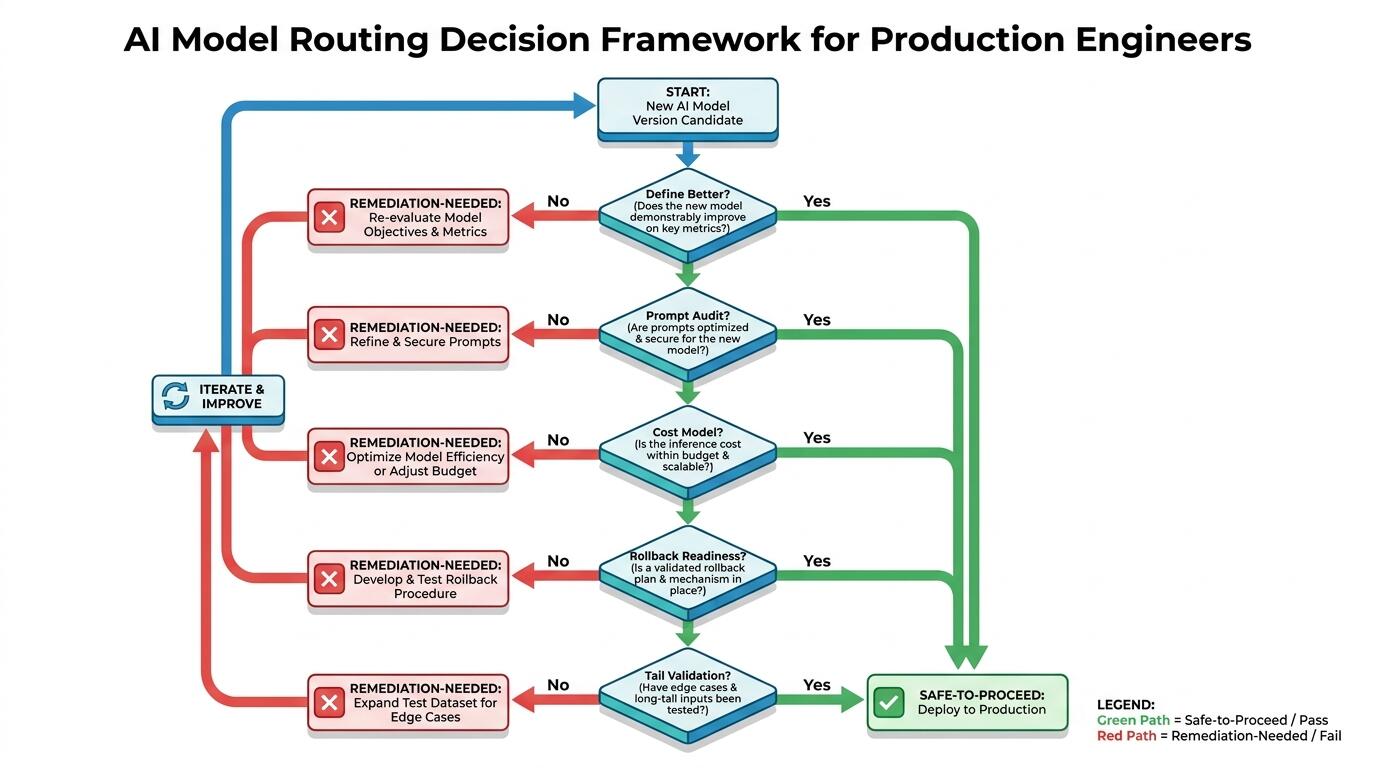
ALT: Flowchart illustrating model routing checklist decision framework for AI engineers evaluating production model switches and quality thresholds
Questions & Answers
Q1: How do you set up model routing without creating a maintenance burden?
Model routing adds operational complexity proportional to the number of routing rules and model endpoints you maintain. The most manageable approach is to start with the simplest routing logic that meets your requirements — typically a two-tier setup with a primary and a fallback — and add complexity only when you have clear evidence that it improves a specific metric. Routing configuration should be stored in a way that allows updates without code deployments, and every routing rule should have a documented rationale so future maintainers understand why it exists.
Q2: Is it safe to rely on a single model provider for all routing tiers?
Relying on a single provider for all routing tiers reduces the operational surface area and simplifies authentication, rate limit management, and billing, but it concentrates your availability risk. If the provider experiences an outage or rate-limits your account, all tiers fail simultaneously. For production systems with high availability requirements, maintaining at least one routing tier on a different provider or a self-hosted model gives you a genuine fallback path. The tradeoff is real: multi-provider routing is more complex to operate but meaningfully more resilient.
Q3: How long does a proper pre-switch validation take, and what does it cost?
The time and cost depend heavily on the complexity of your prompt library and input distribution. A minimal validation — covering representative samples and a curated edge-case set — can be completed in a few days by a small team with existing eval infrastructure in place. Teams without eval infrastructure should expect to invest additional time building it before the switch, which is a fixed cost that pays dividends across every future model decision. Skipping validation to save time is the most reliable way to incur much larger costs post-switch, in the form of production incidents and remediation work.
Key Takeaways
- Define task-specific success criteria before evaluating any candidate model — public benchmarks are a starting point, not a decision signal.
- Prompt compatibility failures and tail-distribution failures are the two most commonly missed risk categories in pre-switch validation; both require deliberate, structured testing to surface.
- Full cost modeling for a routing switch must account for retry rates, latency effects, and engineering overhead — not just token price differentials.
- Rollback capability is a pre-requisite for any production routing change, not an afterthought; if your routing layer cannot be reverted without a deployment, fix that first.
- Model routing is an ongoing operational practice, not a one-time architectural decision — apply this checklist at every significant model version change, not just at initial adoption.
The next step is to map each of these five questions to your current production state and identify which ones you cannot yet answer confidently. That gap is your actual pre-switch work. When you are ready to go deeper on the infrastructure and process questions involved, the Darius AI briefing covers exactly these kinds of practitioner-level decisions every week, with first-hand analysis from engineers operating AI products in production.
If you are building AI products and want to track model routing developments and the broader infrastructure decisions that affect them, subscribe to Darius — a bilingual AI briefing written by an engineering director, with first-hand sourcing and production-grounded analysis on every item. Visit the Darius website to start reading AI news from a builder's perspective.
Sources & Further Reading
- OpenReview. "UNIVERSAL LLM ROUTING WITH CORRECTNESS".
https://openreview.net/pdf?id=QpOCijgaBE - Tessary AI. "Routing Between Cheap and Expensive LLMs".
https://tessary.ai/answers/system-one-models/can-a-decision-model-route-requests-between-a-cheap-llm-and-an-expensive-one - We Are Developers. "From Model Selection to Smart Routing: How to Use the Right LLM for Every Task".
https://www.wearedevelopers.com/videos/100447-from-model-selection-to-smart-routing-how-to-use-the-right-llm-for-every-task
Note: Standards and best practices in this field evolve rapidly; verify against the latest official documentation and consult qualified practitioners before making production routing decisions.