Lessons in Managing Complex Engineering Projects Across Disciplines

ALT: Engineering director managing complex cross-disciplinary project with AI architecture and systems design teams
Why Cross-Disciplinary Engineering Projects Break Down — And What Actually Fixes Them
Imagine you're three months into a product build. The machine learning team has a working model. The backend engineers have an API. The frontend is taking shape. And yet nothing integrates cleanly, the roadmap keeps shifting, and every sprint review feels like a negotiation between people speaking different technical languages. This scenario — familiar to anyone who has led or participated in complex, multi-discipline engineering work — is not a failure of talent. It is a failure of coordination architecture.
Managing complex engineering projects across disciplines is one of the defining challenges for technology leaders today. As products increasingly span AI, infrastructure, data pipelines, and user-facing interfaces simultaneously, the old model of linear, siloed delivery simply cannot hold. The thesis here is straightforward: the teams that ship successfully are not those with the most resources, but those with the clearest coordination primitives, the most honest risk visibility, and leadership that understands the full technical stack well enough to make fast, grounded decisions.
This matters more now than it ever has. The gap between ambitious technical vision and reliable production delivery has widened as systems have grown in complexity. If you are a founder, CTO, or senior engineer accountable for shipping a real product, the lessons below are drawn from the hard edges of that gap.
The State of Cross-Disciplinary Engineering Project Management Today
Cross-disciplinary engineering project management is the practice of coordinating work that spans multiple technical domains — such as AI/ML, backend systems, data engineering, and product design — under a unified delivery structure. The discipline has evolved significantly as software products have grown more layered and the stakes for integration failures have risen.
For much of the history of software delivery, engineering work could be partitioned cleanly. A backend team built services. A frontend team consumed them. A QA team tested the boundaries. Complexity was manageable because the interfaces between disciplines were narrow and well-understood.
That model broke under pressure from two directions. First, the rise of data-intensive and AI-powered products made the boundaries between disciplines genuinely blurry. A recommendation feature, for example, is simultaneously a machine learning problem, a data pipeline problem, a latency problem, and a product design problem. No single discipline owns it fully, and the handoffs between teams become sources of ambiguity and delay. Second, the pace of delivery expectations accelerated. Organizations increasingly expect iterative, fast-cycle shipping, which leaves little tolerance for the kind of sequential handoff model that once gave teams the luxury of throwing work over walls.
According to research cited by the Project Management Institute, a significant share of project failures can be attributed to poor communication and unclear ownership — not technical inability. Engineering projects that span multiple disciplines amplify both of those failure modes. When a team of ML engineers and a team of platform engineers are working toward the same product milestone but using different vocabularies, different success metrics, and different tooling, the communication overhead alone can consume the slack that would have allowed the project to absorb normal schedule variance.
A pattern consistently observed in practice is that organizations underestimate integration costs. They plan for individual team velocity but not for the friction of connecting those teams' outputs. Per guidance from IEEE's software engineering standards body, integration planning is a first-class engineering activity — not a task to be handled at the end of a sprint cycle. Yet in many cross-disciplinary projects, it is treated exactly that way, and the consequences show up as late-stage rework that is expensive to fix and demoralizing to execute.
The current state of the discipline, then, is one of growing awareness that coordination is an engineering problem in its own right — and growing investment in tools, frameworks, and leadership models that treat it as such.
The Root Causes of Cross-Disciplinary Project Failure
Understanding why multi-discipline engineering projects fail requires looking beneath the surface symptoms. Late deliveries, integration bugs, and scope creep are symptoms. The root causes live in the coordination layer, the incentive structure, and the abstraction gaps between disciplines.
Misaligned Abstractions Between Teams
Abstraction mismatch is the condition in which two teams building toward the same interface hold fundamentally different mental models of what that interface is and how it should behave. This is extraordinarily common in projects that involve AI/ML alongside traditional software engineering. An ML team thinks in terms of model inputs, outputs, and evaluation metrics. A backend team thinks in terms of request/response contracts, latency budgets, and error handling. Both are right within their own frame. But if those frames are never explicitly reconciled, the integration point becomes a source of bugs, delays, and blame.
The fix is not a single integration meeting. It is the establishment of shared interface contracts — documented, version-controlled, and co-owned — that force both sides to agree on the abstraction before either side builds toward it. This is unglamorous work. It is also the work that separates projects that integrate cleanly from those that spend the final third of their timeline firefighting.
Ownership Gaps at Discipline Boundaries
Ownership gap refers to the areas of a project that fall between the recognized domains of individual teams — where work is technically necessary but no team considers it clearly theirs. In cross-disciplinary projects, these gaps tend to cluster at exactly the points that matter most: data format transformations, observability and alerting pipelines, deployment orchestration, and end-to-end testing environments.
In our work with clients across AI-powered product builds, a pattern consistently emerges: when asked who owns the end-to-end testing environment, the answer is often "shared responsibility" — which, in practice, means no one is accountable. Shared responsibility without explicit assignment is one of the most reliable predictors of late-stage integration failure. Effective cross-disciplinary project leadership requires making ownership explicit, even when — especially when — the work sits in uncomfortable overlap zones.
Incentive Misalignment Across Disciplines
Incentive misalignment occurs when individual teams or disciplines are evaluated on metrics that do not reflect shared project success. An ML team rewarded purely on model accuracy has no structural reason to optimize for inference latency. A backend team rewarded on uptime has no structural reason to invest time in the integration scaffolding that another team needs. A product team rewarded on feature count has no structural reason to slow down for technical debt that will only become visible months later.
This is a leadership and organizational design problem, not a technical one. But it has deeply technical consequences. The most effective cross-disciplinary teams operate under a shared delivery definition — a documented understanding of what "done" means for the project as a whole, not just for each team's slice of it.
Insufficient Technical Leadership Bandwidth
Technical leadership bandwidth is the capacity of the leaders and architects on a project to engage across all relevant disciplines with enough depth to make fast, grounded decisions. In cross-disciplinary projects, this bandwidth is almost always the binding constraint. A technical leader who understands AI architecture but not backend systems, or who understands systems design but not data engineering, will create coordination bottlenecks at exactly the points where they cannot evaluate trade-offs themselves.
This is one of the strongest arguments for investing in architecture and systems design expertise early in a project, rather than treating it as something that can be bolted on later. For teams navigating these decisions, understanding AI system architecture patterns that CTOs should evaluate is a practical starting point for aligning technical leadership across disciplines before misalignment becomes expensive.
Evidence and Approaches: What Works Across Discipline Boundaries
Managing complex engineering projects across disciplines is a topic with a growing body of practitioner knowledge, even if controlled experiments are difficult to run. The evidence base is largely experiential and case-documented, but the patterns are consistent enough to carry real weight.
According to documented guidance from TU Delft's engineering project management resources, complexity in engineering projects is best managed through early and continuous integration of stakeholder perspectives — including technical stakeholders from each discipline — rather than through sequential handoff. This finding aligns with agile and DevOps principles, but extends them into the organizational dimension: it is not enough to iterate quickly within a team if the iterations are not calibrated against the full cross-disciplinary picture.
Guidance from sources like DX's engineering project management coverage and Epicflow's essential guide to engineering project management consistently point to resource visibility and cross-team dependency tracking as top predictors of project health in complex environments. These are not sophisticated insights — they are fundamentals that get skipped under schedule pressure.
Different approaches to managing cross-disciplinary complexity carry distinct trade-offs. The table below maps the most common models against their real-world strengths and limitations.
| Perspective / Approach | Strengths | Trade-offs | Best Fit |
|---|---|---|---|
| Centralized Architecture Control | Clear ownership, consistent standards, fast decisions at architecture layer | Can become a bottleneck; may reduce team autonomy | Small to mid-sized projects with a strong lead architect |
| Federated Team Ownership | High team autonomy, parallel progress, distributed accountability | Integration risk increases; requires strong interface contracts | Large projects with mature, experienced discipline leads |
| Embedded Cross-Discipline Liaisons | Reduces abstraction mismatch, improves communication in real time | Adds headcount cost; liaison effectiveness varies significantly | Projects with sharp domain vocabulary gaps (e.g., AI + backend) |
| Shared Platform Team Model | Provides common infrastructure, reduces duplication | Platform team can become a dependency bottleneck | Organizations with multiple product lines sharing infrastructure |
The pattern observed in practice is that the most effective approach is almost always a hybrid: centralized architecture governance at the interface layer, combined with federated ownership within each discipline's domain. This gives teams autonomy where autonomy is productive and maintains clear authority where integration decisions must be made decisively.
For teams evaluating the cost-effectiveness of different coordination models, it is worth noting that the overhead of explicit coordination mechanisms — interface contracts, shared ownership documents, cross-disciplinary reviews — almost always costs less than the rework that results from skipping them. The question is not whether to invest in coordination, but when and how.
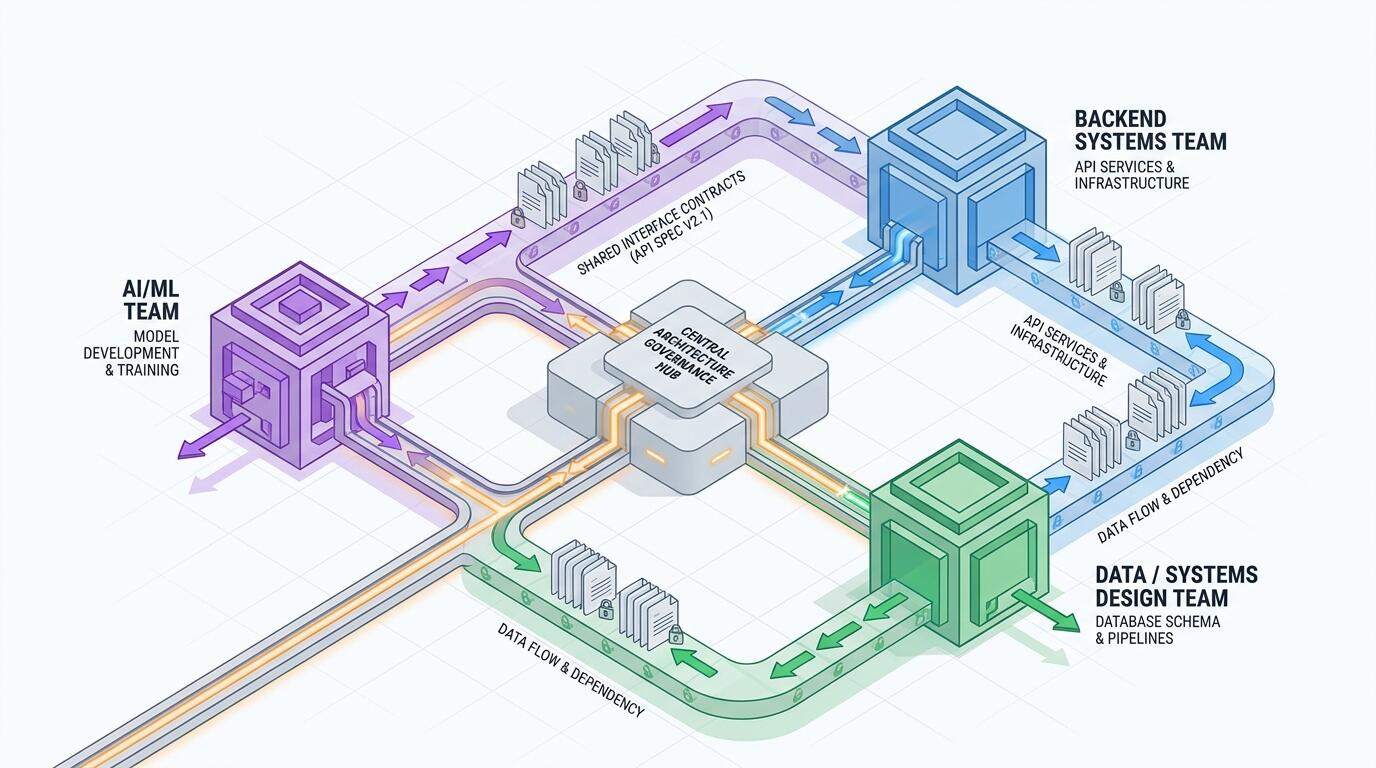
ALT: Cross-disciplinary engineering project management showing AI, backend, and systems design teams coordinating through shared interface contracts and architecture governance
Where Cross-Disciplinary Engineering Management Is Heading
The management of complex, multi-discipline engineering projects is becoming more consequential, not less, as the systems being built grow in scope and integration complexity. Several forces are shaping how this discipline evolves.
First, AI-native products are raising the baseline complexity of integration challenges. A product that incorporates a large language model, a retrieval layer, a structured data store, and a real-time user interface requires coordinated expertise across more disciplines simultaneously than almost any previous generation of software products. The teams that manage this well will have significant competitive advantage. For those weighing how to structure AI-specific architecture decisions, choosing the right AI architecture partner is a decision that affects the entire cross-disciplinary coordination structure downstream.
Second, the economics of engineering are pushing organizations toward leaner teams, which means that individual contributors and leaders must operate across more discipline boundaries than was previously expected. This increases the premium on technical leadership that genuinely spans domains, as opposed to deep specialization in a single discipline.
Third, the tools for managing cross-disciplinary projects — dependency tracking, architectural decision records, shared observability platforms — are maturing rapidly. The organizations that invest in these tools as infrastructure, rather than treating them as optional overhead, will build compounding coordination advantages over time.
The actionable implication for founders, CTOs, and senior engineers is clear: treat cross-disciplinary coordination as a first-class engineering investment. Budget for it explicitly. Staff for it intentionally. Evaluate the ROI not just on individual team velocity but on integration success rate and the cost of late-stage rework. The projects that ship cleanly are not those that had the most talented individual contributors — they are those that invested earliest in the infrastructure of coordination.
Frequently Asked Questions FAQ
Q1: How should a CTO structure technical leadership across a multi-discipline engineering project?
The most effective structure for multi-discipline engineering projects combines a centralized architecture function — responsible for interface contracts, integration standards, and cross-team technical decisions — with federated ownership within each discipline. The architecture function does not need to be a large team; in many cases, a single experienced technical lead with genuine depth across relevant domains is sufficient. Per IEEE software engineering guidance, architecture governance should be established at project inception, not retrofitted after integration problems emerge.
Q2: Are agile methodologies sufficient for managing complex cross-disciplinary engineering work?
Agile methodologies provide a strong foundation for iterative delivery within individual teams, but they are not sufficient on their own for cross-disciplinary complexity. The key gap is that standard agile frameworks are designed for intra-team coordination, not for the integration of outputs across teams with different vocabularies, tooling, and success metrics. Effective cross-disciplinary management requires augmenting agile practices with explicit interface governance, shared delivery definitions, and cross-team dependency visibility — elements that most agile frameworks treat as organizational context rather than prescribed practice.
Q3: How much of a project's budget and timeline should be allocated to cross-disciplinary integration work?
There is no universally applicable figure, and fabricating one would be misleading. What is consistently observed in practice is that organizations that explicitly budget for integration work — including interface design, cross-team reviews, integration testing environments, and coordination overhead — encounter significantly less late-stage rework than those that treat integration as implicit. A useful heuristic, cited in engineering project management literature, is to treat integration as a parallel workstream with its own milestones and resource allocation, rather than as a phase that happens after individual teams complete their work.
Wrapping Up
Managing complex engineering projects across disciplines is, at its core, a problem of coordination architecture — and it deserves the same rigor and investment that teams apply to technical architecture.
Key takeaways from this analysis:
- Abstraction mismatch between disciplines is one of the most reliable sources of late-stage integration failure, and it is preventable through co-owned interface contracts established early in the project.
- Shared ownership without explicit assignment is not ownership — discipline boundary areas require named accountability.
- Incentive alignment across teams is a leadership responsibility that has direct technical consequences; misaligned incentives produce misaligned outputs.
- Technical leadership bandwidth that spans all relevant disciplines is typically the binding constraint on project velocity; invest in it before you need it.
- Cross-disciplinary coordination is a cost-effective investment — the overhead of doing it well is consistently lower than the cost of the rework that results from skipping it.
The next step is to audit your current project's coordination layer honestly: where are the ownership gaps, the undefined interfaces, and the teams working toward incompatible abstractions? That audit is the beginning of a plan.
If you're looking to turn your next big idea into a live, running product, visit Darius to explore real shipped projects, technical insights, and hands-on AI architecture expertise — from system design all the way to deployment.
Sources
- Project Management Institute. "A Guide to the Project Management Body of Knowledge (PMBOK Guide)".
https://www.pmi.org/ - IEEE. "IEEE Standards for Software Engineering and Systems Engineering".
https://www.ieee.org/ - TU Delft. "Engineering Project Management: Mastering Project Complexity".
https://learningforlife.tudelft.nl/engineering-project-management-mastering-project-complexity/ - DX. "Mastering Engineering Project Management: Techniques and Insights".
https://getdx.com/blog/engineering-project-management/ - Epicflow. "Engineering Project Management: The Essential Guide".
https://www.epicflow.com/blog/engineering-project-management-the-essential-guide/
Note: Standards and best practice guidance may be updated; please check the latest official documents or consult qualified professional advisors for current recommendations.