A Practical Roadmap for Migrating Legacy Systems to the Cloud This Year
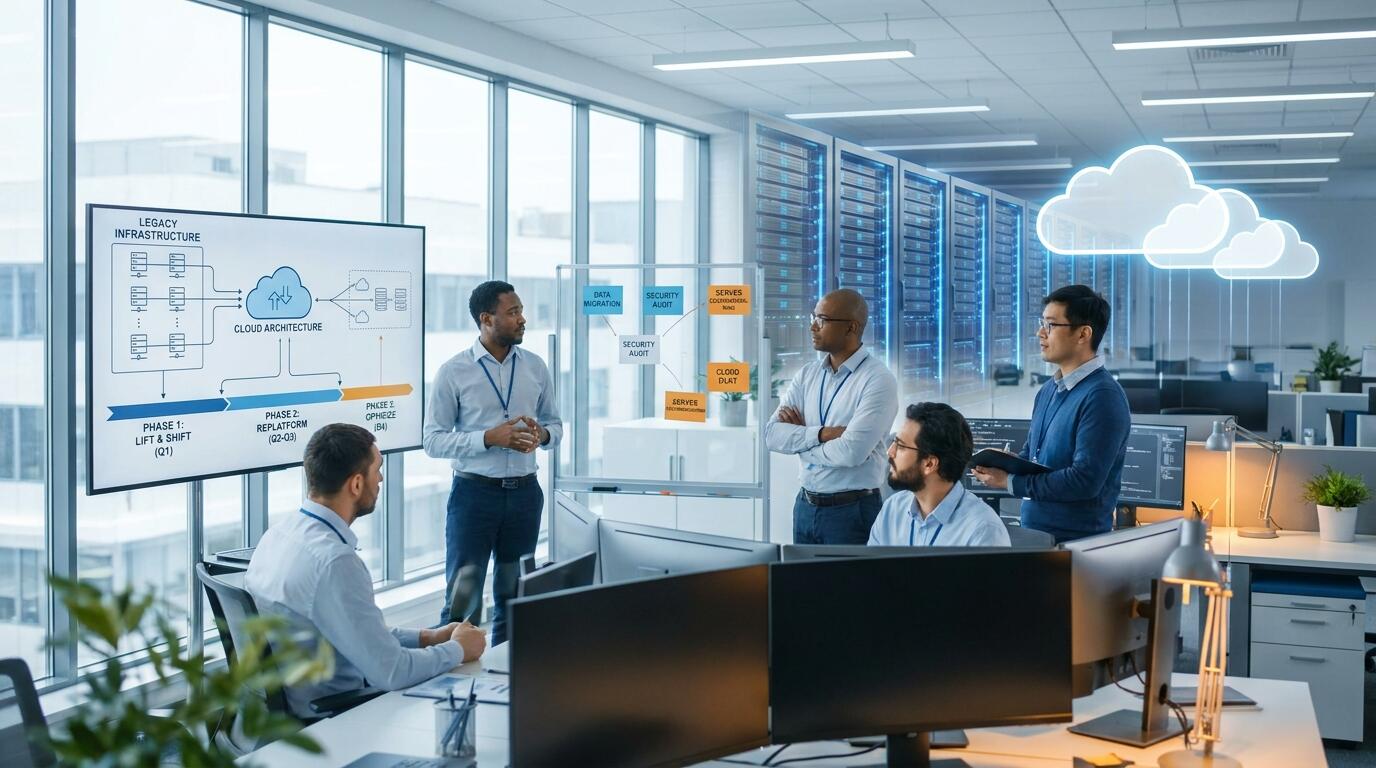
ALT: Engineering team executing a practical cloud migration roadmap for legacy enterprise systems in 2025
Why Legacy System Migration to the Cloud Has Become Urgent for Engineering Teams
Key Conclusion: Migrating legacy systems to the cloud is no longer a future-state ambition — it is an active engineering priority that demands a disciplined, phased roadmap. Organizations that approach this transition without clear dependency mapping, workload classification, and risk sequencing routinely encounter cost overruns, extended downtime, and architectural debt that negates the original business case. A practical migration roadmap connects technical decisions to business outcomes from the first sprint, treating cloud adoption as a systems design challenge rather than a lift-and-shift exercise.
The pressure to modernize aging infrastructure has intensified considerably. Legacy systems — defined here as production environments built on architectures, frameworks, or operational patterns that predate current cloud-native design principles — now represent a compounding liability rather than a depreciating asset. Every quarter those systems remain unmodified, the gap between their operational model and the demands placed on them by AI-powered features, real-time data pipelines, and elastic traffic patterns grows wider. For engineering leaders and technical founders, the question is no longer whether to migrate, but how to sequence the work so the business stays alive and competitive throughout the transition.
The State of Legacy Infrastructure and How We Got Here
Legacy systems did not become liabilities overnight. Most of the monolithic applications, on-premises database clusters, and tightly coupled service architectures that engineering teams are currently trying to modernize were sound engineering decisions at the time they were built. They were optimized for the hardware, deployment cadences, and traffic volumes that existed when they shipped. The problem is not that the original engineers made poor choices — it is that the operational context has changed fundamentally.
The shift toward cloud-native infrastructure has been building for years, but several converging forces have accelerated the urgency. First, major cloud providers — including Amazon Web Services, Google Cloud Platform, and Microsoft Azure — have matured their managed services to the point where the undifferentiated heavy lifting of running databases, message queues, and compute clusters no longer needs to be owned internally. Second, the explosion of machine learning and AI workloads has created a new class of infrastructure requirements — GPU availability, elastic batch processing, vector database integration, and low-latency inference endpoints — that simply cannot be satisfied cost-effectively on fixed on-premises hardware. Third, the talent market has shifted: engineers who understand modern cloud-native patterns are increasingly unwilling to maintain aging infrastructure, creating a skills drain that compounds the operational risk of leaving legacy systems in place.
According to the broader cloud industry conversation documented in migration engineering literature, the most common pattern observed is organizations that delayed migration until a forcing function appeared — a compliance deadline, a critical vendor end-of-life notice, or a scaling failure that became a public incident. A pattern consistently visible in applied systems work is that reactive migration, driven by crisis rather than strategy, produces the worst outcomes. The costs — in engineering time, business disruption, and technical debt accumulated during a rushed transition — dwarf what a planned migration would have required.
The current landscape reflects this reality. Many organizations find themselves operating hybrid environments: some workloads have already moved to cloud, others remain on-premises, and the integration layer between them has grown organically into a tangled mesh of VPN tunnels, data sync jobs, and environment-specific configuration. Cleaning up that hybrid state is now as much a part of the cloud migration problem as moving the remaining on-premises workloads.
Breaking Down the Root Causes of Migration Complexity
Legacy system migration fails — or stalls indefinitely — for reasons that are almost always structural, not technical. Understanding the underlying drivers of complexity is the prerequisite for designing a roadmap that actually ships.
Tight Coupling and Hidden Dependencies
Tight coupling is the most pervasive source of migration risk. In a tightly coupled system, components share state, communicate through direct in-process calls or shared database tables, and cannot be deployed or scaled independently. When you attempt to extract one component and run it in a cloud environment, it pulls on threads that connect to every other component in the system. A pattern frequently encountered in legacy migration work is discovering that what appeared to be a single bounded service is actually four or five implicit services communicating through shared mutable state in a relational database. Mapping these dependencies before writing a single line of migration code is not optional — it is the highest-leverage activity in the entire project.
Data Residency and Stateful Workloads
Stateful workloads — databases, file storage systems, session state, and message queues — are categorically harder to migrate than stateless compute. A stateless web application can be containerized and deployed to a managed Kubernetes service with relatively low risk; a 10-terabyte production PostgreSQL instance with dozens of downstream readers and writers is a different problem entirely. The migration of stateful workloads requires careful planning around replication lag, cutover windows, data consistency guarantees, and rollback strategies. Organizations frequently underestimate this complexity, plan their migration timeline around the stateless components, and then discover the stateful workload migration blows out the schedule.
Organizational and Process Dependencies
Organizational coupling is the dependency dimension that gets the least attention in technical migration literature, but it is often the one that determines whether a migration succeeds. Legacy systems frequently have operational processes, runbooks, monitoring dashboards, and on-call rotations built around their specific failure modes and deployment behaviors. Migrating the technology without migrating the operational knowledge and processes means teams are running cloud workloads with on-premises mental models — a recipe for production incidents. Change management, documentation, and team enablement need to be first-class workstreams in any serious migration roadmap.
Security and Compliance Surface Area
Security posture changes materially during cloud migration, and not always in the direction engineering teams assume. On-premises environments often rely on network perimeter security — physical access controls, firewall rules, and private network segmentation — that do not translate directly to cloud architectures. Cloud-native security requires a shift toward identity-based access control, secrets management through dedicated services, and encryption in transit and at rest as defaults rather than afterthoughts. For organizations operating under compliance frameworks such as SOC 2, ISO 27001, or industry-specific regulations, the security rearchitecture required during cloud migration must be planned in parallel with the technical migration work, not addressed as a cleanup task afterward.
Cost Model Misalignment
Cloud cost models operate on fundamentally different economics than on-premises infrastructure. On-premises costs are largely fixed — depreciation, maintenance contracts, colocation fees. Cloud costs are variable and consumption-based, which creates both opportunity and risk. Organizations that migrate without modeling their expected cloud spend against their actual usage patterns routinely experience bill shock in the first months after cutover. Right-sizing compute, selecting appropriate storage tiers, and architecting for cost — not just performance — are engineering decisions that need to be made during migration design, not after the first invoice arrives.
Comparing Migration Strategies: Evidence, Trade-offs, and Fit
No single migration strategy fits all workloads or all organizations. The engineering community has converged on a set of established patterns — often described using frameworks from cloud providers and practitioner literature — each with distinct strengths and trade-offs. Selecting the right strategy for each workload, rather than applying a single approach across the entire system, is the hallmark of a mature migration program.
| Perspective / Approach | Strengths | Trade-offs | Best Fit |
|---|---|---|---|
| Lift-and-Shift (Rehost) | Fastest time to cloud; minimal code changes; lowest initial risk | No architectural improvement; cloud costs may be higher than optimized alternatives; technical debt persists | Time-sensitive migrations, compliance deadline scenarios, initial foothold before deeper modernization |
| Replatform | Moderate speed; captures some cloud-native benefits (managed databases, auto-scaling) without full rewrite | Requires more planning than rehost; some code changes needed; partial debt reduction | Applications where managed services provide meaningful operational savings without requiring architectural rethinking |
| Refactor / Re-architect | Maximum long-term benefit; enables microservices, event-driven patterns, AI workload integration | Highest cost and time investment; significant engineering risk; requires strong domain knowledge | Core platform components with long expected lifespans; systems blocking AI or real-time feature development |
| Retire / Replace | Eliminates maintenance burden entirely; forces evaluation of actual business value | Requires replacement solution (build or buy); data migration still required | Legacy components with low utilization, available SaaS replacements, or duplicated functionality |
In practice, most migration programs use all four strategies simultaneously — applying lift-and-shift to low-value peripheral systems to move quickly, replatforming mid-tier applications to capture operational savings, and investing in full re-architecture only for the components that are genuinely strategic. The sequencing decision — which workloads to move first, in which order — is where engineering judgment has the most leverage. Migrating low-risk, low-dependency workloads first builds team capability and confidence before tackling the complex stateful core.
Practitioners working through the applied details of migration architecture can find additional context on the dependency mapping and workload classification process in resources such as Legacy System Migration to Cloud: A Practical Roadmap, which examines these sequencing decisions in depth.
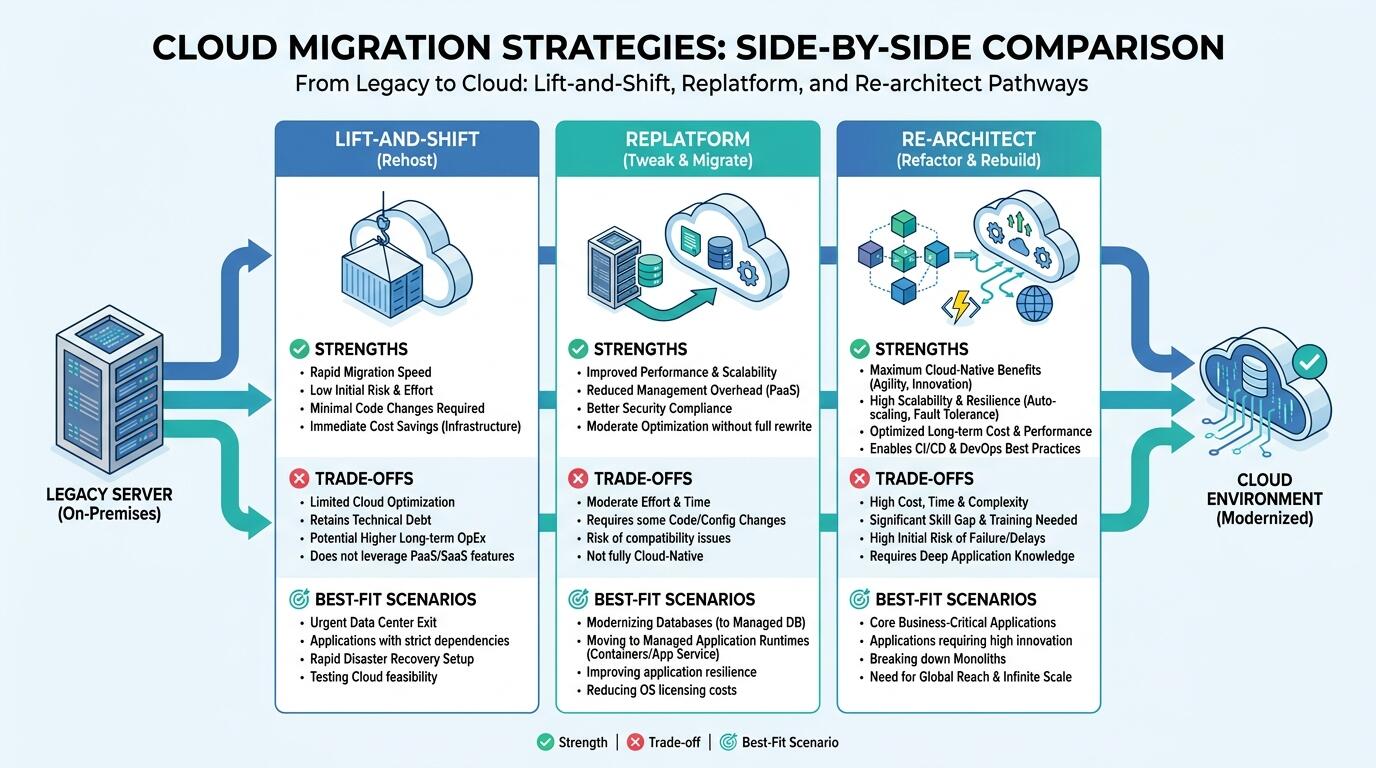
ALT: Diagram comparing cloud migration strategies — lift-and-shift, replatform, and re-architect — for legacy enterprise system modernization roadmap
For engineering leaders who are simultaneously evaluating whether to build custom infrastructure tooling or procure managed cloud services, the build vs. buy framework for AI infrastructure provides a structured decision model that applies directly to migration planning contexts.
The evidence from applied migration work consistently shows that the organizations that execute most effectively share a few common characteristics: they invest in dependency mapping before committing to a migration sequence, they treat the first workload migration as a learning exercise rather than a production-critical event, and they maintain a rollback capability for every cutover until the new environment has proven stability under real load.
According to guidance published by MAGS Group on cloud migration patterns, the operational readiness of the receiving cloud environment — not just the readiness of the migrated workload — is a critical and frequently overlooked dependency. Cloud landing zone configuration, network topology, identity and access management structure, and monitoring infrastructure need to be production-ready before the first workload cutover, not assembled in parallel.
Where Cloud Migration Is Heading and What It Means for Your Roadmap
The trajectory of cloud infrastructure is moving decisively toward AI-integrated, event-driven architectures. The practical implication for engineering teams executing legacy migrations today is that the destination environment they are designing should be evaluated not just against current workload requirements, but against the AI-powered features and data pipeline capabilities the business will need in the next planning horizon.
This means migration decisions made today have a longer shadow than they might appear to. Choosing a managed relational database that lacks vector search capabilities, or designing a compute layer that cannot burst to GPU instances, or building a data access layer that doesn't support streaming reads — these are decisions that will constrain AI feature development a year from now. The migration roadmap is also, implicitly, an AI readiness roadmap.
For teams working under execution pressure, the practical takeaways are direct:
- Begin with a dependency audit, not a cloud account setup. The first deliverable of any migration program should be a complete map of inter-service dependencies, data flows, and operational processes. This map drives every sequencing decision that follows.
- Define your rollback boundary before cutover. Every production migration event should have a documented rollback procedure, a defined trigger condition, and a tested execution path. "We'll figure it out if something goes wrong" is not a rollback strategy.
- Run cost modeling before architecture finalization. Cloud architecture decisions — instance types, storage tiers, data transfer patterns, managed service selections — have direct cost implications that should be visible to engineering and finance stakeholders before commitments are made.
- Treat operational readiness as a migration deliverable. Monitoring, alerting, runbooks, and on-call documentation for the new cloud environment need to be completed before cutover, not scheduled as follow-up work.
- Sequence for learning, not just speed. Moving a low-risk workload first — even if it is not the highest business priority — gives the team an opportunity to develop cloud operational competency before it is needed under pressure.
Engineering leaders navigating these decisions while also managing team velocity can benefit from the principles outlined in resources on shipping fast without sacrificing product quality, which addresses the broader challenge of maintaining execution discipline during complex technical transitions.
People Also Ask
Q1: How do you prioritize which legacy systems to migrate to the cloud first?
Prioritization should be driven by a combination of dependency complexity, business risk, and strategic value. Start by mapping inter-service dependencies and identifying workloads that have the fewest upstream and downstream dependencies — these are the lowest-risk candidates for early migration. Peripheral systems, internal tools, and stateless compute layers typically move first. Reserve the most complex, stateful, or business-critical components for later phases, after the team has developed cloud operational experience on lower-risk workloads.
Q2: Is a full re-architecture always necessary when migrating legacy systems to the cloud?
A full re-architecture is not always necessary and is frequently the wrong default choice. Lift-and-shift and replatforming strategies deliver meaningful value for many workload types without requiring a complete rebuild. The decision should be made workload by workload, based on expected lifespan, current coupling complexity, and whether the existing architecture blocks strategic capabilities — such as AI integration or real-time data processing — that the business needs. Applying re-architecture selectively to genuinely strategic components preserves budget and timeline for the work that matters most.
Q3: How long does a typical legacy system cloud migration take, and what drives the timeline?
Migration timelines vary significantly based on system complexity, team size, and the chosen strategy mix. Simple rehost migrations of peripheral workloads can complete in weeks; full re-architecture of a core monolithic platform is typically measured in quarters. The primary timeline drivers are dependency complexity, the scale and maturity of stateful workload migrations, organizational change management requirements, and the availability of engineering capacity dedicated to migration work rather than divided with ongoing feature development. According to migration practitioners documented in published cloud engineering literature, organizations that underestimate stateful workload migration consistently experience the most significant schedule overruns.
Summary
Migrating legacy systems to the cloud is a systems design challenge that requires the same rigor applied to any complex engineering problem: clear problem decomposition, explicit trade-off analysis, and disciplined sequencing. Three principles consistently separate successful migrations from stalled or failed ones.
First, dependency visibility precedes everything else. You cannot sequence a migration safely without knowing what each workload depends on and what depends on it. The dependency audit is the most important early investment.
Second, strategy selection should be workload-specific, not organization-wide. Applying lift-and-shift to strategic core systems wastes the migration opportunity; applying full re-architecture to low-value peripheral systems wastes engineering budget. Match the approach to the workload's actual strategic value and complexity.
Third, the destination environment should be designed for where the business is going, not just where it is today. Cloud architectures that enable AI feature development, real-time data pipelines, and elastic scaling are not more expensive to design than architectures that don't — but they require intentional decisions made during migration planning rather than retrofit work afterward.
For engineering leaders ready to move from roadmap to execution, the practical next step is a structured dependency audit followed by workload classification. That foundation makes every subsequent decision — sequencing, strategy selection, cost modeling, and operational readiness planning — faster and more defensible.
Ready to turn your legacy migration roadmap into a working architecture? Visit Darius's work and insights to explore shipped projects, read deeper technical analysis, and connect directly to discuss how a structured approach to systems design can accelerate your cloud transition.
Sources & Further Reading
- Darius.wiki. "Legacy System Migration to Cloud: A Practical Roadmap for ..."
https://www.darius.wiki/en/blog/technology/legacy-system-migration-to-cloud-practical-roadmap.html - MAGS Group. "Migrating from Legacy Systems to Modern Cloud Platforms"
https://mags-group.com/insights/articles/legacy-to-cloud - LinkedIn Pulse. "Legacy Systems to Cloud-Native: A Roadmap for Minimal Business Disruption"
https://www.linkedin.com/pulse/legacy-systems-cloud-native-roadmap-minimal-business-disruption-ayuwf - National Institute of Standards and Technology (NIST). Cloud Computing Standards and Guidelines.
https://www.nist.gov
Note: Standards and cloud platform guidance may be updated; please check the latest official documents or consult professional advisors before finalizing migration architecture decisions.