Legacy System Migration to Cloud: A Practical Roadmap for This Year

ALT: Engineering team planning legacy system migration to cloud with a practical roadmap on whiteboards
Why Legacy System Migration to Cloud Is the Defining Technical Challenge Right Now
You inherit a monolithic application that processes millions of transactions a day. It runs on hardware that the vendor no longer patches, calls libraries that haven't seen a commit in years, and sits behind a firewall configuration that only one person truly understands — and that person just gave notice. This is not a hypothetical. It is a scene that plays out across enterprises, scaling startups, and government-adjacent organizations with striking regularity.
Migrating legacy systems to the cloud is not simply a lift-and-shift exercise or a checkbox on a digital transformation slide deck. Done well, it is a deliberate re-architecture effort that trades short-term disruption for long-term operational leverage, cost predictability, and the ability to integrate modern AI and data capabilities. Done poorly, it extends technical debt into a new environment at higher monthly cost. The practical roadmap described in this article is built from patterns observed across real migration engagements — the kind where production traffic keeps flowing while the floors underneath are being replaced.
Who This Roadmap Is — and Is Not — For
Applicable Scenarios:
- Teams running monolithic or service-oriented applications on on-premises infrastructure or aging VMs that are approaching end-of-support
- Startup founders who built a working product quickly and are now hitting the scaling ceiling of their original hosting setup
- Engineering leaders evaluating cloud modernization as a prerequisite for adopting AI/ML pipelines, real-time analytics, or edge computing capabilities
- Product managers and CTOs tasked with reducing operational risk and improving system observability without halting feature delivery
Not Applicable/Cautions:
- Greenfield projects starting from scratch — cloud-native design choices apply, but the migration-specific sequencing in this roadmap does not
- Systems bound by data-sovereignty regulations that prohibit specific cloud regions or third-party infrastructure; those require compliance review before any architectural decision
- Organizations without internal technical ownership or a credible external partner to manage the migration — a roadmap without an accountable engineering team driving it is a document, not a plan
The True Cost of Staying Put: Why Legacy Modernization Has Urgency Now
Legacy system modernization is the process of transforming aging software infrastructure — applications, databases, and integration layers — into architectures that align with current engineering practices, cloud economics, and organizational velocity. The urgency is not manufactured. It reflects genuine shifts in both the cost structure of operating older systems and the competitive dynamics of building on them.
On-premises infrastructure carries a compounding cost profile. Hardware refresh cycles, licensing fees for operating systems and middleware, the overhead of physical data-center management, and the fragility of bespoke deployment processes all accumulate. More importantly, they consume engineering attention that could otherwise go to product development. A pattern consistently seen in organizations with aging infrastructure is that the ratio of time spent keeping the lights on versus shipping new capability skews heavily toward maintenance — often more heavily than leadership realizes until someone does the honest accounting.
Cloud platforms, by contrast, have matured considerably. Managed database services, container orchestration layers, serverless compute, and purpose-built AI/ML infrastructure are now commoditized in ways that make building sophisticated systems more accessible and more economical than self-hosting equivalent capabilities. Per the research published in industry analyses such as those by NIX United on legacy application migration, organizations pursuing structured cloud migration consistently identify operational cost reduction and improved system reliability as primary drivers — not just modernization for its own sake.
The strategic dimension matters too. Legacy codebases are often the hidden tax on AI adoption. When engineering teams attempt to layer modern AI capabilities — recommendation engines, predictive analytics, real-time inference — onto systems with rigid data models and batch-only pipelines, they discover that the integration cost rivals the cost of the AI work itself. Modernizing the underlying system first creates the foundation that makes subsequent AI integration tractable.
That said, modernization is not free, and the business case must be honest. The migration roadmap that follows is structured specifically to sequence investment for early value realization — so the organization begins recovering cost before the full migration is complete.
The Practical Roadmap: From Discovery to Production
Three Steps to Start Before You Write a Single Line of Migration Code
Step 1: Run an Honest System Inventory
Before any architectural decision, map what actually exists. This means cataloging every service, database, integration endpoint, and scheduled job in the current environment — including the ones that are undocumented because they "just work." Dependency mapping is frequently where teams discover the most risk: the payment service that calls an internal SMTP relay, the report generator that reads directly from a production database replica, the authentication module that was bolted on in a different framework version. Allow adequate time for this phase; teams that rush it pay for it in production incidents later.
Step 2: Score Components by Migration Complexity and Business Criticality
Not everything migrates on the same timeline. Use a two-axis scoring framework: how complex is this component to migrate (considering dependencies, state management, integration surface), and how critical is it to revenue or operations? Components that are low complexity and low criticality migrate first — they generate early wins, build team confidence, and surface infrastructure tooling issues in a low-risk environment. High-criticality, high-complexity components migrate last, after the team has rehearsed the playbook on lower-stakes pieces.
Step 3: Define Your Target Architecture Before You Move Anything
The most costly migration mistakes come from moving workloads to the cloud in their current form, discovering that the architecture does not suit cloud economics, and then having to re-architect in place — at cloud prices. Spend time defining the target state: What will run as containers? What becomes a managed service? What gets decomposed into functions? Where does the data tier land, and what does the schema evolution strategy look like? This upfront architecture investment is what separates migrations that reduce costs from migrations that transplant costs into a new environment.
Migration Strategy Comparison: Choosing the Right Approach for Each Component
The migration industry has converged on a set of recognized patterns, often referred to as the "R" strategies. The table below compares the three most frequently applicable approaches for teams migrating legacy systems:
| Comparison Dimension | Rehost (Lift-and-Shift) | Replatform (Lift-Tinker-Shift) | Refactor / Re-architect |
|---|---|---|---|
| Migration Speed | Fastest — days to weeks per service | Moderate — weeks per service | Slowest — months per service |
| Cloud Cost Optimization | Minimal — costs mirror on-prem profile | Moderate — managed services reduce ops overhead | Highest — architecture fits cloud pricing model |
| Risk Level | Lower migration risk, higher long-term tech debt | Balanced | Higher migration complexity, lower long-term debt |
| AI/ML Integration Readiness | Poor — data and compute remain siloed | Moderate — managed databases help | High — enables modern data pipelines and inference layers |
| Team Skill Requirement | Existing ops skills sufficient | Some cloud-native knowledge needed | Cloud-native and distributed systems expertise required |
| Best For | Urgent datacenter exits, initial migration waves | Databases, middleware, batch processing | Core product services, data platforms, AI workloads |
In practice, a mature migration uses all three strategies simultaneously — rehosting components that need to leave their current environment quickly, replatforming stable but operationally expensive middleware, and refactoring the core product services that will need to support new capabilities over the next several years.
The Phased Execution Plan: Making Migration Financially Sustainable
Phase One: Foundation and Low-Risk Wins
The first phase establishes cloud infrastructure, networking, identity, and observability tooling before migrating any application workloads. This is not glamorous work, but teams that skip it discover during production incidents that they have neither the visibility nor the operational runbook to respond effectively. Alongside infrastructure setup, migrate the first wave of low-criticality, low-complexity components. These early migrations validate the runbooks, surface tooling gaps, and — critically — begin generating cloud cost data that refines the business case.
Phase Two: Stateful Services and Data Migration
Data migration is consistently the highest-risk element of cloud modernization. Stateful services — relational databases, object storage, message queues, caches — require careful sequencing. The recommended pattern is to run dual-write or change-data-capture (CDC) pipelines that keep the legacy and cloud data tiers synchronized during the transition period. This allows read traffic to shift to the cloud environment progressively while the legacy system remains the write-of-record — reducing the blast radius of any migration issue. Per documentation from cloud infrastructure providers and migration practitioners documented by Jetbase on legacy system modernization strategies, CDC-based data migration with parallel validation is now considered the production-grade standard for high-availability systems.
Phase Three: Core Product Services and Traffic Cutover
Core product services migrate in this phase, using the infrastructure and tooling validated in earlier phases. The guiding principle is blue-green deployment: the migrated service runs alongside the legacy version, traffic shifts progressively via weighted routing, and automated rollback is configured before any traffic touches the new environment. This phase is where AI-readiness improvements become visible — once core services are on managed cloud infrastructure, integrating vector databases, inference endpoints, and streaming data pipelines becomes an engineering task rather than an infrastructure project.
Phase Four: Decommission and Optimize
Migration is not complete when the last workload moves to the cloud. It is complete when the legacy infrastructure is decommissioned — because until that happens, the organization is paying for both environments. Phase four focuses on validating that all traffic and data has fully transitioned, removing legacy infrastructure, and beginning the cloud cost optimization cycle: right-sizing compute, adopting reserved or committed use pricing, and tuning auto-scaling policies based on observed production load patterns. According to analysis published in industry resources such as Document Media on migration to modern cloud systems, organizations that actively optimize post-migration frequently realize cost profiles substantially better than their pre-migration on-premises spend within the first year of steady-state operation.
Security, Compliance, and Observability: The Non-Negotiables
Security posture must be designed, not patched on. Legacy systems frequently carry implicit security assumptions — network-level trust between services, hardcoded credentials in configuration files, overly permissive IAM patterns inherited from when the system was simpler. Cloud migration is the forcing function to address these. The migration architecture should introduce secrets management (e.g., vault-based credential injection), least-privilege IAM policies from day one, and network segmentation that reflects actual traffic patterns rather than inherited trust relationships.
Observability is the migration team's insurance policy. Before any production traffic migrates, the target environment must have distributed tracing, structured log aggregation, and metric-based alerting in place. The inability to diagnose a production issue in the cloud environment during a migration window is the scenario that forces emergency rollbacks and erodes organizational confidence in the program. Teams that invest in observability tooling early recover from incidents faster and build the institutional knowledge that accelerates subsequent migration phases.
The IEEE and NIST frameworks for cloud security architecture provide documented guidance on control implementation that is worth referencing when establishing security baselines for cloud-migrated workloads — these are standards, not vendor opinions, and they provide defensible audit trails for compliance-sensitive organizations.
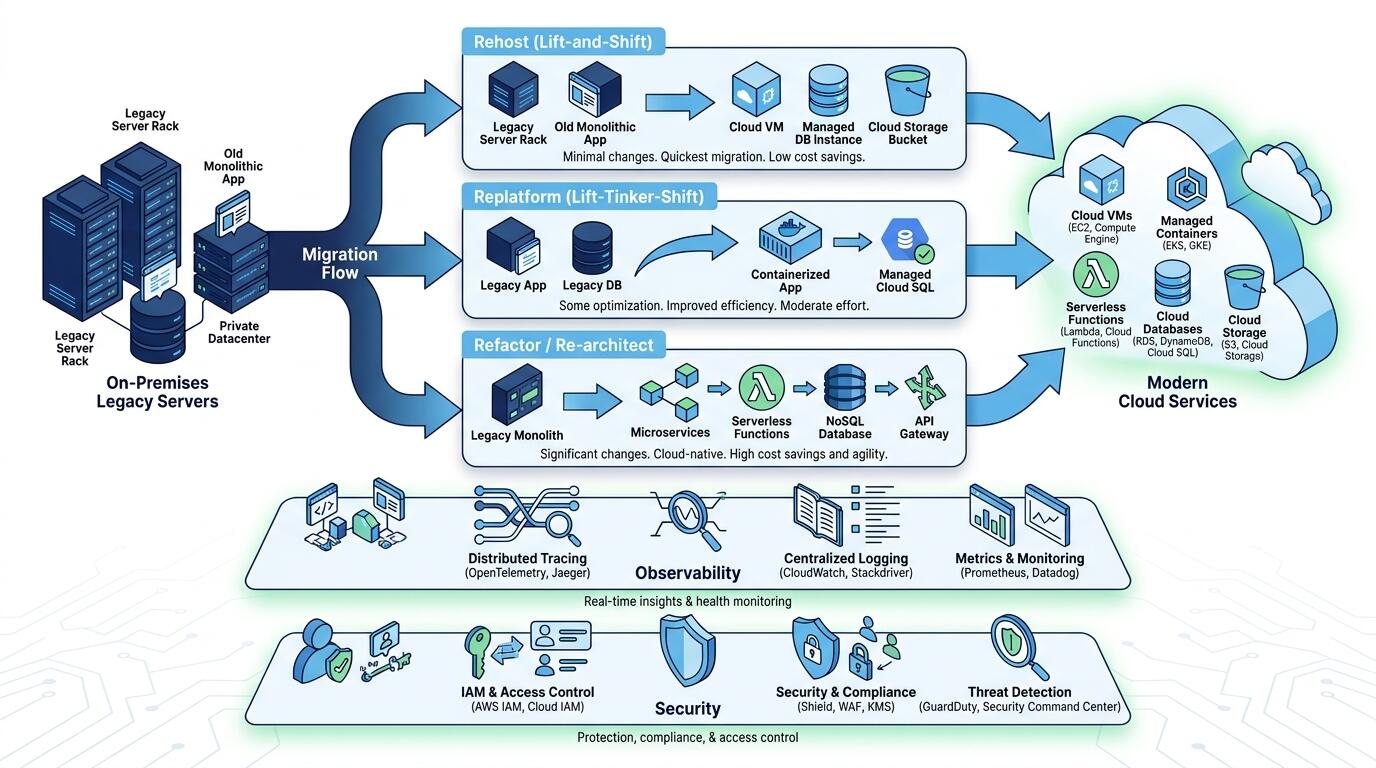
ALT: Diagram illustrating a phased legacy system migration to cloud architecture, showing rehost, replatform, and refactor strategies alongside observability and security layers
Advanced Considerations: Edge Cases, Misconceptions, and AI Integration
The "cloud-first means cloud-only" misconception. Not every workload belongs in the public cloud. High-throughput, latency-sensitive compute with predictable load profiles can, in some cases, be more economically operated on dedicated or co-located hardware. Mature cloud strategy involves honest workload-by-workload analysis rather than dogmatic platform preference. A well-architected hybrid approach — where the orchestration, intelligence, and data layers live in the cloud while specific compute-intensive tasks run on optimized hardware — often produces better economics than a wholesale migration.
The AI integration opportunity that migration unlocks. One pattern consistently observed in work with clients is that the conversation about AI capabilities — real-time personalization, predictive analytics, LLM-powered features — frequently starts during migration planning. Cloud migration, particularly the refactoring phase, is the natural moment to design data pipelines that feed AI systems: event streaming infrastructure, feature stores, vector databases, and inference endpoints. Teams that plan for this from the start of the migration end up with an architecture that is AI-ready by design rather than AI-capable by awkward extension.
Change data capture complexity on heterogeneous legacy stacks. When the source system involves multiple database engines, proprietary data formats, or undocumented schema conventions, CDC implementation becomes significantly more complex. In these cases, an extract-transform-load approach with validation checkpoints may be more reliable than real-time CDC — accepting a longer migration window in exchange for data integrity guarantees. The choice depends on tolerable downtime and the cost of potential data inconsistency.
Organizational change management is a technical risk. The engineering decisions are often the easier part. The harder challenge is aligning operations teams, security teams, and business stakeholders on the migration timeline, the acceptance of temporary dual-environment cost, and the definition of "done." Migrations that succeed have explicit alignment on these dimensions before the first workload moves.
Questions & Answers
Q1: How do you decide which legacy components to migrate first?
Prioritization should follow a two-axis framework: migration complexity versus business criticality. Components that are low complexity and low criticality migrate first — they validate tooling and runbooks at low risk. High-criticality systems migrate later, once the team has rehearsed the process. This sequencing also means the organization begins realizing cloud benefits early while managing risk on the systems where failures carry the heaviest consequence.
Q2: Is a full refactor always better than a lift-and-shift for legacy systems?
Not necessarily. Rehosting is the right choice when the priority is a rapid datacenter exit, or when the component in question is stable, low-traffic, and unlikely to need significant change. Full refactoring delivers superior long-term economics and AI-readiness, but it carries higher short-term cost and timeline risk. The pragmatic answer is a mixed strategy: rehost what needs to move fast, replatform what is operationally expensive, and refactor what drives product differentiation.
Q3: How long does a legacy system cloud migration typically take, and what drives the timeline?
Timeline varies considerably based on system complexity, team size, organizational risk tolerance, and the depth of the target architecture changes. Simple rehosting of a modest workload can complete in weeks; a full re-architecture of a complex, data-intensive platform with compliance requirements is a multi-quarter program. The most reliable way to estimate is by completing the system inventory and complexity scoring described in the three-step quick start — that exercise surfaces the dependencies and unknowns that drive timeline more than any rule-of-thumb estimate.
Key Takeaways
- Legacy system migration to cloud is a sequenced engineering program, not a one-time event — treating it as phased work with defined checkpoints is what separates migrations that reduce costs from those that merely relocate them.
- A system inventory and complexity-criticality scoring exercise must precede any architectural decision — skipping this step is the single most common source of mid-migration surprises.
- The right migration strategy varies by component: rehost for speed, replatform for operational efficiency, refactor for long-term AI readiness and cloud economics — and most real programs use all three simultaneously.
- Security and observability must be designed into the target environment before production traffic arrives, not added after incidents reveal their absence.
- Cloud migration is the most practical moment to design AI-ready data infrastructure — event streaming, feature pipelines, and inference layers are far cheaper to architect during migration than to bolt on afterward.
The next step for most teams is the system inventory — start there, score what you find, and let the data drive the migration sequencing rather than working backward from a predetermined timeline.
If this resonated with you, explore more insights and real-world projects at Darius's portfolio — where AI architecture, systems design, and full-stack engineering meet execution. Whether you're looking to validate a technical approach, learn from shipped products, or connect with an experienced Engineering Director and AI Architect, Darius offers a front-row view into what it truly takes to turn ideas into live, running systems. Visit the Darius website to dive deeper.
Sources
- NIX United. "Legacy Application Migration to Cloud in 2026".
https://nix-united.com/blog/legacy-application-migration-to-cloud/ - Jetbase. "Legacy System Modernization: Top Strategies and Approaches".
https://jetbase.io/blog/legacy-system-modernization-top-strategies-and-approaches - Document Media. "Migration to Modern Cloud Systems".
http://documentmedia.com/article-3774-Migration-to-Modern-Cloud-Systems.html - National Institute of Standards and Technology (NIST). Cloud Computing Standards and Guidelines.
https://www.nist.gov/ - IEEE. Standards and Technical Resources for Cloud and Software Architecture.
https://www.ieee.org/
Note: Standards and technical guidance may be updated; consult the latest official documents or qualified technical advisors before making architectural decisions.