How to Launch an AI SaaS Product in China: A Step-by-Step Compliance Checklist
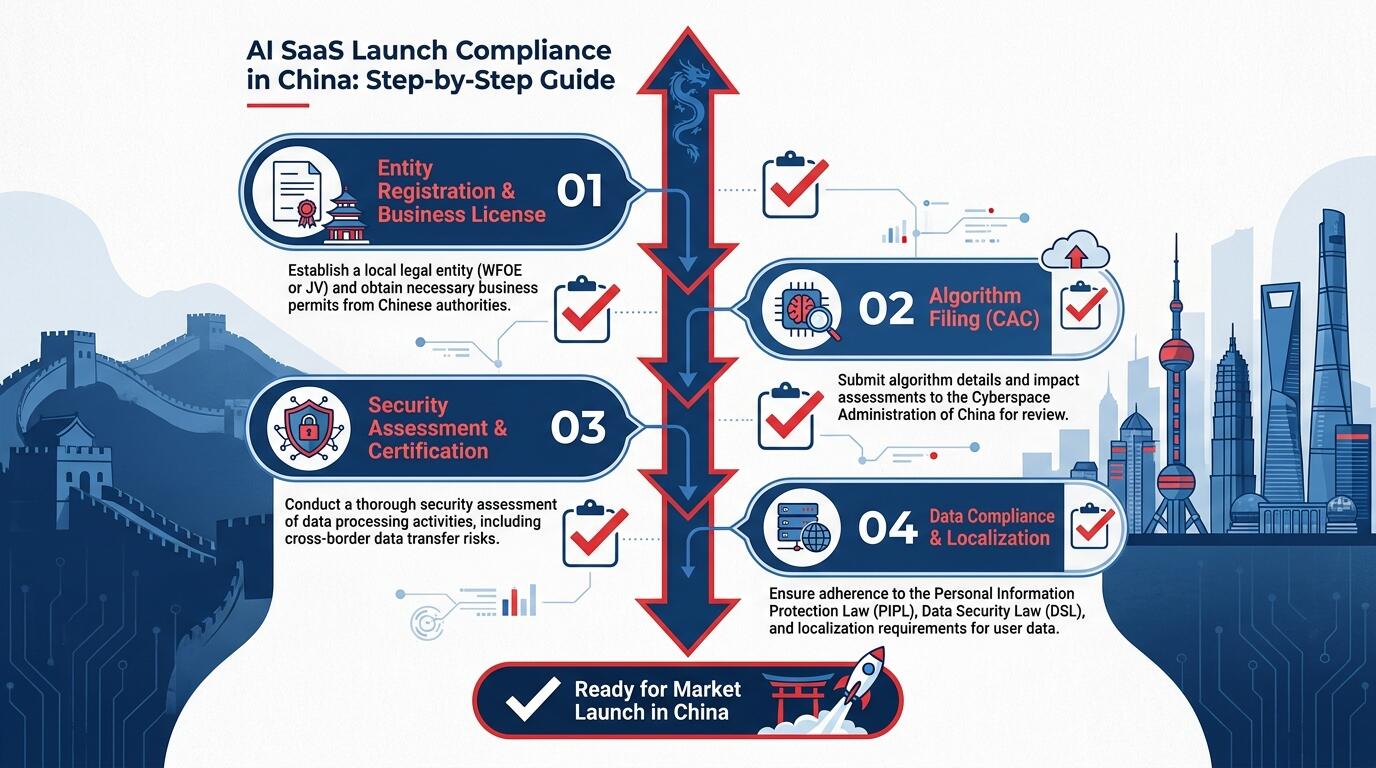
ALT: Step-by-step compliance checklist for launching an AI SaaS product in China
How to Launch an AI SaaS Product in China: A Step-by-Step Compliance Checklist
A founding engineering team finishes a solid generative AI feature, points the release pipeline at mainland China, and discovers the product cannot legally go live without a filing that takes weeks to prepare. This scenario repeats across nearly every team we have advised on cross-border AI launches, and it is entirely avoidable with the right sequence of steps. This guide gives you a practical, step-by-step compliance checklist for launching an AI SaaS product in China, built from the operational patterns we consistently see work in production environments.
This article is written for engineering leaders, AI product builders, and startup founders who are technically strong but new to China's regulatory landscape for AI services. It assumes no prior legal background and defines every term the first time it appears, so you can move from "what does this even mean" to "here is our launch plan" without hiring outside counsel just to read the requirements.
Before You Start: Prerequisites & Preparation
Launching an AI SaaS product in China is not a weekend task bolted onto your existing release process. It is a parallel workstream that should start before your product is feature-complete, because several filings depend on documentation about model training data, content moderation logic, and business licensing that engineering teams do not usually prepare in advance.
Realistically, teams should budget for a preparation phase measured in months rather than days, particularly if this is the organization's first regulated AI filing in China. The exact duration depends on your product category, whether you already have a China-based legal entity, and how quickly your algorithm documentation can be assembled.
Checklist before starting:
- A registered business entity in mainland China, or a clear plan to establish one, since most filings require a local corporate presence
- Internal documentation of your model architecture, training data sources, and content safety mechanisms
- A designated internal or outside compliance contact familiar with Cyberspace Administration of China (CAC) filing processes
- A content moderation and data logging plan that can demonstrate how your system handles user-generated prompts and outputs
- Executive alignment on the timeline, since compliance work often runs on a different cadence than sprint-based product development

ALT: Engineering and legal teams reviewing an AI SaaS compliance checklist for China market entry
Step-by-Step Instructions: The AI SaaS China Launch Checklist
Launching an AI SaaS product in China follows a sequence of legal, technical, and operational steps that must be completed largely in order, because later filings often reference documents produced earlier in the process. The steps below reflect the pattern we consistently guide clients through, from entity setup to post-launch monitoring.
Step 1: Establish Your Legal Entity and Business Scope
- Register a Wholly Foreign-Owned Enterprise (WFOE) or partner with a local entity whose business license explicitly covers internet information services and, where relevant, value-added telecommunications services. Your product's business scope on the license must match what your AI SaaS product actually does, since a mismatch is one of the most common reasons filings stall.
- Confirm early whether your product needs an Internet Content Provider (ICP) license, which is the baseline permit required for operating a commercial website or application inside mainland China.
- Tip: Start entity registration in parallel with early product development, not after your MVP is complete, since corporate registration alone can take longer than a typical engineering sprint cycle.
Step 2: Classify Your AI Service Under Chinese Regulation
- Determine whether your product qualifies as a "generative AI service" under China's rules governing generative artificial intelligence, since this classification triggers a distinct set of algorithm filing and security assessment obligations administered by the Cyberspace Administration of China.
- Review whether your product also falls under recommendation-algorithm rules, which apply to services using algorithms to push personalized content, ads, or suggestions to users.
- Tip: Document your classification reasoning in writing early, because the same reasoning will be reused in your algorithm filing submission later in the process.
Step 3: Prepare and Submit Your Algorithm Filing
- Compile a filing package describing your algorithm's purpose, training data sources, content moderation logic, and risk mitigation measures, then submit it through the CAC's algorithm registration system.
- Include evidence of how your system prevents the generation of prohibited content categories, since reviewers focus heavily on safety mechanisms rather than model architecture details alone.
- Tip: Keep your filing language plain and specific; vague descriptions of "AI safety" without concrete mechanisms are a frequent cause of review delays.
Step 4: Conduct a Security Assessment for Public-Facing Generative AI
- Complete a security assessment if your generative AI service is offered to the public and has the capacity to influence public opinion or social mobilization, a threshold set by China's generative AI regulations. This assessment typically evaluates data handling, content risk controls, and system robustness.
- Prepare technical documentation your engineering team already maintains for production readiness, since a security assessment overlaps significantly with the operational rigor described in our guide on the difference between AI prototypes and production-ready AI systems.
- Tip: Treat this step as a systems audit, not a paperwork exercise; assessors often ask for live demonstrations of moderation behavior.
Step 5: Address Cross-Border Data Transfer Requirements
- Map every place your product moves user data outside mainland China, including model inference calls to overseas servers, analytics pipelines, and customer support tools, since cross-border data transfer is one of the most scrutinized areas of Chinese data law.
- Depending on data volume and sensitivity, arrange a security assessment, standard contractual clauses, or a certification pathway under China's Personal Information Protection Law (PIPL) framework before any data leaves the country.
- Tip: Many teams underestimate how many "invisible" data flows exist, such as logging services or third-party APIs; audit your entire stack, not just your primary database.
Step 6: Build Content Moderation and User Reporting Mechanisms
- Implement real-time content filtering for both user inputs and model outputs, plus a visible mechanism for users to report problematic content, since Chinese regulators expect operational moderation infrastructure, not just policy documents.
- Establish an internal escalation process for flagged content, including logging and retention practices that can be demonstrated during audits or spot checks.
- Tip: This is exactly the kind of production discipline that separates a demo from a shippable product; teams that already follow the guidance in our piece on shipping your first live AI product tend to have this infrastructure in place before compliance even asks for it.
Step 7: Launch, Monitor, and Maintain Ongoing Compliance
- Go live only after all applicable filings are approved, then set up ongoing monitoring for regulatory updates, since China's AI governance framework is actively evolving and requirements can shift with new implementation rules.
- Schedule periodic internal reviews of your algorithm filing accuracy, especially after any significant model update or feature change, since material changes to your system may require a refiled or amended submission.
- Tip: Assign a named owner for regulatory monitoring inside your organization; compliance that has no owner tends to quietly lapse after launch.
Common Mistakes & Troubleshooting
Most compliance delays we encounter trace back to a handful of recurring issues rather than one-off surprises. The table below maps the symptoms teams report to their root causes and the fix that actually resolves them.
| Symptom | Likely Cause | How to Fix |
|---|---|---|
| Algorithm filing rejected or stuck in review | Filing description is too vague about safety mechanisms and training data | Rewrite the submission with concrete, specific descriptions of moderation logic and data provenance |
| Business license does not cover the AI product's actual function | Business scope was registered before the product's final feature set was defined | Amend the business license scope before resubmitting any AI-specific filings |
| Cross-border data transfer flagged during review | Overlooked third-party services (analytics, logging, model APIs) sending data overseas | Complete a full data flow audit and apply the appropriate PIPL transfer mechanism |
| Launch delayed after a major model update | Filing was based on an earlier model version and never amended | Establish a policy requiring compliance review before any material model or feature change ships |
| Content moderation deemed insufficient during assessment | Moderation exists only as a policy document, not as working infrastructure | Build and demonstrate live filtering, logging, and user reporting features before resubmission |
Pro Tips for Better Results
Teams that treat compliance as a parallel engineering workstream, rather than a legal afterthought, consistently launch faster and face fewer post-launch surprises. A few advanced practices go beyond the basic checklist above.
- Build your content moderation and logging systems as first-class product features from day one, not as compliance patches added right before submission; this mirrors the broader philosophy that AI-native products embed governance and safety as native capabilities rather than bolt-ons.
- Maintain a living document that maps every data flow in your architecture to its regulatory basis, and update it every time you add a new third-party service or API integration.
- Assign a single accountable owner for regulatory relationships, since fragmented ownership across legal, product, and engineering teams is a common reason filings stall without anyone noticing.
- A common misconception is that compliance is a one-time gate you clear before launch. In reality, algorithm filings, security assessments, and data transfer mechanisms all require periodic revalidation as your product and regulations evolve.
- Where possible, pilot new AI features in a controlled or limited release before wide distribution, giving your compliance team time to assess risk without blocking your broader roadmap. This pattern also reflects broader shifts described in our analysis of AI adoption trends among Chinese SME leaders, where staged rollouts are becoming standard practice.
Frequently Asked Questions FAQ
Q1: How long does it take to get an AI SaaS product compliant for launch in China?
Timelines vary widely based on entity setup status, product complexity, and filing completeness, but teams should plan for a process measured in months rather than weeks. Entity registration, algorithm filing, and security assessment steps often run partially in parallel, which can shorten the overall calendar time if managed by a dedicated compliance owner from the start.
Q2: Is a foreign company required to have a China-based entity to launch an AI SaaS product there?
Yes, in nearly all cases a China-based legal entity, or a licensed local partner, is required to hold the business license and ICP registration needed to operate commercially in mainland China. Attempting to launch without local registration typically blocks access to essential filings like the algorithm registration process described earlier in this guide.
Q3: What does the algorithm filing process typically involve for generative AI products?
The algorithm filing process, administered by the Cyberspace Administration of China, requires submitting documentation on your model's purpose, training data sources, and content safety mechanisms. According to general guidance from Chinese regulatory bodies, reviewers place significant weight on concrete, demonstrable moderation infrastructure rather than high-level policy statements alone.
Wrapping Up
Launching an AI SaaS product in China rewards teams that treat compliance as an engineering discipline: build moderation and data-flow tracking into your architecture early, classify your service correctly before you file, and assign clear ownership for ongoing regulatory monitoring after launch. These three practices consistently separate teams that ship on schedule from those stuck in filing limbo.
The step-by-step compliance checklist in this guide is designed to be a working reference, not a one-time read. As you move from entity registration through algorithm filing, security assessment, and live monitoring, revisit each step whenever your product or the regulatory landscape changes materially.
If you are building the underlying product architecture that needs to support this level of scrutiny, it helps to learn from teams who have already made the shift from prototype to production-grade AI systems.
Ready to see how AI-native products are built from the ground up? Visit Darius at the Darius website to explore hands-on insights, real product case studies, and practical guidance from an Engineering Director and AI Architect shipping tools like AI cloud drives, mock interview platforms, and creator cockpits. Start building smarter, AI-first products today.
Sources & Citations
- Zylo. "The Essential SaaS Compliance Checklist for 2026".
https://zylo.com/blog/saas-compliance-checklist - Maxio. "How to Launch a SaaS Product: Step-by-Step Guide".
https://www.maxio.com/blog/how-to-launch-a-saas-product-step-by-step-guide - ProductFruits. "SaaS Product Launch Checklist: A Step-by-Step Guide".
https://productfruits.com/blog/saas-product-launch-checklist
Note: Standards may be updated; please check the latest official documents or consult professional advisors.