Keeping Human Editorial Judgment in an Automated Publication

ALT: Human editor reviewing AI-generated content to preserve editorial judgment in automated publication workflows
Why Human Editorial Judgment Still Defines the Quality of Automated Publications
You have an automated pipeline running. It pulls sources every few hours, summarizes them with a language model, formats the output, and queues it for publication — all without you touching a keyboard. Then one morning you wake up to a reader email pointing out that two items in last night's issue contradict each other, one source has since been retracted, and the framing on a third story leans in a direction you would never have approved. The pipeline ran perfectly. The editorial result was a mess.
This is the central tension every builder of automated publications eventually confronts: automation handles volume and velocity; human editorial judgment handles meaning, coherence, and accountability. The two are not interchangeable, and pretending otherwise produces content that is technically correct but editorially hollow. The core conclusion of this article is that preserving human oversight in an automated publication is not a concession to inefficiency — it is the engineering decision that determines whether your product earns and keeps reader trust.
In the work of building and running AI-driven briefings, this reality surfaces in three consistent patterns: the model misreads tone or context in ways that no prompt catches, the retrieval layer surfaces a source that is authoritative-looking but unreliable, and the aggregation logic introduces implicit bias in what it surfaces and what it buries. Each of these is a place where a human editor adds irreplaceable value — not by rewriting everything, but by knowing exactly where to look.
Where This Approach Applies — and Where It Doesn't
Applicable Scenarios:
- Automated briefings, newsletters, or digests that publish on a regular cadence and carry a named editorial voice
- AI-assisted pipelines where a language model drafts, summarizes, or classifies content before publication
- Products where reader trust and brand reputation are core business assets, not incidental concerns
- Teams with a defined editorial policy that needs to be consistently applied across high output volume
Not Applicable/Cautions:
- Fully anonymous, high-frequency data feeds (price tickers, sports scores) where editorial voice is not a factor
- Internal tooling outputs that are reviewed by subject-matter experts before any external use — the human review layer exists, it's just downstream
- Contexts where the "publication" is a single-use internal report with no recurring brand identity at stake
The Problem With "Set It and Forget It" Editorial Automation
The appeal of a fully autonomous publication pipeline is real. Once the retrieval, summarization, and formatting layers are working, the marginal cost of producing another issue approaches zero. For a solo developer or a small team running multiple AI products simultaneously, this scalability is not a vanity metric — it is what makes the product viable at all.
But the economics of production do not map cleanly onto the economics of trust. According to research published in Publication Ethics on the human editor as the ultimate gatekeeper in publication ethics, the editor's role is not reducible to catching errors — it encompasses the judgment calls that determine whether a piece of content belongs in a given publication at all, whether its framing is fair, and whether its sourcing meets the standard the publication claims to uphold. These are not tasks a language model can perform with consistent reliability, not because the model lacks capability in aggregate, but because it lacks the contextual accountability that a named, responsible editor carries.
The pattern we consistently see in automated publication systems is what might be called editorial debt — decisions deferred to the model that accumulate as subtle quality problems: a slight drift in tone over time, a gradual lowering of the sourcing bar, a tendency to favor sensational framings because they score higher in the training data. No single issue looks obviously wrong. The cumulative effect erodes the product.
This is not an argument against automation. The agent pipeline behind a daily AI briefing — covering retrieval, verification, and publication — is precisely the kind of infrastructure that makes a high-quality, high-cadence product possible for a small team. The argument is that the pipeline needs deliberate human checkpoints built into its architecture, not added as an afterthought when something goes wrong.
Designing Human Oversight Into the Automation Architecture
Three-Step Quick Start for Integrating Human Editorial Review
Step 1: Map the decision types your pipeline currently makes autonomously
Before adding review steps, audit what your automation already decides without human input: which sources get included, how items get ranked or weighted, what framing language the summarization model tends to produce, and what gets filtered out. Document these as explicit decision categories. This takes honest observation over a few publication cycles — treat it as a debugging exercise, not a policy exercise. The output is a list of decision types, not a list of failures.
Step 2: Classify each decision by its editorial consequence
Not all automated decisions carry equal editorial risk. Source inclusion and framing language sit at the high-consequence end; formatting and delivery timing sit at the low-consequence end. For each decision type from Step 1, assign a consequence level: decisions that affect what your publication stands for or what your readers believe go on one list; decisions that affect presentation only go on another. This classification drives where you invest human review time — you are not reviewing everything, you are reviewing the decisions that matter.
Step 3: Instrument your pipeline to surface high-consequence decisions for human review before publication
Build a pre-publication review interface — even a simple one — that presents the items flagged in Step 2 for a human to approve, modify, or reject. The interface does not need to be elaborate: a structured queue with the item, the source, the model's framing, and a one-click approval or edit option is sufficient to start. The discipline is in making this step non-bypassable for flagged items. For Darius, this means the engineering director reviews every item that involves a contested claim, a source the model has not encountered before, or framing that touches an area where editorial positioning matters.
Comparing Human Review Architectures for Automated Publications
Different teams adopt different structural approaches to embedding human judgment. The right choice depends on your team size, publication cadence, and risk tolerance. The table below compares three common models.
| Comparison Dimension | Pre-publication Full Review | Selective Checkpoint Review | Post-publication Audit Loop |
|---|---|---|---|
| Human review timing | Before every issue publishes | Before flagged items publish | After publication, on a sample |
| Editorial risk exposure | Lowest | Moderate | Highest |
| Operational overhead | Highest | Moderate | Lowest |
| Best suited for | Small teams, high editorial stakes | Balanced teams, regular cadence | High-volume, lower-stakes content |
| Model error catch rate | Near-complete | High for flagged categories | Partial; errors may reach readers |
| Scalability | Limited by reviewer capacity | Scales well with good flagging logic | Scales without limit, risk accepted |
For most named publications with an editorial voice — the category that includes AI briefings, curated newsletters, and expert digests — selective checkpoint review is the pragmatic middle path. It respects the human editor's time while targeting review effort where editorial consequence is highest.
The Specific Judgment Calls That Automation Cannot Reliably Delegate
Source credibility in context is not the same as source authority in the abstract. A language model can be prompted to prefer sources with high citation counts or institutional affiliations, but it cannot reliably detect when a usually-reliable source is operating outside its area of expertise, when a preprint has been superseded, or when a source's credibility has recently shifted based on events the model's training data does not include. According to the Greenbook research network's analysis in "Where Human Judgment Still Matters in AI Qual," the human reviewer's ability to apply contextual credibility assessment — drawing on current knowledge the model may not have — remains a genuine differentiator in quality-sensitive workflows.
Framing and implication are editorial decisions that live in the space between what is technically true and what a reader will reasonably take away. A summary can be factually accurate and still misleading in its emphasis. A selection of three out of ten available sources can be defensible in isolation and systematically biased in aggregate. The human editor reads not just for accuracy but for the interpretive signal the final text will send — a judgment that requires understanding the audience, the publication's positioning, and the current state of the conversation around a topic.
The boundary between reporting and advocacy is one of the most consequential editorial calls a publication makes, and it is one that automated systems handle poorly. A model instructed to summarize a debate will often produce output that subtly favors the framing of whichever side is more represented in its training data. A human editor who understands the publication's stated position — and its obligations to its readers — can catch and correct this before it shapes audience perception.
As the research published on editorial gatekeeping in the age of generative AI notes, the introduction of AI into editorial workflows does not eliminate the gatekeeping function — it relocates it. The question is not whether gatekeeping happens, but who or what performs it and at what point in the process.
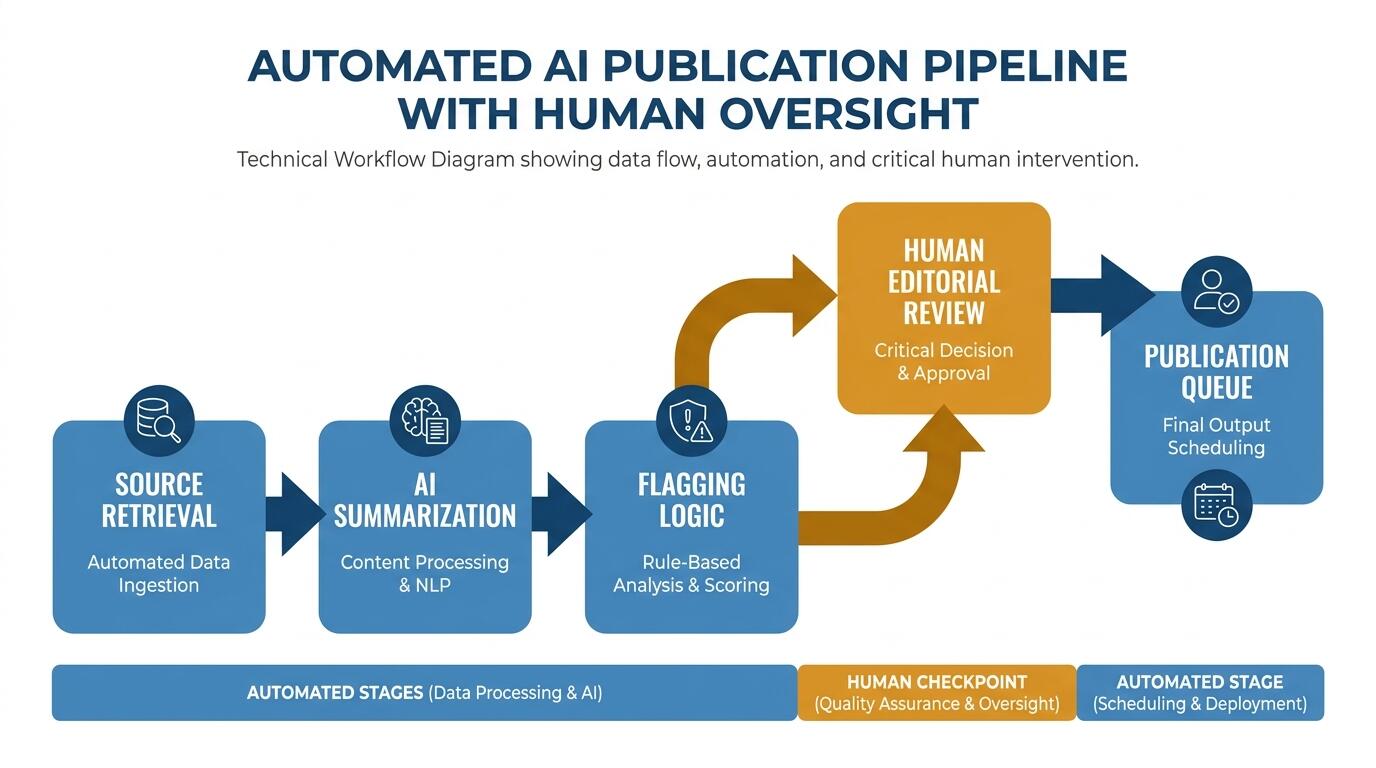
ALT: Editorial workflow diagram showing human checkpoint integrated into an automated AI publication pipeline for quality control
Advanced Considerations: Edge Cases and Common Misconceptions
Handling high-velocity edge cases — When a breaking story moves faster than your review cycle, the temptation is to bypass the human checkpoint to stay current. The better practice is to have a pre-approved protocol for breaking news: a reduced but non-zero review step, such as a single editor confirming source provenance before the item queues. Speed and editorial accountability are not binary opposites; the protocol design determines how much of each you preserve.
The misconception that better prompts replace editorial review is one of the most persistent in the AI builder community. Prompt engineering is genuinely useful for shaping model output, and writing editorial rules an agent can actually follow is a real skill that improves pipeline reliability. But prompts operate on the model's interpretation of content; they do not give the model access to information it does not have, nor do they transfer accountability. A well-prompted model produces better first drafts. It does not produce editorial judgment.
The relationship between human review and output volume is often framed as a tradeoff, but the framing is imprecise. What scales is the proportion of output that receives deep review. A publication that produces ten items and deeply reviews three high-risk ones is practicing selective checkpoint review efficiently. The same publication reviewing all ten for surface errors and none for editorial consequence is performing review theater — the appearance of oversight without its substance.
Distinguishing editorial judgment from stylistic preference matters for keeping the review function efficient. An editor who uses review cycles to relitigate word choices and sentence rhythm is consuming capacity that should go to source evaluation and framing decisions. A useful rule of thumb: if the concern can be addressed by a style guide entry, it belongs in the style guide, not the review queue. If it requires in-context judgment about meaning or accountability, it belongs in the review queue.
Questions & Answers
Q1: How should a small team structure human editorial review without creating a bottleneck?
The most practical approach is asymmetric review: automate the low-consequence decisions completely and concentrate human attention on the high-consequence ones. For a publication of five to ten items per issue, a 15–20 minute pre-publication review focused specifically on source provenance and framing language is sufficient if the flagging logic upstream is well-designed. The bottleneck usually comes from reviewing everything at the same depth — not from reviewing at all.
Q2: Is it possible to use AI to assist the human review step without undermining its independence?
Yes, and done well it actually strengthens the review. AI can surface anomalies — items where the source-claim relationship is weak, where the framing language departs from the publication's historical norm, or where two items in the same issue make conflicting claims. These are useful signals for a human reviewer. The key constraint is that the AI assistance informs the reviewer's attention; it does not substitute for the reviewer's decision. The moment the system auto-approves based on the AI's confidence score, the human review step has been quietly eliminated.
Q3: How much does adding human editorial checkpoints affect publication cadence and operational cost?
The operational cost depends almost entirely on how well the flagging logic is designed. A poorly calibrated system that flags sixty percent of items for review adds substantial overhead and trains the reviewer to approve quickly without actually reading carefully — which is worse than no review. A well-calibrated system that flags ten to fifteen percent of items for substantive review adds a manageable daily commitment and concentrates attention where it produces real quality improvement. The engineering investment in calibrating the flagging logic pays off directly in the sustainability of the human oversight function.
Final Thoughts
Keeping human editorial judgment inside an automated publication is an architectural decision, not a workaround. The three principles that hold up in practice are: first, not all automated decisions carry equal editorial risk, and the review design should reflect that asymmetry rather than treating all output uniformly. Second, the human editor's irreplaceable contribution is contextual accountability — the ability to assess source credibility in the current moment, catch framing that misleads despite being technically accurate, and maintain the publication's position at the boundary between reporting and advocacy. Third, the sustainability of human oversight depends on the quality of the upstream flagging logic; a poorly designed system makes the review step both expensive and ineffective, which is the failure mode that leads teams to abandon it.
The immediate next step for any team running an automated publication is to audit what decisions your pipeline makes autonomously today and classify them by editorial consequence. That audit takes a few hours and immediately reveals where your editorial exposure is concentrated. Everything else — the checkpoint design, the review interface, the flagging calibration — follows from that clarity.
For a deeper look at how this maps onto a real production pipeline, the full breakdown of how an AI briefing agent handles retrieval, verification, and publication is worth working through as a concrete reference.
If you want AI intelligence that has already been filtered through this kind of editorial discipline — primary sources, verified claims, and a named editor's judgment on every item — visit Darius and subscribe to the bilingual AI briefing. Each issue is five to ten items, each anchored to a first-hand source, written by an engineering director who actually ships AI products.
Sources
- ARPHA Publishing Platform. "The human editor as the ultimate gatekeeper in publication ethics."
https://ese.arphahub.com/article/132192/ - Scione Publishing. "Editorial Gatekeeping in the Age of Generative AI."
https://tsp.scione.com/cms/abstract.php?id=151 - Greenbook Research Industry Trends. "Where Human Judgment Still Matters in AI Qual."
https://greenbook.org/insights/the-prompt-ai/where-human-judgment-still-matters-in-ai-qual - IEEE (Institute of Electrical and Electronics Engineers). Standards and publications on AI systems, human oversight, and responsible automation.
https://www.ieee.org/
Note: Standards and research may be updated; please check the latest official documents or consult professional advisors.