How Founders Should Vet Engineering Consulting Firms Before Hiring

ALT: Founder reviewing engineering consulting firm proposals to vet technical partners before hiring
What You'll Actually Achieve by Vetting Engineering Consulting Firms Properly
Hiring the wrong engineering consulting firm is one of the most expensive mistakes a founder can make — not just in wasted fees, but in lost momentum, technical debt, and misaligned architecture decisions that haunt a product for years. This guide is for tech founders, startup CTOs, and senior product leaders who need to evaluate engineering consulting firms rigorously before signing an engagement. By following a structured vetting process, you'll be able to distinguish firms that ship from those that only present well — and make a hiring decision grounded in evidence, not pitch decks.
Before You Start: Prerequisites and Preparation for the Vetting Process
Vetting an engineering consulting firm effectively is not something you can do in a single afternoon call. It requires preparation on your side before you can ask the right questions and recognize the right answers.
The most important prerequisite is having a reasonably clear picture of your own needs. You don't need a finished spec, but you do need to know approximately what you're building, what stage you're at, and what kind of output you expect — whether that's a technical architecture, a shipped MVP, ongoing development capacity, or strategic guidance. Without that clarity, any consulting firm will struggle to give you meaningful answers, and you'll struggle to evaluate whether their answers are meaningful.
You also need to have basic familiarity with your technical domain. You don't need to be an engineer, but founders who enter this process with no understanding of what their product requires tend to get oversold on complexity. Before your first call with any firm, invest time in understanding your core system requirements at a high level.
Prepare to invest real time in this process. Rushing it produces bad hires. Expect multiple conversations, reference checks, and possibly a small paid discovery or scoping exercise before committing to a longer engagement.
Checklist before starting:
- A written summary of what you're building and why, even in rough form
- A sense of your timeline and budget constraints (at least a rough range)
- A list of your key technical unknowns and risks
- Access to any existing technical documentation, prior code, or architecture diagrams
- A shortlist of at least three firms to compare — never evaluate a single option in isolation
- Agreement internally on who has authority to make the final hiring decision
- A defined set of evaluation criteria before the first meeting (avoids being swayed by charisma alone)
How to Vet Engineering Consulting Firms Before Hiring: Step-by-Step
Step 1: Define Your Evaluation Criteria Before Reaching Out
The single most common mistake founders make when hiring engineering consultants is starting with outreach before establishing what "good" looks like for their specific situation. Define your criteria first, independent of any specific firm.
Think in terms of four dimensions: technical depth, delivery track record, communication style, and domain fit. Technical depth means the firm can work at the level your product actually requires — whether that's distributed systems, AI architecture, real-time infrastructure, or something else. Delivery track record means they ship; they have a documented history of taking engagements through to working, deployed products. Communication style means they translate technical complexity into terms that help you make better decisions. Domain fit means they've worked on problems close enough to yours that their instincts are calibrated.
Write these criteria down and weight them relative to your context. A pre-seed founder building an AI product needs different things than a Series B CTO scaling a platform. Getting this on paper before any calls prevents you from being swayed by whoever presents best in the room.
Tip: Create a simple scoring matrix you can fill in consistently across firms. Even a rough one forces you to compare apples to apples rather than relying on gut feel shaped by whoever you spoke to last.
Step 2: Audit Their Portfolio for Evidence of Shipped Work
A credible engineering consulting firm is defined not by what they say they can do, but by what they have demonstrably done. Ask for a portfolio review specifically focused on completed, deployed work — not case studies that stop at "delivered architecture recommendations."
When reviewing their portfolio, look for specificity. Genuine shipped work produces specific outcomes: a system that handled a particular kind of scale challenge, an integration that solved a concrete business problem, a product that went live and continued operating. Vague language like "we helped them modernize their platform" or "we accelerated their roadmap" without concrete deliverables is a warning sign.
Ask directly: which of these projects is fully live and in production? Who can you speak to that was on the client side? A firm with a strong track record will not hesitate to connect you with past clients. One that hedges, cites NDAs for every engagement, or offers only internal references should prompt deeper scrutiny.
Per guidance from CRV's research on founding engineers, the firms and individuals who consistently add the most value are those who can point to concrete products they've put into the world — not just advisory work that preceded someone else doing the building.
Tip: Ask to see a post-mortem or lessons-learned document from a past engagement. Firms that do this kind of reflective work tend to build better systems and communicate more honestly when things don't go to plan.
Step 3: Interrogate Their Technical Depth Through Scenario-Based Questions
A polished pitch is not technical evidence. The best way to assess genuine technical depth is to give the firm a realistic scenario from your domain and watch how they think through it.
Prepare two or three technical scenarios drawn from your actual product. These don't need to be fully specified — in fact, intentionally ambiguous scenarios are more revealing. Ask the firm how they would approach the problem, what tradeoffs they would consider, and where they would push back on your assumptions. The quality of their questions back to you is as informative as the quality of their answers.
A firm with real depth will surface constraints you haven't thought of, ask about your data model or operational requirements, and offer tradeoffs with honest downsides rather than just validating your initial framing. A firm that immediately agrees with everything you say and promises to build exactly what you described is not a technical partner — it's a vendor.
For teams building AI-powered products, this is especially critical. The questions founders should ask when choosing an AI architecture partner go well beyond stack preferences — they probe for real understanding of latency, retrieval strategies, evaluation pipelines, and failure modes in production.
Tip: Don't give the scenario in advance. Genuine technical depth shows up in real-time reasoning. A well-prepared script recitation tells you very little.
Step 4: Evaluate Their Communication and Decision-Making Process
Technical competence without communication clarity produces expensive misalignments. A consulting firm's ability to keep you informed, escalate decisions appropriately, and translate technical context into business-relevant framing matters as much as their engineering ability.
Ask specifically how they handle decision points during an engagement. What happens when they encounter a technical constraint that changes the timeline or scope? How do they surface risks? How frequently do they update stakeholders, and in what format? The answers to these questions reveal whether their process is designed around your success or around minimizing their own accountability.
In our work with founders evaluating consulting partners, a pattern we consistently see is that the firms that ship the best work maintain high-frequency, low-ceremony communication — brief written updates, clear decision logs, and proactive risk flagging — rather than elaborate status reports that arrive on a schedule and say very little.
Ask to see a sample communication artifact from a past engagement: a weekly update, a technical decision record, or a project brief. The quality of that document tells you a great deal about how they operate under pressure.
Tip: Pay attention to how clearly they communicate during the vetting process itself. If their proposal is confusing, their engagement will be too.
Step 5: Check References With Precision, Not Just Permission
Reference checks are one of the most underused tools in the hiring process. Most founders treat them as a formality — a quick call to confirm nothing catastrophic happened. Treated properly, they are the most reliable signal you have.
Ask references specific, behavioral questions: What was the hardest moment in the engagement, and how did the firm handle it? Were there scope or timeline changes, and how were those communicated? Would you hire them again for a different type of project — and if yes, what type? The last question is particularly revealing; a reference who would re-hire the firm only for small, well-defined work is telling you something important about where the firm's capabilities actually plateau.
Also ask whether the end product is still running and being maintained. Engineering work that produces a system nobody uses or that required significant rework shortly after handoff is a meaningful signal about quality.
Per insights shared in founder hiring communities, including discussions surfaced by recruiting professionals on LinkedIn, the reference stage is where the most useful signal about a firm's actual delivery patterns emerges — pattern matching across multiple references reveals consistency that no single call can show.
Tip: Speak to at least two references per firm, and try to reach someone the firm did not proactively provide. A reference you found yourself through their portfolio or network carries more weight than one they curated for you.
Step 6: Assess Commercial Structure and Alignment of Incentives
Even a technically excellent firm can become a bad partner if the commercial structure creates misaligned incentives. Time-and-materials contracts reward hours billed, not outcomes delivered. Fixed-scope contracts create pressure to cut corners or scope-creep disputes. Equity-only arrangements raise questions about the firm's financial stability and how they prioritize their time.
Ask directly how the firm proposes to structure the engagement and why. The best firms will have a reasoned position on this, not just a standard contract template. They should be able to explain what structure makes sense for the type of work, the level of uncertainty, and the expected delivery timeline.
Look for firms that propose a discovery or scoping phase before committing to a full engagement — this signals that they take the risk of misalignment seriously and aren't just trying to close a large contract quickly. A short, paid discovery phase that produces a written architecture proposal or technical roadmap is both a deliverable in itself and a low-risk way to evaluate whether the relationship works.
For founders trying to think through the broader build-versus-buy dimension of technical decision-making, the AI infrastructure build vs. buy framework offers a structured way to think about where external expertise adds the most leverage.
Tip: Ask what their process is when a project runs over budget or timeline. The answer reveals how they handle accountability and whether their incentives stay aligned when things get difficult.
Step 7: Run a Structured Comparative Evaluation Across All Candidates
Never evaluate a single firm. Comparative evaluation is what converts individual impressions into defensible decisions. With your criteria matrix from Step 1, score each firm consistently across technical depth, delivery evidence, communication quality, domain fit, and commercial structure.
Share the same brief, the same scenario questions, and the same reference-checking approach with every firm. Differences in how they respond to identical inputs are themselves informative. Some firms will ask clarifying questions; others will jump to solutions. Some will provide detailed written proposals; others will schedule a follow-up call. These behavioral differences predict how they'll operate as a partner.
Make the final decision based on the aggregate score and reference evidence, not on who gave the most impressive presentation. Founders who are good at sales often mistake a firm's ability to sell itself for a firm's ability to build. These are different skills.
Tip: Involve a technically credible person in at least one evaluation conversation — a trusted advisor, a senior engineer on your team, or a technical board member. Having someone who can assess the technical depth independently removes the risk of being oversold.
Common Mistakes and Troubleshooting When Evaluating Engineering Consulting Firms
| Symptom | Likely Cause | How to Fix |
|---|---|---|
| All firms sound equally capable in early calls | Evaluation criteria are too vague or not defined before outreach | Define a scoring matrix with weighted criteria before any conversations begin |
| References give only positive feedback | You're speaking exclusively to references the firm provided | Find at least one reference independently; ask sharper behavioral questions |
| Proposal scope feels inflated or unclear | Firm is padding scope to increase contract value | Ask them to break the proposal into phases; require a separate scoping deliverable before committing |
| The engagement starts well but delivery slows significantly | No communication cadence or milestone structure in the contract | Build explicit communication checkpoints and deliverable definitions into the contract before signing |
| The firm agrees with everything you say | They're optimizing to close the deal, not to solve your problem | Treat excessive agreement as a red flag; a good firm will push back on weak assumptions |
| Technical output requires significant rework | Firm's work was never stress-tested or reviewed against real requirements | Require interim review points with defined acceptance criteria throughout the engagement |
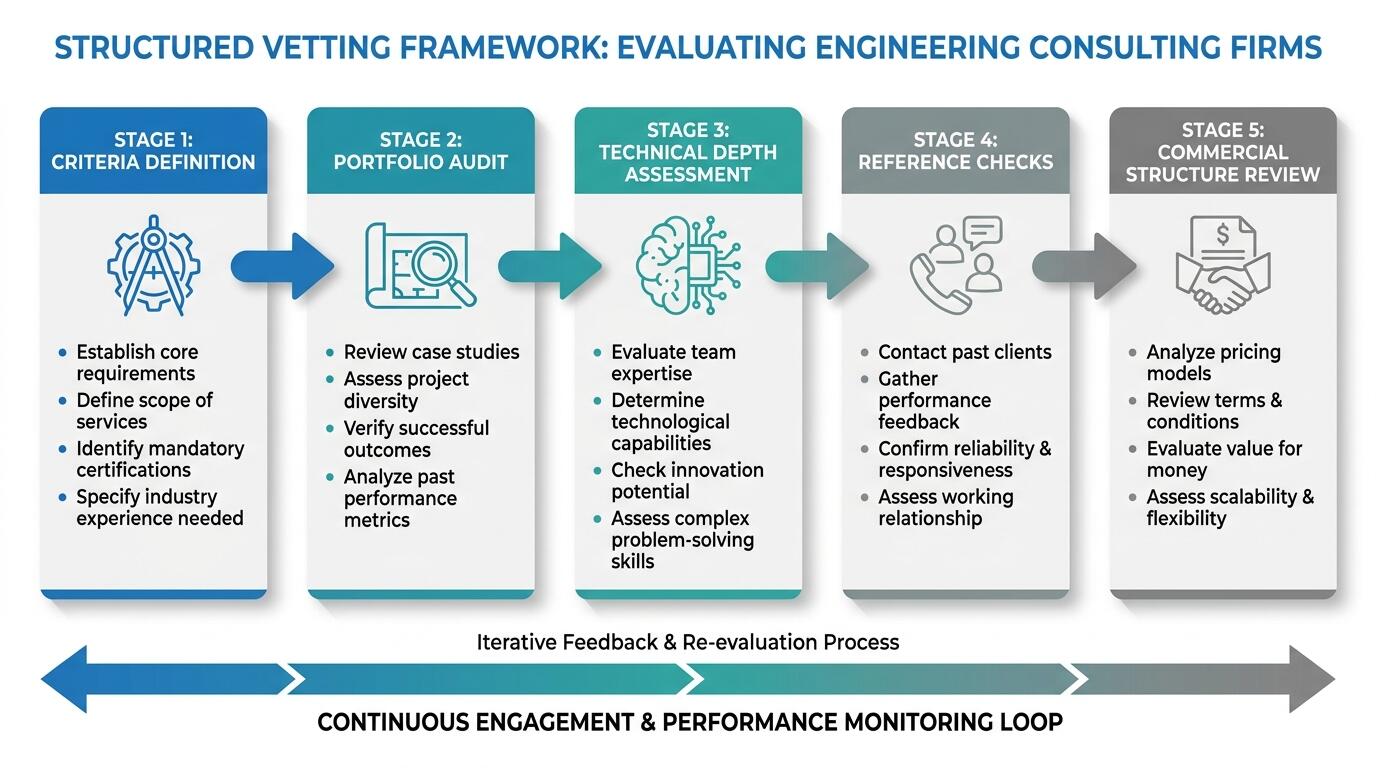
ALT: Structured vetting framework for founders evaluating engineering consulting firms before making a hiring decision
Pro Tips for Better Results When Hiring Engineering Consultants
Run a paid proof-of-concept before a long engagement. A short, bounded piece of work — a technical spike, an architecture document, a prototype — is the most reliable predictor of how a firm will perform over a longer engagement. It removes ambiguity and gives both parties a chance to calibrate before significant resources are committed.
Distinguish AI-fluency from AI-hype. In the current environment, nearly every engineering firm claims expertise in AI. The firms that actually have it can speak concretely to production realities: inference latency, cost modeling at scale, evaluation pipelines, and failure modes in retrieval-augmented systems. If a firm's AI narrative stops at model selection and prompt engineering, their depth is likely shallow. Understanding what goes into a production AI system — including the infrastructure tradeoffs that determine whether it's viable to operate — is a meaningful differentiator. Founders building in this space benefit from reviewing resources like AI system architecture patterns CTOs should evaluate before those conversations.
Pay attention to how they handle what they don't know. The most technically credible consultants are explicit about uncertainty. They distinguish between what they know from direct experience, what they know from research, and what they'd need to investigate before committing to a position. Firms that project uniform confidence across all technical domains are either generalists performing as specialists, or they haven't done enough of this work to know what they don't know.
Clarify the misconception that a larger firm means lower risk. Founder intuition often favors established, larger consulting firms on the assumption that size equals quality or accountability. In practice, larger firms frequently assign junior staff to engagements once the senior talent has won the deal. What matters is not the firm's size but who will actually be working on your project and what their individual track record looks like. Always ask: who specifically will be leading the technical work on our engagement, and can we speak with them directly during vetting?
Build a relationship before you need one. The best consulting partnerships often develop before there's an urgent need. Following the work of credible practitioners, engaging with their published thinking, and having early conversations before a specific project is on the line gives you much better signal than trying to evaluate someone under time pressure.
People Also Ask
Q1: How do founders evaluate the technical depth of an engineering consulting firm before any work begins?
The most reliable method is scenario-based technical conversation rather than credential review. Present the firm with a realistic, slightly ambiguous technical problem from your domain and assess the quality of their reasoning — specifically, whether they ask good clarifying questions, surface non-obvious constraints, and offer tradeoffs with honest downsides. Firms with genuine depth will also push back on weak assumptions rather than simply agreeing. Reviewing their written outputs from past engagements, such as architecture documents or technical proposals, provides additional signal.
Q2: Are fixed-price contracts safer than time-and-materials contracts for consulting engagements?
Neither structure is inherently safer — both carry risks depending on how the engagement is scoped. Fixed-price contracts work well for tightly defined, well-understood work but create pressure to cut corners or trigger costly change-order disputes when scope is ambiguous. Time-and-materials contracts offer flexibility but can reward hours billed over outcomes delivered. A discovery phase with a fixed fee, followed by a structured time-and-materials arrangement with defined milestones and acceptance criteria, often balances both risks better than either model alone.
Q3: How long does a thorough vetting process for an engineering consulting firm typically take?
A rigorous vetting process for a significant engagement should span several weeks at minimum. This includes initial outreach and briefing, scenario-based technical evaluation calls, portfolio and reference review, and comparative proposal assessment. Rushing the process to meet an internal deadline is a common source of poor hiring decisions. The time invested in thorough vetting is consistently smaller than the time required to recover from a misaligned or underperforming consulting engagement.
Key Takeaways
- Define your evaluation criteria and scoring matrix before you speak to any firm — this is the single most important preparation step and prevents decisions driven by whoever presents best.
- Evidence of shipped, production work is the most reliable signal of a consulting firm's actual capability; vague case studies and advisory-only track records deserve scrutiny.
- Scenario-based technical conversations reveal depth that credentials and proposals cannot — give firms real problems from your domain and assess the quality of their reasoning, not just their answers.
- Reference checks, done with behavioral precision and with at least one independently sourced contact, are your most underused evaluation tool.
- Commercial structure shapes incentives throughout the engagement; a firm that proposes a paid discovery phase before a full commitment is signaling alignment with your success, not just their pipeline.
If you're evaluating engineering consulting partners for an AI-powered product or complex system, visit Darius to explore shipped projects, technical thinking, and what an engagement grounded in real architecture expertise actually looks like.
References & Further Reading
- CRV. "Founding Engineer: When to Hire Your First One".
https://www.crv.com/content/founding-engineer - Stytch. "A founder's guide to hiring engineers".
https://stytch.com/blog/a-founders-guide-to-hiring/ - LinkedIn. "Louise Ogilvy's Post — Key things founders look for when hiring engineering consultants".
https://www.linkedin.com/posts/devtools-recruitment_what-are-some-of-the-key-things-that-founders-activity-7285369570133999616-KMv1
Note: Standards and best practices in engineering consulting and technical hiring continue to evolve; verify guidance against the latest professional resources and consult qualified advisors for your specific context.