GPU Utilization Strategies for Teams Running Production AI Workloads

ALT: Engineering team monitoring GPU utilization dashboards for production AI workloads optimization
Comparing GPU Utilization Strategies for Production AI Workloads: Which Approach Fits Your Team?
Imagine your engineering team has just deployed a promising inference service. The GPUs are provisioned, the model is live — and two weeks in, your cloud bill is climbing while the GPU metrics tell a different story: utilization is hovering at a fraction of theoretical capacity. This is one of the most common and costly patterns we see across teams shipping real AI products, from early-stage startups to scaling enterprise groups.
The core question is not simply "how do we use GPUs better" — it is which utilization strategy, or combination of strategies, genuinely fits your workload characteristics, team capabilities, and operational constraints. This article compares the leading approaches to GPU resource management in production AI environments: static dedicated allocation, dynamic batching and multiplexing, and orchestrated multi-tenant sharing. We evaluate each against criteria that matter in live systems — cost efficiency, latency predictability, operational complexity, and scalability — so you can make a grounded decision rather than a speculative one.
Evaluation Criteria for GPU Utilization Strategies
The right framework for choosing a GPU utilization strategy must reflect the realities of production systems, not benchmark labs. The following criteria define the dimensions we use to evaluate each approach.
Cost efficiency is the ratio of useful compute work extracted per dollar spent on GPU resources. According to research published by Anyscale on GPU (in)efficiency in AI workloads, a significant share of provisioned GPU capacity in production environments goes underutilized — meaning teams are paying for idle silicon. Cost efficiency is the first-order business constraint that forces the conversation.
Latency predictability measures how consistently a strategy delivers inference or training responses within acceptable time bounds. Strategies that maximize utilization through aggressive batching or multi-tenancy can introduce latency variance that breaks SLA commitments, particularly for customer-facing AI features.
Operational complexity captures the engineering overhead required to implement, monitor, and maintain the strategy. A technically superior approach that requires a team of specialists to operate is not always the right choice for a startup or a small platform team.
Scalability describes how well the strategy handles growth — both in request volume and in model portfolio breadth. A pattern that works for a single model at moderate load can become a bottleneck as the system evolves.
Hardware compatibility reflects whether the strategy can be applied broadly across GPU types and cloud providers, or whether it requires specific hardware features such as Multi-Instance GPU (MIG) support, which is available on select NVIDIA architectures.
Workload fit acknowledges that different AI tasks — real-time inference, batch processing, fine-tuning, embedding generation — have fundamentally different GPU demand profiles, and a strategy optimized for one profile can perform poorly on another.
The Contenders: Three Core GPU Utilization Strategies
Static Dedicated Allocation
Static dedicated allocation is the simplest approach: each workload or model is assigned a fixed GPU (or a fixed set of GPUs), and that hardware is reserved exclusively for that task. It is the default posture for teams that are new to GPU infrastructure, and it is the baseline against which all other strategies are measured.
In practice, static allocation offers maximum isolation and predictability. There is no contention from neighboring workloads, latency variance is low, and debugging is straightforward. The cost is significant, however: GPU utilization rates in static configurations are often low because real-world request patterns are bursty and uneven. A model that needs full GPU capacity during peak hours may sit nearly idle for most of the day, yet the hardware cost runs continuously.
Static allocation is not inherently wrong — it is the right tool for certain contexts, particularly during early development or for workloads with strict isolation requirements. The problem arises when it becomes the default production posture by inertia rather than by design.
Dynamic Batching and Request Multiplexing
Dynamic batching is a technique in which inference requests arriving at different times are grouped together and processed as a single batch, improving GPU throughput by increasing the parallelism of each GPU kernel execution. Multiplexing extends this concept to allow multiple concurrent requests to share GPU resources in a temporally interleaved fashion.
Frameworks such as NVIDIA Triton Inference Server implement dynamic batching at the serving layer, allowing teams to configure maximum batch sizes and latency budgets simultaneously. The result is a significant improvement in GPU utilization without requiring changes to the underlying model or hardware. According to Mirantis's analysis of GPU utilization strategies and best practices, dynamic batching is one of the highest-leverage interventions available to teams running inference at scale.
The tradeoff is latency management. Batching introduces a queuing delay — requests must wait until a batch fills or a timeout is reached before processing begins. Tuning batch size and timeout parameters requires careful profiling of your specific workload, and getting it wrong can degrade user-facing latency significantly.
Orchestrated Multi-Tenant GPU Sharing
Multi-tenant GPU sharing is a strategy in which multiple models or workloads run concurrently on shared GPU hardware, with an orchestration layer managing resource allocation, prioritization, and isolation. This can be implemented through NVIDIA's MIG feature (which partitions a physical GPU into isolated instances at the hardware level), through spatial multiplexing via CUDA MPS (Multi-Process Service), or through time-sliced scheduling managed by Kubernetes device plugins.
This approach has the highest potential for utilization improvement, particularly in environments running many smaller models or mixed-criticality workloads. A single A100 or H100 GPU can, with MIG enabled, run several independent inference services simultaneously with hardware-enforced memory isolation. As highlighted in Scailium's analysis of why GPUs sit idle in enterprise AI workloads, multi-tenant architectures are increasingly necessary for organizations managing large, diverse model portfolios.
The complexity cost is real. Multi-tenant GPU sharing requires careful orchestration, robust monitoring, and a team with sufficient platform engineering depth to manage it without reliability regressions. For teams not yet operating at this maturity level, the approach can introduce more problems than it solves.
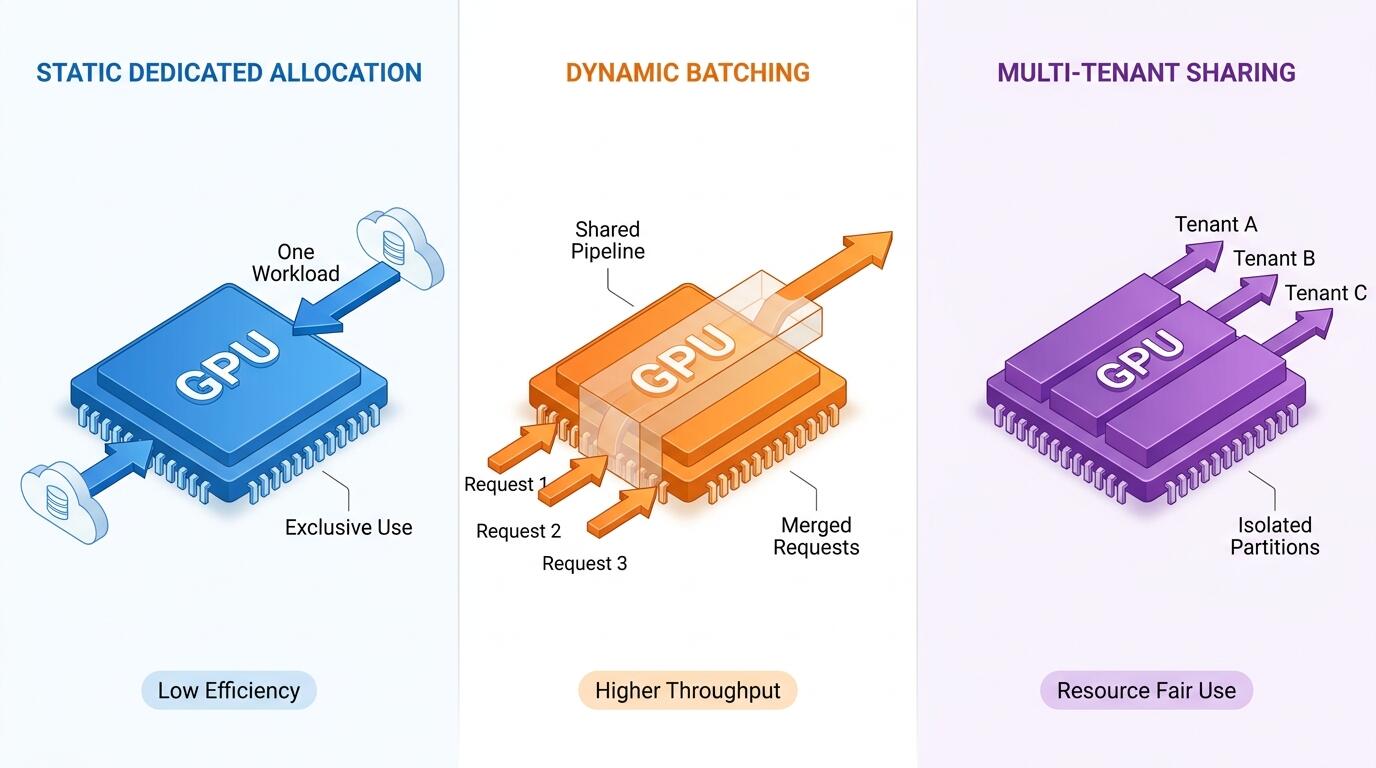
ALT: Side-by-side comparison of static allocation, dynamic batching, and multi-tenant GPU sharing strategies for AI production workloads
Head-to-Head Comparison of GPU Utilization Strategies
| Criterion | Static Dedicated Allocation | Dynamic Batching & Multiplexing | Orchestrated Multi-Tenant Sharing |
|---|---|---|---|
| Cost Efficiency | Low — hardware is often idle | High — improves throughput per GPU | Very High — maximizes hardware density |
| Latency Predictability | Very High — no contention | Moderate — batching adds queuing delay | Moderate to Low — depends on isolation config |
| Operational Complexity | Low — straightforward to manage | Moderate — requires serving framework tuning | High — needs orchestration platform expertise |
| Scalability | Low — scales linearly with hardware spend | High — scales workload capacity without proportional hardware growth | Very High — consolidates many workloads per GPU |
| Hardware Compatibility | Universal — works on all GPU types | Broadly compatible — most inference frameworks support it | Limited — MIG requires specific NVIDIA architectures (A100, H100) |
| Workload Fit | Best for isolated, latency-critical or early-stage workloads | Best for high-throughput inference with tolerable latency budgets | Best for diverse model portfolios, batch processing, and mixed-priority workloads |
The table reveals a clear progression in capability and complexity. Static allocation is the entry point: operationally simple but cost-inefficient for anything beyond development or highly specialized, isolated inference. It is the pattern most teams start with and the one most teams need to move beyond.
Dynamic batching occupies a practical middle ground that delivers meaningful utilization gains without requiring a fundamental rebuild of your infrastructure. It integrates at the serving layer, meaning teams can adopt it incrementally — model by model, service by service. In our work with clients building their first production inference pipelines, this is typically the first optimization lever we recommend pulling, because the implementation effort is bounded and the cost-reduction impact is material.
Multi-tenant GPU sharing is the most powerful strategy, but it demands the most from both your infrastructure and your team. The decision to move in this direction should be driven by clear operational need — a large and growing model portfolio, significant idle capacity that cannot be addressed by batching alone, or cost pressure at scale that justifies the platform investment. It is not a strategy to adopt speculatively.
Which GPU Utilization Strategy Should You Choose? Scenario Recommendations
The right GPU utilization strategy depends on where your team is in its AI product lifecycle, how your workloads are structured, and what operational capabilities you have available.
If you are in early development or running a single production model with strict latency SLAs, static dedicated allocation is the appropriate starting point. The operational simplicity is a real advantage when your team's focus should be on product iteration rather than infrastructure optimization. Accept the cost inefficiency as a temporary condition, and plan to revisit it once your request volume justifies more sophisticated approaches.
If you are running a live inference service with significant and growing request volume, dynamic batching is the highest-priority optimization to implement. The engineering investment is moderate, the gains are immediate, and the approach integrates well with standard serving frameworks. For teams looking to understand the broader cost implications of their AI serving infrastructure, the analysis in What Does It Actually Cost to Run a RAG System for a Month? provides useful context for framing the GPU spend conversation.
If you are managing a diverse portfolio of models with varying load profiles — some always-on, some batch-oriented, some experimental — orchestrated multi-tenant sharing deserves serious evaluation. The prerequisite is genuine platform engineering capability, either in-house or through a qualified partner. Adopting this strategy without adequate operational maturity will trade one problem (idle GPUs) for another (reliability incidents and debugging complexity).
If you are an engineering director or CTO evaluating your AI infrastructure architecture broadly, the GPU utilization question sits within a larger system design conversation. The patterns described here interact with your choice of inference serving framework, your observability stack, your model registry, and your deployment pipeline. The architectural decisions upstream of GPU utilization significantly shape which optimization strategies are even available to you — a consideration explored in depth in AI System Architecture Patterns Every CTO Should Evaluate This Quarter.
Pros and cons summary:
- Static allocation: simple to operate, predictable latency, poor cost efficiency at scale
- Dynamic batching: strong utilization improvement, moderate complexity, requires latency budget flexibility
- Multi-tenant sharing: maximum hardware density, highest cost efficiency, significant operational investment required
Common Questions
Q1: How do I measure current GPU utilization in a production AI system?
GPU utilization is measured using tools such as NVIDIA's nvidia-smi command-line utility, which reports instantaneous GPU and memory utilization metrics per device. For production environments, these metrics should be integrated into your observability platform — Prometheus with a GPU exporter is a widely used pattern — to track utilization over time, identify idle periods, and correlate GPU activity with request throughput. Meaningful utilization measurement requires capturing both compute utilization and memory bandwidth, as a GPU can appear active while still being underutilized in terms of useful work completed.
Q2: Is dynamic batching suitable for real-time customer-facing AI features?
Dynamic batching can be used for real-time features, but it requires careful configuration of batch timeout and maximum batch size parameters to keep end-to-end latency within acceptable bounds. For applications where response time is measured in tens of milliseconds, batching windows must be very short — which limits the throughput gains achievable. Teams should profile their specific latency budget and request arrival rate before committing to batching in a latency-sensitive context, and should implement continuous latency monitoring after deployment to catch regressions early.
Q3: How much engineering effort does it take to implement multi-tenant GPU sharing?
The effort varies significantly based on your existing infrastructure. Enabling time-sliced GPU sharing through Kubernetes is relatively low effort if your cluster is already GPU-enabled. Hardware-level partitioning via NVIDIA MIG requires compatible hardware (A100 or H100 class GPUs) and familiarity with the MIG configuration tooling. Full orchestrated multi-tenancy — with dynamic allocation, priority queuing, and isolation guarantees — is a platform engineering project that can take weeks to months depending on team experience. Teams without deep GPU infrastructure experience should evaluate engaging a specialist architect before committing.
Summary
GPU utilization optimization for production AI workloads is not a single decision — it is a progression of architectural choices that should evolve alongside your product and your team's operational maturity.
Three key points anchor this decision:
First, idle GPU capacity is a direct and ongoing cost, not an abstract inefficiency. Understanding your current utilization baseline is the prerequisite for any optimization work, and the gap between provisioned capacity and useful work is often larger than teams expect.
Second, dynamic batching is the highest-leverage first step for most teams running live inference. It delivers meaningful cost and throughput improvements with bounded engineering investment, and it integrates into existing serving infrastructure without requiring infrastructure rebuilds.
Third, multi-tenant GPU sharing is the right destination for mature platform teams managing diverse model portfolios — but it requires genuine operational investment to implement safely. Adopting it before your team has the required platform depth will create reliability risks that outweigh the cost savings.
The path forward begins with measurement: instrument your current GPU usage, identify the dominant source of inefficiency, and choose the strategy that addresses that specific gap rather than the most sophisticated option available.
Ready to move from idle GPUs to a production AI infrastructure that delivers on its potential? Explore real-world AI architecture projects, technical insights, and professional services at Darius. Whether you're an early-stage founder designing your first inference pipeline or an engineering team optimizing a scaling AI platform, Darius brings the hands-on expertise to help you build smarter and ship faster.
Sources
- Anyscale. "GPU (In)efficiency in AI Workloads".
https://www.anyscale.com/blog/gpu-in-efficiency-in-ai-workloads - Mirantis. "Improving GPU Utilization: Strategies and Best Practices".
https://www.mirantis.com/blog/improving-gpu-utilization-strategies-and-best-practices/ - Scailium. "Why GPUs Sit Idle in Enterprise AI Workloads".
https://scailium.com/insights/gpu-utilization-ai-workloads - IEEE. IEEE Standards for Computing and Artificial Intelligence Infrastructure.
https://www.ieee.org - NVIDIA Corporation. Technical Documentation and Architecture Guides for GPU Computing.
https://www.nvidia.com
Note: Standards and technical documentation may be updated; please check the latest official documents or consult professional advisors.