A Founder's Checklist for Evaluating Multimodal Embedding Models
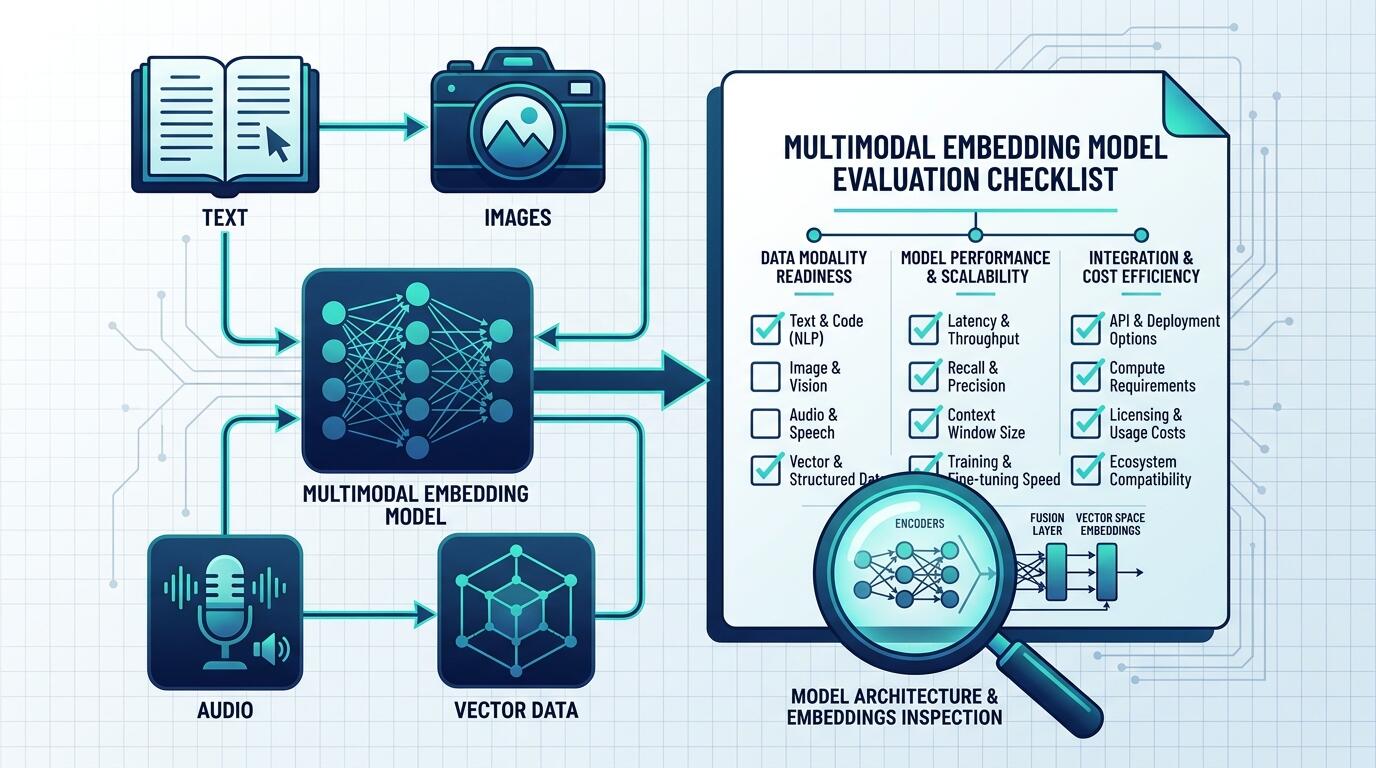
ALT: Founder's checklist for evaluating multimodal embedding models for AI product decisions
What Multimodal Embedding Models Actually Demand From Founders Building AI Products
Multimodal embedding models are systems that project multiple input types — text, images, audio, video, or structured data — into a shared vector space, enabling semantic search, retrieval, and reasoning across modalities in a single unified representation. As more AI products move beyond text-only pipelines, the evaluation burden on founders and engineering leads has grown considerably. Picking the wrong embedding backbone is not a minor inconvenience; it cascades into retrieval quality problems, latency budget overruns, and eventually a replatforming project that consumes a full sprint cycle.
This checklist was assembled from patterns observed while running multiple AI products in production — not from benchmarks read in isolation, but from the friction points that surface when theory meets actual query traffic. Each item reflects a dimension where teams consistently underestimate the evaluation work required. The checklist is designed to be modality-agnostic in framing but practically grounded: you should be able to walk through it with a candidate model on your shortlist and emerge with a clear go/no-go signal.
The items are ordered roughly by the sequence in which they surface during product development — from capability validation early in selection to operational concerns that bite you in production.
The Checklist: Eight Dimensions for Evaluating Multimodal Embedding Models
Modality Coverage and Alignment Quality
Modality coverage refers to which input types a model can encode, while alignment quality describes how faithfully a text query retrieves a semantically matching image, audio clip, or document — and vice versa. These are distinct properties and should be tested separately.
Many models advertise "image-text" support but perform well only in one retrieval direction (text-to-image) while degrading sharply on image-to-text or cross-modal re-ranking. In our experience building retrieval features, the asymmetry is rarely disclosed in published benchmarks; it shows up in your own query logs.
When evaluating, build a small golden dataset representative of your actual distribution — not ImageNet-style stock photos if your product handles user-generated screenshots, receipts, or product catalog images. Run recall at multiple cutoffs (R@1, R@5, R@20) on both retrieval directions. If the model ships a single embedding dimension for all modalities, verify that the joint space is actually dense and not sparse on the modalities you care about.
Best for: Teams whose products require genuinely symmetric cross-modal retrieval — e.g., an e-commerce search that must match a photo to a text description and a text description back to a photo with comparable precision.
Watch out: Domain shift. Models trained on web-scraped data perform well on natural photos and encyclopedic text but degrade on domain-specific visuals such as medical imaging, technical diagrams, or annotated screenshots. Alignment quality scores from general benchmarks do not transfer.
Embedding Dimensionality and Matryoshka Flexibility
Embedding dimensionality is the size of the vector output — a fixed property in traditional models, but now variable in models that support Matryoshka Representation Learning (MRL). MRL is a training technique, documented in academic literature by Kusupati et al., that nests shorter vectors within longer ones so that a model can be truncated at inference time without retraining, trading recall for reduced storage and faster search.
For founders, this matters immediately: a fixed high-dimensional embedding forces you to provision vector database storage at full cost from day one. With MRL-capable models, you can prototype at a reduced dimension, measure the recall degradation on your dataset, and only scale up the dimension — and storage cost — when the quality delta is worth it. This is a genuine infrastructure decision, not an academic one.
Test this by running your golden dataset at multiple truncation levels and plotting precision-recall curves. If the model does not support MRL, assess whether the default dimensionality fits your vector store's cost profile at your projected index size.
Best for: Products at early scale where storage and query latency budgets are tight but query volume is expected to grow, and where the team wants flexibility to trade quality for cost without retraining.
Watch out: Not all vendors that claim MRL support implement it faithfully — the recall degradation curve should be smooth and gradual, not a cliff at a particular cutoff. Validate empirically, not by reading a spec sheet.
Throughput, Latency, and Batching Behavior
Embedding throughput is the number of items encoded per second; latency is the wall-clock time for a single request. Both matter, but they interact differently with your product architecture — a real-time search feature is latency-sensitive, while an offline document ingestion pipeline is throughput-sensitive.
Multimodal models are typically heavier than text-only models because vision encoders carry significant parameter counts. Benchmark throughput at your target batch sizes on representative hardware — do not rely on vendor-published numbers, which are usually measured on high-end GPU configurations at maximum batch size. Measure on the instance type you actually plan to run, and test both single-item latency and batch throughput separately.
Pay attention to cold-start behavior if you are using a serverless or autoscaled deployment. Some model families have non-trivial initialization times that are invisible in steady-state benchmarks but painful for the first request after scale-down.
Best for: Any production system where embedding happens on the critical path of a user-facing request — search, recommendation, or real-time content matching.
Watch out: Throughput numbers from GPU benchmarks rarely translate to CPU deployments. If cost constraints push you toward CPU inference, measure there explicitly. Latency can be an order of magnitude different.
Fine-Tuning and Domain Adaptation Accessibility
Fine-tuning accessibility describes how easily you can adapt a foundation embedding model to your specific domain — whether through full fine-tuning, LoRA-style parameter-efficient adaptation, or contrastive fine-tuning on domain pairs. For many B2B or vertical AI products, out-of-the-box embedding quality on general benchmarks is not the ceiling that matters; domain-adapted quality is.
The key evaluation question is not "can I fine-tune this model" but "can I fine-tune it with the data volume and compute budget I realistically have." Some multimodal embedding architectures require contrastive pairs in the hundreds of thousands before meaningful domain adaptation occurs. Others show measurable gains with a few thousand high-quality pairs. This is a significant implementation risk that should be evaluated before committing to a model family.
Check whether the model architecture exposes a clean fine-tuning interface, whether the training code is publicly maintained by the original team, and whether the licensing terms allow derivative model weights for your deployment context. The last point is often overlooked: some permissive-looking licenses restrict commercial redistribution of fine-tuned derivatives.
If your product roadmap includes domain adaptation, the build vs. buy decision for AI infrastructure becomes directly relevant — because fine-tuning a foundation model is effectively a partial "build" commitment that should be weighed against managed embedding services that handle adaptation differently.
Best for: Vertical AI products where the target domain is far from the training distribution of general-purpose models — legal, medical, industrial, or specialized enterprise data.
Watch out: Fine-tuning a multimodal model incorrectly — for instance, training only the text tower while freezing the vision tower — can improve one retrieval direction while degrading the other. Validate both directions after any domain adaptation.
Licensing and Deployment Constraints
Licensing determines where and how you can run a model, who owns the output embeddings, and whether you can serve the model commercially. This is not legal boilerplate — it is a product architecture constraint. Models released under non-commercial licenses cannot underpin a revenue-generating feature without a commercial agreement. Some licenses restrict cloud deployment or require attribution in the embedding API response.
Read the full license text, not the marketing summary. Pay particular attention to: commercial use permissions, restrictions on fine-tuned derivative distribution, data retention obligations when using a vendor's hosted API, and whether the license covers the model weights, the training code, or both separately.
For founders evaluating hosted embedding APIs, the terms of service govern what happens to your query data and embeddings. In regulated industries, this intersects with compliance requirements — embeddings derived from customer data may themselves be considered sensitive if the embedding space allows reconstruction of approximate inputs.
Best for: Any team that has had a legal or compliance review of their AI stack — the sooner this evaluation happens, the cheaper it is to change course.
Watch out: "Open" labeling is not uniform. Some models are open-weights but not open-data and not commercially permissive. Evaluate each component of the release separately.
Vector Database and Ecosystem Compatibility
Embedding models produce vectors; vector databases store and search them. Compatibility is not just about supported dimensions — it includes the distance metrics the model was trained to use (cosine, dot product, Euclidean), whether the model outputs normalized vectors by default, and how the embedding workflow integrates with your existing data pipeline tooling.
A model trained with cosine similarity that is deployed against a vector store running dot product search without normalization will produce subtly incorrect rankings — a failure mode that is hard to detect because the results are plausible, just quietly wrong. Check the model's training objective and match the distance metric explicitly.
Ecosystem compatibility also covers SDKs, chunking strategies for long documents, and support for metadata filtering in hybrid search scenarios. A multimodal embedding model that integrates cleanly with your existing retrieval stack reduces integration risk significantly. For context on how retrieval pipelines can be structured in production, the agent pipeline behind a daily AI briefing documents how retrieval and verification components interact in a real deployed system.
Best for: Teams already running a vector database in production who need to layer in multimodal retrieval without replatforming the entire search stack.
Watch out: Dimension limits in managed vector stores can be a silent constraint. Some hosted vector databases cap supported dimensions at values below what a state-of-the-art multimodal model produces by default. Check this before evaluation — not after.
Benchmark Honesty and Evaluation Set Contamination
Benchmark honesty means assessing whether a model's published performance numbers are reproducible on your data, and whether the evaluation sets used in published benchmarks overlap with the model's training data. Evaluation set contamination — where a model has been trained or fine-tuned on data drawn from the same distribution as the benchmark — is a documented problem in the embedding model ecosystem and inflates reported numbers without corresponding real-world gains.
The practical test is simple: run the model on a held-out slice of your own data before committing. If the gap between your internal numbers and the published benchmark is large, contamination is one possible explanation; domain mismatch is another. Either way, the internal number is what matters for your product.
When reading published benchmarks, note which evaluation sets were used, whether the model authors ran evaluation themselves or used independent third-party evaluation, and how recent the benchmarks are relative to the model's training cutoff. This is painstaking work, but it prevents a common failure mode where a team selects a model based on a leaderboard position that does not survive contact with their actual query distribution.
Best for: Any founder making a consequential infrastructure decision — which is most of them when embedding models are on the critical path.
Watch out: Leaderboards are not audited. Position on a public leaderboard is a signal, not a guarantee. Treat published numbers as a starting filter, not a final answer.
Total Cost of Ownership Across the Model Lifecycle
Total cost of ownership (TCO) for a multimodal embedding model includes not just API call costs or GPU instance hours, but the full lifecycle: initial evaluation, integration engineering, ongoing storage costs for the vector index, re-embedding costs when the model is updated, and the cost of monitoring embedding quality drift over time.
A frequent underestimation pattern occurs around re-embedding. When a model provider releases an updated version — which is common as the field moves quickly — existing indexes built on the old model's embedding space become incompatible. Re-embedding a large corpus is both compute-expensive and requires careful traffic management to avoid a retrieval quality gap during the transition. Teams that have not budgeted for this discover it at the worst possible time.
If you are evaluating whether to build custom embedding infrastructure or adopt a managed service, the framework for evaluating AI development tools before signing a contract provides a structured approach to making that call before you are locked in.
Model versioning stability should be an explicit evaluation criterion: ask whether the provider commits to stable embedding spaces across versions, or whether each update requires re-indexing. Some providers guarantee backward compatibility within a version family; others do not.
Best for: Teams with large or growing corpora where re-embedding costs would be significant, or where the product SLA cannot tolerate a quality gap during a model transition.
Watch out: Managed embedding APIs often hide the versioning risk by abstracting the model version. This can mean a silent quality change when the provider updates their backend — test your retrieval quality regularly against a fixed golden set, even when you have not changed anything.
Quick Comparison at a Glance
| Evaluation Dimension | Best For | Key Strength | Limitation |
|---|---|---|---|
| Modality Coverage and Alignment Quality | Symmetric cross-modal retrieval products | Catches direction-specific recall gaps early | Domain shift is not visible in general benchmarks |
| Embedding Dimensionality and MRL Flexibility | Cost-constrained early-stage products | Enables storage/recall tradeoff without retraining | Not all MRL implementations are well-calibrated |
| Throughput, Latency, and Batching Behavior | Real-time user-facing retrieval features | Forces realistic hardware-specific measurement | Vendor benchmarks rarely reflect production configs |
| Fine-Tuning and Domain Adaptation | Vertical AI products in specialized domains | Domain adaptation can close the general-benchmark gap | Requires data volume and compute most teams underestimate |
| Licensing and Deployment Constraints | Commercial or regulated products | Prevents costly legal surprises post-launch | "Open" labeling varies widely; requires full license review |
| Vector DB and Ecosystem Compatibility | Teams with existing retrieval stacks | Reduces integration risk and silent ranking errors | Dimension caps and metric mismatches are easy to miss |
| Benchmark Honesty and Contamination | Any high-stakes infrastructure decision | Internal evaluation on own data is the only reliable signal | Requires upfront evaluation engineering investment |
| Total Cost of Ownership | Products with large or growing corpora | Forces re-embedding risk into the selection decision | Versioning stability is hard to assess before commitment |
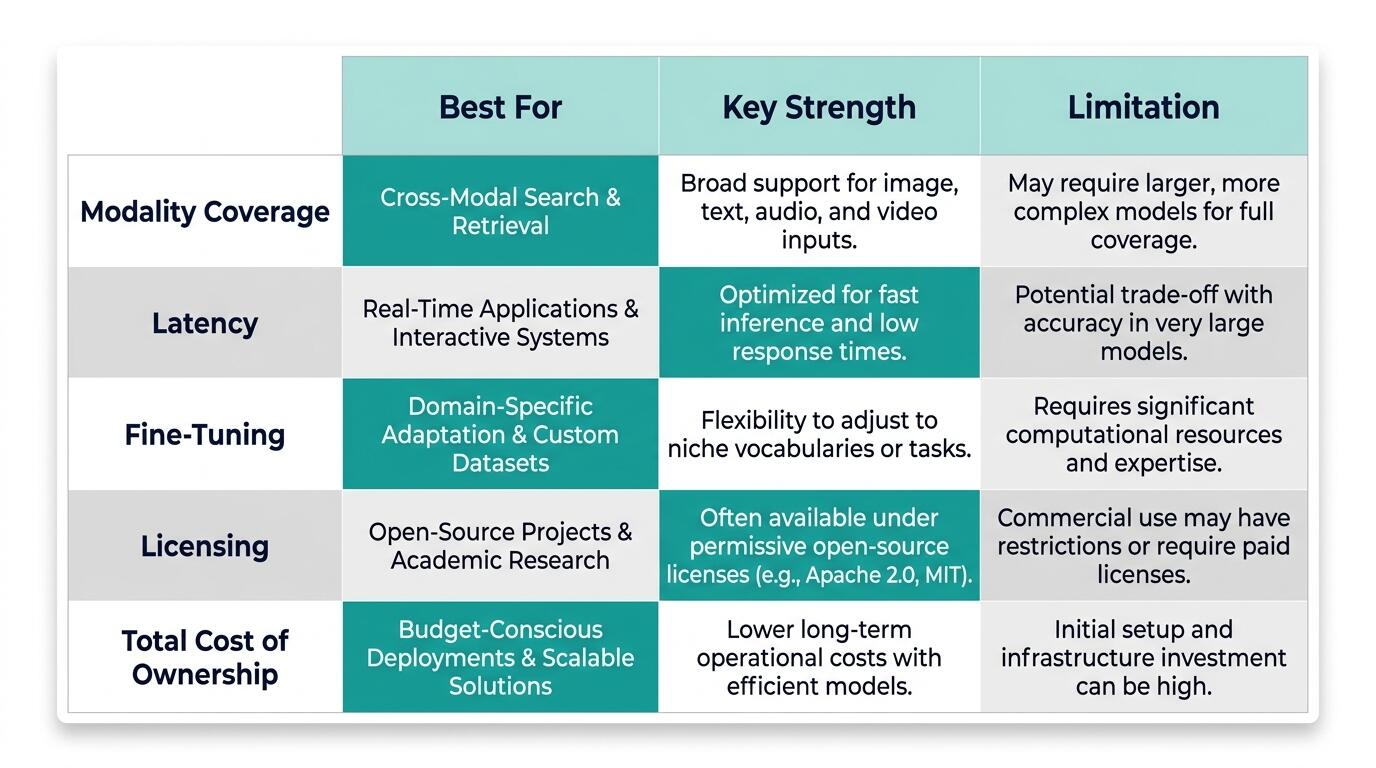
ALT: Table comparing evaluation criteria for multimodal embedding models including latency, fine-tuning, licensing, and total cost of ownership for AI product founders
How to Choose the Right Evaluation Priorities
The right evaluation sequence depends on where your product sits on two axes: how domain-specific your data is, and how latency-sensitive your retrieval use case is.
If your data is highly domain-specific — medical, legal, industrial, or proprietary enterprise data — prioritize modality coverage and alignment quality on your own data first, followed by fine-tuning accessibility. General benchmark performance is a weak signal here. Start with a small internal golden dataset and run your own evaluation before reading any vendor documentation beyond the license terms.
If your product is latency-sensitive and serving real-time user queries, move throughput and latency evaluation to the front of the checklist. A model that performs well on quality benchmarks but cannot fit within your P95 latency budget is not a viable candidate regardless of retrieval quality. Measure on your actual hardware, not on vendor-published specs.
If you are early in the evaluation process and have not yet committed to a vector database, treat the ecosystem compatibility check as a planning input rather than a validation step — let the embedding model characteristics inform your vector store selection rather than the reverse.
A common misconception worth addressing directly: founders often assume that the highest-ranking model on a public multimodal embedding leaderboard is the correct starting point for evaluation. In practice, the leaderboard ranking reflects performance on the specific evaluation sets used by that leaderboard's curators, which may have limited overlap with your query distribution. The leaderboard is a reasonable filter for eliminating clearly underperforming models, but it should not substitute for internal evaluation on representative data.
People Also Ask
Q1: How do I evaluate a multimodal embedding model on my own data without a large labeled dataset?
Start with a small golden set — even a few hundred query-result pairs curated by domain experts is sufficient for an initial directional evaluation. Use recall at multiple cutoffs (R@1, R@5) to measure retrieval quality in both modality directions. If you have user logs from an existing search feature, mine hard negatives from near-miss results to build a more diagnostic evaluation set. Precision on a small, high-quality internal set is more actionable than recall on a large general benchmark.
Q2: Are multimodal embedding models production-ready for domain-specific enterprise applications?
General-purpose multimodal embedding models are production-ready for broad-domain applications but typically require domain adaptation for specialized enterprise data. The adaptation gap is largest for technical diagrams, domain-specific document layouts, and proprietary visual formats that are underrepresented in web-scale training data. Teams evaluating models for enterprise deployment should treat internal evaluation on representative data as mandatory, not optional, before committing to a model family.
Q3: How long does it typically take to re-embed a large corpus when switching or upgrading a multimodal embedding model?
Re-embedding time depends on corpus size, embedding throughput of the target model, and available compute — there is no fixed answer that applies universally. The more important planning variable is traffic management during the transition: you need to serve queries against the old index while building the new one, then cut over cleanly. Teams consistently underestimate this coordination cost. Build re-embedding time and index transition cost into your model selection criteria, not just your operational runbook.
Key Takeaways
Evaluating multimodal embedding models is an engineering discipline, not a procurement exercise. Three core points apply regardless of which specific model family you are assessing.
First, internal evaluation on your own representative data is the only reliable signal. Benchmark leaderboards and vendor documentation are inputs to a shortlist, not a final decision. The gap between general benchmark performance and domain-specific retrieval quality is large enough to reverse a selection decision — and it only becomes visible when you run your own queries against a model.
Second, operational risk is underweighted in most evaluations. Licensing constraints, re-embedding costs when models are updated, vector database compatibility, and latency on real hardware are the dimensions that cause production failures — not recall scores measured on synthetic benchmarks. Build these checks into your evaluation process before you have committed engineering resources to integration.
Third, the checklist is a sequence, not just a list. The order in which you run these evaluations matters: catching a licensing problem or a domain alignment gap early saves significantly more time than catching it during integration or post-launch.
For teams making this decision under time pressure, the practical starting point is: build a golden dataset, run alignment quality on both modality directions, check the license, measure latency on your hardware, and only then go deeper on the remaining dimensions.
If you are building AI products and want clear, first-hand signal on the decisions that actually matter — subscribe to Darius, a bilingual AI briefing written by an engineering director who runs real AI products in production. Every issue covers developments worth acting on, with context that connects to actual product and engineering decisions.
Sources & Further Reading
- IEEE. "IEEE Standards for Artificial Intelligence and Machine Learning".
https://www.ieee.org/ - Association for Computing Machinery (ACM). "ACM Digital Library — Information Retrieval and Multimodal Learning Research".
https://www.acm.org/ - arXiv (Cornell University). "Matryoshka Representation Learning and Multimodal Embedding Research Preprints".
https://arxiv.org/
Note: Standards and research in multimodal embedding are evolving rapidly. Check the latest official publications and consult domain experts before making infrastructure commitments.