Evaluating AI Development Tools Before You Sign a Contract This Fall

ALT: Engineering director evaluating AI development tools and vendor contracts before signing this fall
Why Choosing AI Development Tools This Fall Demands a Different Kind of Due Diligence
The question founders and CTOs are sitting with right now is deceptively simple: which AI development tools should we commit to before we start building? The honest answer is that the tools themselves are almost secondary — what matters is the evaluation discipline you apply before the contract lands in your inbox.
The AI tooling market has matured enough to be genuinely useful, but not enough to be stable. Vendors are repositioning monthly, pricing models are shifting, and the gap between a polished demo and a production-ready integration is wider than most sales cycles let on. Rushing a tool selection this fall — under the pressure of roadmap deadlines, board expectations, or the general urgency that the end of the year creates — is one of the fastest ways to architect technical debt into the foundation of a system that should be a competitive advantage. This article breaks down how to evaluate AI development tools with the rigor that a real contract commitment deserves.
The AI Tooling Landscape Today and How It Got This Complicated
The current AI development tool ecosystem is the product of roughly two years of rapid consolidation following the generative AI wave that crested in late 2022 and 2023. What started as a relatively contained set of model APIs — primarily from a handful of large labs — has expanded into a layered stack that includes foundation model providers, orchestration frameworks, vector database vendors, evaluation platforms, observability tools, fine-tuning services, and infrastructure layers built specifically for LLM workloads.
This layering is not inherently bad. It reflects genuine engineering progress: teams recognized that raw model access was only one piece of shipping a reliable AI-powered product, and the ecosystem responded with tooling that addresses the surrounding infrastructure. The problem is that the ecosystem expanded faster than the tooling matured, leaving many teams with point solutions that solve narrow problems well but integrate poorly with each other at the seams.
A pattern we consistently see in our work with clients is that organizations sign contracts with three to five separate vendors — a model provider, a vector store, an orchestration layer, a monitoring tool — without having mapped how those systems will exchange data, who owns the observability layer across all of them, or what the total cost profile looks like when usage scales. Each individual contract looks defensible in isolation; the combined architecture does not.
According to Glean's published guidance on how to evaluate AI platforms for enterprise search and MCP integration in 2026, enterprise teams are increasingly evaluating platforms not on feature depth alone but on how well they support interoperability standards and data governance at scale — a signal that the market is maturing toward systems thinking rather than point-solution selection.
The seasonal pressure of fall planning adds another variable. Q4 budget cycles mean procurement decisions get accelerated, and vendors know it. Discounts appear, multi-year deals get pitched, and the urgency to "get something signed before the year closes" creates conditions where thorough technical evaluation gets compressed into a two-week window that should have been six.
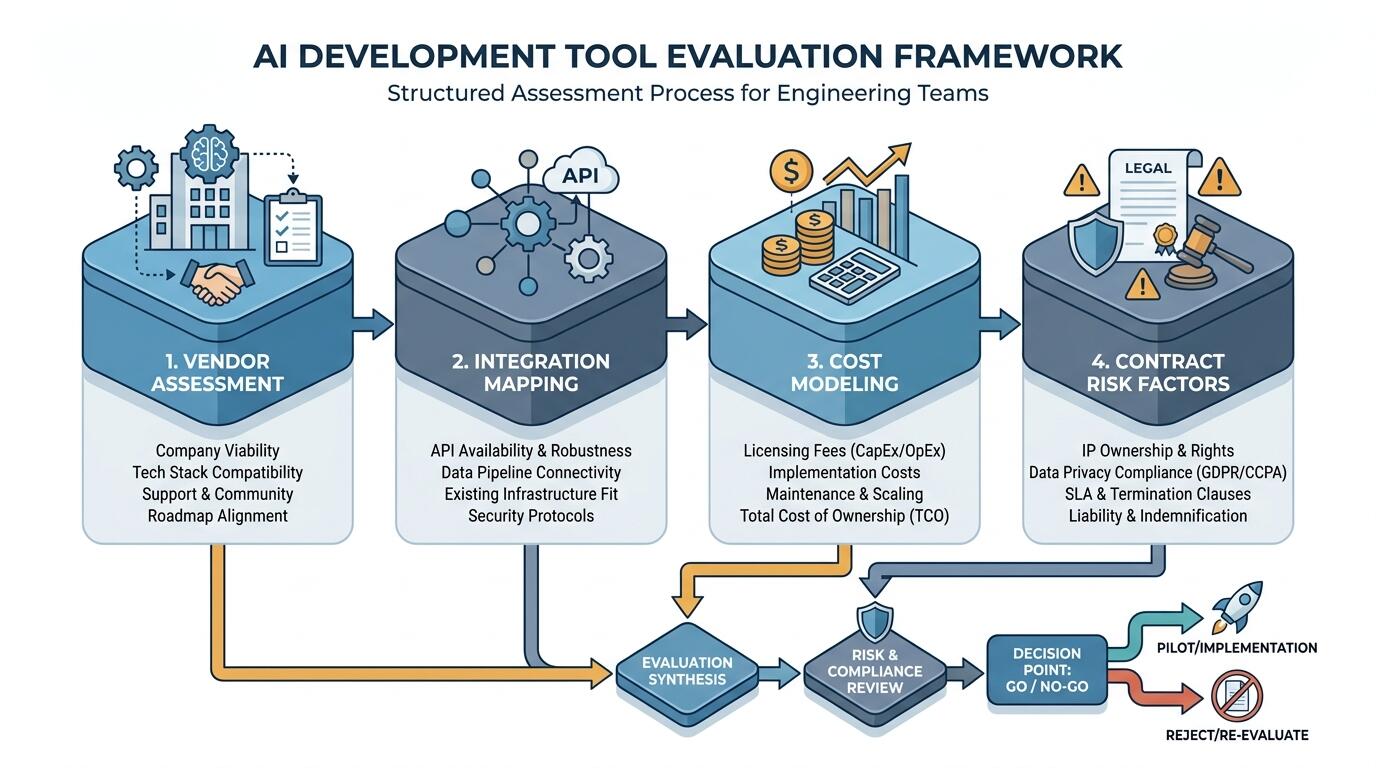
ALT: Diagram of AI development tool evaluation framework showing vendor assessment, integration mapping, and contract risk factors for engineering teams
The Root Causes of Poor AI Tool Selections — and the Mechanics Behind Each
Poor AI tool selections rarely happen because someone made an obviously bad decision. They happen because the evaluation process optimized for the wrong signals at each stage.
Capability Theater During the Demo Phase
Capability theater is the practice — sometimes deliberate, sometimes not — of demonstrating an AI tool under conditions that will never exist in production. Demos use curated datasets, pre-optimized prompts, and sandbox environments with uncapped resources. The tool performs beautifully. The procurement team signs. The engineering team then spends the first month of the engagement discovering that the tool's latency profile degrades significantly under real query volumes, or that the accuracy benchmarks cited in the sales deck applied to a task type that is adjacent to — but meaningfully different from — the actual use case.
The mitigation is straightforward: demand a proof-of-concept environment using your own data, your own query distribution, and your own latency requirements before any contract is signed. This is not an unreasonable ask. A vendor who resists it is telling you something important about the confidence they have in their product under real conditions.
Underestimating Integration Surface Area
Integration surface area refers to the total set of connection points between a new AI tool and the rest of a system: authentication, data pipelines, API contracts, logging sinks, error handling paths, and deployment infrastructure. Teams routinely underestimate this surface area because tool vendors present integration as a solved problem — they ship SDKs, publish quickstart guides, and have developer advocates walking through setup in under ten minutes on YouTube.
What those guides never show is the integration behavior at the edges: what happens when an upstream data source returns malformed payloads, how the tool behaves when rate limits are hit unexpectedly, or how error states surface into the observability stack. A practical guide to AI development tools published on note.com by Sescore, covering engineering-level evaluation criteria, emphasizes that the real integration test begins not with the happy path but with fault injection and edge-case behavior.
Pricing Model Misalignment
Token-based pricing, seat-based licensing, and consumption-based infrastructure costs interact in ways that are non-obvious until you build a realistic usage model. Teams frequently anchor on the per-token price for a model API and underestimate the downstream infrastructure costs: vector store query volume, embedding generation at ingestion time, re-ranking model calls, and the observability data volume generated by a high-throughput LLM application.
The right evaluation asks: what does the total cost of ownership look like at three times our projected usage? At ten times? If the pricing model becomes punishing at scale, the tool is a liability in proportion to your own success. For teams thinking through the full budget picture, a detailed breakdown of RAG system costs by component and usage tier can help ground these projections before vendor conversations begin.
Contract Lock-in and Data Portability
Vendor lock-in in AI tooling manifests most severely at two points: data storage and model fine-tuning. If a vendor stores your embeddings, your fine-tuned weights, or your evaluation datasets in a proprietary format with no export path, you have traded short-term convenience for long-term dependency. This is not a hypothetical risk — it is a documented failure mode across multiple enterprise AI deployments.
Contract language around data portability, model ownership, and termination rights deserves as much scrutiny as the technical evaluation. The Evelyn Learning due diligence guide for AI content tools, covering licensing and data governance considerations, identifies data portability clauses and audit rights as two of the highest-leverage negotiation points in any AI vendor contract — a finding that generalizes well beyond the publishing context it was written for.
Evidence and Competing Approaches: How Different Teams Handle AI Tool Evaluation
In practice, engineering teams approach AI tool evaluation through one of several lenses, each with genuine strengths and real trade-offs depending on the context.
| Perspective / Approach | Strengths | Trade-offs | Best Fit |
|---|---|---|---|
| Feature-first evaluation | Fast to execute; aligns with demo-driven procurement cycles; easy to communicate to non-technical stakeholders | Optimizes for surface capability, not production reliability; often misses integration and cost failures | Early-stage exploration before any contract commitment |
| Architecture-first evaluation | Maps tools to actual system requirements; surfaces integration surface area early; produces defensible build-vs-buy decisions | Slower; requires experienced technical leadership to run; can stall procurement timelines | Teams with defined use cases and 60+ day evaluation windows |
| Cost-model-first evaluation | Grounds decisions in financial reality; prevents pricing surprises at scale; useful for board and CFO alignment | Can eliminate technically superior tools prematurely; hard to model before usage data exists | Growth-stage companies with known usage patterns |
| Risk-first evaluation | Prioritizes contract terms, data portability, and vendor stability; protects against lock-in | Can be overly conservative; may slow adoption of genuinely useful tools | Regulated industries or teams with high switching costs |
A balanced evaluation process borrows from all four of these lenses in sequence: start with architecture requirements (what does the system actually need?), then assess feature fit, then model costs, then scrutinize contract terms. The teams we work with who skip steps two or three in this sequence — jumping from architecture requirements directly to contract negotiation — consistently discover the omission in the first ninety days of the engagement.
For teams who want a broader framework for the build-versus-buy decision that often precedes tool selection, the analysis in revisiting the build vs. buy framework for AI infrastructure provides a structured way to think about which layers of the stack warrant vendor relationships versus internal investment.
Where AI Tool Evaluation Is Heading and What It Means for Your Fall Decisions
AI development tool evaluation is becoming a discipline in its own right, not just a procurement step. Several trends are shaping how this practice will evolve over the next one to two years, and they have direct implications for decisions being made this fall.
Interoperability standards are emerging. The Model Context Protocol (MCP) and similar initiatives reflect a genuine push toward standardizing how AI tools communicate with each other and with enterprise data systems. Evaluating a tool's MCP compatibility or its adherence to emerging interoperability standards is becoming a meaningful differentiator — tools that invest in standards compliance are signaling a longer-term commitment to ecosystem participation rather than proprietary capture.
Evaluation tooling is maturing. A year ago, most teams were evaluating LLM quality through informal human review. Today, structured evaluation frameworks — automated regression testing for AI outputs, benchmark suites aligned to specific task types, and red-teaming methodologies — are becoming standard practice in well-run engineering organizations. If a vendor cannot support your evaluation harness, that is itself a red flag.
Vendor consolidation will continue. The number of AI tool vendors that can sustain themselves through 2026 and beyond is meaningfully smaller than the current market implies. Evaluating vendor financial stability, customer concentration, and roadmap credibility is part of the risk assessment now in a way it was not two years ago.
For teams about to engage with an AI architecture consulting relationship to guide these decisions, understanding what to expect when starting an AI architecture engagement this fall can help set realistic expectations about timelines, deliverables, and the kinds of decisions that benefit most from external expertise.
The actionable takeaway: use fall's natural planning cycle as forcing function to run a structured evaluation process — not to compress one. The tools that deserve a multi-year contract commitment are the ones that survive a rigorous proof-of-concept, a realistic cost model, and a legal review of the contract terms. That process takes time. Build that time into your Q4 planning now.
Frequently Asked Questions FAQ
Q1: How long should an AI development tool evaluation take before signing a contract?
A thorough AI tool evaluation for a production system typically requires between four and eight weeks from initial requirements definition to contract signature. This window accommodates a proof-of-concept using real data, a cost-model exercise across projected usage tiers, and a legal review of contract terms including data portability and termination clauses. Compressing this below two weeks introduces meaningful risk that surface-level capability will substitute for genuine production readiness assessment.
Q2: Are open-source AI development tools a safer choice than commercial vendor solutions?
Open-source AI tools reduce vendor lock-in and licensing costs but shift the burden of integration, maintenance, security patching, and scalability engineering entirely to your internal team. For teams with strong ML engineering capacity, open-source tooling can be the more defensible long-term choice. For teams without that capacity, commercial solutions often provide necessary reliability guarantees and support structures — but require careful contract scrutiny around data ownership and pricing transparency.
Q3: How much budget should be allocated to AI tool evaluation before a contract is signed?
The evaluation budget is best framed as a percentage of the projected first-year contract value rather than a fixed figure. Investing engineering time equivalent to ten to fifteen percent of the anticipated annual cost in a pre-contract proof-of-concept is a reasonable heuristic. This covers the engineering hours for integration testing, the cost of running the tool against real data at meaningful volume, and legal review time — all of which are far cheaper than discovering a fundamental misfit three months into a committed engagement.
The Bottom Line
Evaluating AI development tools before signing a contract is not a procurement formality — it is a technical and commercial risk management exercise that deserves the same rigor as system design.
Key Takeaways:
- Demand a proof-of-concept using your own data and query distribution before any contract commitment; demo environments are not representative of production behavior.
- Map the full integration surface area — including edge cases, fault handling, and observability coverage — not just the happy-path setup.
- Build a cost model that accounts for total system costs at multiple usage multiples, not just the headline per-token or per-seat price.
- Scrutinize contract terms for data portability, model ownership, and termination rights with the same rigor applied to technical evaluation.
- Evaluate vendor stability and standards compliance (such as MCP compatibility) as part of the long-term risk assessment, not as an afterthought.
The teams that sign the right AI tool contracts this fall are the ones who slow down the evaluation process just enough to surface the real risks — before the ink dries.
If this resonated with you, explore more insights and real-world engineering breakdowns at Darius's portfolio and wiki. Whether you're architecting an AI system from scratch, untangling a complex technical stack, or looking to turn an idea into a live product, Darius brings the hands-on experience of an Engineering Director and AI Architect who has done exactly that. Visit the site to dive deeper into frameworks, case studies, and thinking that helps you build and ship with confidence.
Sources
- Glean. "How to evaluate AI platforms for MCP and enterprise search in 2026".
https://www.glean.com/perspectives/how-to-evaluate-ai-platforms-for-mcp-and-enterprise-search-in-2026 - Sescore. "Practical Guide to AI Development Tools for Engineers".
https://note.com/sescore/n/n62c86d1bb6dd?hl=en - Evelyn Learning. "AI Content Tools for Publishers: Due Diligence Guide".
https://www.evelynlearning.com/blog/what-publishers-need-to-know-before-licensing-ai-content-tools-a-practical-due-diligence-guide - IEEE. "IEEE Standards and Publications on Artificial Intelligence and Software Engineering".
https://www.ieee.org/
Note: Standards and vendor guidance may be updated; please check the latest official documents or consult professional advisors before making procurement decisions.