RAG System Costs Explained: A Monthly Budget Breakdown for Q4 2026
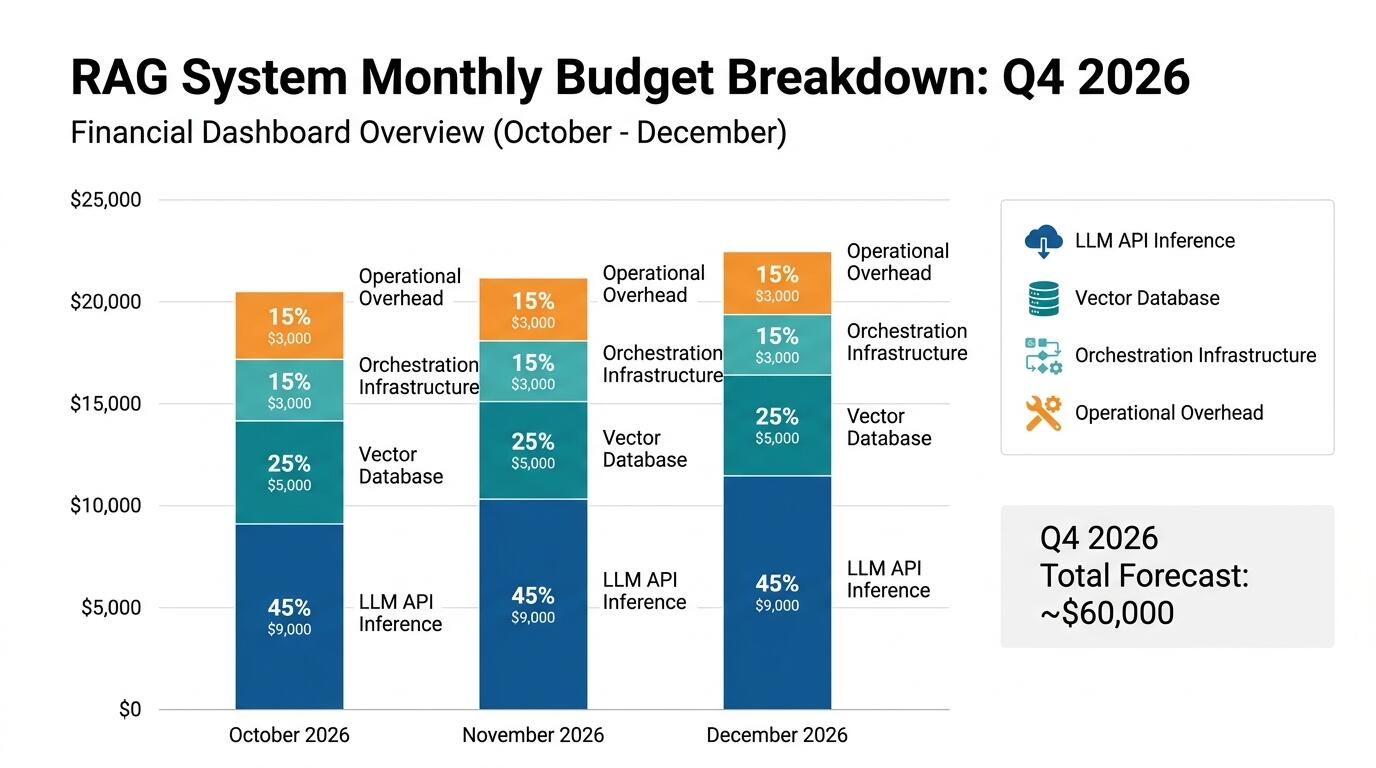
ALT: RAG system monthly budget breakdown showing infrastructure and API costs for Q4 2026
What Does a RAG System Actually Cost to Run in Q4 2026?
Most teams building Retrieval-Augmented Generation systems underestimate their monthly operational costs by a wide margin — not because they're careless, but because the cost structure of a RAG pipeline is genuinely non-obvious until you're inside it. The question every CTO, startup founder, and engineering lead eventually asks is the same: what will this actually cost us per month at production scale? The direct answer is that RAG system costs in Q4 2026 span a wide range depending on query volume, model selection, and infrastructure choices, but the underlying cost drivers are consistent and predictable once you understand the architecture.
This topic deserves serious analysis right now because the RAG landscape has matured rapidly. Teams that built early prototypes on generous free tiers are hitting production and discovering that the economics look very different at scale. The gap between "it works in demo" and "we can sustain this financially" is where many AI products stall. A clear-eyed, component-by-component budget breakdown is the practical tool that bridges that gap.
The Current State of RAG Economics: How We Got Here
Retrieval-Augmented Generation (RAG) is an AI architecture pattern in which a language model is augmented with a retrieval step — querying an external knowledge base or vector database — before generating a response. This architecture emerged as a practical alternative to fine-tuning large models, offering a faster path to domain-specific accuracy without the upfront cost of model training.
Early RAG implementations were relatively simple: a vector store, a few API calls to a hosted language model, and a lightweight orchestration layer. The economics seemed favorable. Managed vector databases offered generous free tiers, and LLM API costs were dropping quarter over quarter. Teams adopted RAG quickly across customer support, internal knowledge management, document Q&A, and code assistance.
What changed is scale and sophistication. Production RAG systems in Q4 2026 are substantially more complex than their 2023-era predecessors. They typically include multi-stage retrieval pipelines, reranking layers, hybrid search (dense plus sparse), chunking and preprocessing infrastructure, evaluation frameworks, observability stacks, and in many cases, multi-modal ingestion. Each layer adds cost. According to analysis published by Spendark, a production RAG system's monthly bill is composed of multiple distinct cost centers that compound in ways that catch teams off guard.
The LLM API pricing environment has also matured. While per-token costs have generally declined, the models teams want to use for production quality — larger context windows, better reasoning, lower hallucination rates — remain meaningfully more expensive than baseline options. And as RAG pipelines grow more sophisticated, the token counts per query increase: you're retrieving more chunks, reranking them, constructing longer context windows, and running more validation passes.
The net result is that a RAG system serving a modest production load in Q4 2026 carries real monthly infrastructure costs that need to be planned for, not discovered after launch. Understanding where every dollar goes is the foundation of sustainable AI product economics.
Breaking Down the Cost Drivers: Where the Money Goes
A production RAG system has four primary cost centers. Each one is independently manageable, but they interact in ways that make holistic budget planning essential.
LLM API Costs: The Largest Variable Line Item
LLM inference — paying for the language model to generate responses — is typically the single largest and most variable cost in a RAG system. Costs are driven by three factors: tokens per query (input and output), queries per month, and the price tier of the model selected.
The practical challenge is that RAG architectures increase input token counts significantly. Where a direct prompt might be a few hundred tokens, a RAG-augmented prompt includes retrieved document chunks, system instructions, and conversation history — often pushing individual query costs into the thousands of tokens per call. At scale, this compounds quickly. Teams that model their costs based on output tokens alone consistently underestimate their actual bills.
Model selection is a genuine lever. A well-configured RAG pipeline using a mid-tier model can outperform a poorly configured pipeline using a frontier model, at a fraction of the inference cost. In our work with clients, this is one of the most consistent patterns we see: over-indexing on model capability rather than prompt engineering and retrieval quality leads to unnecessarily high inference spend.
Vector Database and Embedding Infrastructure
Vector database costs are the second major cost center, covering both storage and query operations. A vector database is a specialized data store that indexes high-dimensional embedding vectors to enable semantic similarity search — the retrieval backbone of any RAG system.
Managed vector database services typically price on dimensions including stored vector count, number of namespaces or indexes, and query operations per second. For small knowledge bases (tens of thousands of vectors), costs are negligible. For enterprise-scale deployments — millions of vectors representing large document corpora — monthly storage and query costs become significant.
Embedding generation adds another layer. Every document ingested into the system must be converted to a vector embedding, which requires calling an embedding model (either hosted API or self-hosted). Ingestion is a one-time cost per document batch, but re-indexing on corpus updates, schema changes, or model upgrades generates recurring embedding spend. According to SFAI Labs' RAG cost breakdown guide, embedding API costs are often underestimated because teams focus on query-time costs while ignoring ingestion-time costs.
Infrastructure and Orchestration Layer
Orchestration infrastructure — the compute layer that runs your RAG pipeline logic — is a persistent monthly cost that scales with query volume and pipeline complexity. This includes the services that handle query preprocessing, retrieval orchestration, reranking, response generation, and any post-processing or validation steps.
Self-hosted deployments carry cloud compute costs: managed Kubernetes clusters, serverless function invocations, load balancers, and networking. Fully managed RAG platforms shift some of this into subscription costs but introduce vendor lock-in and pricing opacity. The right choice depends on team capability and query volume — there is no universally correct answer.
Observability and evaluation infrastructure — logging, tracing, retrieval quality monitoring, latency tracking — adds further cost but is non-negotiable for production systems. Running a RAG system without visibility into retrieval quality and hallucination rates is operationally reckless.
Data Storage, Preprocessing, and Operational Overhead
Document storage and preprocessing costs cover raw document ingestion pipelines, chunk storage, metadata databases, and the compute required to parse, clean, and chunk incoming documents. PDF parsing, OCR for scanned documents, and table extraction are computationally expensive and often underestimated.
Operational overhead — including developer time for maintenance, pipeline updates, and incident response — is a real cost that belongs in any honest monthly budget, even if it doesn't appear on a cloud invoice. For teams without dedicated MLOps capacity, this is frequently the hidden cost that makes RAG systems more expensive than the cloud bill suggests.
Evidence and Cost Structure Comparison: Three Deployment Profiles
Rather than fabricating specific dollar figures that would be immediately outdated, the most useful framework is to compare RAG deployment profiles across the dimensions that drive cost. Analysis from Alpha Corp's infrastructure cost guide corroborates the pattern that deployment scale is the primary determinant of monthly cost profile.
| Perspective / Approach | Strengths | Trade-offs | Best Fit |
|---|---|---|---|
| Low-volume prototype / internal tool (hundreds of queries/month) | Minimal infrastructure cost; fast iteration; free-tier vector DB viable | Limited scale; no production observability; cost profile changes sharply at scale | Internal teams, early validation, single-user tools |
| Mid-scale production (tens of thousands of queries/month) | Real production traffic; measurable retrieval quality; cost structure becomes predictable | LLM API costs become meaningful; vector DB indexing costs appear; orchestration overhead rises | B2B SaaS products, customer support automation, knowledge assistants |
| High-scale production (hundreds of thousands to millions of queries/month) | Economies of scale possible with self-hosted models; architecture optimization ROI is high | Infrastructure complexity; dedicated MLOps required; model hosting costs substantial | Enterprise deployments, consumer-facing AI products, high-volume document processing |
The pattern that emerges consistently is that mid-scale is the hardest cost zone to manage. Low-volume systems benefit from free tiers; high-volume systems justify the investment in self-hosted infrastructure and optimization. Mid-scale teams are paying full API prices without the query volume to justify dedicated infrastructure — this is where budget surprises are most common.
A few cost optimization approaches warrant direct comparison:
Managed LLM APIs vs. self-hosted open-source models: Managed APIs offer low operational overhead and access to frontier models, but per-token costs at scale are significant. Self-hosting open-source models (on GPU instances) carries high fixed infrastructure costs but dramatically reduces per-query variable costs at sufficient volume. The crossover point depends on query volume and acceptable model quality.
Managed vector databases vs. self-hosted: Managed vector databases are operationally simple and well-suited to variable or unpredictable query loads. Self-hosted vector stores (on standard compute) reduce per-query costs at high volume but require operational expertise. For most teams in the mid-scale zone, managed is the correct default.
Full RAG pipeline vs. simplified retrieval: Not every use case requires multi-stage retrieval with reranking. A pattern we consistently see is teams building maximum-sophistication pipelines for use cases that would perform well with simpler, cheaper retrieval. Right-sizing pipeline complexity to actual retrieval quality requirements is one of the highest-ROI cost optimization moves available.
Where RAG Economics Are Heading: What It Means for Your Budget
RAG system economics are moving in a direction that rewards teams who build with architectural discipline rather than those who default to the most powerful available components. Several trends are clearly underway heading into Q4 2026 and beyond.
LLM inference costs continue to decline on a per-token basis, driven by model efficiency improvements and competitive pricing pressure among providers. However, the models that matter for production quality — long-context, low-hallucination, strong reasoning — remain in a higher price tier. The gap between commodity and capable models is narrowing but not closed.
Vector database pricing is becoming more competitive, with a growing number of managed options and improved efficiency of self-hosted alternatives. This is generally favorable for RAG cost structures, though the per-query cost reduction is partially offset by the trend toward larger, more frequently updated knowledge bases.
The most significant cost efficiency gain available to teams right now is architectural: building evaluation and retrieval quality measurement into the pipeline from day one, rather than as an afterthought. Teams that can measure retrieval precision and recall can optimize chunk size, embedding model selection, and retrieval parameters with data — rather than defaulting to expensive brute-force approaches like maximum context windows and frontier models for every query.
Actionable priorities for budget planning in Q4 2026:
- Build your cost model at query volume, not per-query. Spreadsheet your monthly cost at 10x, 50x, and 200x your current volume to understand where architectural decisions need to change.
- Separate ingestion costs from query costs in your budget. They have different scaling profiles and different optimization levers.
- Treat retrieval quality measurement as infrastructure, not a nice-to-have. Poor retrieval forces compensatory spending on larger context windows and more capable models.
- Evaluate self-hosted model options when monthly LLM API spend crosses a meaningful threshold — the operational overhead of self-hosting becomes justifiable well before most teams think to consider it.
- Do not neglect operational overhead in your budget. Developer time spent on RAG maintenance is a real cost that belongs in the monthly total.
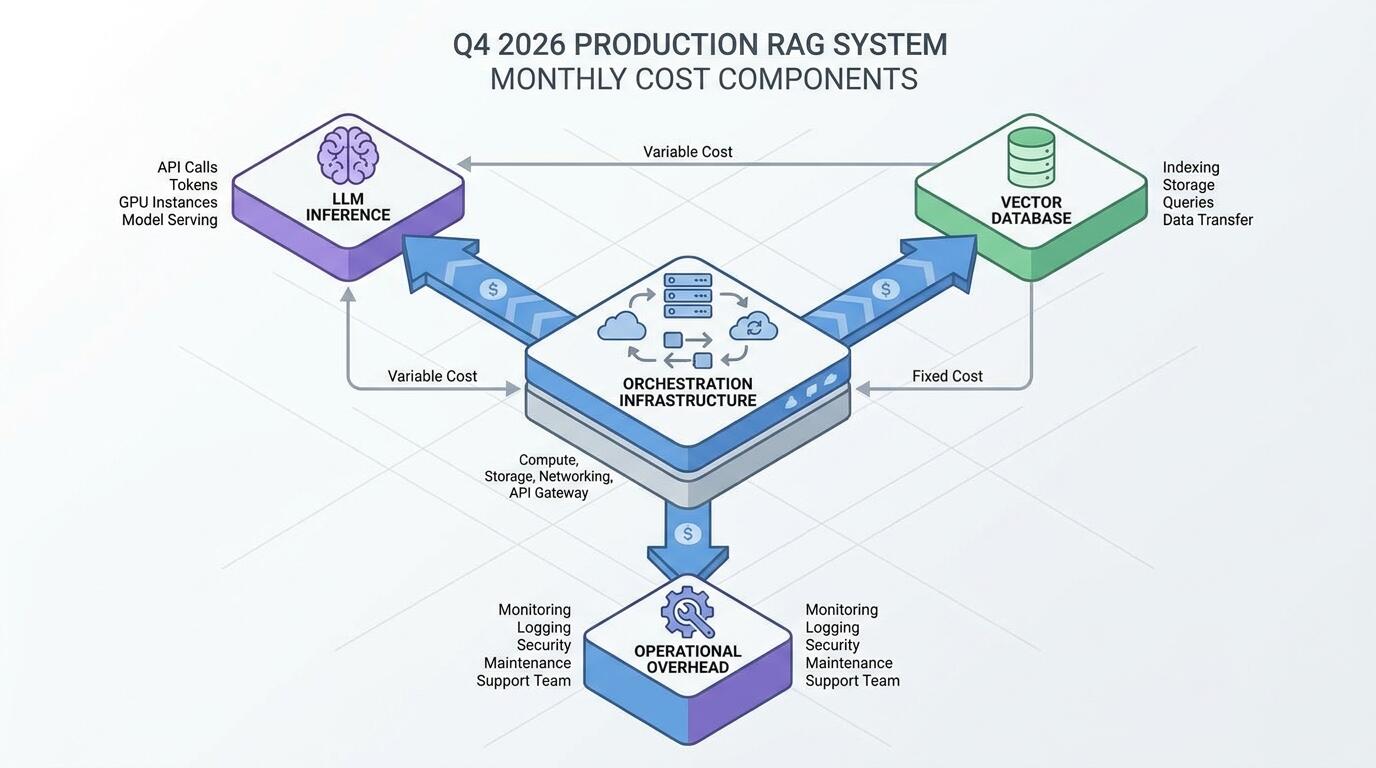
ALT: Diagram of RAG system monthly cost components including LLM inference, vector database, orchestration infrastructure, and operational overhead for Q4 2026 budget planning
Questions & Answers
Q1: How do LLM API token costs affect a RAG system's monthly budget compared to a standard chatbot?
A RAG system's LLM API costs are substantially higher than a standard chatbot's at equivalent query volume because each RAG query includes retrieved document chunks as input context, significantly increasing the input token count per call. Where a direct chatbot query might consume a few hundred input tokens, a RAG-augmented query routinely consumes thousands. At production scale, this multiplier effect makes LLM inference the dominant and most variable line item in a RAG system's monthly budget, requiring careful model selection and context window management.
Q2: Are managed vector databases cost-effective for production RAG systems at mid-scale query volumes?
Managed vector databases are generally cost-effective for production RAG systems at mid-scale query volumes — typically tens of thousands of queries per month — because the operational simplicity they provide outweighs the premium over self-hosted alternatives at that scale. The calculus shifts at high volume, where self-hosted vector stores on standard compute can reduce per-query costs significantly, provided the team has the operational capacity to manage the infrastructure. For most early-stage and growth-stage teams, managed is the pragmatic default.
Q3: How long does it typically take to accurately model RAG system costs before committing to a production architecture?
Accurate RAG cost modeling requires at minimum a working pipeline running against representative query samples and a realistic document corpus. Teams that invest two to four weeks in a production-fidelity cost spike — measuring actual token consumption per query, retrieval latency, and embedding ingestion costs at target document volumes — arrive at budgets that hold. Teams that model costs from documentation estimates alone consistently underestimate by a substantial margin, particularly on LLM inference and operational overhead.
Wrapping Up
Building a RAG system without a clear monthly cost model is a liability, not a technical detail to sort out later. The economics are predictable once you understand the structure, and the teams that plan ahead avoid the painful surprises that stall production deployments.
Key Takeaways:
- LLM inference is the largest and most variable cost driver in a production RAG system — input token count, not just output, is what determines your monthly bill.
- Vector database and embedding costs have two distinct profiles: ingestion-time costs and query-time costs, both of which must be modeled separately.
- Mid-scale production deployments (tens of thousands of queries per month) represent the hardest cost zone to manage, where free-tier benefits disappear but self-hosting isn't yet justified.
- Retrieval quality measurement is a cost optimization tool — poor retrieval forces expensive compensatory spending on larger models and longer contexts.
- Operational overhead, including developer time for maintenance and incident response, belongs in every honest monthly RAG budget.
The next step is to build your own cost model at actual expected query volume, not theoretical averages. Map each pipeline component to its cost driver, stress-test the model at growth multiples, and identify which architectural decisions need to change at scale before you're committed to them.
Ready to move from cost modeling to actually shipping? Explore real-world AI architecture projects, technical writing, and engineering perspectives at the Darius website — built by an Engineering Director who has delivered production AI systems end to end.
Sources
- Spendark. "What a Production RAG System Costs Per Month (2026)".
https://spendark.com/blog/rag-system-cost/ - SFAI Labs. "RAG Development Costs: Complete Budget Breakdown".
https://sfailabs.com/guides/rag-development-costs-breakdown - Alpha Corp. "How Much Does a RAG System Cost? Infrastructure, Development, and Ongoing Expenses".
https://alphacorp.ai/blog/how-much-does-a-rag-system-cost-infrastructure-development-and-ongoing-expenses - IEEE (Institute of Electrical and Electronics Engineers). Standards and technical resources on AI systems architecture and engineering practice.
https://www.ieee.org/
Note: Standards and pricing information may be updated; please check the latest official documents or consult professional advisors.