Five Mistakes to Avoid When Pricing Embedding-Based Search Features
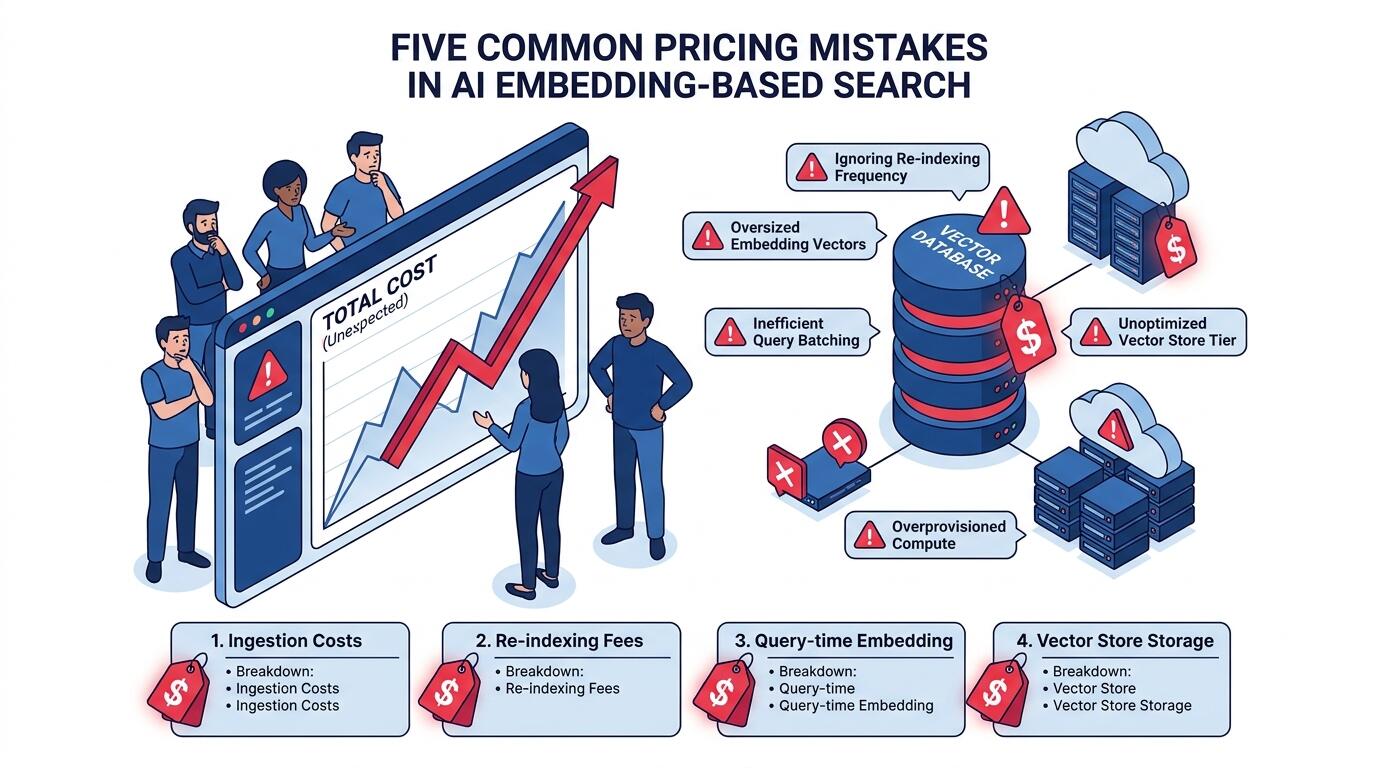
ALT: Five common pricing mistakes that teams make when shipping embedding-based search features in AI products
Why Embedding-Based Search Pricing Goes Wrong — and How to Get It Right
Embedding-based search is a technique in which text, images, or other content is converted into dense vector representations that capture semantic meaning, enabling search systems to retrieve results by conceptual similarity rather than exact keyword matches. Teams building AI products have adopted this approach rapidly because it dramatically improves search quality for natural-language queries. But a pattern we consistently see across product teams — from indie developers to engineering organizations — is that the infrastructure cost model for embedding-based search is systematically misunderstood at the pricing and budgeting stage.
The result is predictable: features that look cheap during prototyping become surprisingly expensive at scale, monetization strategies fail to align with actual usage economics, and product decisions get made on flawed assumptions. This article identifies five of the most consequential pricing mistakes practitioners make when shipping these features, explains why each mistake happens, and lays out how to think more clearly before you lock in a model.
The Dimensions That Determine Whether You Price This Right
Getting embedding-based search pricing right requires evaluating it across several independent dimensions. Understanding each one is a prerequisite for avoiding the mistakes described later.
Compute cost structure. Embedding generation and vector retrieval have different cost profiles. Embeddings are typically generated at indexing time (a one-time or batch cost) and at query time (a per-request cost). These two moments have very different frequency characteristics and must be modeled separately.
Latency and quality trade-offs. Larger, higher-dimensional embedding models generally produce better retrieval quality but cost more per call and add latency. The choice of model directly affects your unit economics. Teams that benchmark quality in isolation without pricing the model run into budget surprises later.
Index management overhead. Vector indexes are not static. Content updates, re-indexing runs, and index storage costs are ongoing operational expenses that are easy to omit from initial cost models. This is especially true when using managed vector database services with storage-based billing.
Usage pattern assumptions. Search features have highly non-uniform usage distributions. A small fraction of users often drives a disproportionate share of queries. Flat pricing assumptions that ignore this distribution understate true cost for power users and overstate it for typical users.
Monetization model alignment. The way you charge users for a search feature (per search, per seat, usage tier, or bundled) must align with how you are charged by your infrastructure providers. Misalignment between your upstream cost model and your downstream pricing model is the root cause of most margin erosion in this category.
The Five Mistakes, Examined Closely
Mistake 1: Treating Embedding Generation as a Fixed Cost
Many teams calculate embedding cost by taking the size of their initial corpus, multiplying by the cost per token of their chosen embedding API, and writing that number into a one-time line item. This is wrong in two ways.
First, content changes. Any product with user-generated content, document updates, or catalog changes requires re-embedding whenever content is modified. The re-indexing cost can be substantial depending on the volume of changes and the freshness requirements of the search index. Second, query-time embedding generation — converting each incoming user query into a vector before retrieval — is a per-request cost that scales directly with query volume. Teams that model this as negligible during low-traffic periods find it materially significant at production scale.
The correct approach is to model embedding costs across three separate buckets: initial ingestion, ongoing re-indexing, and per-query embedding. Each has a different driver (corpus size, content change rate, and query volume respectively) and should be projected independently.
Mistake 2: Ignoring the Cost of the Vector Store
Embedding-based search requires a vector database or index to store and query the generated vectors. A common mistake is to treat vector store costs as negligible or to leave them out of the initial pricing model entirely because they seem like infrastructure background noise.
In practice, managed vector database services charge on multiple dimensions simultaneously: storage (indexed vectors plus metadata), query throughput (reads per second), and sometimes write throughput (index updates). For products with large corpora or high query volumes, vector store costs can rival or exceed embedding API costs. When evaluating the build vs. buy decision for AI infrastructure, vector store pricing is one of the most important factors to model before making a commitment.
A useful exercise is to run a full cost model against your target-state corpus size and query volume using the pricing pages of two or three vector database providers, rather than assuming these costs are trivial. The spread across providers can be significant.
Mistake 3: Conflating Search Quality with Model Size, Then Pricing for the Wrong One
Teams often start with a large, high-capability embedding model because it produces the best retrieval quality in early benchmarks. They then price their feature based on the cost of that model. Two problems follow.
First, the cost of larger models — whether charged by token, by API call, or by compute time — is materially higher than smaller alternatives, and the quality gap may not justify the premium for many production use cases. Research from groups including Google DeepMind has documented specific theoretical limitations of embedding-based approaches, noting that no single embedding model is uniformly optimal across all retrieval tasks. This means blindly choosing the largest available model is not always the correct quality optimization, let alone the correct cost optimization.
Second, teams rarely re-evaluate their model choice after the initial build. If you priced your feature assuming the large model, and then discovered that a smaller model produces acceptable quality for your specific retrieval task, you have headroom to reduce costs — but only if you built that evaluation loop into your process from the start.
The actionable fix is to benchmark at least two model sizes against your actual retrieval task before finalizing any pricing model, and to keep model substitution possible as a cost lever in your architecture.
Mistake 4: Underestimating Index Freshness Requirements
Freshness is the requirement that search results reflect recent content within a specified time window. Many product teams discover late in the build that their users expect near-real-time freshness for search results, which has significant cost implications.
Maintaining a fresh vector index requires continuous or near-continuous re-indexing of new and updated content. This creates a background compute load that is not present in a static-corpus search system. The cost depends on the ingestion pipeline design, the frequency of index updates, and the size of documents being processed.
A particularly common misstep is to design a daily batch re-indexing process for cost reasons, and then face user complaints or product requirements that demand hourly or sub-hourly freshness. Retrofitting a faster re-indexing pipeline after pricing has been set creates both engineering rework and budget pressure.
The right time to define freshness requirements is before you model costs — not after. Treat freshness as a first-class product requirement with a direct cost implication, and include it in every pricing conversation with stakeholders.
Mistake 5: Pricing Users Uniformly When Usage Is Highly Skewed
Usage distributions for search features are almost never uniform. A small segment of users — power users, automated workflows, integration partners — typically generates a large share of total query volume. If your pricing model charges all users at the same rate or bundles search into a flat seat-based subscription, you are likely subsidizing your high-usage users with revenue from low-usage users, compressing your margins invisibly.
This problem is compounded when downstream pricing (what you charge customers) is structured differently from upstream pricing (what your infrastructure costs you). For example, if your infrastructure costs scale with query count but your product pricing is purely seat-based, a customer with many users who each search infrequently is profitable, while a customer with few users who each search heavily is not. The average-case margin looks acceptable until a single high-volume customer shifts the aggregate.
When thinking about how to ship a search feature without exposing yourself to margin risk, it is worth reading about approaches to shipping fast without sacrificing product quality — specifically the discipline of defining cost boundaries before feature commitments are made to customers.
The fix is to model usage distribution explicitly. Instrument your prototype or beta to capture query volume per user or per account, and use the actual distribution — not the mean — to stress-test your pricing model.
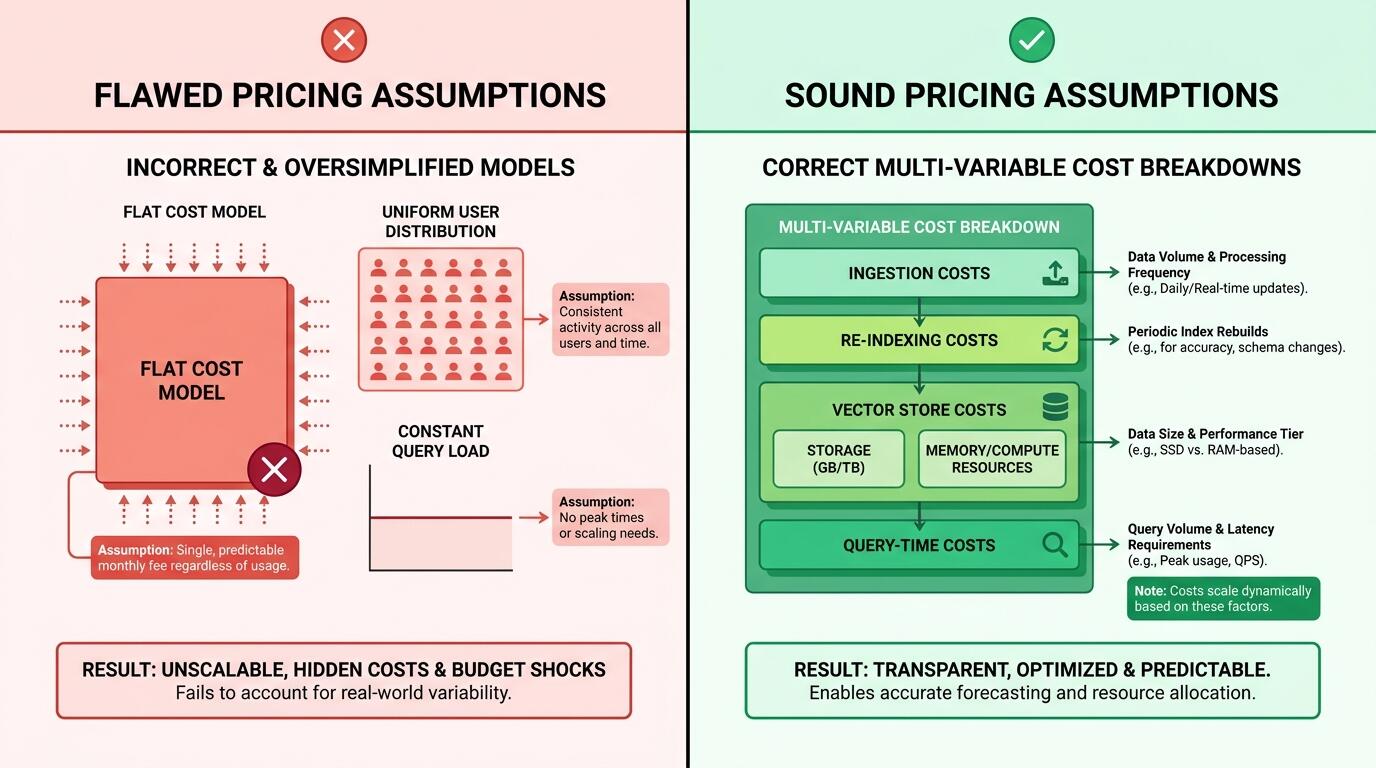
ALT: Side-by-side comparison of correct versus incorrect pricing assumptions for embedding-based vector search in production AI products
Head-to-Head Comparison: Flawed vs. Sound Pricing Assumptions
| Dimension | Common Flawed Assumption | Sound Approach |
|---|---|---|
| Embedding cost type | One-time ingestion cost only | Model ingestion, re-indexing, and per-query costs separately |
| Vector store cost | Negligible infrastructure background | Explicitly model storage, read throughput, and write throughput |
| Model selection | Largest model = best and final choice | Benchmark multiple model sizes; keep substitution possible |
| Index freshness | Daily batch is sufficient by default | Define freshness as a product requirement before modeling cost |
| User usage distribution | Uniform distribution assumed | Model actual distribution; stress-test against high-volume edge cases |
| Pricing-cost alignment | Flat seat or bundle pricing default | Align downstream pricing structure with upstream cost drivers |
The table above clarifies why embedding-based search pricing failures tend to cluster. Most of them stem from treating a dynamic, multi-variable cost structure as if it were static and uniform. The flawed assumptions in the left column all share a common trait: they collapse complexity into a single number to simplify planning, and that simplification breaks down as usage scales.
The sound approaches in the right column require more upfront modeling work, but that work pays for itself quickly. A team that models re-indexing costs separately from query costs, for example, will detect a freshness-driven cost spike before it shows up on an invoice — not after.
One additional observation from teams that have worked through this correctly: the moment of highest pricing risk is not launch, but the first significant volume milestone after launch. That is when usage distribution becomes measurable, when re-indexing load becomes visible, and when the gap between assumed cost and actual cost becomes undeniable. Planning for that milestone explicitly — rather than waiting for it — is the distinguishing habit of teams that price this category well.
Which Approach Should You Choose? Scenario Recommendations
If you are at the prototype stage with an undefined corpus size and no production traffic, prioritize getting your cost model structure right over optimizing specific numbers. Build a spreadsheet that separates ingestion, re-indexing, query-time embedding, and vector store costs as independent line items. Put placeholder values in each cell that you intend to update as you learn more. This structure alone prevents the most common early mistakes.
If you are preparing to price a search feature for customers and your corpus is well-defined but traffic is uncertain, focus on the usage distribution problem above all others. Instrument your beta users to capture per-account query volumes. Even a short beta period with modest traffic will give you enough signal to avoid the uniform-distribution assumption that causes margin erosion later.
If you are operating at scale and discovering that your margins on search are thinner than expected, the most likely culprits in descending order are: vector store costs that were undermodeled at design time, query-time embedding costs from a model that is larger than necessary for your task, and pricing-cost misalignment from high-usage accounts paying a flat rate. Address these in the order that corresponds to your actual cost breakdown, not the order they appear here.
If you are evaluating whether to build your own vector index infrastructure or rely on a managed service, the build vs. buy question has significant pricing implications that extend beyond the initial build cost — operational overhead, re-indexing pipeline complexity, and index freshness guarantees all differ substantially between self-managed and managed approaches. Thinking through this carefully before making an infrastructure commitment is essential.
In our work examining how AI product teams approach infrastructure decisions, a pattern that consistently emerges is that teams who involve a pricing or finance perspective early in the technical design process make substantially fewer of these mistakes than teams who treat pricing as a later-stage concern. The technical and commercial decisions in this category are too tightly coupled to handle sequentially.
Common Questions
Q1: How do I estimate query-time embedding costs before my feature has real traffic?
Query-time embedding cost is a function of query volume multiplied by the cost per query for your chosen model. Before you have real traffic, use your daily active user projection, estimate an average number of searches per user per session based on analogous products in your category, and multiply through. The key is to model this as a per-request variable cost, not a fixed cost. For stress-testing, run the calculation at two to three times your baseline projection to account for power users and automated access patterns that tend to appear after launch.
Q2: Is it always more cost-effective to use a smaller embedding model?
Smaller embedding models are not always the right choice — the cost-quality trade-off depends on your specific retrieval task and quality requirements. Retrieval benchmarks published by academic institutions and model providers consistently show that quality differences between model sizes vary significantly by domain and query type. The correct approach is to evaluate at least two model sizes against your actual retrieval task, measure quality at a threshold that is acceptable to your users, and then choose the smallest model that meets that threshold. This gives you a principled cost floor rather than defaulting to either the largest or smallest available option.
Q3: How much does ongoing re-indexing typically add to the total cost of an embedding-based search feature?
Re-indexing cost varies too widely across use cases to give a universal figure, but it is rarely negligible. The key drivers are content change rate (what percentage of your indexed corpus changes per day), document size, and your freshness requirement (how quickly changes must be reflected in search results). For products with high content churn and sub-hourly freshness requirements, re-indexing can represent a substantial share of total embedding infrastructure cost — comparable to or exceeding query-time embedding costs. Model it explicitly from the start rather than treating it as a residual.
Wrapping Up
Pricing embedding-based search features correctly comes down to three disciplines. First, decompose costs into their constituent parts — ingestion, re-indexing, query-time embedding, and vector store — and model each separately. Second, define product requirements like freshness before modeling costs, not after, because these requirements directly determine the cost structure. Third, model usage distribution realistically rather than assuming uniformity, because the gap between average-case and high-usage-case economics is where margin risk actually lives.
The five mistakes outlined in this article are not exotic edge cases. They appear regularly across teams building AI search products at every stage of maturity. The good news is that all five are avoidable with upfront modeling discipline and a pricing structure that aligns with your actual infrastructure cost drivers.
The next concrete step is to audit your current cost model against each of the five mistake categories. If you have a single number for "embedding costs" that does not separate ingestion from per-query costs, start there. If you have not modeled vector store costs explicitly, do that next. If your downstream pricing is flat when your upstream costs scale with usage, that is the gap most likely to surface as a margin problem at your next volume milestone.
For teams thinking about their broader AI product cost architecture, the agent pipeline and retrieval design decisions that sit upstream of search also have significant cost implications worth examining — particularly the choices around retrieval, verification, and publication in AI agent pipelines that affect both quality and operational cost.
If this article helped clarify how to think about embedding-based search pricing, subscribe to Darius — a bilingual AI briefing written by an engineering director who runs three AI products in production. Each issue covers five to ten AI developments with first-hand sourcing and practitioner-level analysis, filtered specifically for builders making real decisions.
Sources & Citations
- Google DeepMind. "On the Theoretical Limitations of Embedding-Based Retrieval."
https://www.linkedin.com/posts/kasturi-karuna_on-the-theoretical-limitations-of-embedding-based-activity-7497499236406837248-HoKF - IEEE. IEEE Standards and Publications on AI Systems and Machine Learning Infrastructure.
https://www.ieee.org/