Custom Software vs. Off-the-Shelf Platforms: A Founder's Decision Checklist
ALT: Founder comparing custom software versus off-the-shelf platforms using a decision checklist for startups
Custom Software vs. Off-the-Shelf Platforms: How Founders Should Actually Decide
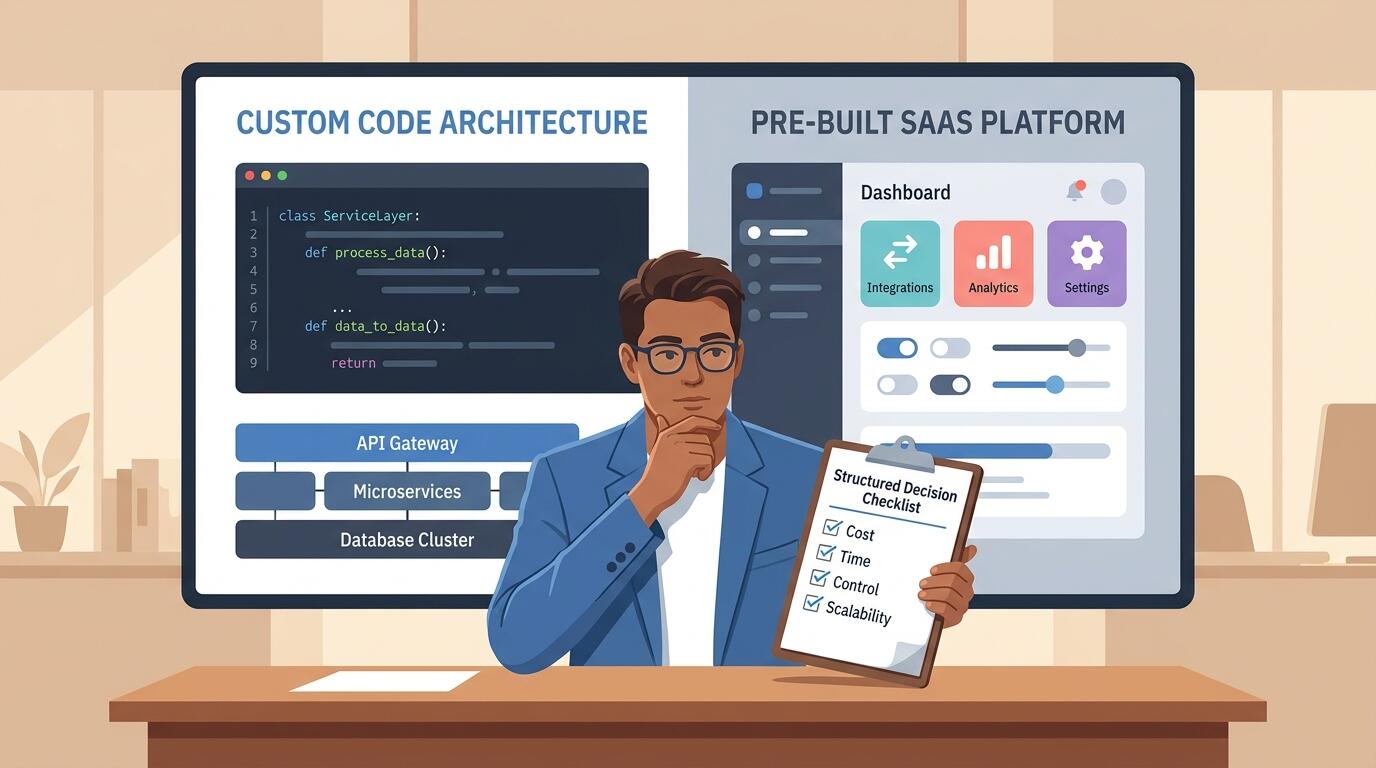
The choice between building custom software and adopting an off-the-shelf platform is one of the most consequential early decisions a founder or engineering leader will make — and it is made wrong far more often than it should be. Off-the-shelf platforms are commercially available, pre-built software products designed to serve a broad market segment with standardized functionality. Custom software is purpose-built code developed specifically to meet a particular organization's requirements. Neither option is universally superior. The right answer depends entirely on your product's differentiation requirements, your timeline, your team's capacity, and your long-term cost tolerance.
This article evaluates both paths across the criteria that actually matter in production: initial cost structure, time to first value, scalability, technical flexibility, and total cost of ownership. The goal is a practical, opinionated checklist — not a theoretical framework — grounded in real-world engineering experience shipping live products.
Evaluation Criteria That Drive the Right Build-vs-Buy Decision
The build-vs-buy decision for software should be evaluated across five dimensions that consistently separate good choices from costly ones.
Initial investment and cash runway impact. Pre-built platforms typically carry lower upfront licensing or subscription costs, while custom development demands significant investment in engineering talent, architecture, and delivery time before a single user interaction occurs. For a capital-constrained startup, this asymmetry can be decisive.
Time to first value. How quickly can your team put a working product in front of real users? Off-the-shelf tools compress this timeline by providing pre-built features, integrations, and infrastructure. Custom builds demand design, development, testing, and deployment cycles before anything ships. In early-stage product work, speed to validated learning often outweighs technical elegance.
Scalability and architectural ceiling. Pre-built platforms are engineered for the average use case. As your product's scale, data model, or interaction patterns diverge from that average, you encounter limits — API rate constraints, data export restrictions, pricing cliffs, or architectural rigidity. Custom software is bounded only by engineering decisions made at design time.
Competitive differentiation and proprietary advantage. If your core value proposition lives inside a workflow or data model that a vendor also serves hundreds of competitors with, your moat is fragile. Custom-built systems can encode your domain logic, your user experience, and your data architecture in ways that no competitor can simply license.
Long-term total cost of ownership (TCO). A pattern consistently seen in production engineering work is that teams underestimate the compounding costs of adapting off-the-shelf platforms to edge cases they were not designed for. Middleware layers, workaround scripts, manual data reconciliation, and vendor lock-in penalties accumulate quietly and expensively. Custom software carries its own ongoing maintenance burden, but that burden is scoped to what you actually need.
The Contenders: Understanding Each Software Path
Custom Software Development
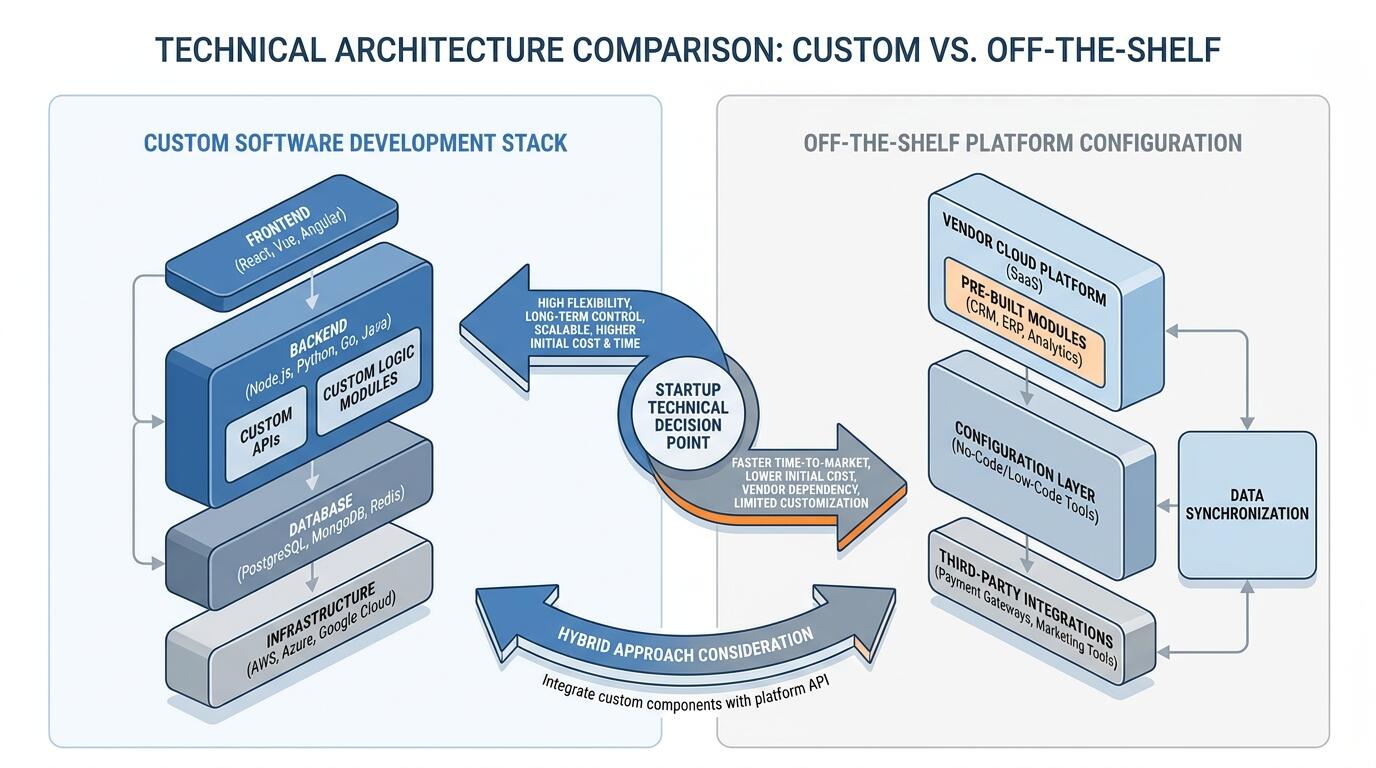
Custom software is purpose-built by an in-house engineering team, a specialist consultancy, or a fractional engineering partner to satisfy a specific product or operational requirement. It is characterized by full architectural control, proprietary data ownership, and the ability to encode domain-specific logic that off-the-shelf tools cannot accommodate without significant workarounds.
The strengths of custom development are well understood: bespoke user experience, integration with any system via designed APIs, no per-seat or per-transaction pricing surprises, and the ability to iterate on the product's core differentiators without negotiating feature requests with a third-party vendor roadmap. The risks are equally well documented: longer delivery timelines, higher upfront engineering costs, and the organizational discipline required to maintain and evolve a codebase over time.
Custom software is the appropriate default when the product's differentiated value is inseparable from its underlying data model, workflow logic, or user experience — and when that differentiation would be compromised or constrained by a vendor's standardized feature set.
Off-the-Shelf Platforms
Off-the-shelf software platforms are commercially produced, market-ready products sold to multiple customers with broadly similar needs. Examples span a wide spectrum: CRM platforms, e-commerce engines, low-code application builders, project management tools, and increasingly, AI-powered SaaS products with configurable pipelines. Vendors in this space compete on feature breadth, integration ecosystems, time-to-deploy, and support infrastructure.
The value proposition of off-the-shelf platforms is real. They absorb the engineering cost of solving common problems, provide battle-tested reliability at scale, and typically include managed infrastructure, compliance frameworks, and vendor support. For non-core business functions — billing infrastructure, email delivery, identity management — off-the-shelf solutions almost always win.
The risk emerges when founders attempt to run core, differentiated product logic through platforms designed for the average use case. According to analysis published by LaunchPad Lab, organizations frequently discover that platform constraints force product compromises that erode competitive positioning over time, making the initial cost savings a poor trade against long-term strategic flexibility.
ALT: Side-by-side architecture diagram comparing custom software development stack versus off-the-shelf platform configuration for founder decision-making checklist
Head-to-Head Comparison: Custom Software vs. Off-the-Shelf Platforms
| Criterion | Custom Software | Off-the-Shelf Platform |
|---|---|---|
| Initial investment | High — engineering, design, and architecture costs before launch | Low to moderate — subscription or licensing fees, configuration |
| Time to first value | Longer — full development cycle required | Faster — deploy and configure in days or weeks |
| Scalability ceiling | High — bounded only by architectural decisions | Moderate — vendor-imposed limits, pricing tiers, API constraints |
| Competitive differentiation | High — proprietary logic, UX, and data model | Low to moderate — same platform available to all competitors |
| Vendor dependency | None — full ownership | High — roadmap, pricing, and availability controlled externally |
| Long-term TCO | Moderate — maintenance scales with complexity added | Variable — licensing costs compound; workaround debt accumulates |
| Integration flexibility | Full — build to any spec | Constrained — dependent on vendor's integration ecosystem |
| Compliance and data ownership | Full control | Dependent on vendor's certifications and data policies |
| Team capability required | High — engineering depth needed | Low to moderate — operational and configuration skills |
The table surface tension between two legitimate engineering philosophies. Off-the-shelf platforms win decisively on speed and initial cost — for use cases they were designed to serve. Custom software wins on differentiation, control, and long-term flexibility — but only when the team has the engineering discipline to ship and maintain it.
A pattern consistently seen in early-stage product work is that founders choose custom development for the wrong reasons: the desire for control, aesthetic preferences, or mistrust of vendor pricing — rather than because their core product value genuinely requires it. The inverse error is equally common: adopting a platform for speed, then spending multiple engineering cycles building workarounds for constraints the platform was never designed to accommodate. Per research compiled by KSense Technologies, organizations that misalign their software strategy with their actual differentiation requirements frequently face costly re-platforming decisions within a relatively short product lifecycle.
The most important insight from production experience is that this decision is rarely permanent at the feature level. Mature products commonly run a hybrid architecture: off-the-shelf infrastructure for commodity functions (authentication, payments, email) alongside custom-built systems for the workflows and data models that encode proprietary value. The decision checklist is not "all custom or all platform" — it is "what requires custom, and what does not."
If you are evaluating how AI-specific infrastructure fits into this build-vs-buy calculus, the build-vs-buy framework for AI infrastructure addresses the unique tradeoffs that emerge when machine learning systems are part of the product stack.
Which Software Path Should You Choose? Scenario Recommendations
Choose custom software when your product's differentiation is inseparable from its logic or data model. If the workflow you are building encodes domain knowledge, proprietary decision rules, or user experience patterns that no vendor serves well, building custom is not a luxury — it is a strategic requirement. This is especially true for AI-native products where model selection, prompt architecture, retrieval logic, and output formatting are core to what users pay for. For these decisions, understanding AI system architecture patterns is foundational before committing to any software path.
Choose an off-the-shelf platform when you are pre-product-market fit and speed of learning outweighs architectural purity. The fastest way to validate whether a product idea deserves custom engineering investment is to test core assumptions with a platform-based MVP. If users do not adopt the core value proposition, you have not spent months building infrastructure. According to MTechZilla's comparative analysis of custom versus off-the-shelf software for startups, teams that over-engineer pre-PMF products consistently lose to faster-moving competitors who validate first and optimize later.
Choose off-the-shelf for non-core functions regardless of your overall strategy. Authentication, billing, transactional email, customer support ticketing, and document storage are solved problems. Building custom versions of these functions consumes engineering capacity that should be allocated to differentiating work.
Choose custom when vendor dependency introduces unacceptable strategic risk. If a single platform controls pricing, data access, and feature availability for your core product, that vendor has significant leverage over your business. Founders who have experienced a vendor deprecating a critical API, raising prices at contract renewal, or pivoting their product roadmap understand this risk acutely.
Pros of custom software: full architectural control, proprietary competitive advantage, no vendor lock-in, long-term cost predictability for stable workloads.
Cons of custom software: high initial investment, requires strong engineering leadership, longer time to first user validation.
Pros of off-the-shelf platforms: rapid deployment, lower initial cost, managed infrastructure and compliance, established support ecosystems.
Cons of off-the-shelf platforms: vendor lock-in, platform constraints force product compromises, scaling costs can become prohibitive, limited differentiation potential.
Questions & Answers
Q1: How do you know if your product actually requires custom software versus a platform?
The clearest signal is whether your product's differentiated value lives inside a workflow or data model that a vendor also serves to your competitors. If you can describe your core feature set using a vendor's marketing materials, you do not need custom software for that feature. If your product requires logic, data relationships, or user interactions that no available platform accommodates without significant workarounds, custom development is warranted. When evaluating this, ask your engineering team how many vendor constraints they would need to work around — the answer is diagnostic.
Q2: Is it realistic to migrate from an off-the-shelf platform to custom software later?
Migration from a platform to custom software is possible but consistently more expensive and disruptive than founders anticipate. Data model mismatches, vendor-specific integrations, and user behavior anchored to platform-specific UX patterns all create migration friction. The realistic path is a parallel build — running custom and platform systems side-by-side during a transition — which demands engineering capacity most growth-stage teams find difficult to sustain. Planning for eventual migration at the time of platform adoption, by maintaining clean data exports and avoiding deep platform-specific customizations, significantly reduces future cost.
Q3: How long does it typically take to ship a custom-built product versus deploying an off-the-shelf platform?
Off-the-shelf platforms can be configured and deployed in days to a few weeks for standard use cases. Custom software development timelines vary substantially based on product complexity, team size, and architectural scope — but production-ready custom systems rarely ship in under several weeks, and more complex products require longer delivery cycles. The more relevant question is how long it takes to validate your core value proposition with real users: platforms win on this measure for pre-PMF products, while custom builds win on the flexibility to iterate deeply once the right product direction is confirmed.
Key Takeaways
- The build-vs-buy decision for software is not a one-time binary choice — it is a recurring architectural judgment applied feature by feature across a product's lifecycle.
- Off-the-shelf platforms win on speed and initial cost for non-differentiating functions; custom software wins on differentiation, control, and long-term flexibility for core product logic.
- The most costly mistake founders make is choosing custom development for prestige or control rather than because their differentiated value genuinely requires it — and the second most costly is adopting a platform for speed and then accumulating years of workaround debt.
- Hybrid architectures are the production reality for mature products: commodity infrastructure runs on platforms, proprietary workflows run on custom-built systems.
- Migration from platform to custom software is always possible and always more expensive than anticipated — design for optionality from the start by keeping data portable and avoiding deep vendor-specific customizations.
Ready to clarify which parts of your product genuinely require custom engineering and which can be served by existing platforms? Explore the right questions to ask an architecture partner before committing to either path — the framing you bring to that conversation will determine the quality of guidance you get.
Visit the Darius website to explore shipped projects, architectural insights, and hands-on engineering resources. Whether you are mapping out your product architecture, evaluating a platform migration, or building an AI-native product from the ground up — connect directly for guidance grounded in real-world delivery experience.
Sources & Citations
- LaunchPad Lab. "Custom Software vs Off-the-Shelf: How to Choose in 2026".
https://launchpadlab.com/blog/custom-software-vs-off-the-shelf/ - KSense Technologies. "Off The Shelf vs Custom Software: Choose the Better ROI".
https://ksensetech.com/blog/off-the-shelf-vs-custom-software/ - MTechZilla. "Custom Software vs Off the Shelf Software for Startups".
https://www.mtechzilla.com/blogs/custom-software-vs-off-the-shelf-software-for-startups
Note: Standards and industry guidance may be updated; please check the latest official documents or consult professional advisors for decisions with significant financial or regulatory implications.