Create Once, Distribute Everywhere: A Step-by-Step Content Workflow

ALT: Step-by-step content workflow showing create once distribute everywhere strategy for AI-powered creators
Build a Smarter Content Engine: The "Create Once, Distribute Everywhere" Workflow
In a world where every platform demands its own format, cadence, and tone, content creators and technical teams alike are drowning in repetitive production work. The problem isn't a lack of ideas — it's the operational drag of reformatting, repurposing, and reposting the same core message across a dozen different surfaces. A pattern we consistently see in our work with clients is that teams spend the majority of their content time on distribution mechanics rather than on the thinking that actually drives value.
This guide is for software engineers, product managers, technical leads, and anyone building or advising on AI-native products who wants to escape that trap. You'll walk away with a concrete, repeatable workflow that lets you create a single authoritative piece of content and systematically distribute it across every relevant channel — without starting from scratch each time. This is the "Create Once, Distribute Everywhere" (COPE) philosophy, operationalized with modern tooling and an AI-native mindset.
Before You Start: Prerequisites and Preparation for a Scalable Content Workflow
Before you build the pipeline, you need to audit what you already have and be honest about what you're missing. Rushing into a distribution workflow without the right foundation is one of the most common reasons these systems collapse within weeks.
What you need before starting:
You'll need a clear sense of your primary content format — the "pillar" format that plays to your natural strengths. For most technical practitioners, this is either a long-form written article, a recorded talk or video, or a detailed audio conversation. You should also have at least one destination platform where you publish consistently, and a rough understanding of two or three secondary channels where your audience also lives (LinkedIn, Twitter/X, YouTube Shorts, newsletters, community Slack groups, etc.).
On the tooling side, you'll need a writing or content management environment (Notion, Obsidian, Google Docs, or similar), access to an AI writing assistant (any capable large-language-model-based tool will do), a lightweight scheduling or publishing tool, and a simple asset storage system — even a well-organized cloud folder works at this stage.
Time and effort: The initial setup requires a meaningful upfront investment — expect to spend several focused sessions designing your templates and testing your pipeline before it runs smoothly. Once the system is in place, the per-piece effort drops substantially.
✅ Checklist before starting:
- Identified your primary "pillar" content format (article, video, podcast, etc.)
- Defined two to four secondary distribution channels
- Access to an AI writing/editing assistant
- A content storage and organization system in place
- At least one completed piece of content to use as a test case
- Basic familiarity with your target audience's platform preferences
- A rough editorial calendar or publishing cadence in mind
The Step-by-Step Content Distribution Workflow: From One Source to Every Channel
Step 1: Create the Pillar Asset — Your Single Source of Truth
The entire workflow depends on one thing: a high-quality, substantive pillar piece. This is the canonical version of your idea — the most complete, most nuanced expression of the insight you want to share. Everything else you publish will be derived from this asset, so investing deeply here pays compounding dividends.
For technical practitioners, a pillar piece typically runs long. It might be a comprehensive written guide (like this one), a recorded 30-to-60-minute deep-dive video, or a detailed podcast episode. The key characteristic is depth: it should contain more insight than any single secondary format can hold, which is exactly what makes it generative.
Write or record as if you're explaining the topic to a smart peer who has no context — be explicit about your reasoning, include examples, and don't skip the nuance. The more complete this source asset, the more derivative content you can extract from it without the outputs feeling thin.
Tip: Before you finish the pillar piece, tag or annotate sections that feel especially quotable, visually interesting, or self-contained. These annotations will save significant time in later steps when you're mining the asset for shorter-form content.
Step 2: Structure Your Content Inventory with an Extraction Map
Once your pillar is complete, resist the urge to immediately start repurposing. Instead, spend time building an "extraction map" — a structured inventory of every content unit the pillar contains. Think of this as decomposing a monolith into microservices: you're identifying the discrete, independently valuable units before deciding how to deploy them.
Go through your pillar and catalog: key arguments or insights (each one is a potential standalone post), memorable quotes or framings (great for social cards or pull quotes), step-by-step sequences (ideal for carousels or thread formats), data points or frameworks (candidates for infographics), and questions the piece answers (perfect for FAQ content or community engagement).
A simple table or spreadsheet works well here. Columns might include: content unit, type (quote, framework, step, etc.), potential formats, and priority. This map becomes your production backlog.
Tip: Aim for at least eight to twelve discrete content units from a single substantial pillar piece. If you're finding fewer, the pillar may not be deep enough — consider expanding it before proceeding.
Step 3: Use AI to Adapt, Not Just Abbreviate
This is where most people go wrong. They use an AI assistant to simply summarize their pillar content, producing shorter versions that feel hollow and derivative. That's not adaptation — that's compression, and it destroys the value that made the original worth reading.
The right approach is to use AI to transform content for each channel's native grammar. Every platform has a different conversational register, structural expectation, and audience intent. A LinkedIn post is not a short blog post. A Twitter/X thread is not a bulleted summary. A newsletter section is not a transcript excerpt.
For each content unit in your extraction map, prompt your AI assistant with explicit context: the target platform, the intended audience on that platform, the tone that performs well there, and the specific insight you want to land. Ask it to rewrite the unit in the native voice of that channel — not to summarize, but to translate.
For example: "Here is a section from a technical article about AI content workflows. Rewrite this as a LinkedIn post for engineering leaders. The post should open with a counterintuitive observation, use short paragraphs, and end with a question that invites comments. Do not summarize — make it feel like an original standalone insight."
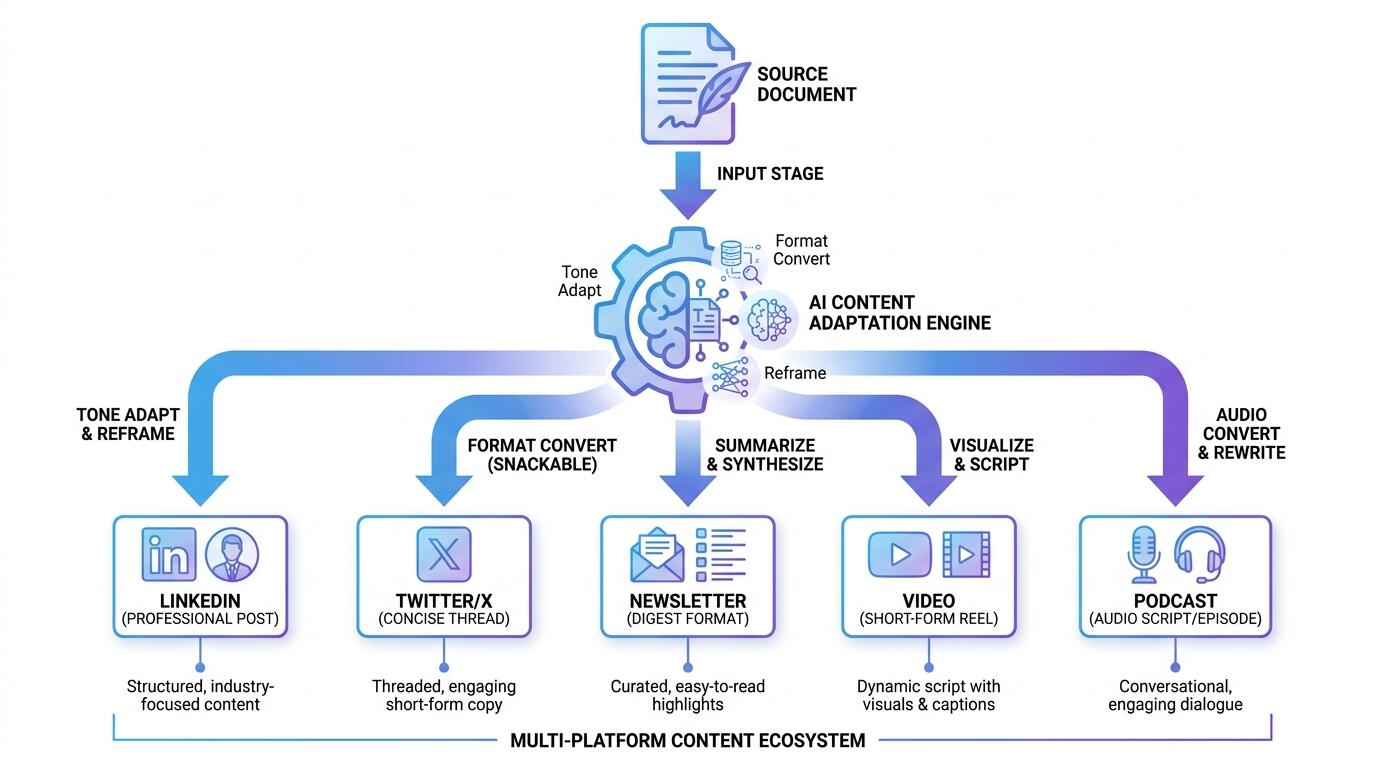
ALT: AI-powered content adaptation workflow diagram showing pillar content being transformed into platform-specific formats for distribute everywhere strategy
Tip: Always review and edit AI-generated adaptations before publishing. AI is excellent at structural transformation and tone-matching, but it can flatten your specific voice or miss the subtle technical nuance that makes your perspective credible. Treat the AI output as a strong first draft, not a finished product.
Step 4: Build Reusable Templates for Each Channel
One of the highest-leverage moves in this workflow is templating. After you've manually adapted content for each channel a few times, you'll notice patterns — the LinkedIn post that performs best tends to follow a specific structure, your newsletter intro always works a certain way, your Twitter/X threads have a recognizable opening move. Codify these patterns into templates.
Templates serve two purposes. First, they dramatically reduce the cognitive load of each distribution cycle — you're filling in a proven structure rather than designing from scratch. Second, they create consistency that audiences come to recognize and trust, which is a meaningful compounding advantage over time.
Store your templates alongside your content management system, ideally with example outputs and brief notes on what makes each template work. When you bring AI into the loop, these templates become system prompts or few-shot examples that dramatically improve output quality.
For technical teams building this as a shared workflow rather than a solo practice, templates are essential for maintaining voice consistency across contributors. This is especially relevant if you're building content operations as part of a broader AI product strategy — the same principle of moving from prototype to production-ready systems applies here: what works once needs to be systematized to work reliably at scale.
Tip: Version-control your templates. As you learn what resonates with your audience, you'll want to iterate on them — and you'll want to know what changed between versions when you're trying to understand performance differences.
Step 5: Schedule and Publish Across Channels with Intentional Spacing
With your adapted content ready, the temptation is to publish everything at once. Don't. Flooding all channels simultaneously with content derived from the same source creates a perception of spam and dilutes the impact of each individual piece.
Instead, build a publishing calendar that spaces out your derivative content over days or weeks following the pillar's release. A common pattern: publish the pillar piece first (your blog, newsletter, or primary platform), then release derivative content in waves — social posts in the first few days, a newsletter section mid-week, a short-form video or audio clip the following week, a community post or Q&A thread shortly after.
This spacing serves multiple purposes: it extends the shelf life of your core idea, it reaches audience members who missed earlier touchpoints, and it creates the impression of a consistent, active presence even when your actual creation effort was concentrated in a single session.
Use a scheduling tool to batch-queue your posts in advance. This removes the daily decision fatigue of "what should I post today?" and keeps the workflow sustainable.
Tip: Tailor the timing of each channel's post to that platform's peak engagement windows. These windows shift over time and vary by audience, so treat your own analytics as the most reliable signal rather than generic best-practice advice.
Step 6: Repurpose Across Formats, Not Just Channels
Channel distribution (same format, different platforms) is only half the picture. Format repurposing — turning written content into visual, audio, or interactive formats — dramatically expands your reach and serves audience members with different consumption preferences.
Consider these format transformations from a single written pillar:
A detailed written guide becomes the script for a recorded walkthrough video. Key frameworks or step-by-step sequences become visual carousel posts or infographic assets. A series of insights becomes the outline for a podcast episode or a live Q&A session. A collection of related questions from your extraction map becomes a standalone FAQ article or a community discussion thread.
Each format transformation requires genuine effort, but the cognitive work is minimal compared to creating from scratch — the thinking is already done. You're investing in production, not ideation.
For practitioners building AI-native products, this principle maps directly onto how well-designed systems reuse core logic across multiple interfaces. The same underlying model capability can power a chat interface, an API endpoint, and an embedded widget — just as the same core insight can power an article, a video, and a social thread.
Tip: Prioritize format transformations based on where your audience actually spends time, not where you're most comfortable producing. Discomfort with a format is often a signal that it's underexplored and therefore less competitive.
Step 7: Close the Loop — Measure, Learn, and Feed Back into the Pillar
A distribution workflow without a feedback loop is just a broadcast system. The most valuable part of the "create once, distribute everywhere" approach is what you learn from seeing how different audiences respond to different framings of the same idea.
Track which derivative pieces generate the most engagement, comments, shares, or click-throughs. Pay attention to the questions people ask in response — these are signals about what your audience finds confusing, surprising, or wants to explore further. Note which framings resonate most strongly, and which fall flat.
Feed these observations back into your content creation process. The questions people ask become the seeds of your next pillar piece. The framings that resonate become the templates you prioritize. The gaps in understanding you identify become the topics you address in future content.
This feedback loop transforms a one-time workflow into a compounding content engine. Over time, your pillar pieces become more precisely targeted, your templates become more effective, and your distribution becomes more efficient — because you're building on real signal rather than assumptions.
If you're serious about shipping content as part of a broader product or personal brand strategy, this iterative discipline is what separates practitioners who build durable audiences from those who burn out after a few months. The same rigor applies whether you're iterating on content or shipping your first live AI product — the feedback loop is the engine of improvement.
Tip: Don't over-index on vanity metrics like raw follower counts or impression numbers. The most useful signals are qualitative: the comments that show genuine engagement, the direct messages asking for more, the shares accompanied by someone's own commentary. These indicate that your content is actually moving people, not just reaching them.
Common Mistakes and Troubleshooting in Content Distribution Workflows
| Symptom | Likely Cause | How to Fix |
|---|---|---|
| Derivative content feels thin and low-value | Pillar piece lacks sufficient depth; AI used to compress rather than transform | Expand the pillar before distributing; rewrite derivative pieces with platform-native framing, not summaries |
| Workflow collapses after a few weeks | No templates or systems in place; relies on willpower rather than process | Build and store reusable templates; batch production sessions rather than daily ad-hoc creation |
| Audience ignores repurposed content | Content is too obviously recycled; no platform-specific adaptation | Invest in genuine format and tone transformation for each channel; make each piece feel native to its platform |
| AI-generated adaptations sound generic or off-brand | Prompts lack sufficient context about voice, audience, and channel norms | Add detailed system prompts with examples of your own writing; treat AI output as a first draft requiring editorial review |
| Publishing cadence is inconsistent | No scheduling system; content is published reactively | Build a content calendar; use scheduling tools to queue posts in advance after each production session |
| No improvement in content quality over time | Feedback loop is missing; not tracking what resonates | Implement lightweight analytics review; document observations and feed insights back into pillar creation |
Pro Tips for Better Results in Your Content Repurposing System
Build a "content vault" alongside your workflow. Every piece of content you create — pillar pieces, derivative posts, strong individual sentences, useful frameworks — should be stored in a searchable repository. Over time, this vault becomes an incredibly valuable resource: you can pull from it when creating new pillars, identify evergreen content worth re-distributing, and spot patterns in what consistently resonates.
Treat your extraction map as a living document. Don't archive it after the initial distribution cycle. Audience questions, comments, and engagement patterns will surface new content units you didn't identify initially. Update the map as you learn, and return to it when planning future content.
Separate creation sessions from distribution sessions. A pattern we consistently see is that creators who try to do both simultaneously end up doing neither well. Batch your pillar creation in deep-work sessions, then handle distribution and scheduling in separate, more operational sessions. The cognitive modes are different, and protecting each one improves the quality of both.
Don't neglect the long tail. Your pillar piece will likely rank in search results and accumulate traffic over months or years. Derivative content has a shorter half-life on social platforms, but the pillar keeps working. Invest in SEO fundamentals for your pillar pieces — clear structure, relevant headings, substantive answers to real questions — and they'll continue generating distribution value long after the initial push.
Common misconception to address: Many practitioners believe that distributing the same content across multiple channels will cannibalize their audience — that people who saw the LinkedIn post won't read the full article. In practice, the opposite is true. Different people discover you through different channels, and those who encounter multiple touchpoints tend to develop stronger connections with your work. Repetition across channels builds recognition, not fatigue — as long as each piece delivers genuine value in its native format.
Questions & Answers
Q1: How do I decide which content format should be my "pillar"?
Choose the format that allows you to express your thinking most completely and that you can sustain over time. For most technical practitioners, this is long-form writing or recorded video. The key test: does this format let you develop an argument with full nuance, or does it force you to compress? Your pillar should be the most complete version of your idea — everything else is derived from it. Start with what feels most natural, then expand to other formats as the workflow matures.
Q2: Is it acceptable to publish nearly identical content across multiple platforms?
Not without meaningful adaptation. Platforms have distinct audiences, norms, and content grammars — what works on LinkedIn reads as tone-deaf on Twitter/X, and vice versa. The goal isn't to copy-paste but to translate the same core insight into each platform's native language. Audiences are also increasingly cross-platform, and encountering identical posts creates a poor impression. Genuine adaptation — even if the underlying idea is the same — is what makes multi-channel distribution feel valuable rather than spammy.
Q3: How much time does it take to maintain this workflow once it's set up?
The upfront investment is real — designing templates, testing AI prompts, and building your extraction map process takes meaningful effort. Once the system is running, however, the per-piece overhead drops substantially. A single deep-work session to create a pillar piece, followed by a focused production session to generate and schedule derivatives, can realistically fuel several weeks of consistent multi-channel presence. The workflow is designed to front-load effort and reduce ongoing friction, not eliminate effort entirely.
Final Thoughts
The "create once, distribute everywhere" workflow is fundamentally a leverage play. It recognizes that the scarcest resource in content creation isn't time or tools — it's original thinking. By investing deeply in a single authoritative piece and then systematically translating it across channels and formats, you multiply the reach of every insight you develop without multiplying the cognitive cost.
Three things to carry forward: First, the quality of your pillar piece determines the ceiling of everything downstream — don't rush it. Second, AI is a powerful transformation tool, but it requires specific, context-rich prompting and editorial oversight to produce output that maintains your credibility and voice. Third, the feedback loop is what turns a workflow into a compounding system — without it, you're just broadcasting.
Your next step is concrete: take a piece of content you've already created — an article, a talk, a detailed Slack message that resonated — and build an extraction map for it. Identify eight to ten discrete content units, pick two channels, and adapt one unit for each using the principles in this guide. Run the experiment before you build the full system. The fastest way to believe in a workflow is to see it work once.
Want to go deeper on building AI-native products that actually ship? Visit Darius to explore hands-on insights, real-world AI product breakdowns, and frameworks from an Engineering Director who has designed and launched production AI systems. Whether you're an engineer leveling up or a leader shaping your team's AI strategy, Darius has the perspective to help you move from idea to deployment.
References
- Content Marketing Institute. "Content Marketing Framework and Best Practices".
- Nielsen Norman Group. "Content Strategy for the Web: Principles and Guidelines".
- Google Search Central. "Creating helpful, reliable, people-first content".
https://developers.google.com
Note: Standards may be updated; please check the latest official documents or consult professional advisors.