How Much Does It Cost to Make 10,000 Files Semantically Searchable?
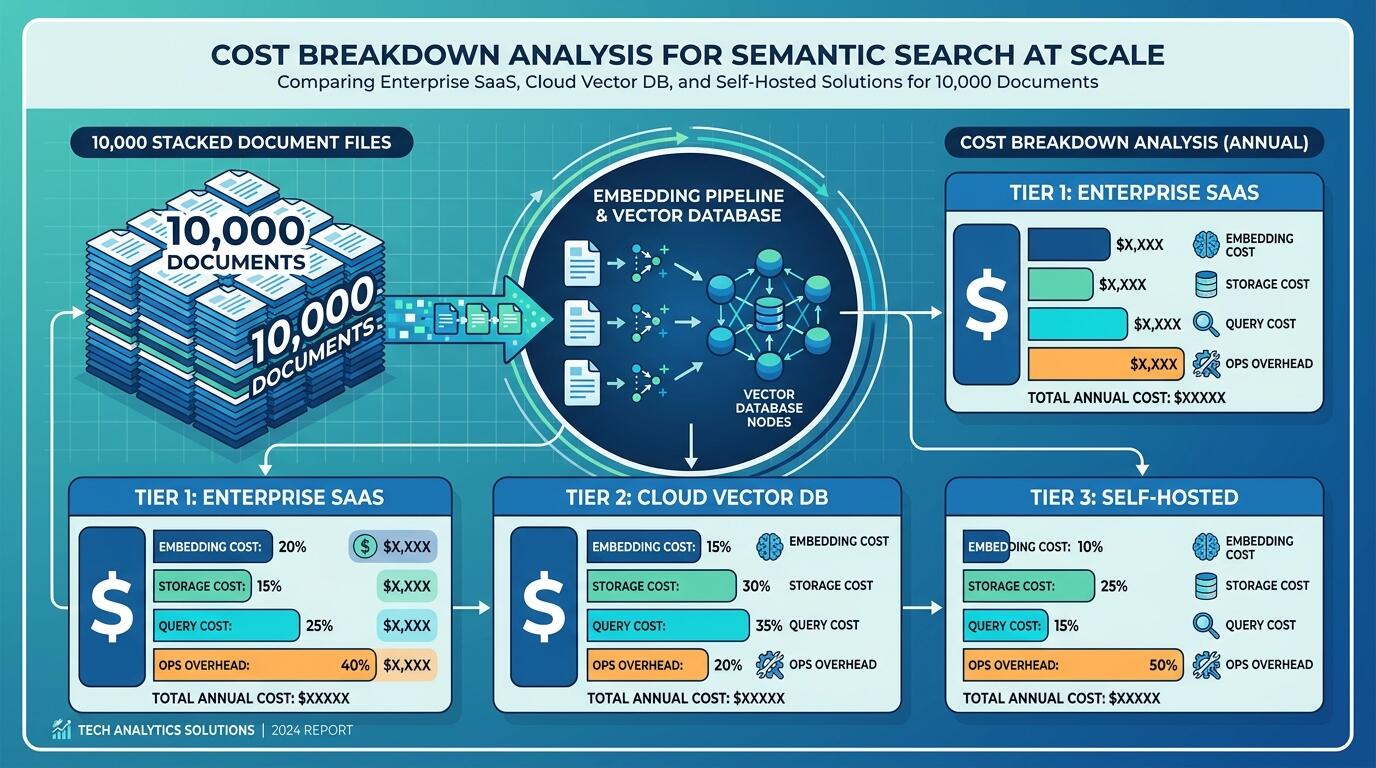
ALT: Cost breakdown for making 10,000 files semantically searchable using embeddings and vector databases
Semantic Search at Scale: Comparing the Real Costs of Making 10,000 Files Discoverable by Meaning
Making 10,000 files semantically searchable — where users find documents based on meaning rather than exact keywords — is no longer a moonshot reserved for big-tech engineering teams. The underlying technology has matured, cloud costs have dropped, and open-source tooling has closed the gap with proprietary platforms. But "semantically searchable" can mean wildly different things depending on the architecture you choose, and those choices carry cost implications that vary by an order of magnitude.
This article compares three primary approaches to building semantic search over a corpus of 10,000 files: a fully managed, enterprise SaaS solution; a cloud-hosted vector database with bring-your-own embedding models; and a self-hosted, open-source stack. The evaluation weighs upfront ingestion cost, ongoing monthly operating cost, latency and performance characteristics, operational overhead, and flexibility to scale. Understanding these trade-offs helps founders, CTOs, and engineering leaders make a defensible, budget-conscious decision before committing engineering resources.
Evaluation Criteria: What Actually Drives the Cost of Semantic File Search
The total cost of making a document corpus semantically searchable is determined by five distinct cost drivers. Ignoring any one of them leads to sticker shock after deployment.
Embedding generation cost is the price paid to convert raw text into dense numerical vectors. Every file must be chunked, tokenized, and passed through an embedding model — either a proprietary API or a self-hosted model. This is a one-time ingestion cost plus an ongoing cost whenever files are updated or re-indexed.
Vector storage cost covers persisting the resulting embeddings in a vector database. Storage cost scales with the number of vectors, their dimensionality, and whether you store metadata alongside them. A corpus of 10,000 files, chunked at a reasonable granularity, can easily generate hundreds of thousands of individual vectors.
Query-time inference cost applies every time a user submits a search. The query itself must be embedded, then compared against the stored vectors using approximate nearest-neighbor search. At low query volumes this is nearly negligible; at high query volumes it becomes the dominant cost line.
Operational and maintenance overhead is the hidden cost most people undercount. Managed services bundle this into a subscription price. Open-source stacks push this cost onto your engineering team — replication, backups, model updates, and infrastructure monitoring all require human attention.
Flexibility and lock-in risk is not a dollar figure but a business risk with financial consequences. A stack that is cheap today but requires a full rebuild to change embedding models or add hybrid search capabilities can easily cost more than a premium managed service when you factor in re-engineering time.
The Contenders: Three Approaches to Semantic Search Over 10,000 Files
Enterprise SaaS Semantic Search (Managed End-to-End)
Enterprise SaaS platforms for semantic search — exemplified by offerings from vendors such as Elasticsearch with its vector search tier, Azure AI Search, and similar cloud-native products — provide a fully managed pipeline. You upload documents, configure chunking and embedding settings through a web UI or API, and the platform handles indexing, storage, and query serving. As described in the LlamaIndex glossary, semantic search over documents is the process of retrieving information based on the meaning of a query rather than keyword matching, and these platforms implement the full lifecycle behind a single pricing tier.
The headline characteristic of managed SaaS is predictability — you pay a subscription or consumption fee, and operational complexity stays on the vendor's side. The tradeoff is that you pay a significant premium for that convenience, and customizing the embedding model or retrieval logic is constrained by what the platform exposes.
Cloud Vector Database with Bring-Your-Own Embeddings (Hybrid Managed)
This approach — used by teams building on Pinecone, Weaviate Cloud, Qdrant Cloud, or similar vector database services — separates embedding generation from vector storage. You call an embedding API (such as OpenAI's text-embedding models or Cohere's embed endpoints) to generate vectors, then store and query them via a managed vector database. The building blocks are independently priced, which creates more granular cost control.
As documented in the tutorial Building a magical AI-powered semantic search from scratch, assembling these components is approachable for a competent engineering team — but it does require deliberate architecture decisions about chunking strategy, metadata filtering, and index configuration. This approach is the most popular starting point for startups building their first semantic search feature.
Self-Hosted Open-Source Stack (Full Control)
The self-hosted path combines an open-source vector database (such as Qdrant, Milvus, or Chroma running on your own infrastructure) with an open-source embedding model (such as sentence-transformers or a locally deployed model from the Hugging Face Hub). Embedding generation happens on your own compute — GPU instances if throughput demands it, CPU if the corpus is small and ingestion is infrequent.
The capital or cloud compute cost is real and upfront. But once the infrastructure is in place, the marginal cost per query trends toward zero. This approach suits teams with strong infrastructure ownership, compliance requirements that prohibit sending document content to third-party APIs, or large enough query volumes to justify the operational investment.
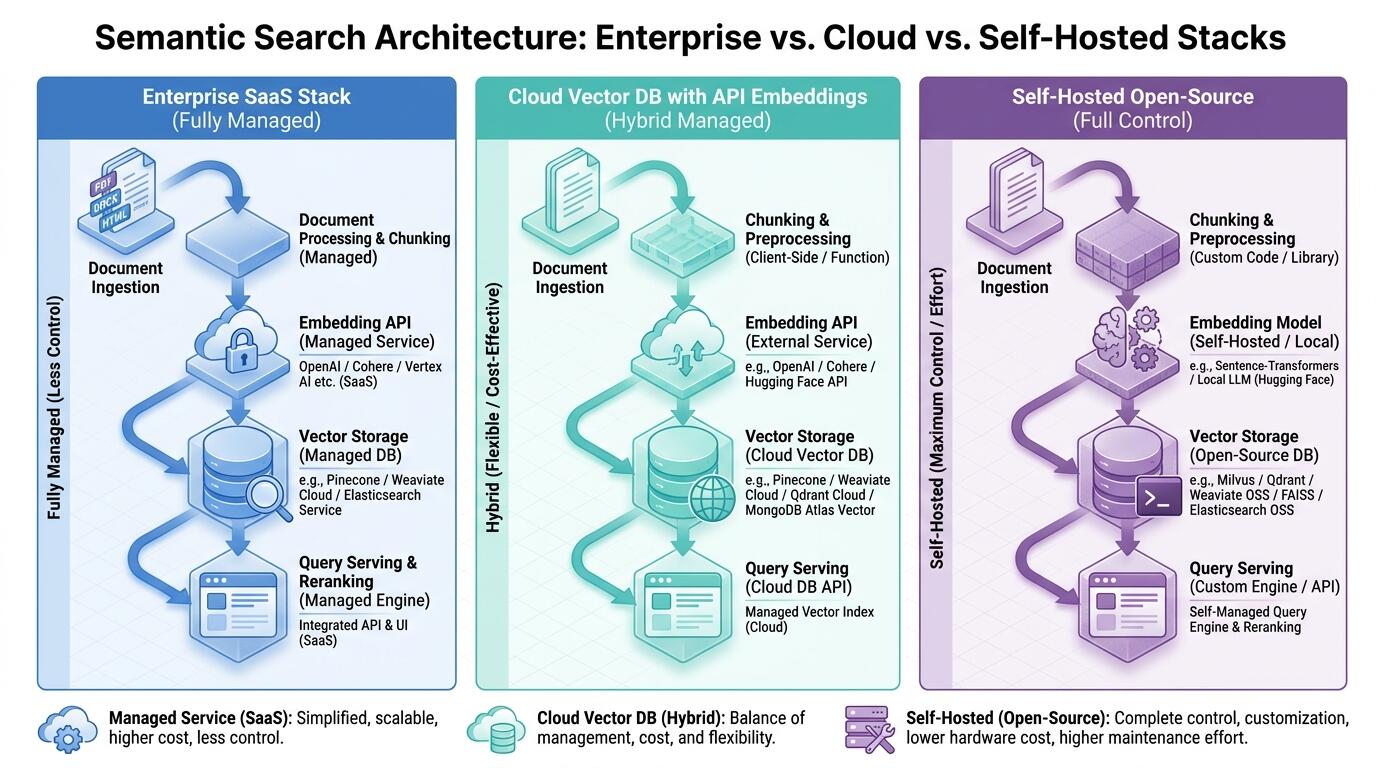
ALT: Diagram comparing enterprise SaaS, hybrid cloud vector database, and self-hosted open-source semantic search architectures for 10,000 file corpus
Head-to-Head Comparison: Costs and Trade-offs Across All Three Approaches
The table below maps each approach across the five evaluation criteria for a representative workload: 10,000 documents, moderate chunking (roughly 20–50 chunks per document yielding an estimated 200,000–500,000 vectors), and moderate query volume.
| Criterion | Enterprise SaaS | Cloud Vector DB + API Embeddings | Self-Hosted Open-Source |
|---|---|---|---|
| Embedding ingestion cost | Bundled in subscription | Per-token API fee (pay-as-you-go) | Compute cost only (amortized) |
| Vector storage cost | Bundled, higher per-unit price | Per-vector or per-pod pricing | Infrastructure cost only |
| Query-time cost | Bundled, often throttled by tier | Per-query embedding + read ops | Near-zero marginal cost |
| Operational overhead | Very low (vendor-managed) | Low-to-moderate (DB managed, model your responsibility) | High (full infrastructure ownership) |
| Flexibility / model choice | Low (vendor's models) | Moderate (swap embedding API) | High (any model, any config) |
| Setup time to production | Hours to days | Days to weeks | Weeks to months |
| Compliance / data residency | Depends on vendor certifications | Depends on cloud region | Full control |
| Relative cost at low volume | High | Moderate | Moderate-to-high (fixed overhead) |
| Relative cost at high volume | Very high | High | Low (fixed cost, high leverage) |
The most important insight the table surfaces is that cost curves cross. Enterprise SaaS appears deceptively affordable at small scale because the upfront friction is low, but as query volume grows the per-unit cost becomes punishing. Self-hosted stacks carry a fixed overhead that looks expensive at launch but becomes the cheapest option per query at sustained high volume. The hybrid managed approach — cloud vector database with API-based embeddings — occupies a genuinely useful middle ground for most startups and mid-sized teams, according to the cost analysis published by Bonnici as part of their total cost of ownership for semantic search comparison.
A second critical insight is that embedding model selection has an outsized impact on ingestion cost. Models with higher-dimensional output vectors are more expressive but generate larger indexes, increasing both storage and query latency. Choosing a model that is "good enough" for your retrieval quality requirements — rather than defaulting to the largest available — is one of the highest-leverage cost optimizations available at the architecture stage.
Operational overhead is the cost dimension most frequently underestimated by founders evaluating these options. In our work with clients designing early semantic search systems, a pattern we consistently see is that a self-hosted stack chosen for cost reasons ends up requiring more engineering hours per month than anticipated, effectively erasing the infrastructure savings. The right choice depends critically on the team's existing infrastructure expertise and appetite for on-call responsibility. This is exactly the kind of architectural trade-off discussion covered in depth in AI system architecture patterns every CTO should evaluate before committing to a path.
Which Should You Choose? Scenario Recommendations for Semantic Search Architecture
If you are a founder or small team validating a semantic search product for the first time, choose the hybrid managed approach — cloud vector database plus an embedding API. It minimizes setup friction, keeps fixed infrastructure costs low, and gives you genuine observability into per-document and per-query costs from day one. You can tune chunking strategy and swap embedding models without rebuilding your infrastructure.
If you are a startup with an established product and growing query volume, re-evaluate your embedding provider costs on a monthly basis. When your embedding API costs begin to rival or exceed the cost of running a small GPU instance, it is time to benchmark open-source embedding models against your retrieval quality requirements. The transition from API embeddings to self-hosted models is modular and does not require migrating your vector database.
If you work in a regulated industry — healthcare, finance, legal — where document content cannot leave your infrastructure, the self-hosted open-source stack is not optional; it is the baseline requirement. Budget accordingly for the engineering time to build and maintain it, or engage an architecture consultant to scope the system correctly before any code is written.
If you are a larger enterprise with existing cloud contracts and a procurement preference for managed services, enterprise SaaS is defensible — especially if the vendor's compliance certifications (SOC 2, HIPAA, GDPR alignment) directly satisfy your security team's requirements. Negotiate on volume tiers and ensure your contract includes provisions for data portability.
Pros and cons at a glance:
Enterprise SaaS — fastest time to production, lowest operational overhead, highest per-unit cost at scale, limited model flexibility.
Cloud Vector DB plus API Embeddings — strong balance of cost control and managed convenience, moderate setup complexity, most adaptable to changing requirements.
Self-Hosted Open-Source — lowest long-run marginal cost, highest flexibility, significant operational overhead, best for compliance-sensitive or high-volume workloads.
For teams weighing the broader infrastructure investment, the ongoing operational economics are well worth modeling before you commit — a detailed perspective on what production RAG and semantic search systems actually cost month-to-month is available in what it actually costs to run a RAG system for a month.
People Also Ask
Q1: How many vectors does a corpus of 10,000 files actually generate for semantic search?
The number of vectors depends on how you chunk documents before embedding. A common strategy splits each document into overlapping text chunks of roughly 256–512 tokens. A 10,000-file corpus with an average of 20–50 chunks per document generates approximately 200,000 to 500,000 vectors. Longer documents with finer chunking can push this significantly higher. The total vector count directly drives storage cost and should be estimated before choosing a vector database pricing tier.
Q2: Is it possible to make 10,000 files semantically searchable without using third-party embedding APIs?
Yes. Open-source embedding models — such as those available through the Hugging Face Hub's sentence-transformers library — can run entirely on your own infrastructure. Embedding generation happens on CPU or GPU compute that you control, so no document content leaves your environment. The trade-off is that you are responsible for model selection, infrastructure provisioning, and keeping the embedding model updated. For compliance-sensitive workloads, this is often a hard requirement rather than a preference.
Q3: How long does it take and what does it cost to re-index if files change frequently?
Re-indexing cost scales with the frequency and volume of changes. If only a small fraction of your 10,000 files change regularly, incremental indexing — processing only changed or new files — keeps ongoing embedding costs low. A full re-index of a 10,000-file corpus using a commercial embedding API typically completes within minutes to a few hours depending on file size and API rate limits. Self-hosted embedding pipelines can process at higher throughput with no per-token cost, making frequent re-indexing substantially cheaper at scale.
The Bottom Line
Making 10,000 files semantically searchable is achievable at a range of price points, and the "right" cost is determined by three factors above all others: your current query volume and its expected growth trajectory, your team's infrastructure ownership capability, and any compliance constraints that govern where document content can travel.
The three core points that should anchor your decision are: first, embedding ingestion is a one-time cost that can be contained with smart chunking and model selection; second, operational overhead is a recurring cost that is consistently underestimated, especially for self-hosted stacks; and third, the cost curves for all three approaches cross at different volume thresholds — model the math for your specific workload before choosing.
The next concrete step is to estimate your vector count (chunk your sample documents, count the chunks, multiply by embedding dimensionality), price it against each provider's current published rates, and add a realistic engineering-hours estimate for setup and maintenance. That exercise alone will narrow the field to one or two approaches worth prototyping.
Ready to make the right architectural call before you start building? Visit the Darius website to explore real shipped projects, technical insights, and professional background. Whether you're an early-stage founder or a scaling team, connect with Darius to discuss how structured engineering thinking can accelerate your product journey.
References & Further Reading
- Bonnici. "Total Cost of Ownership for Semantic Search".
https://www.bonnici.co.nz/blog/semantic-search-cost-comparison-open-source-vs-enterprise - Maxime Heckel. "Building a magical AI-powered semantic search from scratch".
https://blog.maximeheckel.com/posts/building-magical-ai-powered-semantic-search/ - LlamaIndex. "What Is Semantic Search Over Documents?".
https://www.llamaindex.ai/glossary/semantic-search-over-documents - IEEE. IEEE Standards on Artificial Intelligence and Machine Learning Systems.
https://www.ieee.org/ - Hugging Face. Open-Source Embedding Models and the Sentence Transformers Library.
https://huggingface.co/
Note: Standards and pricing structures may be updated; please check the latest official documents or consult professional advisors before making infrastructure commitments.