Cloud Computing Security Best Practices for Enterprise Compliance in 2026
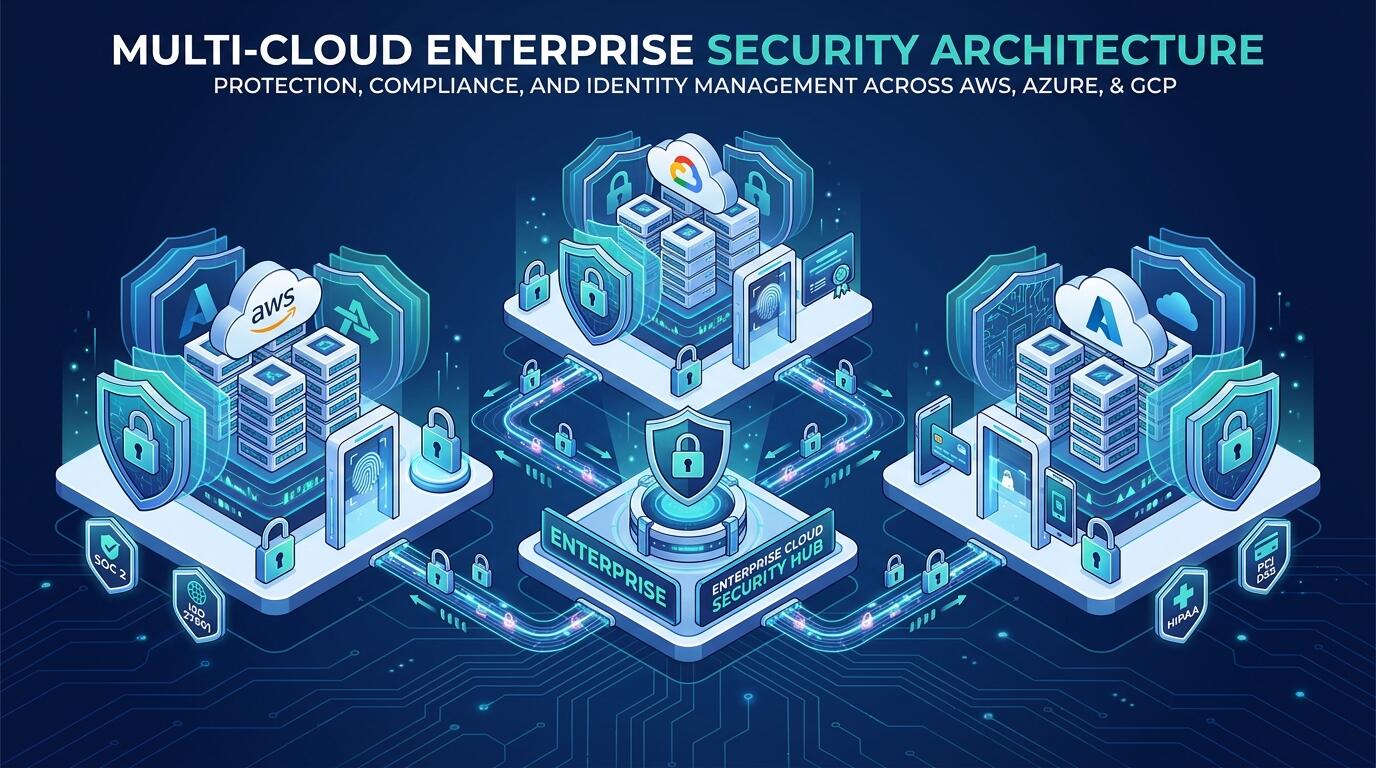
ALT: Cloud computing security best practices for enterprise compliance in 2026 across multi-cloud environments
Enterprise Cloud Security in 2026: Best Practices for Compliance That Actually Hold Up in Production
Key Conclusion: Cloud computing security for enterprise compliance in 2026 demands more than policy documents and checkbox audits. It requires a layered, operationally grounded approach that spans identity, data governance, workload protection, and continuous compliance monitoring. This list distills the practices that consistently determine whether an organization can pass a regulatory audit, withstand a real-world threat, and scale its cloud footprint without accumulating crippling security debt. Each item is selected for its direct impact on compliance posture and production resilience.
The practices below are drawn from patterns observed repeatedly in enterprise and growth-stage environments — organizations running regulated workloads on AWS, Azure, and GCP, often simultaneously. They are ordered not by theoretical importance but by the sequence in which gaps tend to surface during audits or incidents. Use this list as a diagnostic: if your current posture is strong on some items and thin on others, that asymmetry is usually where compliance risk concentrates.
The Core Practices: Cloud Security and Compliance for Enterprise Teams
Implement a Zero-Trust Identity and Access Model
Zero-trust identity is the principle that no user, service, or workload is trusted by default — every access request must be verified continuously, regardless of network location or previous authentication state. In regulated cloud environments, this directly maps to audit requirements under frameworks such as SOC 2, ISO/IEC 27001, and HIPAA, all of which demand demonstrable access controls and least-privilege enforcement.
In practice, this means moving beyond static IAM roles and implementing just-in-time (JIT) access provisioning, short-lived credentials, and conditional access policies that factor in device posture, location, and behavioral signals. The gap we consistently see is that organizations configure IAM correctly at initial deployment, then let it drift as teams grow and roles accumulate permissions organically.
- Best for: Organizations handling regulated data (PII, PHI, financial records) across multi-cloud or hybrid cloud environments where access patterns are complex and dynamic.
- Watch out: Zero-trust implementations can introduce operational friction that causes engineering teams to create workarounds — permanent high-privilege service accounts, shared credentials — that undo the security posture. Adoption requires as much change management as it does tooling.
Enforce Continuous Compliance Monitoring and Automated Remediation
Continuous compliance monitoring means running automated checks against your cloud configuration and workload state in real time, rather than relying on periodic manual audits. Point-in-time assessments — a quarterly penetration test, an annual audit — are structurally insufficient for cloud environments where infrastructure changes happen dozens or hundreds of times per day through CI/CD pipelines.
According to SentinelOne's analysis of cloud security practices, configuration drift is one of the most common root causes of compliance failures — resources are provisioned correctly, then modified by automated processes or manual interventions that bypass policy controls. Effective continuous compliance requires integrating policy-as-code tools (such as Open Policy Agent or cloud-native policy engines) into deployment pipelines so that non-compliant configurations are blocked before they reach production, not flagged after the fact.
- Best for: Engineering teams operating in environments governed by frameworks with continuous control requirements — PCI DSS, FedRAMP, HIPAA — where a single misconfiguration can trigger a reportable incident.
- Watch out: Automated remediation that modifies production infrastructure without human review can cause availability incidents if the remediation logic itself is flawed. Introduce remediation gradually, starting with alerting and logging before enabling auto-remediation.
Apply Data Classification and Encryption at Every Layer
Data classification is the systematic process of categorizing data assets by sensitivity level so that appropriate security controls — encryption standards, access restrictions, retention policies, audit logging — can be applied consistently. Without classification, encryption tends to be applied inconsistently: strong at rest for databases, absent in transit between internal microservices, or missing entirely for unstructured data in object storage.
Enterprise compliance frameworks universally require demonstrable encryption of sensitive data at rest and in transit, with documented key management practices. This means using cloud-native key management services with customer-managed keys (CMKs) for the most sensitive tiers, enforcing TLS for all internal and external service communication, and ensuring that encryption key rotation is automated and auditable. In our experience working through compliance readiness engagements, object storage misconfiguration — public buckets, unencrypted exports — accounts for a disproportionate share of audit findings.
- Best for: Organizations subject to data residency and sovereignty requirements, or those handling multiple categories of regulated data (financial records alongside personal health information, for example) where a single encryption policy does not apply uniformly.
- Watch out: Encryption at every layer creates key management complexity. A robust key management practice is as critical as the encryption itself — lost or unrotated keys create both security and availability risks.
Build a Cloud-Native Security Operations Capability
A cloud-native security operations capability is a threat detection and response function designed specifically for the ephemeral, API-driven nature of cloud infrastructure — as opposed to porting on-premises SIEM tooling directly to the cloud. Traditional security operations centers built around perimeter monitoring and static asset inventories are structurally misaligned with cloud environments where workloads spin up and down in minutes and attack surfaces shift continuously.
Effective cloud security operations in 2026 centers on three capabilities: cloud-native detection (leveraging cloud provider audit logs, VPC flow logs, and workload telemetry), behavioral analytics that can distinguish legitimate automation from adversarial activity, and playbooks designed for cloud-specific incident types — credential compromise, data exfiltration via storage APIs, cryptomining on hijacked compute. Per Sysdig's research on cloud security best practices, the mean time to detect and respond to cloud threats remains significantly longer in organizations relying on adapted on-premises tooling versus purpose-built cloud detection stacks.
- Best for: Organizations that have moved beyond lift-and-shift and are running cloud-native workloads at scale — containerized microservices, serverless functions, managed Kubernetes clusters — where traditional endpoint-centric detection is structurally blind.
- Watch out: Cloud-native security tooling generates high alert volumes. Without proper tuning and integration into a coherent detection workflow, teams experience alert fatigue and miss genuine signals. Invest in signal quality over coverage breadth.
Harden Supply Chain and Third-Party Dependency Security
Software supply chain security is the practice of verifying the integrity and provenance of every software component — open-source libraries, container base images, CI/CD tooling, infrastructure modules — that enters your production environment. In cloud-native architectures, the attack surface has expanded well beyond application code to include the pipelines, registries, and toolchains that build and deploy that code.
Compliance frameworks are catching up to this reality: NIST's Secure Software Development Framework (SSDF) and the requirements emerging from executive-level guidance on software supply chain security explicitly address third-party component risk. In practice, this means implementing software bill of materials (SBOM) generation for all production artifacts, scanning container images for known vulnerabilities before promotion to production registries, signing artifacts cryptographically, and enforcing provenance verification in deployment pipelines.
- Best for: Engineering organizations with complex CI/CD pipelines, heavy open-source dependency usage, or those building software for regulated industries where downstream customers require auditable software provenance.
- Watch out: Supply chain hardening is a non-trivial engineering investment. Starting with the highest-risk components — externally consumed container images, packages with direct network access — delivers more compliance value than attempting comprehensive coverage immediately.
Implement Robust Cloud Logging, Audit Trails, and Evidence Management
Comprehensive audit logging is the foundational evidence layer that makes compliance demonstrable. Without tamper-evident, centralized, retention-compliant logs, every other security control becomes an assertion without proof — and regulatory auditors require proof. Cloud audit trails must capture not just application events but infrastructure-level actions: API calls, configuration changes, privilege escalations, network flow anomalies.
The specific requirements vary by framework — SOC 2 Type II, ISO 27001, and PCI DSS each have distinct retention periods and log integrity expectations — but the architectural pattern is consistent: centralize logs in an immutable, access-controlled repository separate from the workload environment itself, ensure log completeness (including control-plane activity), and establish documented retention and disposal procedures. Qualys's analysis of cloud compliance tooling for 2026 identifies log completeness and retention as among the most commonly cited deficiencies in enterprise cloud audits.
As teams design AI-powered systems and complex distributed architectures, the logging architecture itself becomes a critical design decision. Reviewing AI system architecture patterns every CTO should evaluate alongside your logging strategy can surface integration points that are often overlooked during initial design.
- Best for: All organizations subject to any formal compliance framework — log integrity requirements are effectively universal across regulatory regimes.
- Watch out: Logging everything without a defined query and alerting strategy produces forensic data that is expensive to store and difficult to use. Define what constitutes a compliance-relevant event before building the logging infrastructure around it.
Operationalize Vulnerability Management for Cloud Workloads
Cloud workload vulnerability management is the continuous process of identifying, prioritizing, and remediating security weaknesses in compute instances, containers, serverless functions, and the dependencies they run — adapted for the velocity and ephemerality of cloud environments. Static vulnerability scans run on schedule are insufficient when workloads are rebuilt and redeployed continuously.
Effective cloud vulnerability management in 2026 integrates scanning into the build pipeline (pre-deployment), the running workload (runtime scanning for containers and VMs), and the infrastructure layer (cloud configuration benchmarks aligned to CIS Controls or equivalent). Prioritization is critical: raw vulnerability counts in cloud environments are typically high, and engineering teams need risk-contextualized prioritization — exploitability, internet exposure, data sensitivity of the workload — to allocate remediation effort effectively.
- Best for: Organizations running containerized or serverless workloads where the workload inventory changes rapidly and traditional patch management cadences don't apply.
- Watch out: Vulnerability management programs that generate findings without actionable remediation paths erode engineering team trust in the security function. Ensure that findings are triaged, prioritized, and routed to the teams with the authority and context to fix them.
Design for Resilience and Business Continuity Compliance
Cloud resilience architecture is the design discipline of building systems that maintain acceptable levels of operation under failure conditions — hardware failures, availability zone outages, region-level incidents, and targeted disruptions — in a manner that satisfies regulatory business continuity and disaster recovery requirements. Compliance frameworks including ISO 22301 and sector-specific regulations mandate documented recovery time objectives (RTOs) and recovery point objectives (RPOs), and — critically — tested evidence that those objectives can actually be met.
The gap between documented resilience targets and actual recovery capability is one of the more consequential findings in compliance assessments. Architectures that look correct on paper — multi-AZ deployments, automated backups, failover configurations — frequently have untested failure modes that only surface during actual incidents. Organizations building AI-powered products and complex distributed systems should pay particular attention to this: the governance and operational frameworks for AI systems introduce additional dimensions of resilience and continuity planning. For teams navigating how enterprise AI governance intersects with operational continuity, the emerging practices around enterprise AI governance frameworks offer relevant architectural context.
- Best for: Organizations in regulated industries — financial services, healthcare, critical infrastructure — where downtime has regulatory, contractual, or safety implications beyond operational inconvenience.
- Watch out: Resilience architecture is only as good as its last tested failure scenario. Compliance requires not just the architecture but the evidence of regular, documented recovery testing — runbooks, test results, and remediation records for gaps discovered during tests.
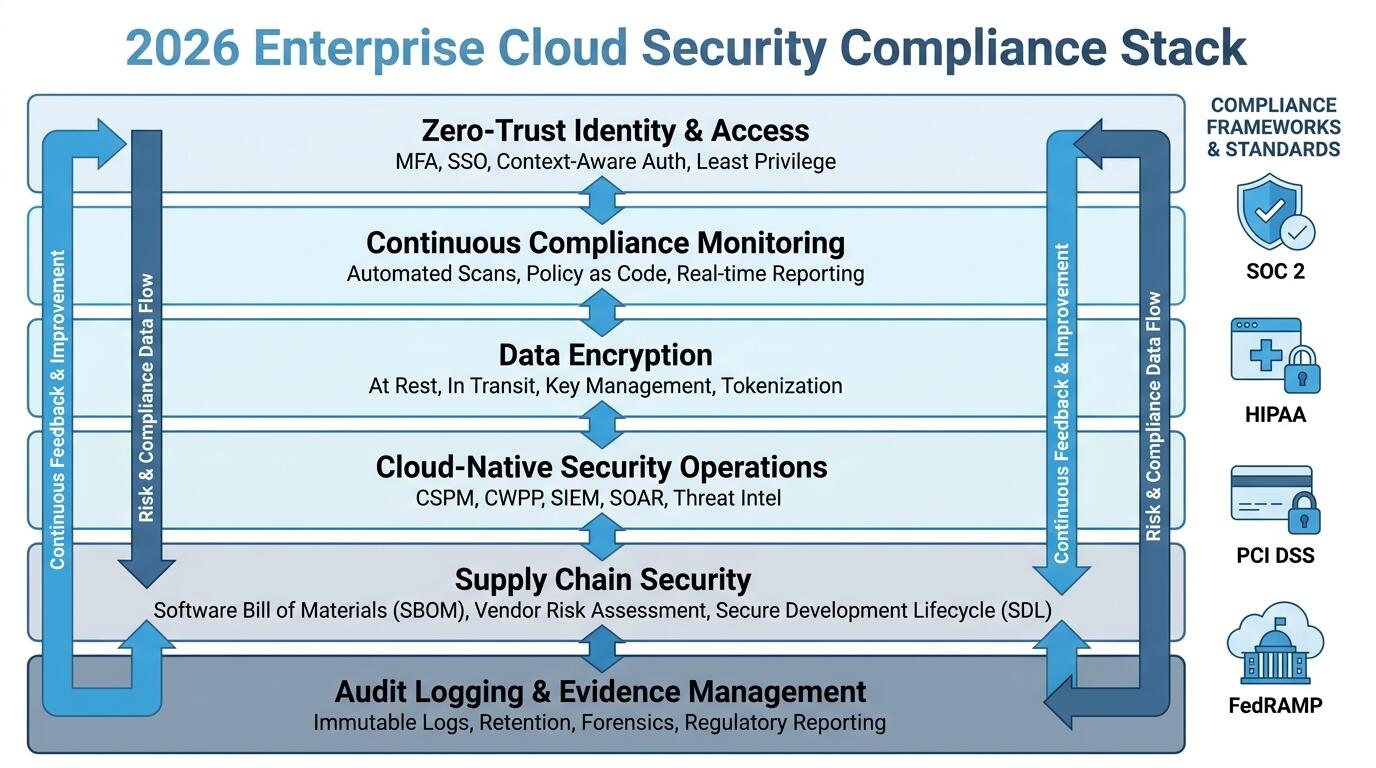
ALT: Enterprise cloud security compliance architecture showing zero-trust identity, continuous monitoring, encryption, and audit logging layers for 2026 regulatory requirements
Quick Comparison at a Glance
The following table maps each practice to the organizational context where it delivers the most compliance value, its primary strength, and the most common implementation limitation.
| Practice | Best For | Key Strength | Limitation |
|---|---|---|---|
| Zero-Trust Identity and Access | Regulated multi-cloud environments with complex access patterns | Directly addresses least-privilege and access control audit requirements | Can introduce friction that drives engineering workarounds |
| Continuous Compliance Monitoring | High-change CI/CD environments under PCI DSS, FedRAMP, HIPAA | Catches configuration drift before it becomes a compliance finding | Automated remediation carries availability risk without careful scoping |
| Data Classification and Encryption | Organizations with mixed data sensitivity tiers and residency requirements | Aligns encryption controls precisely to data risk level | Key management complexity grows with encryption breadth |
| Cloud-Native Security Operations | Cloud-native workloads — containers, serverless, managed Kubernetes | Detection designed for cloud-specific threat models | High alert volume without tuning leads to operational fatigue |
| Supply Chain and Dependency Security | Complex CI/CD pipelines, open-source-heavy stacks, regulated software delivery | Addresses an expanding attack surface not covered by traditional controls | Significant engineering investment; best implemented incrementally |
| Logging, Audit Trails, Evidence Management | All compliance framework environments — universally required | Creates the evidential foundation that makes all other controls demonstrable | Undifferentiated logging is expensive and hard to operationalize |
| Vulnerability Management for Cloud Workloads | Containerized and serverless environments with rapid workload turnover | Integrates security into build and runtime cycles | Unprioritized findings erode team trust in the security program |
| Resilience and Business Continuity Compliance | Regulated industries with contractual RTO/RPO obligations | Ensures recovery objectives are architecturally achievable and evidenced | Requires ongoing tested documentation, not just design |
How to Choose the Right Starting Point
Selecting where to invest first in cloud security and compliance depends on your current posture, your regulatory environment, and the nature of your workload. The decision is less about which practice is most important in the abstract and more about where the gap between your current state and your compliance obligations is largest.
For organizations approaching their first formal audit — SOC 2 Type II, ISO 27001 certification, or a sector-specific review — the highest-leverage starting point is almost always the logging and audit trail layer. Without complete, tamper-evident, properly retained audit logs, no other control can be demonstrated to an auditor. Build that foundation first.
For organizations that have passed initial audits but are struggling with ongoing compliance maintenance, continuous monitoring and policy-as-code integration typically deliver the most durable value. The pattern we see repeatedly is that organizations pass a point-in-time audit and then experience compliance drift as infrastructure evolves faster than manual review cycles can track.
For organizations scaling into new cloud regions, adding new data categories, or integrating AI-driven workloads, data classification and encryption paired with zero-trust identity reconfiguration should be prioritized. Growth events — new regions, new product lines, acquisitions — are when existing security boundaries are most likely to develop gaps.
A common misconception worth addressing directly: many teams conflate cloud provider security features with enterprise compliance readiness. Cloud providers — AWS, Azure, GCP — offer substantial native security tooling, and that tooling is genuinely useful. But the shared responsibility model means that configuration, access management, data handling, and compliance evidence generation are squarely in the customer's domain. The provider secures the infrastructure; the enterprise is responsible for what runs on it, how it is configured, and how it handles regulated data. Organizations that treat native cloud security features as a compliance solution rather than a compliance component routinely discover material gaps during their first formal audit.
When evaluating whether to build, integrate, or buy components of your cloud security and compliance stack, the architectural decision framework matters as much as the tooling selection. For teams working through complex build-versus-buy decisions in the context of technical infrastructure, the build vs. buy decision framework for technical infrastructure offers a structured way to think through these trade-offs before committing to a direction.
Questions & Answers
Q1: How should enterprise teams prioritize cloud security investments when facing multiple compliance frameworks simultaneously?
Prioritize controls that satisfy the most overlapping framework requirements first. Identity and access management, encryption, and audit logging are required — in some form — by virtually every major compliance framework, including SOC 2, ISO 27001, PCI DSS, and HIPAA. Mapping your control set against a unified controls framework (the Cloud Security Alliance's Cloud Controls Matrix, for example) allows teams to identify which investments satisfy multiple obligations simultaneously, reducing duplication and total compliance overhead.
Q2: Are cloud-native security tools sufficient for enterprise compliance, or do third-party tools remain necessary?
Cloud-native security tools from major providers have matured significantly and can satisfy many compliance control requirements. However, third-party tools typically remain necessary for multi-cloud visibility, cross-cloud audit log aggregation, and compliance reporting formats that align with auditor expectations. The most practical approach is to use native tools for workload-level detection and configuration enforcement, and to layer purpose-built compliance tooling for evidence management, cross-environment reporting, and framework-specific control mapping.
Q3: How long does it typically take to reach a defensible cloud compliance posture from an early or informal security baseline?
The timeline depends heavily on the complexity of the cloud environment, the specific framework requirements, and whether the organization has dedicated security engineering capacity. From a realistic practitioner standpoint, reaching a defensible posture for a focused scope — a single product, a defined data environment — under a framework like SOC 2 Type II typically takes several months of focused effort for the observation period alone, preceded by a readiness and remediation phase of comparable duration. Starting with a gap assessment against the target framework is the most reliable way to scope the actual effort.
Final Thoughts
Cloud computing security for enterprise compliance in 2026 is not a solved problem you configure once and maintain with minimal effort. Three points consistently separate organizations that sustain a defensible compliance posture from those that pass one audit and struggle with the next.
First, compliance is an operational discipline, not an architectural state. The controls you design must be continuously monitored, tested, and adapted as your cloud environment evolves. Configuration drift, supply chain changes, and new workload types all create compliance gaps that accumulate faster than periodic reviews can catch.
Second, evidence is the product. Every control you implement must produce auditable, tamper-evident records that demonstrate the control operated as designed over the audit period. Security without evidence is not compliance.
Third, the gap between compliance and security is real but manageable. Compliance frameworks define a floor, not a ceiling. The organizations that treat compliance as the minimum rather than the goal tend to build security programs that hold up under real-world conditions, not just audit conditions.
The practices outlined here are a starting point for that conversation — a map of where the leverage is highest and where the most common gaps appear in production environments.
If you're ready to turn these practices into a concrete security and compliance architecture for your cloud environment, visit the Darius website to explore technical insights, shipped project examples, and how to engage with an engineering director who can move from architecture to implementation.
References
- Sysdig. "13 cloud security best practices for 2026".
https://www.sysdig.com/learn-cloud-native/top-cloud-security-best-practices - SentinelOne. "Top 25 Cloud Security Best Practices".
https://www.sentinelone.com/cybersecurity-101/cloud-security/cloud-security-best-practices/ - Qualys. "Top 10 Cloud Compliance Tools 2026: Security & Audit Readiness".
https://blog.qualys.com/product-tech/2026/01/29/top-10-cloud-compliance-tools-for-enterprise-security-and-audit-readiness-in-2026 - National Institute of Standards and Technology (NIST). Secure Software Development Framework (SSDF) and Cloud Security Guidance.
https://www.nist.gov/
Note: Standards and regulatory requirements may be updated; please check the latest official documents or consult professional advisors.