Chunking, Metadata, and Why Retrieval Quality Degrades in Production
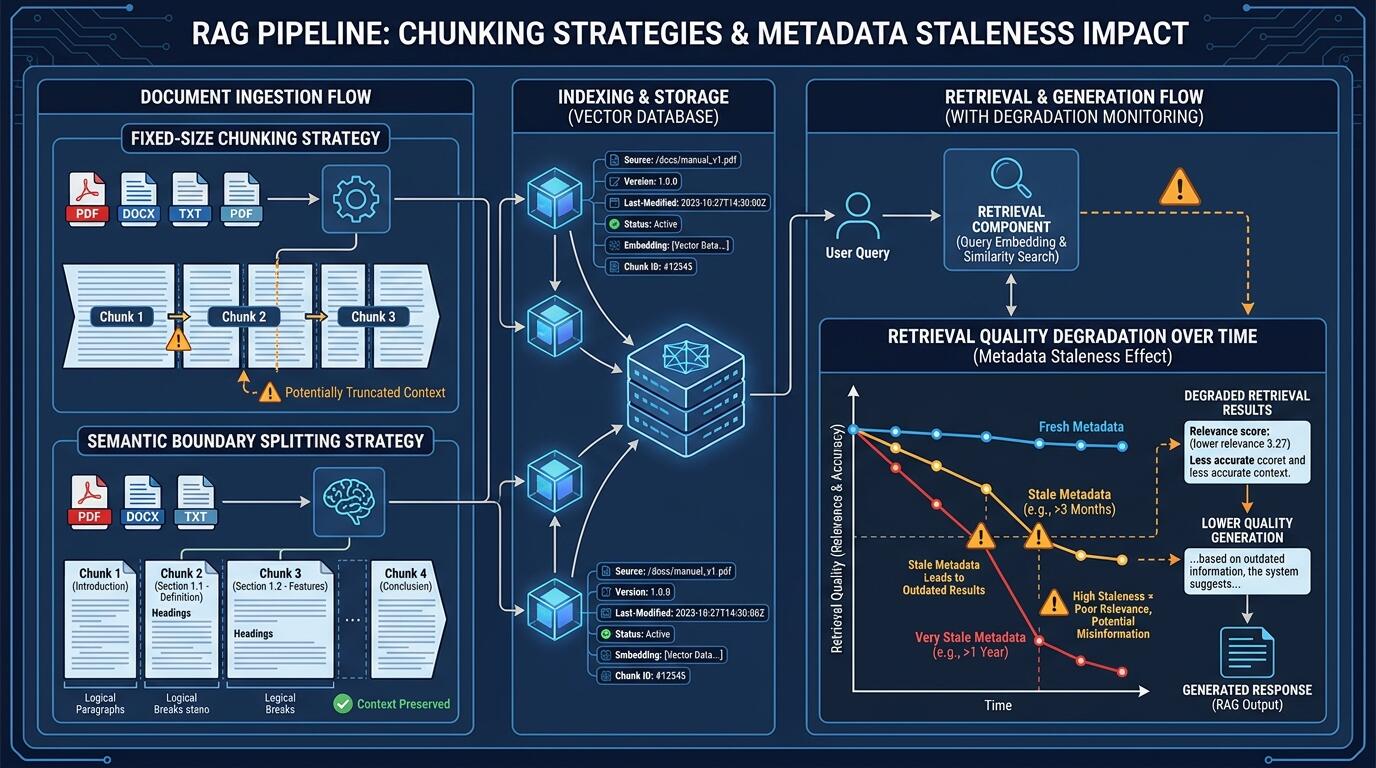
ALT: RAG pipeline diagram showing chunking strategies and metadata degradation in production AI retrieval systems
Why Your RAG Retrieval Gets Worse Over Time — Not Better
Key Conclusion: Chunking strategy and metadata design are the two variables most responsible for retrieval quality degradation in production RAG systems. Poor chunk boundaries fragment semantic context, while stale or absent metadata causes the retrieval layer to return results that were once relevant but no longer match the query intent or the corpus state. Engineers who treat chunking as a one-time preprocessing decision and metadata as an afterthought will consistently observe precision and recall declining as their knowledge base grows and evolves.
Most RAG (Retrieval-Augmented Generation) failures in production are not model failures. They are indexing failures — problems introduced before the first embedding is ever computed. In our experience building and operating AI products at the pipeline level, retrieval quality degradation almost always traces back to two root causes: how text is split before indexing, and how poorly the index is annotated with structured metadata. These are solvable engineering problems, but only if you diagnose them correctly.
The State of Production RAG: Where Most Systems Actually Break
Retrieval-Augmented Generation (RAG) is a technique that combines a vector search index with a language model: a user query is embedded, the nearest document chunks are retrieved, and those chunks are passed as context to the LLM to generate an answer. The architecture looks simple in demos and falls apart systematically in production.
The current landscape is roughly as follows: teams prototype a RAG system using a framework like LangChain or LlamaIndex, achieve acceptable results on a curated test set, and then ship it. Weeks or months later, users report that answers have gotten worse, or that the system confidently returns outdated information. The debug cycle begins, and it almost always surfaces the same class of problems: chunk boundaries that split mid-argument, metadata fields that were never populated or that expired silently, and a vector index that now contains contradictory versions of the same document.
The volume and complexity of this problem has grown considerably as organizations moved from toy corpora (a few dozen PDFs) to live knowledge bases containing thousands of documents that are updated continuously. In that regime, the naive approaches — fixed-size token splitting, no metadata, no versioning — break down quickly.
There is also a subtler dynamic at work. Semantic drift in the corpus is invisible to the retrieval layer unless you explicitly track it. If a policy document is updated, the old chunks remain in the index unless you delete and reindex them. The retrieval system has no concept of document recency unless you give it one. And even if you do reindex, the chunk boundaries in the new version may be structurally identical to the old ones, making deduplication unreliable.
The Root Causes: How Chunking and Metadata Failures Compound
Fixed-Size Chunking Destroys Semantic Units
Fixed-size chunking is the practice of splitting documents at a uniform token or character boundary, without regard to the semantic structure of the content. It is the default in most tutorial-level RAG setups, and it is also the single most common cause of retrieval quality problems we see in practice.
The core issue is simple: language does not align with fixed windows. A 512-token chunk may contain half an argument and the beginning of the next one. When that chunk is embedded and retrieved, the resulting context is semantically incomplete — the LLM receives something analogous to a sentence that was cut off mid-thought. The model will attempt to answer from that fragment, producing answers that are technically grounded in the retrieved text but miss the actual point the source document was making.
The alternative — semantic chunking — splits on structural boundaries: paragraphs, sections, or logical units detected via header parsing, sentence-boundary detection, or recursive splitting. Semantic chunking is harder to implement uniformly across document types (a PDF parsed through a poor extraction pipeline loses its structure entirely), but it produces chunks whose embeddings more faithfully represent a coherent idea.
A related failure mode is chunk size miscalibration. Chunks that are too small lose context; chunks that are too large dilute the signal. The right chunk size is corpus-dependent and query-dependent, which means it cannot be set once during prototyping and left unchanged as the corpus grows. In practice, a chunk size tuned for short FAQ entries performs poorly when the corpus is expanded to include long technical specifications, and vice versa.
Overlap Without Coherence Adds Noise, Not Signal
Many teams add chunk overlap — a sliding window that includes the last N tokens of the previous chunk at the start of the next — to mitigate boundary fragmentation. Overlap helps at the margins but creates its own problems. Overlapping chunks that contain near-duplicate content inflate the index size and introduce retrieval noise: the top-k results may be dominated by five slightly different versions of the same passage rather than five distinct pieces of evidence. Overlap is a mitigation, not a solution.
Metadata Is an Afterthought Until It Isn't
Metadata in a RAG index refers to the structured fields attached to each chunk: document source, author, creation date, last-modified date, document type, section title, version, and any domain-specific tags your application logic depends on. Most teams populate source and creation date, and then stop.
The consequence becomes visible during filtering and ranking. If you need to restrict retrieval to documents modified within the last 90 days, you need a reliable last_modified field. If you need to surface only content approved for a specific user role, you need an access-control field. If you want to deprioritize deprecated content, you need a status field. These are not features you can add retroactively without reindexing everything — and reindexing is expensive at scale.
A pattern we consistently observe is the metadata desynchronization problem: the source document is updated in the CMS or document store, but the chunk-level metadata in the vector index is never refreshed. The index now contains chunks labeled with the old metadata, and any filters operating on that metadata will produce incorrect results silently. There is no error — the retrieval system returns chunks, the LLM generates an answer — but the answer is based on stale attribution.
Embedding Model Staleness Compounds Indexing Errors
When a corpus is partially reindexed using a newer embedding model while legacy chunks remain indexed under the old model, the vector space becomes inconsistent. Queries embedded with the new model will not reliably retrieve chunks embedded with the old one, because the two embedding spaces are not aligned. This embedding model mismatch is a production failure mode that is easy to introduce and hard to detect without systematic retrieval quality monitoring.
Retrieval Evaluation Is Absent or Misleading
Most teams evaluate retrieval on a static golden dataset assembled during development. In production, query distributions shift, the corpus evolves, and the golden dataset becomes unrepresentative. A retrieval system that scores well on the original evaluation set can degrade significantly on live traffic while metrics dashboards show no change. Real retrieval quality monitoring requires live query analysis, not just static benchmarks.
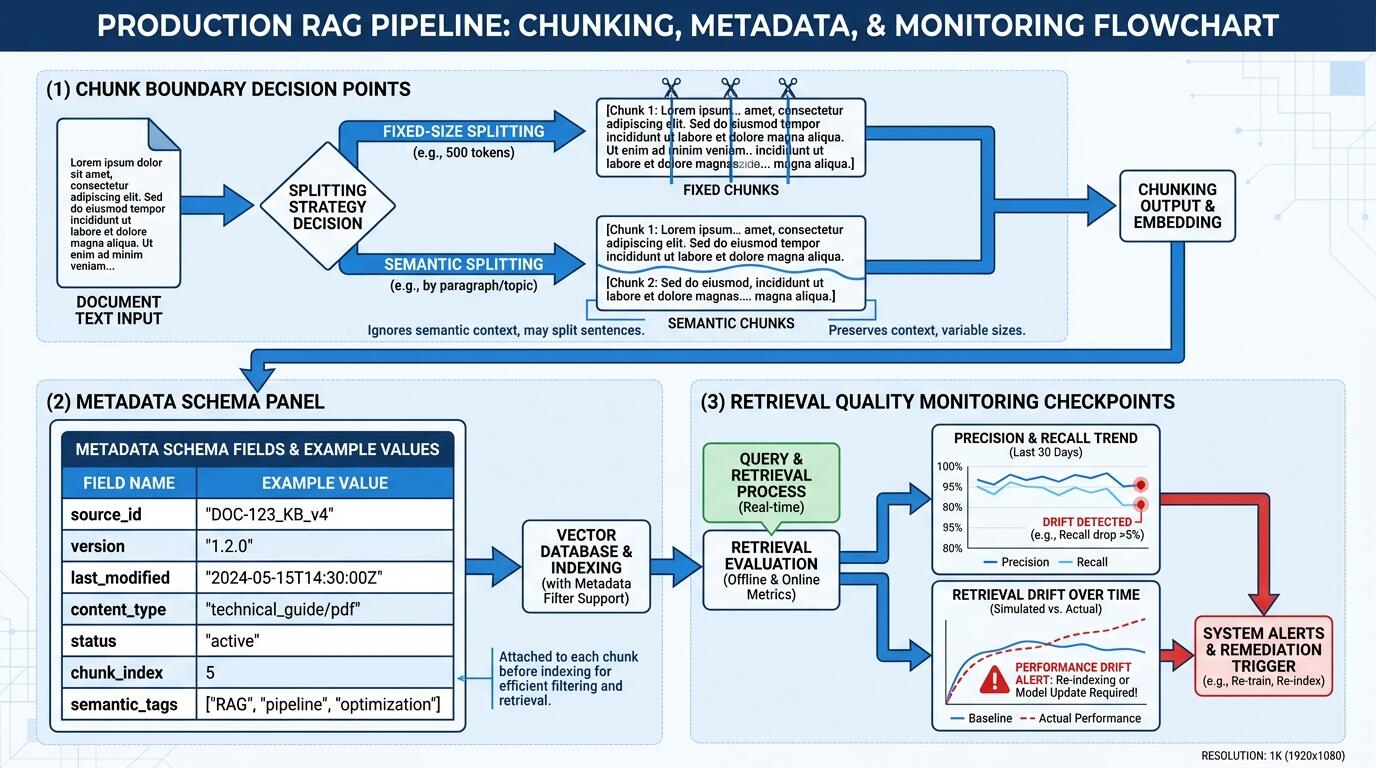
ALT: Diagram of a production RAG pipeline illustrating chunk boundary decisions, metadata schema fields, and retrieval quality monitoring checkpoints
Evidence and Approaches: Comparing Chunking and Metadata Strategies
Different teams take different approaches to these problems. The following comparison reflects documented approaches and their practical trade-offs as we understand them from building and observing production systems.
| Perspective / Approach | Strengths | Trade-offs | Best Fit |
|---|---|---|---|
| Fixed-size token chunking | Simple to implement; predictable index size; works reasonably on uniform corpora | Breaks semantic units; requires manual tuning; degrades on varied content types | Homogeneous document collections with consistent structure |
| Semantic / structure-aware chunking | Preserves semantic coherence; better embedding fidelity; lower retrieval noise | Depends on reliable document parsing; more complex pipeline; slower preprocessing | Mixed document types, long-form content, technical documentation |
| Hierarchical chunking (parent-child) | Retrieves fine-grained chunks but provides broader context on demand; reduces dilution | Increases index complexity; requires two-stage retrieval logic | High-precision use cases where context window management matters |
| Minimal metadata (source + date) | Fast to implement; low storage overhead | Insufficient for filtering, versioning, or access control; fails at scale | Prototypes and internal tools with stable, small corpora |
| Rich metadata with lifecycle tracking | Enables precise filtering; supports deprecation; keeps index synchronized with source | Significant upfront schema design; requires metadata sync pipelines | Production systems with frequently updated corpora and compliance requirements |
The evidence from teams working at meaningful scale consistently points in the same direction: the systems that age well are the ones that invest in metadata schema design and semantic chunking during the initial architecture phase, not as a retrofit. The teams that skip this work during early development universally report it as a debt that compounds.
For a detailed look at how a real production pipeline handles retrieval, verification, and publication end-to-end, the agent pipeline behind a daily AI briefing covers the architecture decisions and failure modes we encountered directly — including how retrieval quality is monitored at each stage.
Outlook: Where Retrieval Engineering Is Heading
Retrieval quality engineering is converging toward two developments that matter for anyone building production RAG systems today.
The first is retrieval evaluation as a first-class concern. Teams that ship serious RAG products are building continuous retrieval evaluation into their CI/CD pipelines — not just checking whether the system returns an answer, but whether the retrieved chunks actually support that answer. This means annotated test queries, coverage metrics over the corpus, and drift detection as the knowledge base evolves.
The second is metadata-aware retrieval becoming the standard architecture rather than the exception. Hybrid retrieval — combining dense vector search with sparse keyword search and structured metadata filters — is now the approach recommended by most practitioners who have operated RAG systems at scale. Pure vector search on a large, heterogeneous, continuously updated corpus does not maintain acceptable precision without metadata to constrain and rank results.
For engineers making build-vs-buy decisions on retrieval infrastructure, understanding the specific chunking and metadata capabilities of candidate solutions is now a primary evaluation criterion — not a secondary one. The question is not just "how does it embed?" but "how does it partition, annotate, version, and refresh?"
Practically, the highest-leverage actions you can take right now are:
- Audit your current chunk boundaries using real query logs — identify the queries where retrieved chunks are adjacent to but not containing the relevant information.
- Design a metadata schema that includes at minimum: source ID, version, last-modified timestamp, content type, and a status field (active / deprecated / draft).
- Build a metadata sync pipeline that is triggered by document updates in your source system, not by periodic batch reindexing.
- Run your retrieval evaluation on live query samples, not just your original golden set.
- If you are evaluating infrastructure choices, read through the trade-offs discussed in the context of build vs. buy decisions for AI infrastructure — the chunking and metadata pipeline is one of the areas where build-or-buy calculus is most non-obvious.
Questions & Answers
Q1: How should chunk size be determined for a production RAG system?
Chunk size should be determined empirically, not preset. Start with a working hypothesis based on your document structure — typically smaller chunks (128–256 tokens) for dense factual content and larger chunks (512–1024 tokens) for narrative or argumentative text. Then measure retrieval precision on real query samples. Chunk size is a tunable parameter, not a fixed constant; it needs to be revisited as your corpus content type evolves. Relying on framework defaults without corpus-specific tuning is one of the most common sources of retrieval degradation.
Q2: Is metadata filtering worth the engineering overhead for smaller RAG deployments?
Metadata filtering is worth building from the start even for smaller deployments, because retrofitting it later requires reindexing the entire corpus. The minimum viable metadata schema — source identifier, creation date, last-modified date, and a status field — is low effort to implement initially and prevents the most common production failure modes. The engineering overhead scales with schema complexity, not with corpus size. A simple schema applied consistently from day one is far less expensive than debugging metadata desynchronization across thousands of chunks months later.
Q3: How long does it typically take for retrieval quality to noticeably degrade after initial deployment?
Retrieval quality degradation timelines vary based on corpus update frequency and query volume. In our observation, systems with frequently updated corpora (daily or weekly document changes) and no metadata sync pipelines begin showing measurable quality issues within weeks of deployment. Systems with stable corpora can maintain acceptable quality longer, but are still vulnerable to embedding model staleness if the index is partially updated. The degradation is usually gradual and silent — precision drops incrementally, making it easy to miss without active retrieval quality monitoring against live traffic.
Key Takeaways
Three findings from this analysis that are worth carrying forward:
Chunking is an ongoing engineering decision, not a preprocessing step. The chunk boundaries, sizes, and strategies that work for your corpus on launch day will not be optimal as the corpus scales and diversifies. Build chunking configuration as a tunable, versioned parameter in your pipeline, not a hardcoded constant.
Metadata schema design is infrastructure. Treating metadata as optional annotation rather than as a core part of your retrieval architecture is the fastest path to a system that appears to work but silently returns stale, misattributed, or unconstrained results. Design the schema before you index the first document.
Retrieval quality requires continuous measurement on live traffic. Static golden datasets cannot tell you whether your retrieval is degrading in production. Instrument your retrieval layer to capture query-level precision signals — even rough approximations like click-through on retrieved sources — and alert on drift.
The next step is an honest audit of your current pipeline. Pull a sample of recent queries, trace them through your retrieval layer, and inspect the actual chunks being returned. In most production systems, that audit is revealing.
If you are building AI products and need to stay current on retrieval engineering, evaluation methodology, and the practical details that don't appear in framework documentation, the Darius briefing covers exactly this kind of ground — filtered through the perspective of engineers operating real AI systems in production. Visit Darius to subscribe to the bilingual briefing and stay in sync with practitioners who are building in the same space.
Sources & Further Reading
- PremAI. "Building Production RAG: Architecture, Chunking, Evaluation, and Monitoring — 2026 Guide".
https://www.premai.io/blog/building-production-rag-architecture-chunking-evaluation-monitoring-2026-guide/ - Yigtwxx (GitHub). "chunking-strategies.md — Awesome RAG Production".
https://github.com/Yigtwxx/awesome-rag-production/blob/main/chunking-strategies.md - BackendBytes. "Building Production RAG Pipelines: Chunking, Embeddings, and Retrieval".
https://backendbytes.com/articles/production-rag-pipelines-go/ - IEEE (Institute of Electrical and Electronics Engineers). Standards and publications on information retrieval systems and natural language processing evaluation.
https://www.ieee.org/
Note: Technical practices in RAG and retrieval engineering evolve rapidly. Cross-reference the above sources with the latest documentation from your embedding model and vector database providers.