Build vs. Buy for AI Infrastructure: A Decision Framework for Startups

ALT: Build vs buy for AI infrastructure decision framework comparing custom-built and vendor AI platforms for startups
Build vs. Buy for AI Infrastructure: A Decision Framework for Startups
Should a startup build its own AI infrastructure or buy a managed platform? The direct answer: buy for speed and undifferentiated capability, build only for the narrow slice of the stack that creates your durable competitive advantage — and most startups get this ratio wrong in both directions. This article compares three real-world paths — fully custom-built infrastructure, managed AI platforms, and a hybrid composable approach — against the criteria that actually determine startup survival: time-to-value, total cost of ownership, control and differentiation, talent requirements, and scalability. The goal is not a universal winner but a repeatable framework you can apply to your own product roadmap.
In our work with engineering teams shipping production AI products, the build-versus-buy question resurfaces at every funding stage, not just at the beginning. A seed-stage team debates it when choosing a vector database; a Series B team debates it again when their inference bill triples. This comparison is written to be useful at any of those moments, not just the first one.
Evaluation Criteria for Comparing AI Infrastructure Options
Any credible build-versus-buy analysis has to be judged against a fixed set of dimensions, or the conversation collapses into anecdotes and vendor slide decks. The five criteria below are the ones we consistently return to when advising teams on AI infrastructure decisions, because they map directly to what determines whether an early-stage product survives its first eighteen months.
Time-to-value measures how quickly a team can move from idea to a working, customer-facing capability. For a startup, every week spent wiring together infrastructure is a week not spent validating product-market fit, and this criterion often dominates all others in the earliest stages of a company.
Total cost of ownership looks beyond the sticker price of a managed service or the payroll of an infrastructure team, and instead accounts for maintenance, upgrade cycles, incident response, and the opportunity cost of engineering hours diverted from the core product. A cheap-looking build can become expensive the moment a senior engineer has to firefight a production outage instead of shipping features.
Control and differentiation assess whether the infrastructure choice actually protects or extends your competitive moat. Buying a commodity capability that every competitor can also buy creates no advantage; building a commodity capability you could have bought instead wastes scarce engineering capacity.
Talent and operational burden evaluate whether your current team has, or can reasonably acquire, the skills to operate the chosen path reliably — including monitoring, security patching, and model lifecycle management, since AI infrastructure carries operational demands that traditional software infrastructure does not.
Scalability and flexibility examine how gracefully each option adapts as usage grows or product requirements shift, because an early architectural decision that cannot scale often forces a costly re-platforming effort at exactly the moment a startup can least afford the distraction.
The Contenders: Custom-Built, Managed Platforms, and Hybrid AI Infrastructure
Fully Custom-Built AI Infrastructure
Custom-built AI infrastructure is an in-house stack — self-hosted models, proprietary data pipelines, and internally maintained orchestration layers — that a startup designs and operates end-to-end rather than licensing from a third party. It appeals to founding teams with strong systems engineering backgrounds who want maximum control over data residency, model behavior, and cost structure at scale. The tradeoff is substantial upfront engineering investment and an ongoing operational burden that competes directly with feature development.
Managed AI Platforms and Vendor Services
A managed AI platform is a vendor-operated service — spanning foundation model APIs, managed vector databases, and end-to-end MLOps tooling — that a startup consumes through an API or SDK rather than operating itself. These platforms, offered by major cloud providers and specialized AI infrastructure vendors, are built to abstract away GPU provisioning, model serving, and scaling so that a small engineering team can ship an AI feature in days rather than months. The tradeoff is recurring cost at scale, less granular control over model behavior, and a degree of dependency on the vendor's roadmap and pricing decisions.
Hybrid, Composable AI Infrastructure
A hybrid or composable approach combines bought components for commodity capabilities — such as embedding generation, base model inference, or vector storage — with custom-built logic for the specific orchestration, evaluation, and product workflows that differentiate the startup. This is the path we most often recommend in practice, because it lets a lean team buy its way through undifferentiated infrastructure while investing scarce engineering time only where it compounds into real product advantage. The tradeoff is architectural complexity: more integration points to maintain and more vendor relationships to manage than either pure extreme.
Head-to-Head Comparison: Build vs. Buy vs. Hybrid AI Infrastructure
| Criterion | Custom-Built | Managed Platform | Hybrid / Composable |
|---|---|---|---|
| Time-to-value | Slow — months of infrastructure work before first customer-facing feature | Fast — functional prototype in days to weeks | Moderate — fast for bought layers, slower for custom differentiation logic |
| Total cost of ownership | High fixed engineering cost, lower marginal cost at very large scale | Low upfront cost, cost scales with usage; can become expensive at high volume | Balanced — pay for commodity usage, invest engineering only in differentiators |
| Control & differentiation | Maximum control, full ownership of data and model behavior | Limited differentiation; capability is available to competitors on the same platform | Differentiation concentrated where it matters; commodity layers stay standardized |
| Talent requirement | Requires dedicated ML infrastructure and platform engineering expertise | Requires application-layer engineering skill; less deep infra expertise needed | Requires both integration skill and targeted infra expertise for custom components |
| Scalability & flexibility | Highly flexible long-term, but re-architecture risk if early choices are wrong | Scales operationally with minimal effort, but flexibility bounded by vendor's roadmap | Consult provider — scalability profile depends on which layers are built vs. bought |
| Vendor lock-in risk | Minimal, since the stack is fully owned | Moderate to high, depending on how deeply the vendor's APIs are embedded | Low to moderate — modular design allows swapping individual components |
The table makes the core tension visible: managed platforms win decisively on time-to-value and initial cost, while custom-built infrastructure wins on long-term control and differentiation, but only for teams that can absorb the talent and operational cost. Hybrid architectures exist precisely to avoid choosing one extreme prematurely, letting a startup defer the most expensive build decisions until product-market fit justifies them.
A pattern we consistently see is that startups overestimate how much of their infrastructure is actually differentiating. Teams frequently build custom vector search or custom model-serving layers that a managed platform already handles adequately, while under-investing engineering time in the evaluation harnesses and orchestration logic that genuinely separate their product from a demo. According to the National Institute of Standards and Technology, organizations building AI systems benefit from structured risk and lifecycle management practices regardless of whether components are built or bought, which reinforces why the evaluation and governance layer is rarely a candidate for outsourcing even in a buy-heavy strategy.
Cost dynamics also shift nonlinearly with scale. Managed platforms are typically priced per API call or per compute-hour, which is economically efficient at low volume but can invert in favor of self-hosted infrastructure once usage crosses a threshold that varies by workload and vendor pricing — a threshold that should be modeled explicitly rather than assumed, since guessing wrong in either direction is expensive.
Which Should You Choose? Scenario Recommendations for Startup AI Infrastructure
If you are a pre-seed or seed-stage team validating product-market fit, choose a managed AI platform for nearly everything outside your core product logic. Speed of iteration matters more than cost efficiency or control at this stage, and the ability to ship a working AI feature within weeks — rather than months — is often the difference between securing the next funding round and running out of runway. Pros: fastest time-to-value, minimal talent requirement, low upfront capital. Cons: limited differentiation, potential cost escalation if usage grows quickly without a migration plan.
If you have validated product-market fit and are scaling toward significant, predictable usage volume, a hybrid approach is usually the right move. Keep commodity infrastructure — base model inference, generic storage — on managed services, but bring the evaluation, orchestration, and any proprietary data pipelines in-house, since this is where sustained competitive advantage actually accumulates. Pros: cost control at scale, protected differentiation, manageable talent burden. Cons: added architectural complexity and more integration surface area to maintain.
If your core product is the AI infrastructure itself, or your defensibility depends entirely on proprietary model behavior, data advantages, or extreme cost efficiency at massive scale, fully custom-built infrastructure becomes justified. Pros: maximum control, no vendor dependency, cost efficiency at large scale. Cons: significant upfront engineering investment, ongoing operational overhead, and real re-platforming risk if early architectural decisions prove wrong. Teams considering this path should read our detailed comparison of AI prototypes versus production-ready AI systems, since the operational gap between a working demo and a resilient production system is precisely where custom-build efforts most often stall.
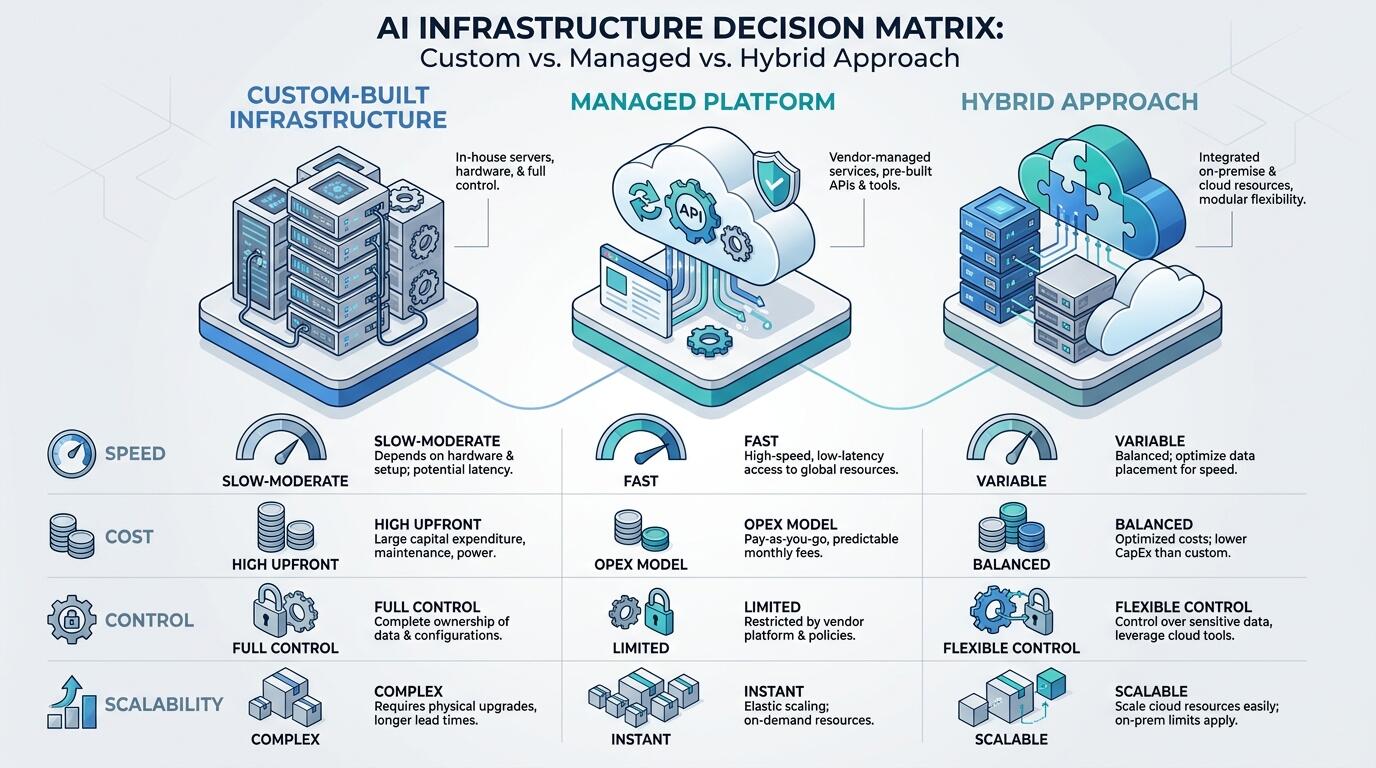
ALT: Decision matrix comparing custom-built, managed platform, and hybrid AI infrastructure options for startup engineering teams
Frequently Asked Questions FAQ
Q1: How do I know if my startup should build or buy AI infrastructure?
Start by identifying which layer of the stack actually differentiates your product. If a capability — such as base model access or vector storage — is available off-the-shelf to any competitor, buy it. If it embodies proprietary logic, unique data, or workflow design that competitors cannot easily replicate, that is the layer worth building in-house.
Q2: Is buying managed AI infrastructure a long-term risk for startups?
It can be, primarily through vendor lock-in and unpredictable cost scaling as usage grows. The risk is manageable with a hybrid architecture that keeps integration points modular, so core components can be swapped or brought in-house later without a full re-platforming effort.
Q3: How much does it cost to build custom AI infrastructure versus buying a platform?
Exact costs vary widely by workload, team size, and vendor pricing, so there is no universal figure. In practice, managed platforms usually minimize upfront cost while custom builds require greater initial engineering investment that may pay off only at meaningfully large usage volumes — model your specific workload before committing.
The Bottom Line
The build-versus-buy decision for AI infrastructure is not a single, permanent choice — it is a layer-by-layer assessment that should be revisited as a startup matures from prototype to scaled product.
Key Takeaway: Buy commodity infrastructure to preserve speed and runway in the earliest stages of your product.
Key Takeaway: Build only the layers — orchestration, evaluation, proprietary data pipelines — that create durable competitive advantage.
Key Takeaway: Reassess the decision as usage scales, since cost and control tradeoffs shift nonlinearly with volume.
Key Takeaway: A hybrid, composable architecture is usually the most defensible default for growth-stage startups.
Key Takeaway: Talent availability and operational burden should weigh as heavily as sticker price in any infrastructure decision.
The next step is to map your own product roadmap against these five criteria before your next architecture review, rather than defaulting to whatever your team built or bought last time. Teams that want a practical, execution-focused reference for translating this framework into a working feature can review our guide on shipping a first live AI product within a short timeframe, which walks through exactly this kind of layer-by-layer decision-making in a real build.
Ready to see how AI-native products are built in practice? Visit Darius at https://www.darius.wiki to explore hands-on AI tools like the AI Cloud Drive, AI Mock Interview Platform, and AI Creator Cockpit, and learn how to design AI as a core capability rather than an afterthought. Join Darius's journey to build smarter, production-ready AI products today.
References & Further Reading
- National Institute of Standards and Technology. "AI Risk Management Framework".
https://www.nist.gov/ - Institute of Electrical and Electronics Engineers. "IEEE Standards for Artificial Intelligence Systems".
https://www.ieee.org/ - International Organization for Standardization. "ISO/IEC Standards on Artificial Intelligence".
https://www.iso.org/
Note: Standards may be updated; please check the latest official documents or consult professional advisors.