Building an AI-Ready Engineering Team from Scratch: A Founder's Guide
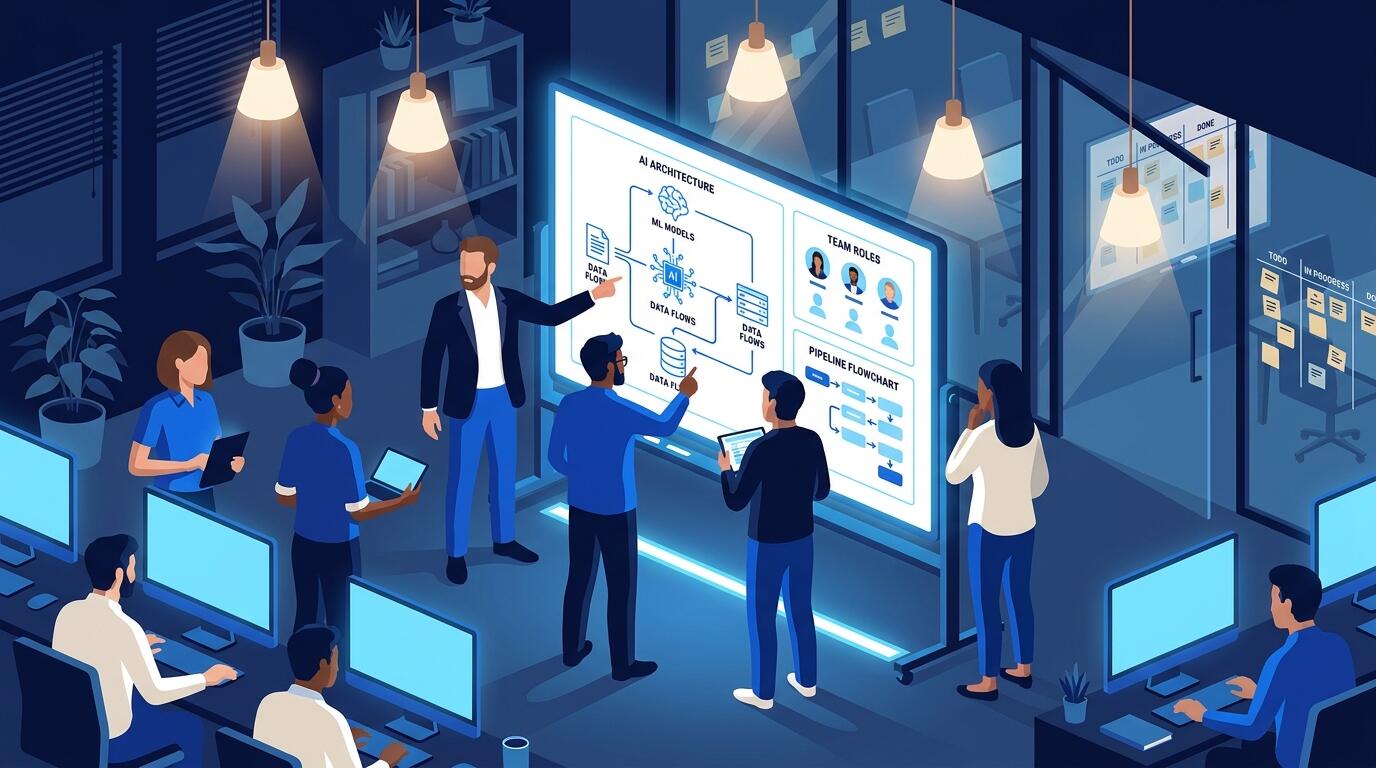
ALT: Founder building an AI-ready engineering team from scratch with modern tools and collaborative strategy
What You'll Actually Build: An AI-Ready Engineering Team That Ships
How do you build an engineering team capable of delivering real AI products — not just demos — when you're starting from zero?
That's the question every founder, technical lead, and engineering director eventually faces as AI moves from buzzword to business requirement. The answer isn't simply "hire more data scientists" or "buy an AI platform." It's a deliberate, architectural decision about how you structure people, process, and culture around AI as a native capability — not a bolt-on feature. This guide is for founders, CTOs, and technical leads who are ready to build that team from the ground up, with clarity and intention.
Before You Start: Prerequisites and Preparation for Building Your AI Team
Before you recruit a single engineer or write a single job description, you need to do some honest groundwork. Building an AI-ready team without this foundation is like training a model on bad data — the output will reflect the input.
What you need before you begin:
First, you need a clear product vision. Not a vague "we'll use AI to improve X" statement, but a concrete understanding of what problem AI will solve, for whom, and how success will be measured. AI teams built around fuzzy goals drift toward research rather than delivery.
Second, you need a working understanding of the AI product lifecycle. This means knowing the difference between a proof-of-concept, a prototype, and a production system. A pattern we consistently see in early-stage teams is that founders conflate these stages — they hire for research when they need deployment, or vice versa. Understanding the difference between AI prototypes and production-ready AI systems is foundational before you make your first hire.
Third, you need a realistic budget and timeline expectation. AI talent is expensive and the ramp-up period for even experienced engineers entering a new domain is real. Don't expect a team of three to build and ship a production AI system in two weeks — that's a recipe for burnout and technical debt.
Finally, you need executive alignment. If you're a founder, this means your co-founders and board understand that AI product development is iterative, requires data infrastructure, and won't always produce linear progress. Misaligned expectations at the top cascade into dysfunctional team dynamics below.
✅ Checklist before starting:
- Clear, documented problem statement that AI is genuinely suited to solve
- Basic understanding of the AI product development lifecycle (prototype → staging → production)
- Budget allocated for talent, infrastructure, and tooling — not just headcount
- Executive or co-founder alignment on iterative delivery expectations
- Access to relevant data (or a clear plan to acquire it) — AI teams without data are stalled teams
- A defined first milestone: what does "working" look like in 30, 60, and 90 days?
The time investment here is significant but front-loaded. Teams that skip this preparation phase spend months course-correcting later.
Step-by-Step Instructions: How to Build Your AI Engineering Team from Scratch
Step 1: Define the AI Capability You're Actually Building
Before you think about roles, think about capabilities. What does your product need AI to do? Natural language understanding? Recommendation systems? Predictive analytics? Computer vision? Each of these requires a different skill mix, different data infrastructure, and different evaluation criteria.
Map out your AI capability stack: what needs to be built custom, what can be powered by third-party APIs or foundation models, and what is purely infrastructure. This map becomes your hiring blueprint. A team building a custom fine-tuned language model looks very different from a team integrating a large language model API into a product workflow.
Tip: Resist the urge to build everything from scratch. In our work with clients, the most effective early-stage AI teams are ruthlessly pragmatic — they use managed services and APIs where possible so they can focus engineering energy on the differentiated layer of the product.
Step 2: Design Your Team's Core Roles — and Resist Over-Specialization Early
For an early-stage AI team, the temptation is to hire narrow specialists immediately: a data scientist, an ML engineer, a data engineer, an AI researcher. Resist this. Early teams need generalists who can span multiple layers of the stack.
The three foundational roles for a lean AI engineering team are:
The AI/ML Engineer — someone who can build, train, evaluate, and deploy models. They understand both the research side (model selection, fine-tuning, evaluation) and the engineering side (APIs, latency, reliability). This is your most critical early hire.
The Data/Platform Engineer — someone who builds and maintains the pipelines that feed your AI systems. No model is better than the data it runs on. This role is chronically undervalued and chronically underhired in early teams.
The Product-Minded Engineer or Technical PM — someone who bridges the gap between AI capability and user experience. AI products fail not because the model is bad, but because the product experience doesn't translate model output into genuine user value. This person keeps the team honest about what actually matters to users.
Tip: In very early stages, one strong AI engineer who also understands product thinking can cover significant ground. Hire for intellectual range first, deep specialization second.
Step 3: Build a Hiring Process That Filters for Production Mindset
Most AI hiring processes test for academic knowledge — can the candidate explain backpropagation, recite ML theory, or solve a toy dataset problem. These tests are poor predictors of whether someone can ship a production AI system.
Redesign your hiring process around production signals. Ask candidates to walk you through a real AI system they've built and deployed — not a Kaggle competition or a research paper, but something that ran in production and served real users. Ask about the failure modes they encountered, how they monitored the system, and what they would do differently.
Include a practical exercise that mirrors your actual work. If your product involves retrieval-augmented generation (RAG) — a technique where AI retrieves relevant information before generating a response — give candidates a small RAG problem to design and discuss. Evaluate their reasoning about trade-offs, not just their technical output.
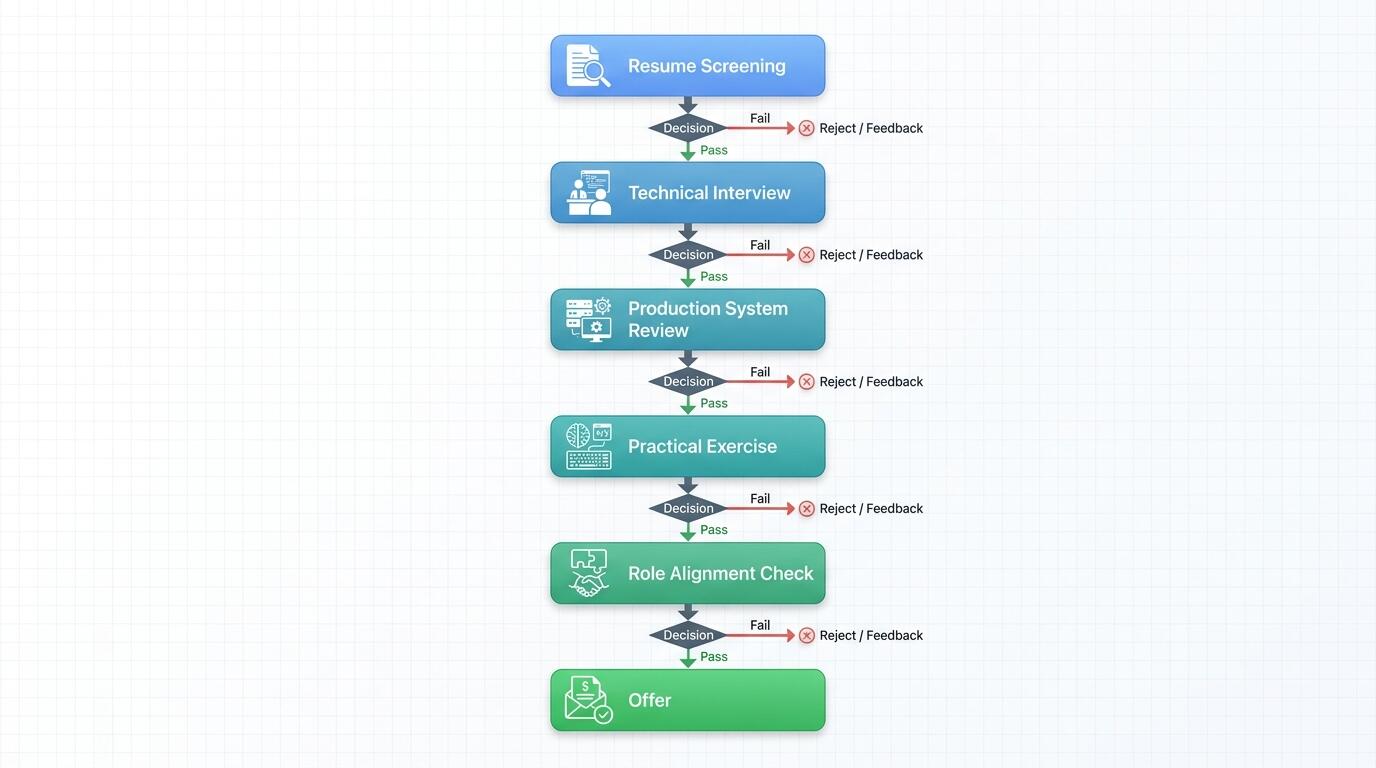
ALT: Structured AI engineering hiring process flowchart showing production mindset evaluation steps and team role alignment
Tip: Add a "production readiness" question to every technical interview: "How would you monitor this system in production, and what would cause you to roll it back?" Candidates who haven't thought about this have likely never shipped.
Step 4: Establish Your AI Development Infrastructure Before Day One
A common mistake founders make is hiring the team first and figuring out infrastructure later. This forces your new engineers to spend their first weeks doing setup work instead of building — and it signals organizational dysfunction before the team has even started.
Before your first AI engineer joins, have these in place:
A data environment: cloud storage, a basic data pipeline, and access to whatever training or evaluation data exists. Even if it's messy, having it accessible is better than having it locked in someone's laptop.
A model experimentation environment: a platform where engineers can run experiments, track results, and compare model versions. Tools like MLflow or cloud-native experiment tracking services serve this purpose — the specific tool matters less than having something consistent.
A deployment pathway: a clear, documented process for how code goes from development to staging to production. AI teams that lack this end up with models that work on a laptop but never reach users.
Tip: Your infrastructure doesn't need to be perfect — it needs to be functional and documented. A simple, well-documented setup beats a sophisticated, undocumented one every time.
Step 5: Establish a Culture of Evaluation, Not Just Experimentation
AI teams are naturally drawn to experimentation — trying new models, new architectures, new prompting strategies. This is healthy. But without a culture of rigorous evaluation, experimentation becomes endless tinkering that never converges on a shippable product.
From day one, establish that every AI change must be evaluated against defined metrics before it moves forward. This means having baseline metrics, test datasets, and evaluation criteria defined before you start building — not after. It means treating model evaluation with the same rigor as code review.
This also means being honest about what your AI system can't do. In our experience, the most dangerous moment for an AI team is when a demo goes well and the team convinces itself the hard problems are solved. Production is where the hard problems live.
Tip: Create a shared "evaluation playbook" — a living document that defines how your team measures AI quality, what thresholds trigger a rollback, and how you handle edge cases. This document becomes the team's north star when debates arise.
Step 6: Ship Something Real, Early
The fastest way to build team capability, product intuition, and stakeholder confidence simultaneously is to ship something real as quickly as possible. Not a perfect system — a real one, with real users, generating real feedback.
This is where many AI teams stall. They wait until the model is "good enough," the infrastructure is "clean enough," the product is "polished enough." Meanwhile, they accumulate technical debt, lose momentum, and miss the learning that only comes from production usage.
If you're wondering how to compress this timeline responsibly, the framework for shipping your first live AI product in 30 days offers a structured approach to getting to production without cutting corners on the fundamentals.
Tip: Define your "minimum lovable AI feature" — the smallest AI-powered capability that genuinely delights a user. Ship that first. Everything else is iteration.
Step 7: Build Feedback Loops That Make the Team Smarter Over Time
The final step — and the one that separates teams that plateau from teams that compound — is building systematic feedback loops between production behavior and team learning.
This means instrumenting your AI systems to capture not just performance metrics but user behavior signals: where do users disengage, where do they correct the AI, where do they express confusion? These signals are your most valuable training data — both for your models and for your team's product intuition.
It also means running regular retrospectives focused specifically on AI product decisions: what did we predict the model would do, what did it actually do, and what does that tell us about our assumptions? Teams that do this consistently develop a calibrated intuition for AI behavior that can't be taught in a classroom.
Tip: Treat every production incident involving your AI system as a learning event, not just a bug to fix. Document what the system did, why it did it, and what the fix reveals about your evaluation gaps.
Common Mistakes and Troubleshooting When Building an AI Engineering Team
| Symptom | Likely Cause | How to Fix |
|---|---|---|
| Team ships demos but never reaches production | Hiring for research skills without production engineering experience | Rebalance hiring toward ML engineers with deployment track records; add a dedicated platform engineer |
| Model performance degrades after launch | No monitoring or data drift detection in production | Implement model monitoring from day one; define data drift alerts and retraining triggers |
| Team is always busy but product isn't progressing | Lack of clear evaluation criteria and shipping milestones | Establish weekly evaluation reviews with defined pass/fail thresholds; tie work to user-facing milestones |
| AI features confuse or frustrate users | Gap between model output quality and product UX design | Involve a product-minded engineer or designer in AI feature design from the start, not after the model is built |
| Engineers are demoralized and leaving | Unrealistic expectations, lack of infrastructure, or no clear product direction | Revisit the foundational preparation checklist; align leadership on realistic timelines and provide proper tooling |
| Data pipelines are constantly breaking | Data infrastructure was underhired or deprioritized | Hire or upskill a dedicated data/platform engineer; treat data infrastructure as a first-class product concern |
Pro Tips for Better Results When Scaling Your AI Team
Hire for learning velocity, not just current knowledge. The AI landscape shifts rapidly — models, tools, and best practices that are standard today may be obsolete in a year. The most durable AI engineers are those who learn fast, stay curious, and adapt without ego. In interviews, probe for how candidates have updated their thinking in response to new information.
Make AI literacy a team-wide expectation, not just an engineering concern. Product managers, designers, and even customer success team members who understand AI capabilities and limitations make dramatically better decisions. Invest in lightweight AI literacy programs for non-engineering team members early — it pays compounding dividends.
Treat your AI team's work as a product, not a service. A pattern we consistently see in dysfunctional AI teams is that they operate as an internal service bureau — taking requests from other teams and delivering model outputs. This model kills ownership and accountability. Structure your AI team so they own outcomes, not just outputs.
Don't confuse tool adoption with capability building. Deploying a new AI framework or integrating a new foundation model API is not the same as building organizational AI capability. Real capability lives in your team's ability to evaluate, adapt, and improve AI systems over time — not in which tools they happen to be using today.
Common misconception to address: Many founders believe that hiring a "Head of AI" or a senior AI researcher will solve their AI team-building challenge. In practice, a single senior hire without the right supporting team, infrastructure, and product context rarely succeeds. AI team building is a systems problem, not a talent problem — the whole system needs to be designed, not just the top of the org chart.
People Also Ask
Q1: How do you evaluate whether an engineering candidate is truly AI-ready for a production environment?
Look beyond academic credentials and Kaggle rankings. Ask candidates to describe a production AI system they've built, including how they monitored it, what failed, and how they responded. Strong candidates speak fluently about evaluation metrics, data pipelines, latency constraints, and rollback strategies — not just model architecture. The ability to reason about failure modes and production trade-offs is the clearest signal of genuine production readiness.
Q2: Is it better to hire AI specialists or upskill existing engineers when building an AI team?
Both strategies have merit, and the right answer depends on your timeline and existing team. Upskilling strong engineers who already understand your product domain can be faster and more culturally cohesive than hiring externally. However, for core AI/ML engineering roles, specialized experience genuinely accelerates delivery. A pragmatic approach combines both: hire one or two experienced AI engineers as anchors, then invest in structured upskilling for the broader team.
Q3: How long does it realistically take to build a functional AI engineering team from scratch?
Building a team capable of shipping production AI features typically takes several months of deliberate effort — from initial hiring through infrastructure setup, team calibration, and first production deployment. The timeline compresses significantly when you have strong foundational preparation (clear product vision, data access, infrastructure) and expands when those foundations are missing. Founders who treat team-building as a sprint rather than a structured process consistently underestimate the ramp-up period.
Key Takeaways
- Start with capability mapping, not headcount planning. Define what AI needs to do in your product before you define who you need to hire — the capability requirements drive the role design.
- Production mindset is the most important hiring filter. Prioritize engineers who have shipped and operated AI systems over those who have studied or experimented with them.
- Infrastructure before headcount. Set up your data environment, experimentation platform, and deployment pathway before your first AI engineer joins — it signals organizational seriousness and accelerates onboarding.
- Evaluation culture is what separates shipping teams from tinkering teams. Define metrics, baselines, and evaluation criteria before building, and hold every AI change accountable to them.
- Ship early, learn fast, iterate deliberately. The feedback loops that come from real production usage are irreplaceable — no amount of internal testing substitutes for real users interacting with your AI system.
Your next step: audit your current preparation against the checklist in this guide. Identify the single biggest gap — whether it's product vision clarity, infrastructure readiness, or hiring process design — and address that gap before making your next move.
Want to go deeper on building AI-native products that actually ship? Visit Darius to explore hands-on insights, real-world AI product breakdowns, and frameworks from an Engineering Director who has designed and launched production AI systems. Whether you're an engineer leveling up or a leader shaping your team's AI strategy, Darius has the perspective to help you move from idea to deployment.
References
- McKinsey & Company. "The State of AI in Organizations: Talent, Infrastructure, and Delivery Gaps".
https://www.mckinsey.com - Google. "Machine Learning Engineering for Production (MLOps) — Best Practices and Organizational Guidance".
https://www.google.com - MIT Sloan Management Review. "Building AI Capability: Organizational Design and Talent Strategy for AI-Native Teams".
Note: Standards and organizational guidance may be updated; please check the latest official documents or consult professional advisors.