Why Bilingual Publishing Is Harder Than It Looks: A Builder's View for This Quarter
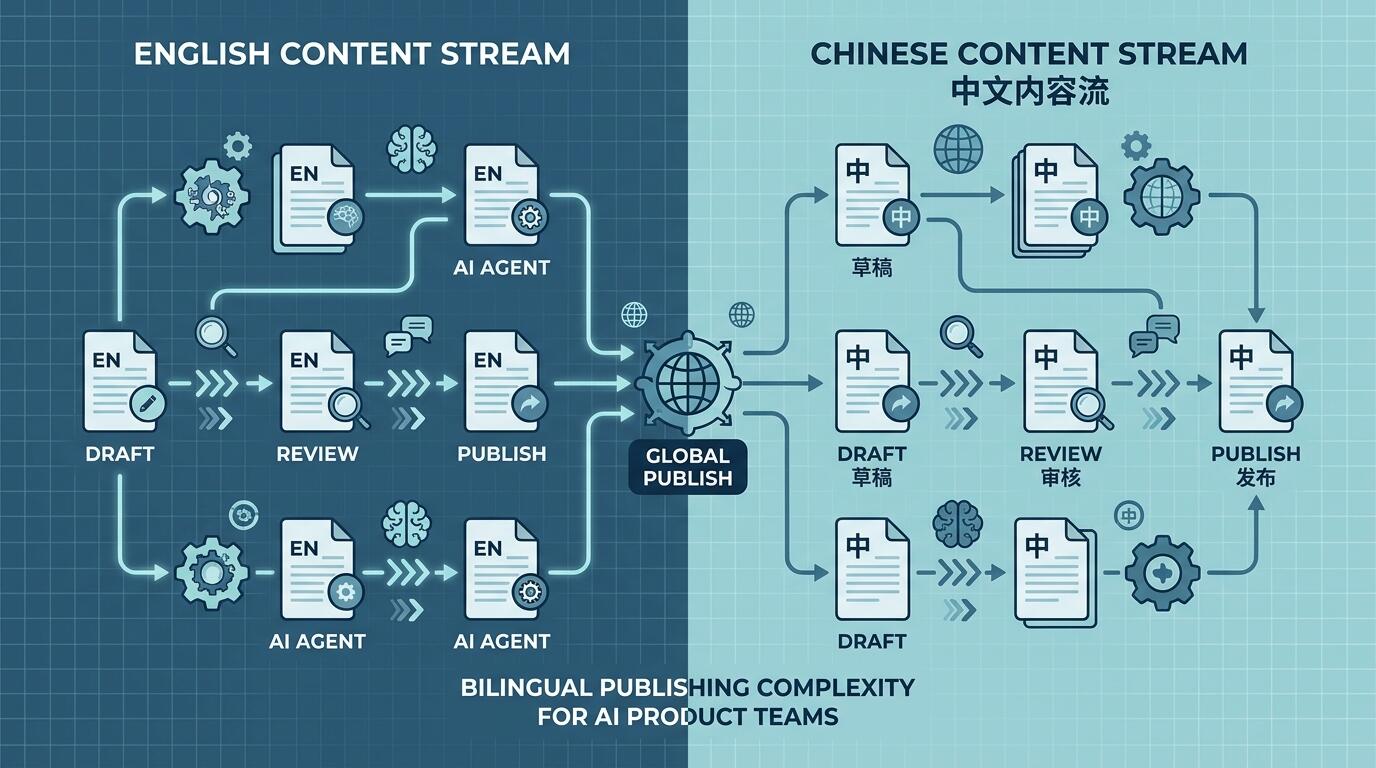
ALT: Bilingual publishing challenges for AI product builders navigating dual-language editorial workflows
Framing the Problem: Bilingual Publishing Is a Systems Challenge, Not a Translation Task
Key Conclusion: Bilingual publishing — the practice of producing substantive content in two languages simultaneously for a technical or professional audience — is far more operationally complex than it appears from the outside. For builders running AI-adjacent products, the difficulty is not vocabulary or grammar. It is the compound friction created by misaligned editorial cadence, structural differences between languages, audience context gaps, and the brittleness of automated pipelines when applied to nuanced, domain-specific text. Understanding these failure modes is the first step toward shipping bilingual content that actually works.
Most teams underestimate bilingual publishing because they treat it as a translation workflow bolted onto an existing content process. That framing is wrong, and it costs real time and credibility. This quarter, as more AI product teams are expanding their reach across English-speaking and Chinese-speaking technical audiences simultaneously, the question of how to do bilingual publishing well has moved from editorial nicety to operational necessity.
The State of Bilingual Technical Publishing Today
Bilingual publishing is the practice of producing original content in two languages — not translating from one into another as an afterthought, but treating both languages as primary channels from the beginning of the editorial process. In technical fields, and particularly in AI, this distinction matters enormously.
The landscape has shifted meaningfully in recent years. English has long dominated scientific and technical publishing, but its grip is loosening. Research tracked by library and information science communities notes that scholarly publishing across multiple languages is gaining ground, with non-English output growing in relevance across technical disciplines. For AI specifically, some of the most significant model releases, research outputs, and practitioner communities are Chinese-language-first. A product team that publishes only in English is not reaching those builders, and a team that simply machine-translates English content into Chinese is not serving them either.
The practical consequence is that bilingual publishing has become a competitive differentiator for content brands targeting technical audiences across both markets. At Darius, this reality shapes the entire editorial model. The briefing is designed from the ground up as a bilingual product — not an English newsletter with a Chinese translation layer, but a dual-language publication where both versions are held to the same standard of precision and practical utility. That architectural decision, made early, has structural implications for every downstream part of the workflow.
What makes this moment particularly interesting is that AI-assisted drafting tools are now sophisticated enough that teams are tempted to believe the bilingual problem is largely solved. It is not. The tools help with vocabulary and fluency. They do not solve the harder editorial and systems problems, which are fundamentally about context, trust, and audience-specific framing.
Root Causes: Why Bilingual Publishing Breaks Down
Bilingual publishing fails in predictable ways. Understanding the underlying mechanics of each failure mode is more useful than generic advice about "translation quality."
Structural Mismatch Between Languages
Structural mismatch refers to the fact that English and Chinese impose different cognitive expectations on the reader at the sentence and paragraph level. English technical writing tends toward linear, topic-first argumentation: state the claim, then justify it. Chinese technical writing, especially for a professional audience with academic reading habits, often layers context before conclusion, and tolerates longer noun phrases and embedded subordination in ways that would feel redundant in English.
When a bilingual publication forces one structural style onto both languages — which happens when you translate rather than co-author — one version always reads as a pale copy of the other. Readers notice. The Chinese version of an English-drafted piece frequently sounds formal but thin. The English version of a Chinese-drafted piece can feel overly deferential or under-argued. Neither failure is a vocabulary problem; both are structural ones.
Terminology Drift Across Languages
Terminology drift is the phenomenon where equivalent terms in two languages diverge in community usage over time, so a technically accurate translation is nonetheless wrong for the audience. In AI specifically, this happens constantly. Terms like "fine-tuning," "grounding," "context window," "agent," and "retrieval-augmented generation" have English-language definitions that are reasonably stable within the technical community — but their Chinese-language counterparts vary significantly across different practitioner communities, academic institutions, and commercial platforms.
A bilingual publication that locks in a single Chinese equivalent for a contested English term risks alienating part of its audience every time that term appears. Managing this requires an explicit terminology governance process — a living glossary maintained across issues — which is an operational overhead most small teams have not budgeted for.
Editorial Cadence and the Freshness Problem
Editorial cadence misalignment is less obvious but equally damaging. When a bilingual briefing covers fast-moving AI developments, the time between drafting and publishing matters. If the English version is drafted first and the Chinese version is prepared afterward — even by a few days — the Chinese audience receives content that is already stale relative to the news cycle. In AI, where major model releases and capability announcements can change the framing of an issue within 48 hours, a two-day lag is not trivial.
Running both versions in true parallel — drafting, editing, and publishing simultaneously — requires either a larger team or a well-designed automated pipeline with human oversight at every decision point. Neither is free. The agent pipeline behind a daily AI briefing involves retrieval, verification, and publication steps that must be engineered to support concurrent bilingual output, not treated as sequential tasks.
Audience Context Gaps
Audience context gaps arise because the same piece of technical information lands differently depending on what the reader already knows and what infrastructure they are working within. An insight about deploying large language models in production may assume AWS or Azure as the default cloud environment for an English-speaking audience, while a Chinese-language audience may be operating primarily within Alibaba Cloud, Tencent Cloud, or Huawei Cloud environments. The technical content is the same; the operational framing needs to be different to be genuinely useful.
Ignoring this produces content that is technically bilingual but practically monolingual — it serves one audience well and the other superficially. The honest version of bilingual publishing requires the author to hold both contexts simultaneously, which is a cognitive and editorial demand that cannot be fully automated away.
Automation Limits in Domain-Specific Contexts
Automation limits in bilingual publishing are real and specific. Large language models are genuinely useful for first-draft translation of technical prose, but they fail in consistent ways on domain-specific content. Nuanced editorial voice is flattened. Subtle hedges — the difference between "this approach may be appropriate" and "this approach is worth considering if your latency budget allows" — are frequently collapsed into blander equivalents. Terminology choices default to the most common usage rather than the most precise one for the specific audience.
As explored in our post on writing editorial rules an AI agent can actually follow, the failure is not that agents cannot write — it is that agents cannot yet internalize the audience-specific editorial standards that make the difference between content that is technically correct and content that practitioners actually trust.
Evidence and Approaches: Comparing Strategies for Bilingual Technical Content
Different teams have converged on different approaches to the bilingual publishing problem. None is without trade-offs.
| Perspective / Approach | Strengths | Trade-offs | Best Fit |
|---|---|---|---|
| Translate-after-publish | Lowest initial overhead; editorial process remains simple | Structural mismatch; staleness; voice loss; audience context gaps unaddressed | Teams with low publishing frequency and non-time-sensitive content |
| Co-author in both languages simultaneously | Both versions receive full editorial attention; no freshness lag | High resource requirement; demands rare bilingual editorial capacity | Well-staffed editorial operations with dedicated bilingual writers |
| AI-assisted parallel drafting with human review | Scalable; reduces per-issue labor; captures first-draft efficiency gains | Requires careful prompt and rule engineering; terminology governance overhead; review load remains significant | Small technical teams with strong editorial standards willing to invest in pipeline design |
| Single-language-first with structured adaptation | Cleaner authorial voice in primary language; adaptation allows audience context tuning | Still requires significant editorial judgment in adaptation phase; not true simultaneity | Practitioners who treat one market as primary and the other as secondary |
The pattern we consistently see at Darius is that the translate-after-publish model, which is the default for most teams starting out, degrades credibility with the secondary-language audience faster than teams expect. The Chinese-language reader of an AI briefing is often themselves a technical practitioner with high standards for precision and currency. They will notice when a piece reads like a translation, and they will discount the signal accordingly.
The AI-assisted parallel drafting approach, when properly engineered, is the most viable path for a small team that wants to serve both audiences at a high standard. But "properly engineered" is doing significant work in that sentence. It requires explicit editorial rules that the drafting agent can follow, a terminology governance layer, and a human review step that goes beyond proofreading — the reviewer must be asking whether the content is genuinely useful for the specific audience, not just whether it is fluent.
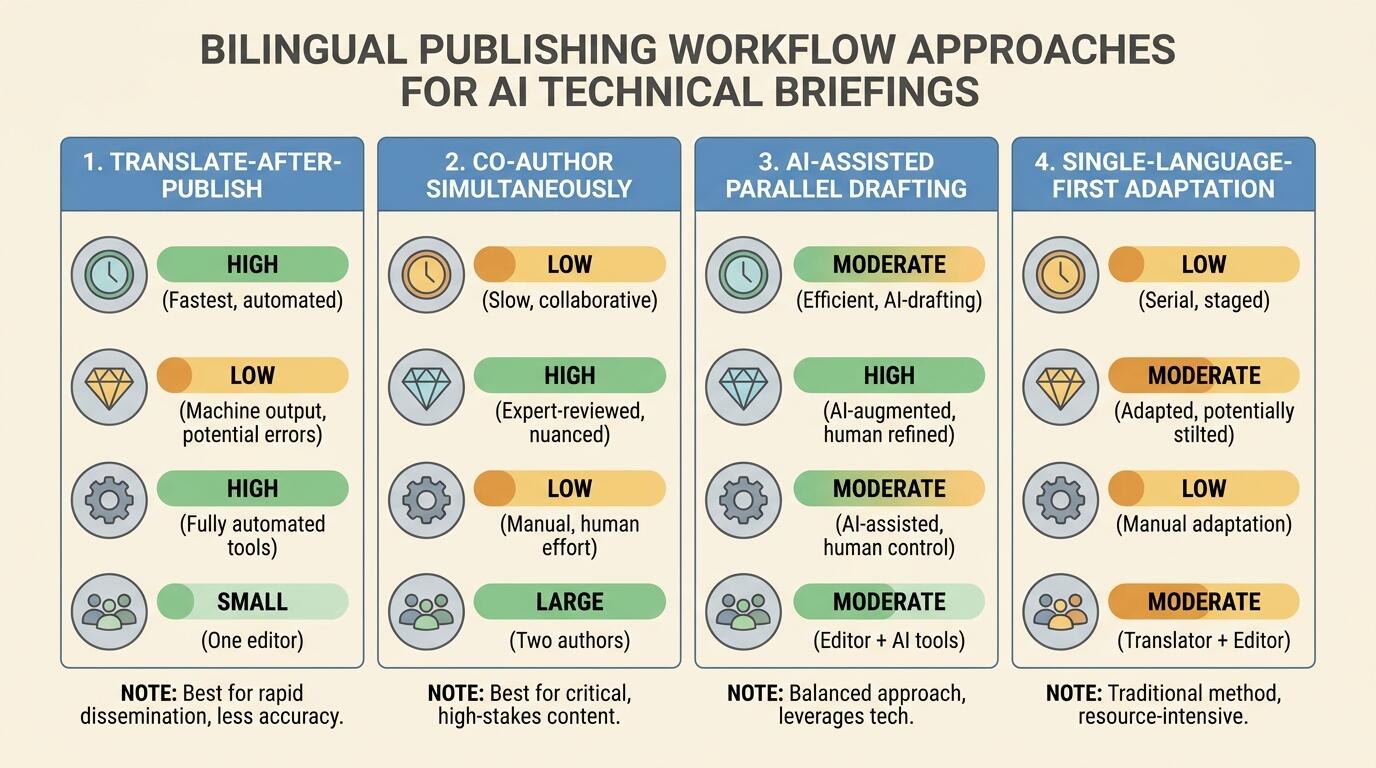
ALT: Comparison of bilingual publishing workflow approaches for AI technical briefings, showing editorial and automation trade-offs for builder teams
Research in bilingual and multilingual publishing — including work documented in journals focused on language and communication — consistently finds that audience trust in bilingual publications is built not on translation quality alone but on perceived expertise and relevance. A piece that is grammatically perfect but contextually generic loses the reader's trust just as surely as one with translation errors. This finding aligns directly with what we observe in practice.
Outlook: Where Bilingual Publishing for AI Is Heading
Bilingual publishing for technical AI content is becoming more important, not less, as the global practitioner community grows and as the assumption that English is the universal language of AI builders becomes increasingly inaccurate.
The near-term trajectory points toward a small number of meaningful changes. First, terminology governance tooling will mature. Teams are beginning to treat multilingual glossaries as engineering artifacts — versioned, reviewed, and systematically applied — rather than editorial afterthoughts. Second, the human-in-the-loop role in bilingual pipelines will shift from translation review toward audience-context review. The question will not be "is this fluent?" but "does this serve the specific reader?" Third, AI drafting tools will improve at holding editorial voice across languages, though the improvement will be gradual and uneven across domains.
For builders considering whether to invest in bilingual publishing, the practical implication is this: if your audience is genuinely split across English-speaking and Chinese-speaking technical communities, bilingual publishing done well is a durable competitive advantage. Done poorly — meaning translate-after-publish with no audience-context layer — it can actively damage credibility with the secondary audience while consuming non-trivial resources.
The investment required to do it well is front-loaded. It requires designing the editorial and technical pipeline for bilingual output from the start, not retrofitting it. Teams that make this design decision early, as part of shipping with quality as a constraint rather than a casualty, will find the ongoing cost manageable. Teams that treat bilingual publishing as an add-on will find themselves in an increasingly expensive remediation cycle.
The actionable takeaway for this quarter: audit your current bilingual workflow against the four failure modes above — structural mismatch, terminology drift, cadence misalignment, and audience context gaps. Identify which one is causing the most friction. Fixing one failure mode at a time, with deliberate pipeline changes, is more effective than a wholesale overhaul.
People Also Ask
How does bilingual publishing differ from translation in technical content?
Bilingual publishing is a parallel editorial process in which two language versions of a piece are developed with equal intentionality, audience context, and structural consideration from the start. Translation, by contrast, takes a completed piece in one language and converts it into another. In technical fields like AI, the difference is significant: a translated piece often carries the structural conventions and audience assumptions of its source language, making it contextually weaker for the secondary audience, even when it is grammatically accurate.
Are AI tools sufficient to handle bilingual technical publishing at professional quality?
AI drafting tools are useful for first-draft bilingual work but are not sufficient on their own for professional technical publishing. They struggle with terminology governance — choosing between competing community-specific translations of contested technical terms — and with audience-context adaptation. The output of an AI-assisted bilingual draft consistently requires human review focused on whether the content is genuinely useful for the specific audience, not just whether it is fluent. Research in the language and publishing field supports the finding that reader trust depends on perceived expertise and relevance, not fluency alone.
What does it cost in time and resources to run a genuinely bilingual AI briefing?
The resource cost of a genuinely bilingual AI briefing is higher than most teams estimate at the outset, and the cost structure depends heavily on which failure modes you choose to address. A translate-after-publish model has low initial cost but incurs ongoing credibility costs with the secondary audience. An AI-assisted parallel drafting model with human review requires upfront investment in pipeline design and editorial rule engineering, but becomes more cost-efficient over time. For a detailed breakdown of the operational cost structure of running a daily AI briefing on agents, the Darius engineering blog provides a direct analysis of the numbers and decisions involved.
Key Takeaways
- Bilingual publishing is a systems design problem, not a translation problem. The failure modes — structural mismatch, terminology drift, cadence misalignment, and audience context gaps — are architectural, and they require architectural solutions.
- Translate-after-publish is the default and the weakest approach. It consistently underserves the secondary-language audience and degrades credibility faster than teams expect.
- AI-assisted parallel drafting is viable but only when paired with explicit editorial rules, terminology governance, and an audience-context review step — not just a fluency check.
- Terminology governance is an engineering artifact, not an editorial nicety. Treating your multilingual glossary as a versioned, maintained system component will pay dividends every issue.
- Front-load the design decisions. Teams that build bilingual output into their editorial pipeline from day one will find the ongoing cost manageable. Retrofitting bilingual capability is consistently more expensive.
The next step: map your current publishing workflow against the four failure modes described above. Pick the one that is causing the most friction and design a specific fix before the next publishing cycle.
If you are building an AI product and cannot afford to waste time on information noise, the Darius bilingual AI briefing is written for you — curated, practitioner-first, and grounded in real production experience. Visit the site, subscribe, and let every issue serve your building decisions directly.
References
- BilPub Open Journal Services. "Language — Journal on Bilingual and Multilingual Communication".
https://ojs.bilpub.com/index.php/card/Language - Diez, Julia. "The Bilingual Temptation: Notes on Publishing in More Than One Language".
https://juliadiez.substack.com/p/the-bilingual-temptation-notes-on/comments?utm_medium=web - Library Learning Space. "English Dominance in Scholarly Publishing Declines, New Languages Gain Ground".
https://librarylearningspace.com/english-dominance-in-scholarly-publishing-declines-new-languages-gain-ground/ - IEEE — Institute of Electrical and Electronics Engineers. Standards and publications on technical communication and engineering documentation.
https://www.ieee.org/ - Association for Computational Linguistics. Research publications on natural language processing, machine translation, and multilingual systems.
https://www.aclweb.org/
Note: Standards and research findings may be updated; please check the latest official documents or consult professional advisors for current guidance.