Best Programming Languages for Machine Learning Engineering Right Now
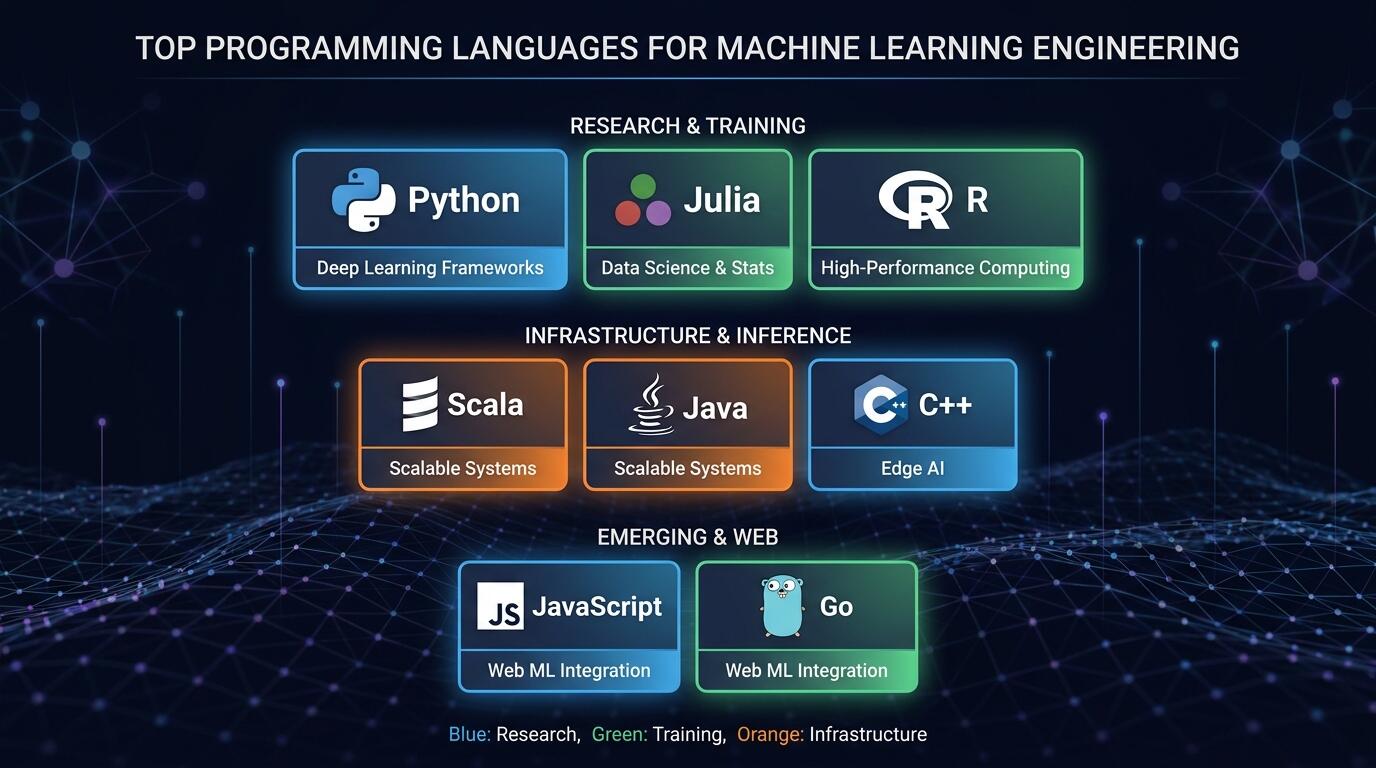
ALT: Best programming languages for machine learning engineering compared for AI developers and architects
Which Programming Languages Actually Matter for Machine Learning Engineering Today?
Every engineer stepping into machine learning faces the same early fork in the road: which language do I invest in? The honest answer is that the ML ecosystem has consolidated significantly, and a clear hierarchy has emerged — one shaped not by marketing but by what practitioners actually reach for when they need to ship working systems. This list cuts through the noise and maps the leading languages to real engineering contexts, from rapid prototyping to production inference pipelines.
The languages below were selected based on three criteria that matter in applied ML work: ecosystem maturity (the availability of battle-tested libraries and frameworks), production viability (whether the language can carry a model from training through to a live serving endpoint), and community momentum (whether the tooling is actively maintained and hiring demand is real). This is not a theoretical survey — it reflects the patterns consistently visible when working across AI architecture projects and full-stack deployments.
The Best Programming Languages for Machine Learning Engineering Right Now
Python: The Undisputed Default for Machine Learning
Python is a high-level, interpreted programming language that has become the de facto standard language for machine learning engineering, owing primarily to its readable syntax and the extraordinary depth of its ML ecosystem. Libraries such as PyTorch, TensorFlow, scikit-learn, Hugging Face Transformers, and LangChain are all Python-first — which means the freshest research code, the newest model architectures, and the most active open-source communities are all writing Python. When a team needs to go from a research idea to a working prototype quickly, Python removes nearly every structural obstacle.
In practice, Python serves as the lingua franca that connects data scientists, ML engineers, and backend developers on the same codebase. A model trained in a Jupyter notebook can be packaged into a FastAPI endpoint, wrapped in a Docker container, and deployed to a Kubernetes cluster — all without leaving the Python ecosystem. That end-to-end coherence is genuinely rare and enormously valuable for teams that cannot afford to context-switch between languages at every layer of the stack.
When thinking about how to build machine learning pipelines that scale past prototype stage, Python's orchestration tools — Prefect, Airflow, Metaflow — make it the natural backbone for MLOps workflows that need to run reliably in production.
Best for: Nearly every ML use case — research, model training, data preprocessing, API serving, and MLOps orchestration. It is the right default for any team that does not have a compelling reason to choose otherwise.
Watch out: Python's interpreted nature and the Global Interpreter Lock (GIL) make it a poor fit for CPU-bound, latency-critical inference where you need deterministic sub-millisecond response times. In those cases, the Python layer is typically a thin wrapper around a compiled runtime, not the performance-critical path itself.
Julia: Built for Numerical Computing and Research Speed
Julia is a high-performance, dynamically typed programming language designed specifically for numerical and scientific computing. It compiles to native machine code via LLVM, which means it can match C-level performance on mathematical operations without requiring the engineer to write C. Julia's multiple dispatch system also makes it exceptionally expressive for writing mathematical models — code often reads nearly like the underlying math.
In the ML research space, Julia attracts teams working on physics-informed neural networks, differential equation solvers, and custom optimizer implementations where Python's speed ceiling becomes a genuine constraint. The Flux.jl framework provides a fully native deep learning stack in Julia, and Zygote.jl offers source-to-source automatic differentiation that researchers find particularly powerful for novel architecture work.
Best for: Research teams doing computationally intensive numerical work, custom algorithm development, or scientific ML where performance and mathematical expressiveness both matter.
Watch out: Julia's production ecosystem is materially thinner than Python's. Library coverage, deployment tooling, and available engineering talent all lag significantly — which makes it a harder sell for startup teams that need to hire quickly and ship to customers.
R: The Statistical Analysis Specialist
R is an open-source programming language and environment designed for statistical computing and data visualization, originally developed by statisticians for statisticians. While it is not an ML engineering language in the systems sense, R holds a durable place in the machine learning landscape for exploratory data analysis, statistical modeling, and communicating results through rich visualizations. The tidymodels ecosystem and packages like caret and mlr3 provide structured ML workflows that feel natural to researchers from quantitative disciplines.
R's strength is precision in statistical reasoning. When a team needs to audit a model's fairness properties, run rigorous A/B test analyses, or produce publication-quality visualizations of model behavior, R often outperforms Python's data science tooling in expressiveness and conciseness.
Best for: Data scientists and ML practitioners with a statistics or research background, teams working in healthcare or finance where rigorous statistical validation is a regulatory or methodological requirement.
Watch out: R is not designed for production software engineering. Deploying R-based models to high-throughput serving infrastructure is cumbersome, and integrating R into a standard ML platform pipeline requires extra tooling and organizational discipline.
Scala: The Language of Big Data ML Pipelines
Scala is a statically typed, JVM-based programming language that combines functional and object-oriented programming. Its relevance in machine learning engineering is tightly coupled to Apache Spark — the dominant distributed data processing framework — and to the broader JVM ecosystem that underpins much of enterprise data infrastructure. For teams running ML feature engineering or training workloads at very large scale, Scala is often the language in which those Spark jobs are written.
Scala's type system catches a meaningful class of errors at compile time that Python will only surface at runtime, which matters when a data pipeline running on a cluster of hundreds of nodes fails midway through a multi-hour job. That reliability in large-scale batch processing environments is Scala's core value proposition for ML engineering.
Best for: Data platform engineering teams building large-scale feature stores, ETL pipelines, and distributed training infrastructure on JVM-based stacks.
Watch out: Scala has a steep learning curve, and its tooling — build systems, dependency management, IDE support — adds meaningful overhead. Teams without existing JVM expertise will spend considerable time on infrastructure before writing their first line of ML-relevant code.
Java: Mature Tooling for Enterprise ML Deployment
Java is a statically typed, compiled, JVM-based language with decades of production-battle-tested tooling and one of the largest engineering talent pools in the world. Its role in ML engineering has historically been limited to the deployment and serving side — wrapping trained models in REST services, integrating ML inference into enterprise applications, and building the surrounding microservices infrastructure. Libraries like Deeplearning4j provide native Java deep learning capabilities, and ONNX Runtime has strong Java bindings for serving models trained in Python.
For organizations running on a JVM-centric platform, the ability to serve an ONNX-exported model from the same Java service layer that handles the rest of the application logic is a significant operational simplification. Java also benefits from mature observability and production operations tooling that ML-specific frameworks have only recently begun to match.
Best for: Enterprise engineering teams deploying ML inference within existing Java-based backend systems, where integration consistency and operational maturity outweigh the flexibility of a Python-native stack.
Watch out: Java is not a language you would choose for model development or experimentation. The feedback loop for iterative ML work in Java is slow compared to Python, and almost no new model research is published with Java example code.
C++: Where Performance Is Non-Negotiable
C++ is a compiled, statically typed systems programming language that gives engineers direct control over memory and hardware. In ML engineering, C++ operates primarily beneath the visible layer — it is the language in which PyTorch, TensorFlow, ONNX Runtime, and most high-performance inference engines are actually implemented. Engineers who need to write custom CUDA kernels, optimize inference latency at the hardware level, or build embedded ML systems work directly in C++.
The use cases where C++ is genuinely required — rather than merely an option — include on-device inference for edge and IoT deployments, robotics systems with hard real-time constraints, and the kernel-level customizations that high-throughput serving platforms sometimes require. According to IEEE, C++ consistently ranks among the top languages by usage in systems and embedded domains, a pattern that holds for production ML infrastructure as well.
Best for: Performance-critical inference systems, custom neural network operator development, embedded and edge ML deployments, and ML framework internals.
Watch out: The development velocity in C++ is dramatically lower than in Python. Teams should exhaust optimization options at the Python and runtime configuration level before committing to C++ as the primary development language for a new ML system.
JavaScript / TypeScript: Bringing ML to the Browser and Edge
JavaScript is the native language of the web platform, and TypeScript is a statically typed superset of JavaScript that adds compile-time type checking. Together, they have become increasingly relevant in ML engineering as model deployment moves toward client-side inference, browser-based AI features, and Node.js backend services. TensorFlow.js enables running trained models directly in the browser or in a Node.js server without any additional runtime dependency, and frameworks like ONNX.js and Transformers.js bring capable model serving to JavaScript environments.
The practical case for JavaScript in ML is straightforward: if your ML feature lives inside a web application and latency, privacy, or offline capability requirements favor running inference on the client device, then JavaScript is the right tool. Teams building AI-powered user experiences — real-time text classification, image recognition in browser, on-device personalization — increasingly reach for the JavaScript ML ecosystem rather than building a separate Python inference service.
Best for: Web application teams adding ML inference features directly to the frontend, teams building offline-capable or privacy-preserving applications where client-side inference is architecturally preferable.
Watch out: JavaScript's ML ecosystem is not comparable in depth to Python's. Model support, quantization options, and performance tuning capabilities lag the mainstream ML runtimes. For complex model architectures or latency-sensitive workloads, a compiled Python or C++ inference backend will typically outperform a JavaScript solution.
Go: Reliable Infrastructure Around ML Systems
Go — also known as Golang — is a statically typed, compiled programming language developed at Google that emphasizes simplicity, fast compilation, and built-in concurrency primitives. Go's role in ML engineering is primarily infrastructural: it is the language in which many ML serving frameworks, model registries, feature store APIs, and MLOps tooling components are built. Kubeflow, a Kubernetes-native ML platform, has substantial Go components, and many high-performance model-serving sidecars and API gateways in ML platforms are written in Go.
For engineering teams that need to build the scaffolding around an ML system — the serving APIs, the data ingestion services, the monitoring endpoints — Go offers an excellent balance of development speed, performance, and operational simplicity. It compiles to a single static binary with minimal runtime dependencies, which makes deployment and container packaging genuinely straightforward.
Best for: ML platform engineers building the infrastructure layer around model training and serving, teams that need high-concurrency API services and operational simplicity in their ML platform stack.
Watch out: Go's ML library ecosystem is thin — you will not train models in Go. Its value is entirely in the surrounding infrastructure, not in the model development workflow itself.
Quick Comparison at a Glance
| Language | Best For | Key Strength | Limitation |
|---|---|---|---|
| Python | All ML stages — training, serving, MLOps | Unmatched ecosystem depth and community | GIL limits CPU-bound concurrency; slower at runtime than compiled languages |
| Julia | Research-heavy numerical and scientific ML | Near-C performance with mathematical expressiveness | Thin production ecosystem; limited engineering talent pool |
| R | Statistical analysis, model auditing, visualization | Rigorous statistical tooling and publication-quality graphics | Not designed for production deployment or high-throughput serving |
| Scala | Large-scale distributed ML pipelines (Spark) | Type safety at scale; native Spark integration | Steep learning curve; heavy JVM tooling overhead |
| Java | Enterprise ML model serving and integration | Mature operational tooling; large talent pool | Slow iteration cycle; almost no research code published in Java |
| C++ | Performance-critical inference and edge ML | Direct hardware control; powers major ML frameworks | Low development velocity; significant engineering overhead |
| JavaScript / TypeScript | Client-side and web-based ML inference | Runs in-browser; no separate inference server needed | Shallow ML ecosystem; limited model and optimization support |
| Go | ML platform infrastructure and serving APIs | Fast compilation, simple deployment, strong concurrency | No meaningful model training ecosystem |
How to Choose the Right Language for Your ML Engineering Context
The right language for machine learning engineering is determined by where you are in the system lifecycle and what problem you are actually trying to solve — not by what is trending.
If you are building a new ML system from scratch and your primary constraint is time-to-value, start with Python. The ecosystem's breadth means you will rarely hit a wall that cannot be solved with an existing library, and the hiring market for Python ML engineers is the deepest available. This is the pattern consistently visible when working with early-stage teams and startup founders: the teams that ship fastest are almost always Python-native.
If your ML workload is research-first — custom architectures, novel optimization methods, heavy numerical simulation — Julia deserves serious consideration, particularly if your team already has quantitative computing experience. The performance ceiling in Julia is materially higher than Python's for pure numerical work, and the expressiveness of its type system for mathematical code is genuinely useful.
If you are deploying ML features into an existing enterprise Java or JVM backend, resist the temptation to introduce a separate Python serving layer if the model can be exported to ONNX and served through the Java stack. The operational complexity of maintaining two runtimes often outweighs the convenience of a Python-native serving API.
If the ML feature lives in a web application and client-side inference is architecturally justified — privacy requirements, offline capability, latency reduction by eliminating a round trip — JavaScript and TypeScript are the pragmatic choices, not a compromise.
A common misconception worth addressing directly: many teams assume they need to pick one language and commit to it exclusively. In practice, production ML systems almost always span multiple languages. The model is trained and experimented with in Python. The serving infrastructure might be Go or Java. The performance-critical components of the runtime are C++ under the hood. The web frontend runs TypeScript. This is not a sign of architectural disorder — it is the normal architecture of a mature ML system. The goal is to select the right language for each distinct layer rather than forcing a single language to do things it was not designed for.
For early-stage teams working with constrained resources, the guidance in resources on how early-stage startups should approach AI system design on a lean budget applies directly here: resist premature optimization of language choice. Ship in Python, identify the performance or integration constraints that actually emerge in production, and then introduce alternative languages at the specific layer where they solve a real problem.
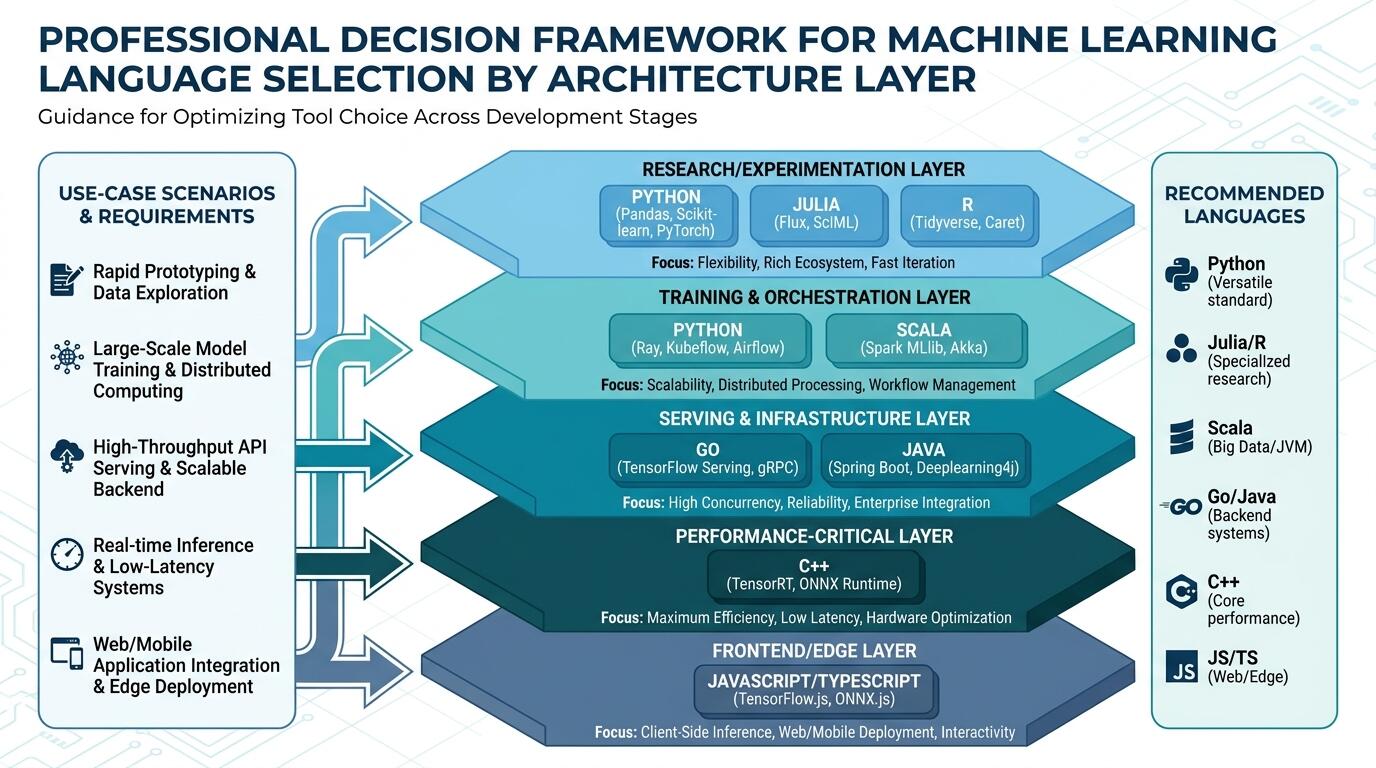
ALT: Decision framework for choosing the best programming language for machine learning engineering based on use case and system architecture layer
Frequently Asked Questions FAQ
Q1: How do I know when to stop using Python and move to a lower-level language for ML?
The signal is almost always concrete and measurable: inference latency exceeds your service-level objective at acceptable hardware cost, or a specific operation creates a CPU bottleneck that profiling confirms is Python-bound rather than IO-bound. In practice, most teams reach for ONNX Runtime, TensorRT, or similar optimized runtimes first — which are C++ under the hood but called from Python — before writing any native C++ themselves. True Python replacement should be a deliberate, last-resort decision, not a premature architectural move.
Q2: Is Python still the best language for machine learning engineering, or is something replacing it?
Python remains the dominant language for machine learning engineering and shows no meaningful signs of displacement in the near term. Its position is reinforced by the fact that virtually all major ML research is published with Python implementations, and framework developers — including the teams behind PyTorch and Hugging Face — treat Python as the primary interface. Julia and Mojo (a newer Python-compatible systems language) are worth watching for performance-critical niches, but neither has the ecosystem depth to challenge Python's dominance in applied ML engineering.
Q3: How long does it take to become productive in Python for machine learning engineering?
Engineers with prior programming experience in any language can typically become productive in Python for basic ML tasks — data manipulation, model training with a framework like scikit-learn or PyTorch, and simple API serving — within a period of focused study and hands-on project work. The bigger learning curve is not the language syntax but the ecosystem: understanding how NumPy, pandas, PyTorch, and deployment tooling fit together takes consistent project-based practice. There is no fixed timeline, but deliberate, project-driven learning consistently accelerates the path to competence.
Final Thoughts
Three conclusions emerge clearly from a practitioner's view of the ML language landscape. First, Python is the non-negotiable foundation — any serious ML engineering capability is built on top of it, and there is no credible alternative for teams starting fresh today. Second, no production ML system is monolingual — the mature pattern is Python for model development, a compiled or JVM language for infrastructure and serving, and C++ at the performance-critical kernel level. Third, language choice should follow architectural need, not trend — the teams that waste the most time are those that optimize language selection before they have enough production experience to know what their actual constraints are.
The practical next step is straightforward: if you are evaluating your current ML stack or designing a new one, map each layer of your system to the language criterion that matters most at that layer — development velocity, ecosystem coverage, performance, or operational simplicity — and let that mapping drive your decisions. Avoid the trap of picking a single language for the whole system before the system's real constraints are visible.
If you are navigating these architectural decisions without a clear picture of how the pieces fit together end-to-end, looking at real shipped systems is one of the fastest ways to calibrate your thinking.
If this resonated with you, explore more insights and real-world projects at Darius's portfolio — where AI architecture, systems design, and full-stack engineering meet execution. Whether you're looking to validate a technical approach, learn from shipped products, or connect with an experienced Engineering Director and AI Architect, Darius offers a front-row view into what it truly takes to turn ideas into live, running systems. Visit the Darius website to dive deeper.
Sources & Further Reading
- IEEE Computer Society. "Programming Language Rankings and Usage Trends in Software and Systems Engineering."
https://www.ieee.org/ - The Python Software Foundation. "Python Language Reference and Ecosystem Documentation."
https://www.python.org/ - The Apache Software Foundation. "Apache Spark — Unified Analytics Engine for Large-Scale Data Processing."
https://www.apache.org/
Note: Standards may be updated; please check the latest official documents or consult professional advisors.