Best Full-Stack Projects to Build While Leveling Up Your Skills in 2026
ALT: Best full-stack projects to build in 2026 for leveling up software engineering skills
The Full-Stack Projects Worth Building in 2026 (And Why Most Lists Get This Wrong)
Key Conclusion: The best full-stack projects to build in 2026 are not throwaway tutorials — they are production-minded systems that expose you to the real complexity founders and engineering teams face daily: authentication flows, AI integration, distributed data, and deployment pipelines. This list cuts through the noise to give developers, technical leads, and senior engineers a portfolio-worthy set of project ideas selected for their depth, market relevance, and direct applicability to the problems that matter most right now.
Selecting which projects to build is itself a high-leverage decision. The items in this list were chosen based on one consistent criterion: does this project teach you something you will immediately apply in a professional context? Tutorials about to-do apps and weather dashboards have their place, but in 2026, the gap between junior and senior capability is increasingly defined by whether you can reason about system design, AI integration, and real-world deployment constraints — not just whether you can write a CRUD endpoint. Each item below is weighted for teaching density: how much genuine engineering judgment it demands, and how directly it maps to the kinds of systems that actual startups and product teams are shipping today.
The Best Full-Stack Projects to Build in 2026 for Meaningful Skill Progression
AI-Powered Document Intelligence Platform
An AI-powered document intelligence platform is a system that ingests unstructured documents — PDFs, contracts, research papers, spreadsheets — and allows users to query, summarize, and extract structured data from them using a large language model (LLM) backend. This project sits at the intersection of full-stack web development and applied AI architecture, making it one of the most technically dense builds you can undertake right now.
Building this system forces you to confront real retrieval-augmented generation (RAG) design choices: how you chunk documents, which embedding strategy you use, how you manage vector store indexing, and how you handle context window limits gracefully. On the front-end side, you'll need to design streaming UI responses, session-based conversation state, and file upload handling. The backend work involves orchestrating LLM API calls, managing costs per query, and ensuring that hallucination risks are mitigated through source citation and grounding.
In our work with clients building AI-native products, this class of system consistently surfaces the most important architectural questions early. For deeper context on how these pipelines scale in production, the breakdown in what it actually costs to run a RAG system for a month is worth reading before you begin.
Best for: Senior engineers transitioning into AI-adjacent roles, or founders who want a working proof-of-concept they can show investors.
Watch out: LLM API costs can accelerate quickly during testing. Build hard token budget limits and caching layers from day one — retrofitting them is painful.
Multi-Tenant SaaS Boilerplate with Billing and RBAC
A multi-tenant SaaS boilerplate is a full-stack application scaffold that supports isolated workspaces per customer organization, role-based access control (RBAC), and integrated subscription billing. This project is deliberately unglamorous — and that is exactly why it is valuable. Every commercial SaaS product needs this foundation, yet most tutorials skip it entirely.
Building this teaches you the plumbing that engineers only encounter in professional environments: tenant isolation at the database layer (either via separate schemas or row-level security), JWT-based session management with refresh token rotation, Stripe webhook integration for subscription lifecycle events, and audit logging for compliance-ready teams. You will also have to think carefully about how roles propagate across resources — a user who is an admin in Workspace A should not accidentally have admin permissions in Workspace B.
According to industry practitioners and resources like NareshIT's guidance on top projects for full-stack developers to build in 2026, SaaS boilerplate architecture consistently ranks as one of the most transferable builds a developer can complete because the patterns apply across industries and technology stacks.
Best for: Engineers who want to move into startup environments or founding engineer roles where they'll own the entire stack from day one.
Watch out: Tenant isolation bugs are production-catastrophic. Write cross-tenant access tests explicitly — don't assume your ORM query scope handles it.
Real-Time Collaborative Workspace (Think Notion or Linear, Smaller)
A real-time collaborative workspace is an application where multiple users can view and edit shared content simultaneously, with changes propagated instantly across all connected clients. The educational value here is in the concurrency model, not the UI.
This project introduces you to conflict-free replicated data types (CRDTs) or operational transformation (OT) — the mechanisms that make simultaneous edits consistent without locking. It also demands a solid understanding of WebSocket connection management at scale, optimistic UI updates, and presence indicators (showing which users are currently active in a document). On the infrastructure side, you'll confront the stateful server problem: WebSocket connections are sticky, which creates horizontal scaling complexity that stateless HTTP APIs never expose you to.
A pattern we consistently see in teams that struggle to ship real-time features is that they underestimate this statefulness problem until they're already in production. Building this project in a learning context lets you fail safely and reason through solutions — Redis pub/sub, sticky sessions, or edge-deployed WebSocket proxies — before the stakes are high.
Best for: Engineers aiming for mid-to-senior roles at product companies where real-time features are a competitive differentiator.
Watch out: CRDTs have a learning curve. If you're time-constrained, start with a library implementation (Yjs is well-regarded) before rolling your own.
Developer Tool with a CLI, API, and Web Dashboard
A developer tool is an application designed for a technical audience, typically exposing functionality through a command-line interface (CLI), a programmatic API, and a web-based dashboard — all operating over the same underlying data and business logic. Building all three surfaces in one project is a masterclass in interface abstraction.
The core discipline here is designing your business logic as a pure service layer, then building three different clients on top of it. This forces you to think clearly about what belongs in the domain model versus what is presentation-layer concern. You'll also touch authentication across very different contexts: API keys for machine-to-machine auth, OAuth for the web dashboard, and token-based sessions for CLI logins. This breadth of auth surface area alone is worth the project.
Best for: Engineers who want to work on developer-facing products, platform engineering teams, or internal tooling at larger organizations.
Watch out: The CLI user experience is a craft in itself. Poor error messaging and missing --help documentation will make a technically solid tool feel unusable.
E-Commerce Platform with Inventory, Fulfillment, and Analytics
A full-stack e-commerce platform built from scratch is an application that handles product catalog management, cart and checkout flows, inventory tracking, order fulfillment state machines, and a reporting dashboard for business metrics. This is not about building another Shopify clone — it is about understanding the event-driven patterns that power commerce at scale.
The inventory and fulfillment layer is where this project earns its keep. Oversell prevention (ensuring you don't sell stock you don't have) requires optimistic locking or event sourcing patterns. Order state machines — from pending to confirmed to shipped to delivered to returned — teach you how to model business processes as explicit state transitions with audit trails, which is a skill that maps directly to workflow engines, fintech systems, and logistics platforms.
Per the Grokking Tech Career newsletter's analysis of projects that will get engineers hired in 2026, commerce and marketplace platforms consistently appear because they compress many engineering concerns — payments, data integrity, async processing, and reporting — into a single codebase.
Best for: Engineers targeting roles in commerce, marketplace, or fintech companies, or generalists who want a project that showcases breadth.
Watch out: Payment integration (Stripe, PayPal) has its own compliance surface. Use a test-mode environment religiously and never log raw card data under any circumstances.
Observability Dashboard for a Microservices System
An observability dashboard is a full-stack application that ingests telemetry data — logs, metrics, and distributed traces — from a set of microservices and presents it in a queryable, visual interface. This project is deliberately meta: you are building tooling that makes other systems understandable.
The back-end work involves ingesting high-volume event streams (structured log lines, OpenTelemetry trace spans) and storing them in a time-series or columnar format optimized for range queries. The front-end work involves building responsive, real-time chart components that update as new data arrives without full page reloads. You will also reason about data retention policies, aggregation windows, and the difference between high-cardinality and low-cardinality metrics.
Engineers who have built their own observability tooling develop an intuition for instrumentation that makes them dramatically better at debugging production systems. This project teaches you both how to build the dashboard and why good observability design matters — a rare double payoff.
Best for: Platform engineers, SREs in training, and backend-leaning full-stack developers who want to specialize in infrastructure-adjacent work.
Watch out: Ingesting high-velocity telemetry data naively will fill your database quickly. Design your data pipeline with sampling and aggregation from the start.
AI Agent Orchestration Playground
An AI agent orchestration playground is a full-stack application that allows users to define, chain, and observe autonomous AI agents — programs that use LLMs to plan and execute multi-step tasks using tools like web search, code execution, or external API calls. This is one of the most forward-looking builds on this list and one of the most technically demanding.
The core challenge is building the orchestration layer itself: how agents hand off tasks to one another, how you implement tool use reliably, how you handle agent failures gracefully, and how you log and inspect agent reasoning steps so users can understand what happened. The front-end needs a visual trace viewer that shows the agent's thought process step by step — this is both a UX challenge and a data modeling problem.
This category of system is evolving rapidly, and the AI system architecture patterns every CTO should evaluate are directly applicable here — particularly around how to structure the interface between your orchestration layer and underlying model providers in a way that avoids tight vendor coupling.
Best for: Engineers who want to position themselves at the frontier of applied AI, or founders prototyping autonomous AI product features.
Watch out: Agent systems are non-deterministic by nature. Build robust logging and replay capability before you build anything else — debugging without a trace is impossible.
Quick Comparison at a Glance
| Project | Best For | Key Strength | Limitation |
|---|---|---|---|
| AI Document Intelligence Platform | AI-transitioning engineers, technical founders | Covers RAG, streaming UI, LLM orchestration | LLM API cost management requires early planning |
| Multi-Tenant SaaS Boilerplate | Aspiring founding engineers | Directly mirrors production SaaS architecture | Tenant isolation bugs are high-stakes; requires rigorous testing |
| Real-Time Collaborative Workspace | Mid-to-senior engineers at product companies | Concurrency, WebSockets, stateful infra | CRDTs have a steep learning curve |
| Developer Tool (CLI + API + Dashboard) | Platform and developer-tooling engineers | Forces clean domain/interface separation | CLI UX is a craft that requires dedicated attention |
| E-Commerce Platform | Generalists, fintech/commerce-track engineers | Compresses payments, state machines, and analytics | Payment compliance surface is non-trivial |
| Observability Dashboard | Backend, SRE, platform engineers | Teaches instrumentation intuition alongside UI | High-velocity data ingestion requires careful pipeline design |
| AI Agent Orchestration Playground | AI-frontier engineers, founders | Cutting-edge; maps directly to agentic product categories | Non-determinism makes debugging hard without proper tooling |
How to Choose the Right Project for Where You Are Now
The right project depends more on your trajectory than your current skill level. If you are a backend engineer who wants to move into AI-adjacent roles, start with the document intelligence platform — it gives you a concrete, deployable artifact while forcing you to learn the retrieval and orchestration patterns that are now table stakes in AI product development.
If your goal is a founding engineer or early-stage startup role, the multi-tenant SaaS boilerplate is the highest-leverage build you can do. It is not exciting, but it is what separates engineers who have only ever worked on features from engineers who can own the infrastructure of a commercial product from day one.
If you are already senior and want to specialize further, the observability dashboard and the agent orchestration playground both push into territory that most engineers never explore. The observability project deepens your understanding of production systems from the outside; the agent project puts you at the frontier of applied AI.
A common misconception worth addressing directly: complexity of technology is not the same as complexity of engineering. Building an agent orchestration system with five LLM providers is not automatically more impressive than a well-designed e-commerce platform with proper inventory locking and a clean state machine implementation. Recruiters and technical hiring managers who know what they are doing look for evidence of systems thinking and production-awareness — not framework diversity. Pick the project that genuinely stretches your weakest area, and build it to a standard you would be willing to maintain.
If you are unsure whether a given project direction maps well to your product goals, the guidance in how to ship fast without sacrificing product quality applies directly — the same principles that govern rapid product delivery also govern what makes a side project genuinely portfolio-worthy.
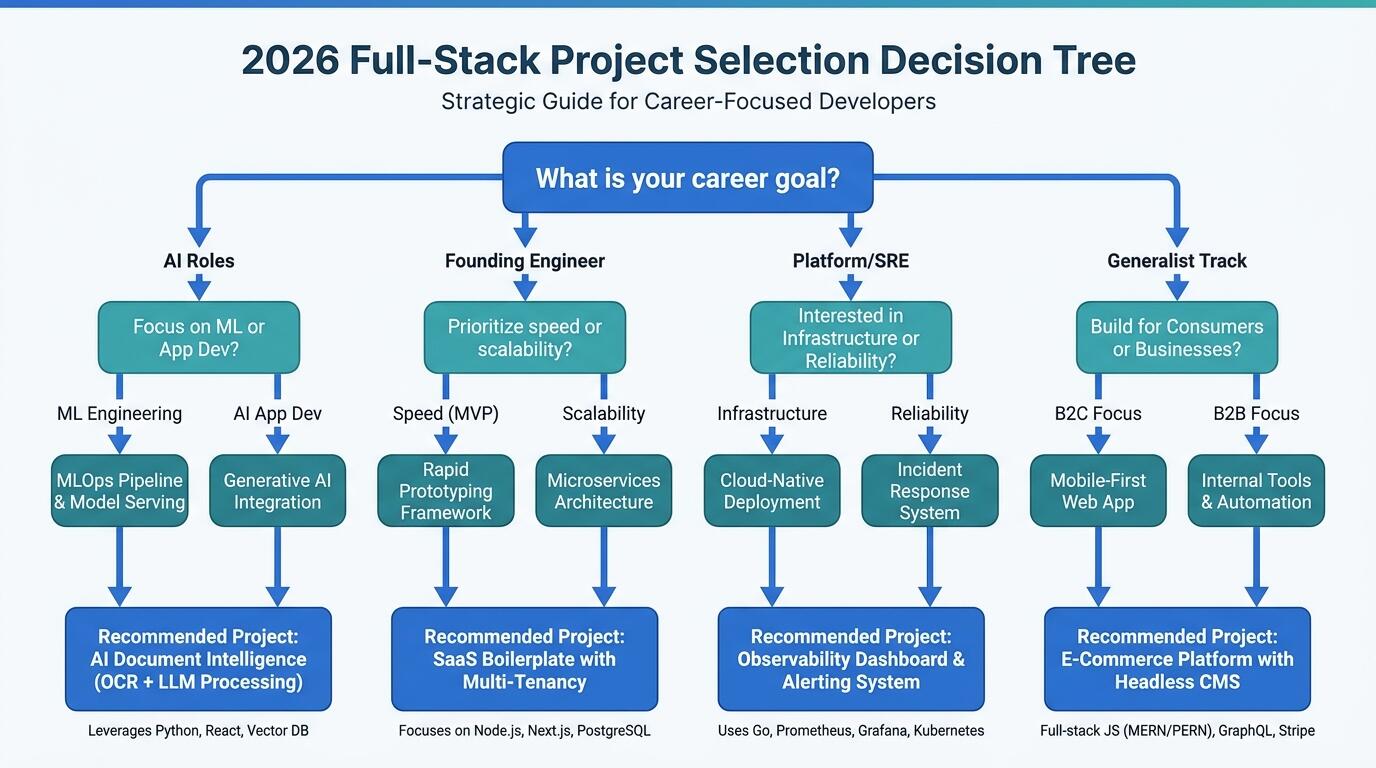
ALT: Flowchart decision guide for selecting the best full-stack project to build in 2026 based on career goals and skill gaps
People Also Ask
Q1: How do I make a full-stack project stand out to technical hiring managers in 2026?
A full-stack project stands out when it demonstrates production-awareness rather than tutorial-level completion. Hiring managers who can evaluate technical work look for evidence of deliberate architectural decisions: why did you choose this data model? How does the system handle failure? Is there a deployment pipeline? Document your trade-offs in a README. A smaller project that shows clear reasoning is consistently more compelling than a large project built by following a step-by-step video.
Q2: Are AI-integrated projects necessary to stay competitive as a full-stack developer in 2026?
AI integration is increasingly expected rather than exceptional in full-stack development. This does not mean every project needs an LLM, but understanding how to call, manage, and cost-control AI APIs has become a standard expectation in many product engineering roles. More precisely, what the market is rewarding is the ability to integrate AI components thoughtfully — knowing when to use them and when not to is as valuable as knowing how. A strong non-AI project that demonstrates systems depth is still highly competitive.
Q3: How long does it realistically take to build a portfolio-quality full-stack project?
A genuinely portfolio-worthy full-stack project — one deployed, documented, and defensible in a technical conversation — typically requires several weeks of consistent effort, not a weekend. Projects like a multi-tenant SaaS boilerplate or a real-time collaborative workspace have enough depth that rushing them produces something that looks incomplete to an experienced reviewer. Budget enough time to revisit your initial design decisions after building the first version, because the most valuable learning often happens in the refactoring phase.
Summary
The best full-stack projects to build in 2026 share one characteristic: they teach you how to think about systems, not just how to write code. The seven projects in this list were selected because each one exposes a different class of production engineering challenge — from AI orchestration and multi-tenancy to real-time concurrency and observability — that generalist tutorials consistently skip.
Key takeaways:
- Choose your project based on the skill gap you most need to close, not the technology that sounds most impressive.
- Build for deployment from day one — a project that is never shipped teaches you less than one that hits a real environment, even a free tier one.
- Document your architectural decisions as you make them; the ability to explain your choices is what converts a project into a credential.
- AI integration is increasingly a baseline expectation; understanding RAG pipelines, LLM cost management, and agent orchestration is now full-stack territory.
- Production-awareness — error handling, logging, auth, and data integrity — is what separates projects that impress senior engineers from projects that only impress peers.
The most direct next step is to pick one project from this list, scope a minimal version you can ship in a defined time window, and treat it as a real product — because in the hands of an experienced engineer, it is one.
Ready to move from building practice projects to shipping a real product? Visit Darius to explore real shipped projects, case studies, and the kind of architectural thinking that takes ideas from concept to production.
References & Further Reading
- Grokking Tech Career Newsletter. "6 projects that will get you hired in 2026".
https://grokkingtechcareer.substack.com/p/6-projects-that-will-get-you-hired - NareshIT. "Top Projects Every Dot Net Full Stack Developer Should Build in 2026".
https://nareshit.com/blogs/top-projects-every-dot-net-full-stack-developer-should-build-in-2026 - IEEE Computer Society. "IEEE Standards and Technical Resources for Software Engineering".
https://www.computer.org
Note: Standards and best practices in software engineering evolve continuously. Consult the latest official documentation and community resources before making architectural commitments in production systems.